


EICR for Warehouses, Workshops and Industrial Units in London
EICR Certificate
29 June 2026
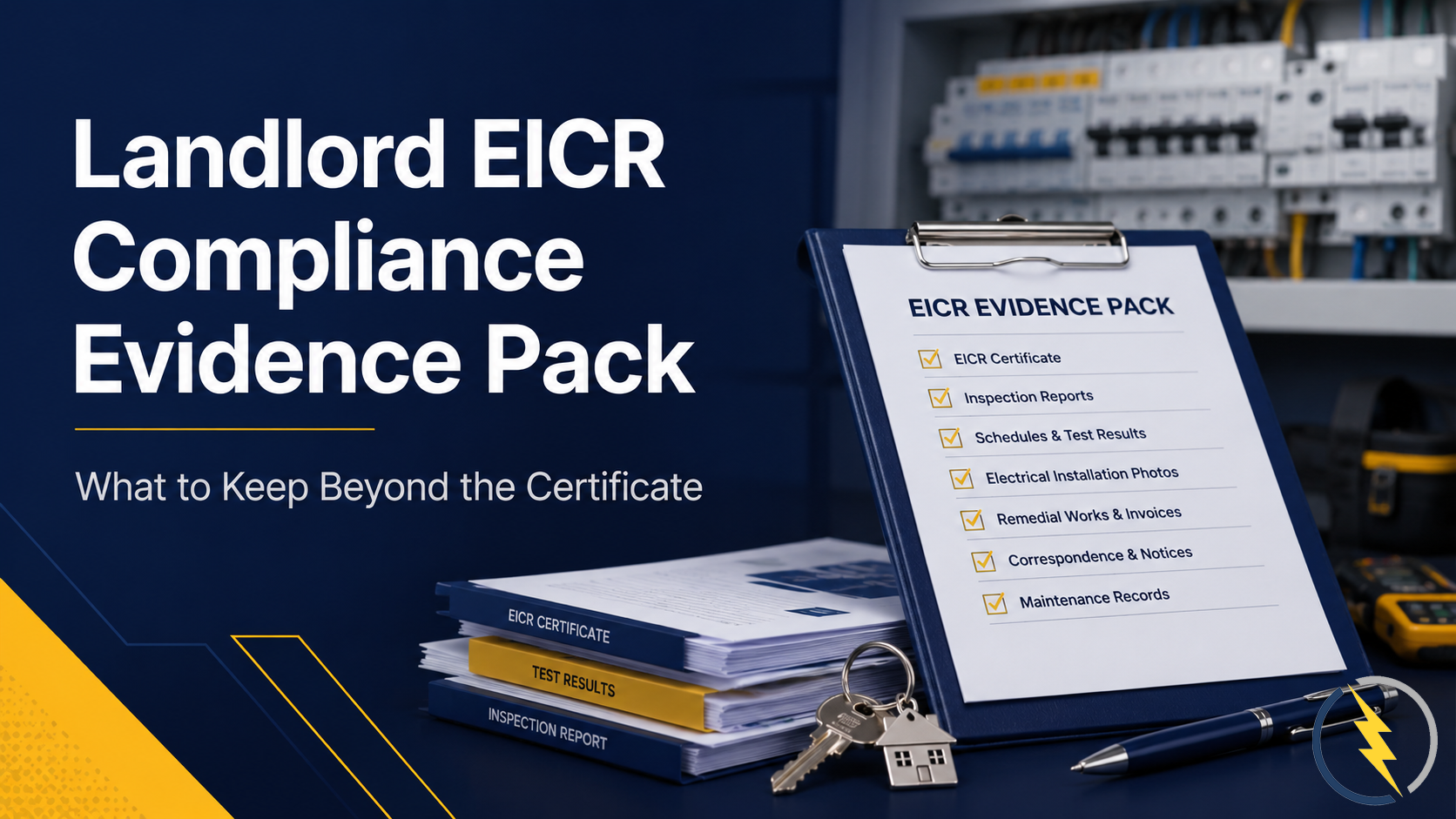
For many London landlords, an EICR feels like a simple task: book the inspection, receive the electrical certificate, send it to the letting agent, and move on. In reality, the certificate is only one part of the compliance picture.
If a tenant challenges the condition of the property, a council asks for proof, a buyer’s solicitor raises questions, or remedial work is disputed, the final certificate alone may not explain the full story. A landlord may need to show when the inspection was booked, what the electrician found, what defects were recorded, what remedial works were recommended, what was completed, and when the final satisfactory electrical installation condition report was issued.
This is where a London EICR compliance evidence pack becomes valuable. It is not just an admin file. It is a practical compliance record that protects landlords, agents, property managers and commercial property owners when electrical safety evidence is needed quickly.
If you need to book an EICR certificate in London, the inspection is important. But the records around that inspection are just as important, especially if the report is unsatisfactory and remedial work is required.
An EICR compliance evidence pack is a structured file containing the key documents, messages, photos and reports connected to an electrical installation condition report. Its purpose is simple: it helps prove that the landlord acted properly, arranged the inspection, responded to defects, completed the required work, and retained the correct electrical safety records.
The EICR certificate itself confirms the condition of the fixed electrical installation at the time of inspection. However, it does not always show the full compliance journey. For example, a property may fail its first EICR because of C2 observations, FI items, damaged accessories, missing RCD protection or unsafe bathroom fittings. After that, remedial work may be carried out and a satisfactory report may be issued. If the landlord only keeps the final satisfactory certificate, the earlier risk, decision-making and remedial evidence may be lost.
A good evidence pack keeps everything together. It allows the landlord or managing agent to answer questions quickly without searching through old emails, WhatsApp messages, invoices, PDFs, photos and tenant access notes.
For landlords with one flat, this may be a simple folder on a laptop. For portfolio landlords, letting agents, estate managers and commercial landlords, it should be a repeatable system used for every property.
London property management is document-heavy. Landlords deal with tenants, councils, managing agents, freeholders, insurers, estate agents, buyers, solicitors and sometimes tribunal-style disputes. When an electrical issue appears, the first question is rarely just “do you have a certificate?” The more serious question is usually “can you prove what happened?”
A landlord may have a valid EICR certificate but still struggle if they cannot show supporting evidence. For example, if a tenant refused access several times, the landlord should keep access messages and appointment records. If an EICR failed, the landlord should keep the unsatisfactory report, the remedial quote, evidence of authorisation, invoice, photos and confirmation that the work was completed. If a letting agent asks for compliance evidence before a new tenancy, they may need more than one PDF.
This matters because EICR compliance is not only about passing an inspection. It is about proving that the electrical installation was inspected by a competent person, that defects were acted on, and that the landlord retained proper records.
For residential landlords, our dedicated page on EICR certificates for landlords in London explains how the inspection process works for rental properties. This evidence pack approach goes one step further by showing what should be kept after the inspection.
For commercial landlords, the same principle applies. Offices, shops, restaurants, warehouses and managed buildings may need electrical safety evidence for leases, insurers, facilities audits, managing agents or sale due diligence. If you manage business premises, our page on commercial EICR certificates in London covers the commercial inspection route.
A proper EICR evidence pack should be clear enough that another person could open it and understand the full history of the inspection without needing a long explanation. The best system is to organise the documents in the same order as the compliance journey: before inspection, during inspection, after inspection, remedial stage, final certificate, and future reminder.
The first document is the original EICR report. This should be saved even if the result is satisfactory. A proper electrical installation condition report contains the property address, client details, inspection date, inspection limitations, schedule of inspections, schedule of test results and the overall outcome.
If the report is unsatisfactory, keep the failed EICR report. This is one of the most common documents landlords lose. Some landlords only keep the final satisfactory certificate after remedials, but the failed report is important because it shows the original observations and why action was required.
The pack should also include engineer observations. These may include notes about access limitations, circuits that could not be fully tested, locked cupboards, inaccessible equipment, tenant belongings preventing access, labels missing from the consumer unit, or visible defects found during inspection.
Photos of defects are also important. A written observation is useful, but a photo can often explain the issue faster. Examples include broken sockets, damaged accessories, exposed copper, unsuitable bathroom lights, missing blanks, old plastic consumer units, heat damage, poor terminations or signs of DIY electrical work.
The remedial quote should be saved with a clear date. If the landlord receives a quote for remedial work for failed EICR certificates, the quote should show what work is being proposed and, where possible, which EICR observations are being addressed.
The remedial invoice should then be added after completion. This shows that the work was not only recommended but completed. If the invoice is vague, ask for it to show enough detail to connect the remedial work to the failed EICR observations.
The pack should include confirmation of completed works. This may be a written confirmation from the contractor, a minor works certificate where relevant, an updated EICR, or a final satisfactory report depending on the type of remedial work and the inspection outcome.
The final satisfactory EICR or written confirmation should be clearly labelled. If a new satisfactory report is issued after the remedial work, save it as the final certificate. If the original report is updated with confirmation that defects have been rectified, keep that version with the earlier failed report.
Tenant access messages should also be saved. This is particularly important where the tenant delayed, cancelled or refused access. Keep email chains, text messages, WhatsApp screenshots and appointment confirmations. If the tenant later claims the landlord did not act, access evidence may be extremely useful.
The certificate issue date and next inspection date should be recorded separately. Do not rely only on the PDF. Add a reminder into your property management system, diary or spreadsheet so the next EICR is arranged before expiry.
The value of an EICR compliance evidence pack is not obvious when everything goes smoothly. It becomes valuable when something goes wrong or when someone asks questions months later.
The first scenario is tenant refusal of access. A landlord may arrange the inspection, but the tenant may not respond, may cancel at short notice, or may not be home during the agreed time window. In this situation, the landlord should keep all appointment messages, reminders and failed access records. The evidence pack should show that the landlord made reasonable attempts to arrange access.
The second scenario is a council request for proof. Local authorities may ask landlords or agents to provide electrical safety evidence. A single certificate may be enough in some cases, but if remedial work was involved, the landlord should be ready to provide the report, remedial evidence and completion confirmation.
The third scenario is a buyer’s solicitor asking for electrical evidence during a sale. In London, older flats, converted buildings, HMOs and leasehold properties can generate many due diligence questions. A clean evidence pack can help answer solicitor enquiries faster and reduce delay.
The fourth scenario is an insurance claim after electrical damage. If there is a fire, overheating, water damage near electrics, damaged accessories or alleged electrical fault, the insurer may ask for proof of maintenance and inspection. A landlord who can produce inspection history and remedial invoices is in a stronger position than one who only has a final certificate with no supporting context.
The fifth scenario is a letting agent compliance audit. Many agents are tightening their compliance systems. They may ask landlords for current certificates, expiry dates and supporting records. A landlord with a complete pack is easier to manage and creates fewer delays before marketing or tenancy renewal.
The sixth scenario is a failed EICR before a new tenancy. If a report fails shortly before tenants are due to move in, speed and evidence matter. The landlord must understand what failed, approve remedial works, arrange access, confirm completion and obtain a satisfactory outcome. Keeping the full paper trail helps avoid confusion between landlord, agent, tenant and contractor.
The seventh scenario is where remedial works are challenged. Sometimes a landlord questions why work was needed, or a tenant disputes whether the property was safe. The evidence pack should show the original observation, the risk category, the quote, the completed work and the final outcome.
Consider a realistic London rental flat where a landlord arranges an EICR before a new tenancy starts. The property is a two-bedroom flat in a converted building. The landlord believes the electrics are acceptable because the lights and sockets appear to work, and the previous tenant never reported an electrical issue.
During the inspection, the electrician identifies several observations. The bathroom light is not suitable for the environment. Some socket accessories are damaged. The consumer unit is older and several circuits do not have RCD protection. There are also signs of previous electrical alterations that were not clearly labelled.
The report is issued as unsatisfactory. The landlord now has two choices: treat the failed report as an inconvenience or treat it as a compliance record. The correct approach is to save the failed EICR immediately and build the evidence pack from that point.
The landlord saves the original report, including the schedule of test results and observations. The engineer supplies photos showing the bathroom light, damaged accessories and consumer unit condition. A remedial quote is prepared. The quote explains that the bathroom light needs replacing with a suitable fitting, damaged accessories need replacement, and RCD protection needs to be addressed.
The landlord approves the remedial work. The contractor attends, completes the work and provides an invoice. The electrician then confirms that the relevant defects have been rectified. A final satisfactory EICR is issued.
Six months later, the letting agent requests compliance evidence for an internal audit. Because the landlord kept the full EICR evidence pack, the response is simple. They can provide the original unsatisfactory report, remedial quote, invoice, completion evidence and final satisfactory certificate. There is no need to search old emails or ask the contractor to resend documents.
This is the difference between having a certificate and having a defensible compliance file.
The most common mistake is only saving the final certificate. This looks tidy, but it removes the inspection history. If the property failed first and passed later, the landlord should keep both the failed and final versions.
The second mistake is losing the failed report. An unsatisfactory EICR is not something to hide or delete. It is part of the compliance trail. It shows that the issue was identified and then acted on.
The third mistake is not keeping photos. Photos help explain observations clearly, especially when defects are physical and visible. They also help reduce disputes about whether work was necessary.
The fourth mistake is not recording tenant access attempts. Access is one of the biggest practical problems in London rental properties. If the tenant does not provide access, the landlord should keep evidence of attempts to arrange the inspection.
The fifth mistake is not keeping remedial invoices. A quote shows proposed work, but an invoice or completion confirmation shows that the work was actually carried out.
The sixth mistake is accepting unclear cheap certificates. A low-cost inspection may look attractive, but the report should still be properly completed, clearly written and issued by a competent person. If the certificate is vague, incomplete or difficult to interpret, it may not help when questioned later.
The seventh mistake is not checking engineer competence. Electrical safety inspection is not just a form-filling exercise. Landlords should use suitably qualified and competent electricians who understand EICR classification, inspection limitations and remedial requirements.
The eighth mistake is failing to record the next inspection date. An EICR can sit forgotten in an email inbox until it expires. A proper evidence pack should include a visible renewal date so the landlord can act before the deadline.
A downloadable checklist can turn this blog into a practical compliance tool. Landlords, agents and property managers can use the checklist every time an inspection is completed.
The first section should be inspection evidence. This includes the booking confirmation, property address, certificate name, engineer attendance date, original EICR report and inspection limitations.
The second section should be failed EICR evidence. This includes the unsatisfactory report, observation list, C1, C2, FI or C3 notes, defect photos and any engineer comments explaining what requires urgent attention.
The third section should be remedial evidence. This includes remedial quote, landlord approval, remedial invoice, photos after completion, minor works certificate where applicable, and confirmation that the failed observations were addressed.
The fourth section should be tenant access evidence. This includes access requests, reminders, appointment confirmations, failed access notes, tenant cancellations and agent communication.
The fifth section should be council or agent evidence. This includes any request from a council, letting agent, managing agent or freeholder, together with the documents supplied in response.
The sixth section should be insurance or sale evidence. This includes any electrical safety records supplied to insurers, buyers, solicitors, mortgage advisers or surveyors.
The seventh section should be the next inspection reminder. This should show the certificate date, expiry date, recommended next inspection date and renewal reminder.
This checklist gives the landlord a repeatable file structure. Instead of treating each EICR as a one-off job, the landlord creates a standard compliance process for every London property.
Letting agents and portfolio landlords need a stronger system than a single PDF folder. If you manage multiple flats across London, each property should have its own electrical compliance file. The file should be named consistently and stored in a way that allows staff to locate it quickly.
A simple structure could be:
This structure is especially useful where several people are involved: landlord, tenant, property manager, electrician, accounts department and compliance team.
If your team regularly arranges EICR services in London, the evidence pack system can reduce repeated questions, missing reports and last-minute compliance stress.
Residential and commercial properties both benefit from EICR evidence packs, but the documents may differ slightly.
For residential landlords, the pack normally focuses on landlord compliance, tenant safety, access evidence, remedial works and the final satisfactory certificate. This is especially relevant for flats, HMOs, converted houses, buy-to-let properties and managed rental portfolios.
For commercial properties, the pack may also include facilities management records, lease obligations, insurer requirements, landlord and tenant responsibilities, distribution board schedules, limitations caused by occupied areas, shutdown restrictions and phased remedial planning.
A restaurant, office, retail unit or warehouse may not be able to shut down all circuits during trading hours. In those cases, the evidence pack should record inspection limitations and any agreed follow-up works. This helps avoid confusion later when someone asks why part of the installation was not tested or why certain remedial works were scheduled after hours.
Commercial landlords should also retain electrical records alongside fire safety records, emergency lighting records, PAT testing records and maintenance invoices. A joined-up compliance file gives a clearer picture of building safety.
Cost disputes are common when an EICR fails. A landlord may ask why the inspection was one price but the remedial work is much higher. A tenant may question whether the works were genuinely needed. A managing agent may need to explain the cost to the property owner.
This is where cost evidence helps. The pack should contain the EICR inspection invoice, remedial quote, remedial invoice and explanation of what each cost relates to. The cost of an EICR inspection is not the same as the cost of repairing defects found during that inspection.
If you need guidance on typical inspection pricing, see our page on EICR certificate cost in London. For landlords, the key point is to separate the inspection fee from any remedial cost. The inspection identifies the condition of the installation. Remedial work corrects the defects that prevent a satisfactory outcome.
A clear evidence pack prevents those two stages being mixed together.
Before saving an EICR into the evidence pack, the landlord or agent should understand the result. Do not only look for the word “satisfactory” or “unsatisfactory”. Review the observations, limitations and schedule of test results.
A satisfactory EICR may still include C3 improvement recommendations. These are not normally the same as urgent defects, but they should still be recorded. An unsatisfactory EICR may include C1, C2 or FI items that require action. It may also include limitations that explain what was not inspected or tested.
If you are unsure how to interpret the report, our guide on how to read an EICR report explains the main sections and what landlords should look for.
Understanding the report helps landlords make better decisions. It also helps them explain the position to tenants, agents and property owners in plain English.
London EICR Certificates helps landlords, homeowners, letting agents and commercial property owners arrange electrical installation condition reports across London. Our service is built around practical compliance, not just issuing a document.
We can arrange EICR inspections for residential rental properties, homeowners, HMOs, commercial units, offices, shops and managed buildings. Where a report is unsatisfactory, we can help explain the observations and provide remedial options where required.
For landlords, this means the process is clearer. You can book the inspection, receive the report, understand the result, arrange remedial work if required, and keep the correct evidence for your records.
Our service is particularly useful where landlords need quick turnaround, tenant access coordination, clear pricing, remedial support and proper documentation. If you are preparing for a tenancy, renewing an existing certificate, selling a property, responding to an agent request or dealing with a failed EICR, we can help organise the process properly.
To arrange an inspection, you can book online. If you want to compare services first, review our main EICR services in London page. For common questions, you can also visit our EICR FAQs.
An EICR certificate is essential, but it should not be treated as the only compliance record. For London landlords, the stronger approach is to keep a full EICR compliance evidence pack showing the inspection, findings, defects, remedial decisions, completed works and final outcome.
This is especially important where the property fails its first inspection, where tenants delay access, where remedial works are disputed, or where an agent, solicitor, insurer or council asks for evidence.
The best landlords do not wait for a dispute before organising their records. They build the file at the time of inspection. That way, if a question comes later, the answer is already documented.
If you need an electrical inspection for a London rental property, commercial unit or managed building, London EICR Certificates can help you arrange the inspection, understand the report and keep the right compliance evidence from the start.
Ready to organise your next inspection? Book an EICR certificate in London or use our book online page to send your property details.
Clear answers for London landlords, letting agents, property managers and commercial property owners who need to keep proper EICR records, remedial evidence, tenant access notes and final electrical safety certificates.
A London EICR compliance evidence pack is a structured file containing the documents that prove an electrical safety inspection was arranged, completed, reviewed and acted on correctly.
It should usually include the original EICR report, any unsatisfactory report, engineer observations, photos of defects, remedial quote, remedial invoice, completion evidence, final satisfactory EICR, tenant access messages and the next inspection reminder.
The final EICR certificate is essential, but it may not always be enough if there is a dispute, council request, agent audit, insurance query or sale due diligence question.
If the property originally failed the inspection, the landlord should also keep the failed report, remedial evidence and completion confirmation. This creates a stronger compliance trail than keeping only the final certificate.
If you are arranging a rental inspection, see our EICR certificates for landlords in London service page.
Yes. Landlords should keep the unsatisfactory EICR report because it shows what defects were identified at the time of inspection and why remedial work was required.
Deleting or losing the failed report weakens the compliance record. A proper evidence pack should show the full journey: failed inspection, defects found, remedial decision, completed work and final satisfactory outcome.
After a failed EICR, the landlord should save the unsatisfactory report, observation list, defect photos, remedial quote, approval messages, remedial invoice, completion confirmation and final satisfactory report.
Where the failed report includes C1, C2 or FI observations, the evidence should clearly show how those issues were dealt with. For more detail, see our page on remedial work for failed EICR certificates.
Photos help explain electrical defects more clearly than text alone. They can show damaged sockets, missing blanks, unsuitable bathroom lights, exposed copper, overheating, poor labelling, old consumer units or unsafe accessories.
Photos are especially useful if a landlord, tenant, managing agent or insurer later questions why remedial work was recommended. They provide practical visual evidence alongside the written EICR observations.
If a tenant refuses access or repeatedly cancels appointments, the landlord should keep all access evidence. This may include emails, text messages, WhatsApp messages, appointment confirmations, reminders, failed access notes and agent correspondence.
This evidence can help show that the landlord made reasonable attempts to arrange the EICR inspection. Access records are particularly important where the certificate is close to expiry or the property is being prepared for a new tenancy.
An EICR evidence pack allows landlords to respond quickly when a council, letting agent, managing agent, buyer’s solicitor or insurer asks for electrical safety records.
Instead of sending only one certificate, the landlord can provide a clear compliance trail showing inspection date, report outcome, defects, remedial action, invoice evidence and final satisfactory result.
Commercial landlords should keep a more detailed evidence pack because commercial premises may include distribution boards, plant rooms, landlord supplies, tenant areas, office circuits, retail areas, kitchens, emergency systems and phased access limitations.
The pack should show what areas were inspected, what was excluded, what limitations applied, what remedial work was recommended and what was completed. For business premises, review our commercial EICR certificates in London service page.
Landlords should keep EICR records for the full period they relate to and ideally retain older reports as part of the property history. This is useful for renewals, disputes, sale enquiries, insurance questions and future remedial planning.
The evidence pack should include the certificate issue date and next inspection reminder. Keeping older reports also helps compare whether electrical conditions are improving, worsening or repeatedly showing similar observations.
The best approach is to arrange the inspection with clear property details, certificate name, access contact, property type, tenant availability and any known electrical issues. After the inspection, save the report, invoice and any engineer comments immediately.
If remedial work is required, keep the quote, approval, invoice and completion evidence in the same folder. You can book online with London EICR Certificates or review our main EICR services in London page.
Book a professional EICR inspection for your London rental property, commercial premises or managed building. Get clear reporting, practical guidance and remedial support if the inspection is unsatisfactory.
Book Your EICR OnlineFind answers to common questions about EICR certificates and electrical safety inspections in London. Visit our FAQ page on EICRcertificates.com for more information.


