
How to read an EICR report
An Electrical Installation Condition Report is evidence of what was inspected and tested within an agreed scope. This guide helps landlords, homeowners and property managers understand the main sections, observation codes and practical next steps — without turning the document into DIY electrical diagnosis.
- 5.0Google (58)
- 4.6Trustpilot (19)
- From £142.80 inc VAT
- Report usually within 24h
Your fixed price
VAT included, no call-out fee. Pay when your report is ready.
All of London and inside the M25.
Pick bedrooms and add the postcode to see your exact price.
from
£142.80
Why customers choose London EICR Certificates
- Fixed price, VAT includedThe price you see is set before you book. No call-out fee and nothing to pay until your report is ready.
- Qualified, vetted electriciansEvery inspection is done by a qualified electrician whose name and signature are on your report.
- Report usually within 24 hoursYour full EICR arrives by email as a PDF, ready for your tenant, agent or council.
- Repairs quoted, never forcedIf anything fails you get a repair quote. You choose who does the work.
How it works
Step 1: Get your price
Flat or house, bedrooms and postcode. Your fixed price shows straight away.
Step 2: Book in two minutes
Pick a weekday morning or afternoon window (evenings and weekends on request) and tell us who will let the electrician in.
Step 3: A full inspection and test
The electrician inspects and tests the installation within the agreed scope and records any limitations in the report. Visit length depends on the property, the number of circuits and access; we give you an estimate when we confirm the appointment. Power is switched off for parts of the testing.
Step 4: Report in your inbox
We email the invoice with your result after the visit; the report follows as soon as it's paid, usually within 24 hours. If anything needs fixing, the quote comes with it.
Questions first? Call 0203 811 8331 or WhatsApp us, any time, 7 days a week.
What an EICR report records
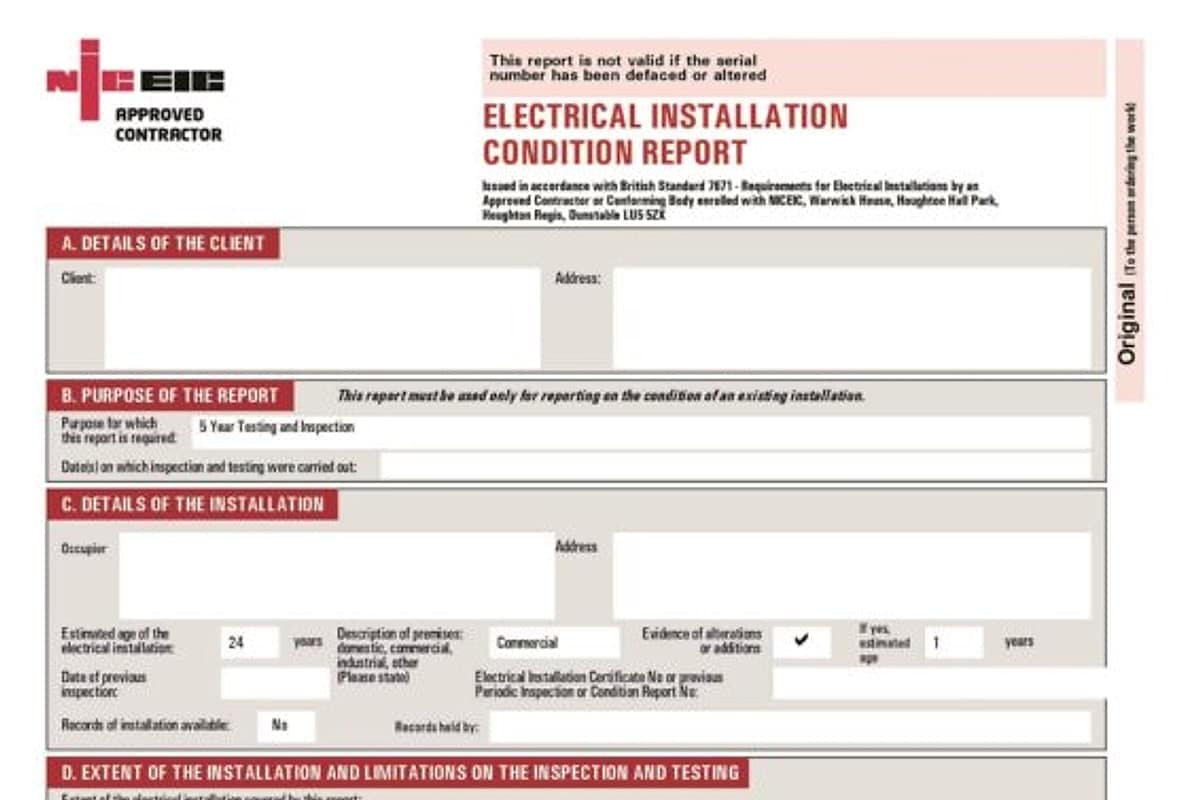
An Electrical Installation Condition Report records the condition of a fixed electrical installation within an agreed extent. It typically covers client and installation details, the purpose of the inspection, extent and limitations, an overall assessment, a schedule of observations with classification codes, and schedules of inspection and test results. It is a technical report of what could be assessed safely at that time — not a guarantee that concealed or inaccessible parts are free of defect.
People often say “EICR certificate” in everyday speech. The document you receive is usually an Electrical Installation Condition Report. A separate Electrical Installation Certificate or Minor Works Certificate may be issued later if new or remedial work is carried out. Reading the report means reading the whole pack that was issued for your instruction, not only a headline summary or an informal message that the visit is complete.
Do not judge the installation from one isolated line. An overall satisfactory or unsatisfactory outcome is decided from the report as a whole — observations, codes, limitations and the inspector’s recorded assessment together.
Where to start on the document
Begin with the property and installation details: address, description of premises, estimated age, and whether previous records were available. Confirm the report describes the premises you instructed — for example one flat versus a house, or a defined landlord supply rather than every communal riser in a block.
Next read the extent and limitations. These explain what was included, what was excluded by agreement or operational constraint, and where access or labelling stopped a full check. Then read the overall assessment (satisfactory or unsatisfactory) before diving into the observation schedule and the test-result schedules.
Inspector and contractor details on the report identify who issued the document. If wording is unclear, the issuing inspector or a competent electrical professional is the right place to ask — not an unverified online paraphrase.
- Property and installation details — confirm scope matches your instruction
- Extent and limitations — what was and was not assessed
- Overall assessment — satisfactory or unsatisfactory for that report
- Observation schedule — numbered findings with classification codes
- Test-result schedules — supporting measurements for the agreed circuits
- Inspector / contractor information — who issued the report
Satisfactory and unsatisfactory outcomes
A satisfactory outcome means the installation was assessed as satisfactory for continued use within the recommendation period stated on that report, subject to any limitations recorded. It does not mean every accessory is brand new, or that nothing will ever need attention later.
An unsatisfactory outcome means the recorded findings prevent a satisfactory assessment. That is serious and needs a clear follow-up plan. It does not automatically mean the entire property is immediately dangerous in every room, and it does not automatically mean a complete rewire is required. Urgency depends on the observation text and codes — especially any C1 danger-present findings — not on a single word on the front page alone.
Understating serious findings is unsafe. Over-reacting with DIY diagnosis is also unsafe. Use the observation schedule to understand what was found, then arrange competent attention where the report indicates danger, potential danger or further investigation.
Observation codes: C1, C2, C3 and FI
Classification codes summarise urgency for each observation. They help non-electricians prioritise; they do not replace the observation wording or the inspector’s judgement. This page gives a practical reading guide. For the dedicated code hub — definitions, misconceptions and carefully qualified examples — see the EICR classification code guide.
C1 means danger present and typically requires immediate attention. C2 means potentially dangerous and usually contributes to an unsatisfactory overall result until remedied or otherwise resolved. C3 recommends improvement and does not, by itself, make a report unsatisfactory. Under the A4:2026 report format, FI means further investigation is advised and does not itself make the overall assessment unsatisfactory. Earlier report formats may differ. FI is; read the observation and any applicable landlord duty.
Do not invent alternative meanings for the codes or assume every similarly named defect always receives the same code. Risk context, location, protective measures and what could be inspected on the day all matter.
Understanding your EICR result
Quick orientation for reading observation codes on your report. Colour accents are not the only cue — each code name is written in text. Full code-hub detail lives on the dedicated classification page.
C1: Danger present
Immediate risk. The observation requires urgent attention. It should not be treated as a cosmetic issue.
Typical next step: Urgent attention required before further use where practicable.
C2: Potentially dangerous
Potential danger. Remedial work or further action is typically needed before the installation can be considered satisfactory.
Typical next step: Plan remedial work or further action before a satisfactory outcome.
C3: Improvement recommended
Improvement recommended. A C3 observation alone does not make a report unsatisfactory.
Typical next step: Optional improvement. A C3 observation alone does not make the report unsatisfactory.
FI: Further investigation
Under A4:2026, further investigation is advised. FI does not itself make the report unsatisfactory; earlier report formats may differ.
Typical next step: Read the report edition, observation and any applicable duty.
The classification applied depends on the installation and the inspector's professional assessment.
Why extent and limitations matter
Extent describes what part of the installation was covered. Limitations record what could not be inspected or tested — for example locked rooms, inaccessible voids, circuits that could not be isolated safely, sensitive equipment that could not be shut down, or high-level fittings outside the agreed method of work.
A report that looks “satisfactory” for a narrow extent is not evidence for areas that were never included. Likewise, an unsatisfactory result still needs to be read against what was actually assessed. Before you rely on the report for a tenancy, sale, insurer or managing-agent request, check that the scope matches the property and the purpose you needed answered.
If the instruction was for one dwelling but you need communal landlord supplies assessed, that is usually a separate scoped visit — not something the original report invents after the fact.
Test results and technical schedules
Inspection and test schedules support the observations and overall assessment. They record measurements and checks for circuits that were included in the agreed work. They are not a training course for an unqualified person to certify or diagnose an installation.
If a figure looks unfamiliar, or an observation refers to a schedule entry you do not understand, ask the issuing inspector or a competent professional for clarification. Do not override the recorded assessment based on a forum post or a generic blog summary.
Portable appliance testing (PAT) is a different process from fixed-installation EICR testing. Appliance lists are not made part of an EICR merely because appliances were present on site. See our PAT testing guide if your question is about portable equipment rather than the fixed installation.
What to do after receiving the report
If the outcome is satisfactory, retain the complete report and note any recommendation period or C3 improvements you may still choose to schedule. Keep the document accessible for future tenancy, sale or managing-agent requests.
If there are C3 observations only, they do not by themselves create an unsatisfactory result. You may still plan improvements for risk reduction, future-proofing or third-party expectations — those are separate decisions from the code itself.
If there are C1, C2 or FI findings, treat the observation text as authoritative for that property. Arrange competent attention for danger or potential danger, and consider the investigation described by FI observations and any applicable statutory requirement before assuming the picture is complete. Remedial or investigative work is scoped separately from the original inspection — start with our remedial work page when you need that pathway.
Retain the original report and any later certificates or confirmation documents. Losing the pack makes it harder to demonstrate what was assessed and what was later corrected.
Landlords, homeowners and property managers
Landlords and managing agents often use the report as evidence for private-rented-sector electrical safety duties, local-authority or licensing queries, and day-to-day property management. Exact duties can depend on tenure, property type and applicable rules — there is no single universal rule that covers every London property the same way. For rental-focused process guidance see our landlord EICR guide and the unsatisfactory outcome guidance where it applies.
Homeowners may commission or receive a report for purchase due diligence, sale, renovation planning or clearer evidence about an older installation. A buyer’s solicitor may ask for the document; that request is not the same as a landlord’s rental-duty timetable. See our homeowner EICR guide for homeowner-oriented next steps.
Property managers should confirm which demise the report covers, who holds the original, and whether communal supplies need a separate instruction. Sharing a partial screenshot is rarely as useful as sharing the complete report when a competent person needs to quote remedial work.
Common mistakes when reading a report
Reading only the front-page satisfactory/unsatisfactory word and ignoring the observation schedule, limitations and schedules of results.
Ignoring extent and limitations — then assuming areas never inspected were somehow covered.
Treating C3 as equivalent to C1 or C2, or assuming C3 alone means the property “failed”.
Assuming remedial work is included in the inspection price or will happen automatically without a separate instruction.
Losing the original report, version history or supporting evidence needed later for a tenant, buyer, agent or authority.
Relying on unverified online interpretations instead of the issuing inspector when an observation is unclear.
Practical questions about EICR reports
What makes an EICR unsatisfactory? Under the A4:2026 report format, C1 or C2 makes the assessment unsatisfactory; FI does not do so by itself. Earlier report formats may differ. Read the issued assessment, edition and observations together.
Is a C3 observation a failure? No. C3 recommends improvement. A C3 observation alone does not make the overall report unsatisfactory.
What does FI mean? Under the A4:2026 format, further investigation is advised. FI does not itself make the assessment unsatisfactory. Check the report edition and any applicable landlord duty; it is not another name for C2.
Does an unsatisfactory EICR always require a complete rewire? No. Some unsatisfactory reports involve limited remedial or investigative work; others may involve wider defects. Only a competent assessment of the actual observations can define the work.
Can another electrician carry out remedial work? Remedial work is often carried out by a competent contractor instructed for that work. The original inspector’s observation text remains the starting evidence; a new certificate or confirmation may be issued for the remedial work itself where appropriate.
When is a follow-up report or confirmation appropriate? After remedial or investigative work, you typically need clear evidence of what was corrected. Whether that is a new EICR, a Minor Electrical Installation Works Certificate, or another appropriate document depends on the work done — ask the competent person scoping the remedy.
What should I do if I do not understand an observation? Contact the issuing inspector or a competent electrical professional with the observation number and the full report. Do not attempt DIY electrical diagnosis or remedial work from a guidance page.
Useful next steps
If you still need an inspection arranged, use our inspection and testing guide for the general London EICR testing journey and residential pricing pathway. If you are interpreting codes in more depth, use the EICR classification code guide. If the report is unsatisfactory and you need remedial scoping, use our remedial work page.
For pricing context see the EICR cost guide. Landlord and homeowner audience pages remain the owners for tenure-specific process detail. This guidance page does not replace those owners and is not a second “book an EICR in London” service landing page.
Review basis
This page provides general operational guidance for reading an EICR report. It is not personalised legal advice and it is not a substitute for the inspecting electrician’s recorded assessment.
Always read your own report. Classification, renewal and remedial decisions depend on installation condition, use, applicable rules and professional judgement.
Related pages
Book your EICR in two minutes
Fixed prices from £142.80 including VAT. Pick a weekday window, or ask for an evening or weekend, and get your report by email, usually within 24 hours.
- 5.0Google (58)
- 4.6Trustpilot (19)
- From £142.80 inc VAT
- Report usually within 24h