
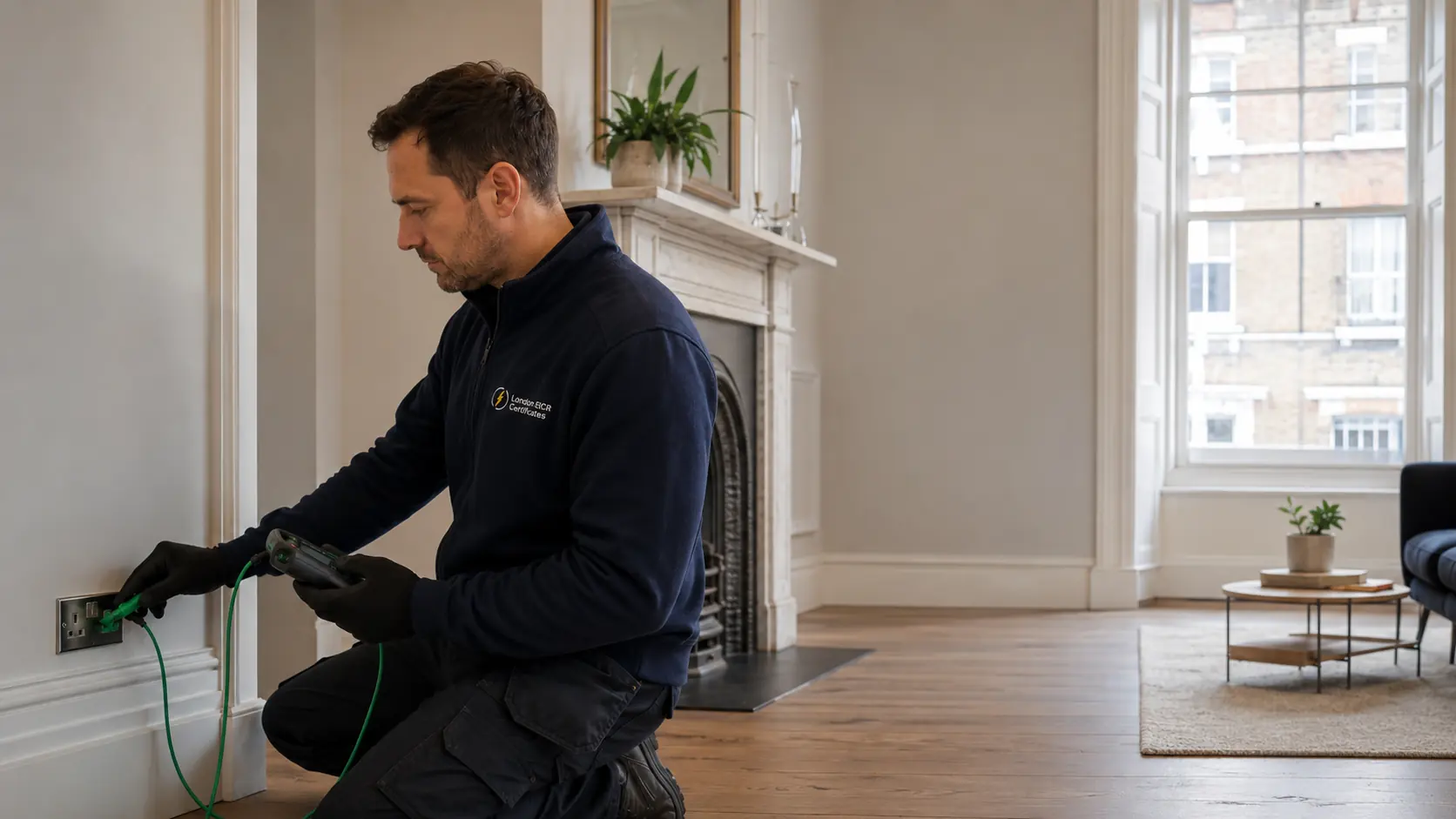
EICR certificates for homeowners in London
Buying, selling or renovating? Find out what condition your wiring is really in before you commit. A qualified electrician tests the installation and your EICR is usually ready within 24 hours of completing the inspection, emailed after payment. Fixed prices from £142.80 including VAT.
- 5.0Google (58)
- 4.6Trustpilot (19)
- From £142.80 inc VAT
- EICR usually ready within 24h
Your fixed price
VAT included, no call-out fee. Pay when your report is ready.
NICEIC or NAPIT registered engineers
All of London and inside the M25.
Pick bedrooms and add the postcode to see your exact price.
from
£142.80
Why customers choose London EICR Certificates
- Fixed price, VAT includedThe price you see is set before you book. No call-out fee and nothing to pay until your report is ready.
- Qualified, vetted electriciansEvery inspection is done by a qualified electrician whose name and signature are on your report.
- EICR usually ready within 24 hoursUsually ready within 24 hours of completing the inspection. Your PDF follows payment, unless different written terms apply.
- Repairs quoted, never forcedIf anything fails you get a repair quote. You choose who does the work.
How it works
Step 1: Get your price
Flat or house, bedrooms and postcode. Your fixed price shows straight away.
Step 2: Book in two minutes
Pick a weekday morning or afternoon window (evenings and weekends on request) and tell us who will let the electrician in.
Step 3: A full inspection and test
The electrician inspects and tests the installation within the agreed scope and records any limitations in the report. Visit length depends on the property, the number of circuits and access; we give you an estimate when we confirm the appointment. Power is switched off for parts of the testing.
Step 4: Report in your inbox
Your EICR is usually ready within 24 hours of completing the inspection. We email the report once the invoice is paid, unless different written terms apply.
Questions first? Call 0203 811 8331 or WhatsApp us, any time, 7 days a week.
Understand the findings before choosing work
An inspection gives you a record to discuss with your electrician. Read the observations and limitations before deciding on repairs, improvements or further investigation.
Your installation
The report identifies the installation, agreed extent and any limitations.
Your next decision
Findings explain what needs attention. Discuss the scope and price before instructing further work.
Do homeowners need an EICR?
There is no legal deadline for owner-occupiers. Owner-occupied homes are not automatically subject to the private rented sector rules that apply to landlords. The usual recommendation is an EICR every 10 years, and whenever something changes: you buy, sell, plan building work or notice a problem.
An EICR replaces guesswork with facts. A qualified electrician tests the installation and tells you in writing what is safe, what needs fixing and what could be improved, so your next decision is an informed one.
If you let the property, the legal rules for landlords apply instead. See our landlord EICR guide.
Buying a home: get an EICR before you exchange
A building survey may note visible electrical issues, but it does not normally test the installation. An EICR does. Ask the seller for their latest report. If there is none, or it is old, book one before exchange so you know about any repairs before you are committed.
Just tell us who will let the electrician in, often the seller or the estate agent. You get the report by email, and if anything needs fixing you get a repair quote, which is useful when you are weighing up the true cost of the purchase.
Selling a home: reassure buyers early
Buyers and their solicitors often ask about the electrics. A recent satisfactory EICR answers the question before it is asked, especially in an older, extended or converted home.
Book early rather than the week before exchange. If the report finds anything, you have time to get it fixed, or to share the report alongside the repair quote, without holding up the sale.
Planning a renovation or extension?
A new kitchen, loft conversion, extension or home office puts new demands on your electrics. An EICR before you start shows what you are working with, so your builder and electrician plan and price from facts, not guesses.
It is also the best time to find problems, before new plaster and flooring go down. Share the report with whoever is designing the work. Any new electrical work gets its own certificate when it is finished.
Older homes: what we often find
Many London homes have wiring from several decades and several owners. A modern-looking socket or a new kitchen does not mean the whole house was rewired.
Age alone does not fail a report. What matters is the condition the electrician finds. These are common findings in older installations:
- Rewireable fuses in an old fuse box.
- No RCD, the safety device that cuts the power fast if something goes wrong.
- An old consumer unit.
- Alterations by previous owners with no paperwork.
Tripping, burning smells or hot sockets?
If you smell burning, see scorch marks, feel a socket getting hot or get a shock, switch off at the fuse board if it is safe to do so and call us on 0203 811 8331. Do not wait for a routine appointment.
Less urgent signs are still worth checking: lights that flicker, a fuse board that trips now and then, unlabelled circuits or a history of DIY work. Tell us about them when you book so the electrician knows what to look at. Faults that come and go do not always show up on the day, so describe when they happen.
Already have an older EICR?
Check the date, the overall result and the recommended date for the next inspection. If the report is satisfactory and still in date, and nothing major has changed, it may still serve you well.
Book a new one if the report has passed its next-inspection date, if electrical work has been done since, or if large parts of the home were not inspected. If the old report listed C1, C2 or FI items, look for a completion certificate showing they were fixed.
What does a homeowner EICR check?
A qualified, vetted electrician inspects and tests the fixed electrics in your home within the agreed scope. Visit length depends on the property and its circuits; we give you an estimate when we confirm. The power goes off for parts of the testing. The electrician checks:
- The consumer unit (fuse board): its condition, protective devices and labelling.
- Every circuit: continuity, insulation resistance, polarity and earth fault loop impedance.
- RCD protection: whether it is there where it should be, and that it trips fast enough.
- Earthing and bonding to gas and water pipes.
- Sockets, switches, lights and fixed appliances, with extra care in kitchens and bathrooms.
What an EICR does not cover
An EICR covers the fixed electrics. Plug-in appliances are a separate check: see our PAT testing guide. Gas, the building structure and the design of new electrical work sit outside it too.
The electrician tests everything they can safely reach. Wiring buried in walls or under floors, locked rooms and areas blocked by furniture are recorded on the report as limitations, so you know exactly what was checked. Clear access to the fuse board and every room gives you the most complete report.
The report shows the condition of the installation on the day it was tested. Keep it, and book the next one by the recommended date.
What do C1, C2, C3 and FI mean?
Every observation on your report has a code that tells you how urgent it is, plus a short note saying what was found and where. For worked examples, read the EICR classification code guide. In short:
- C1, danger present: made safe immediately. The report is unsatisfactory.
- C2, potentially dangerous: needs fixing. The report is unsatisfactory.
- FI, further investigation: needs a closer look. Under the A4:2026 format this does not by itself make the report unsatisfactory.
- C3, improvement recommended: advisory. The report can still be satisfactory.
Satisfactory or unsatisfactory: what your result means
Satisfactory means the installation is safe to keep using. You may still see C3 recommendations, which are worth considering next time you have work done. Keep the report with your property documents and hand it to any electrician who works on the house later.
Unsatisfactory means at least one C1 or C2 item was found. Any C1 danger is made safe straight away. The other items need fixing, and you get one quote for the agreed repair work.
Fixing what the report finds
Repairs are always quoted separately and are always optional. Small repairs start from £150 + VAT (£180 inc VAT), and a full consumer unit replacement starts from £975 + VAT (£1,170 inc VAT). Deal with C1 and C2 items first, then anything marked FI. C3 items are your choice.
You are free to use any qualified electrician. When the work is done you get a completion certificate, either a Minor Works certificate or an Electrical Installation Certificate, to keep with the report. See our remedial work page for how it works.
Homeowner EICR FAQs
Is an EICR a legal requirement for homeowners? No. Owner-occupiers have no legal deadline. The usual recommendation is every 10 years, or when you buy, sell or renovate. Landlords have separate legal duties.
How long does it take? It depends on the property, the number of circuits and access. A small flat can take well under an hour; larger homes take longer. We give you an estimate when we confirm.
Do I need to be at home? No, as long as someone can let the electrician in.
Will the power be off? Only for short spells while circuits are tested. Tell us about anything that must stay on, such as medical equipment or a freezer.
When do I pay? We email the invoice after the visit, with your result. Your EICR is usually ready within 24 hours of completing the inspection and emailed after payment, unless different written terms apply. There is no call-out fee.
Can I change the date? Yes, free of charge up to 24 hours before the visit. Later cancellations, or a visit where we cannot get in, cost £110 + VAT.
How much does a homeowner EICR cost?
Fixed prices from £142.80 to £250.80 including VAT, depending on the size of your home. Central London postcodes (EC, WC, W1, SE1 and parts of SW1) add £21.60. No call-out fee, and you pay when your report is ready.
Use the calculator on this page for your exact price, then pick a weekday morning or afternoon window; after 4pm and weekends are on request. Book online, by phone or on WhatsApp, 24/7. Every price band is also in the EICR cost guide.
- Studio flat: £142.80
- 1-bed flat: £154.80
- 2-bed flat: £166.80
- 3-bed flat: £178.80
- 4+ bed flat: £202.80
- 1-bed house: £178.80
- 2-bed house: £190.80
- 3-bed house: £202.80
- 4-bed house: £226.80
- 5+ bed house: £250.80
Common situations and what to do next
Whatever brought you here, this is the quickest next step:
- Buying a converted flat with no electrical paperwork: ask the seller for records, then book an EICR before exchange.
- Selling an older house: book early so there is time to fix anything before buyers ask.
- Starting a renovation: book before work begins and share the report with your builder.
- Holding a failed report: send it for a remedial quote rather than booking a new inspection.
- Tripping or a burning smell: switch off if it is safe to do so, then call us.
- Just want peace of mind: check your price and book a visit that suits you.
Guidance for your property and purchase
Prepare for an inspection, review existing paperwork and plan any work you choose.
- Before an EICR on an empty inherited property
- How does an EICR differ for a flat and a house?
- EICRs for converted flats and split houses
- What does an EICR decide in a listed or heritage building?
- Can the electrical installation be inspected before an auction?
- Preparing a high-spec or complex property for an EICR
- What can the age of a period property tell you before an EICR?
- What an EICR can and cannot say in an insurance claim
- What should you send when an insurer asks for electrical papers?
- After a water leak in a flat, do you need an EICR?
- Do I need an EICR for my own home?
- Buying a property: what to check before exchange
- Read a genuine anonymised EICR report
- Plan a consumer unit replacement
Related pages
Book your EICR in two minutes
Fixed prices from £142.80 including VAT. Pick a weekday window, or ask for an evening or weekend, and receive your EICR after payment. It is usually ready within 24 hours of completing the inspection.
- 5.0Google (58)
- 4.6Trustpilot (19)
- From £142.80 inc VAT
- EICR usually ready within 24h