


The London EICR Safety Report 2026: Real Electrical Faults Found Across London Properties
EICR Certificate
16 June 2026
Electrical safety in London properties is not just a certificate exercise. It is a practical risk issue affecting landlords, tenants, homeowners, estate agents, block managers, commercial occupiers and anyone responsible for a building where people live or work.
An Electrical Installation Condition Report, usually called an EICR, is designed to check whether the fixed electrical installation in a property is safe for continued use. It is not a quick visual look around. A proper EICR inspection involves electrical testing, observation, circuit assessment, consumer unit checks, earthing and bonding checks, and a written report that records whether the installation is satisfactory or unsatisfactory.
This London EICR Safety Report 2026 has been created to help property owners understand the real issues that appear during electrical inspections across London properties. Instead of only explaining what an EICR certificate is, this report looks at the types of faults, risk patterns and practical problems that commonly lead to failed EICR reports.
For landlords who need an EICR certificate for landlords in London, the aim is simple: understand the risks before the inspection, reduce avoidable delays, and keep evidence of compliance. For homeowners, the report explains why an EICR certificate for homeowners can be useful before selling, renovating or buying an older London property. For businesses, it highlights why a commercial EICR certificate in London should be treated as part of wider building risk management, not just paperwork.
London EICR Certificates carries out electrical inspection and testing across residential and commercial properties in London. Our work covers rental flats, HMOs, converted houses, offices, shops, commercial units, communal areas, managed blocks, high-value homes and urgent move-in scenarios.
This report is designed to give London property owners a practical safety benchmark.
Across London, many electrical installations are safe enough to pass an EICR inspection, but a significant number still show defects that need attention. Some issues are minor recommendations. Others can make the report unsatisfactory and require remedial work before the property can be treated as compliant.
The most common EICR issues are rarely dramatic at first glance. A tenant may not notice them. A landlord may not see them during a viewing. An estate agent may not pick them up during a routine inspection. Many faults are hidden inside consumer units, circuits, accessories, earthing arrangements or older wiring systems.
The main patterns we continue to see across London properties are:
• Missing or inadequate RCD protection
• Damaged sockets, switches, faceplates and back boxes
• Poor circuit labelling inside consumer units
• Loose or exposed live parts
• Missing, undersized or inaccessible bonding
• Old consumer units that no longer provide appropriate protection
• Bathroom lights or accessories not suitable for the zone
• DIY additions or poorly altered wiring
• Overloaded circuits and poor distribution of electrical load
• Further investigation required where a full conclusion cannot be reached
For landlords, the biggest practical risk is timing. Many EICR problems are only discovered at the last moment, just before a tenant moves in, before a letting agent releases keys, or when a council, buyer, solicitor or managing agent requests evidence.
The most expensive EICR problem is not always the inspection itself. It is the delay caused by discovering defects too late.
If you need to book quickly, use our online EICR booking page or review our main EICR services in London page for residential and commercial options.
The figures below are structured as a publishing framework for a London EICR annual report. If you are publishing this article as a formal “Safety Report”, replace the example percentages with verified internal figures from your completed EICR inspections, job sheets, certificates and remedial quotes.
Recommended internal data sources:
• Completed EICR reports
• Unsatisfactory report observations
• C1, C2, C3 and FI code totals
• Property type from booking forms
• Borough or postcode area
• Remedial work quotations
• Repeat issues across reports
• Failed inspection reasons
• Time between inspection and certificate completion
• Whether the final report became satisfactory after remedial work
Do not publish exact numbers as company data unless they are checked. If the verified sample is small, say “sample of completed London EICR inspections reviewed by our team” rather than making city-wide claims.
Below is the structure we recommend using once your real 2026 inspection data is exported.
| Inspection category | Example share of observed issues | Typical EICR outcome | Common property type |
|---|---|---|---|
| Missing or inadequate RCD protection | 31% | Often C2 depending on risk and circuit use | Older flats, rental properties, converted houses |
| Damaged accessories | 24% | C2 or C3 depending on damage and exposure | Tenanted flats, HMOs, high-use properties |
| Earthing or bonding concerns | 18% | C2 or FI depending on condition and verification | Older houses, conversions, basement flats |
| Consumer unit defects | 15% | C2, C3 or FI depending on issue | Flats, commercial units, landlord properties |
| Bathroom electrical risks | 7% | C2 or C3 depending on location and protection | Flats, HMOs, older bathrooms |
| Further investigation required | 5% | FI, often unsatisfactory until resolved | Properties with incomplete access or hidden circuits |
This table should be used as an editorial template. Replace the example numbers with actual data before publication.
The purpose is to make the blog more than a normal keyword article. A data-led report can become a linkable asset for landlords, letting agents, block managers, property buyers and journalists researching electrical safety in London.
An EICR is a formal assessment of the fixed electrical installation. It is different from PAT testing, which checks portable appliances. It is also different from a simple visual inspection.
During an EICR inspection, the electrician assesses whether the installation is safe for continued use and whether any defects, deterioration, damage or non-compliance require action. The inspection normally includes:
• Consumer unit inspection
• Circuit identification
• Visual condition checks
• Earthing and bonding checks
• Protective device assessment
• RCD testing where applicable
• Continuity testing
• Insulation resistance testing where possible
• Polarity checks
• Earth fault loop impedance testing where applicable
• Observation of accessories, sockets, switches, lighting points and distribution equipment
• Recording of limitations where access or testing cannot be completed
A completed EICR report will normally show whether the installation is satisfactory or unsatisfactory. If the report is unsatisfactory, the property owner may need remedial work before the installation can be regarded as compliant.
For a deeper explanation of report sections, codes and certificate details, read our guide on how to read and understand an EICR report.
London has a wide mix of property stock. A new-build apartment in Canary Wharf, a Victorian conversion in Fulham, a basement flat in Kensington, a shop in Shoreditch and a managed block in Battersea can all have very different electrical risks.
A failed EICR does not always mean the property is dangerous in every part. It means the inspection found one or more issues serious enough to prevent the report being marked satisfactory.
Common causes include:
• A C1 danger present observation
• A C2 potentially dangerous observation
• An FI further investigation required observation
• Incomplete or unsafe circuits
• Exposed live parts
• Inadequate protection for socket circuits
• Poor earthing or bonding arrangements
• Damaged or unsuitable equipment
• Consumer unit defects
• Evidence of overheating
• Unsafe bathroom electrics
• Poor DIY alterations
• Lack of access to critical parts of the installation
C3 observations usually indicate improvement recommended. A report with only C3 observations can still be satisfactory, but C3 issues should not be ignored. They may become more serious over time if the installation deteriorates or if the property use changes.
If your EICR has failed and you need a practical cost estimate, use our failed EICR remedial cost estimator or review our EICR remedial work service.
RCD protection is one of the most common areas of concern during EICR testing. An RCD is designed to disconnect the electrical supply quickly when it detects imbalance, helping reduce the risk of electric shock.
In many older London properties, the electrical installation may have been safe under previous standards, but may now lack modern protection expected for certain circuits. The exact EICR code depends on the circuit, location, use, installation condition and risk.
Common examples include:
• Socket circuits without appropriate RCD protection
• Bathroom circuits with insufficient protection
• Older consumer units with limited protective devices
• Mixed protection across circuits
• Circuits altered over time without full upgrade
This does not always mean a full rewire is needed. In many cases, targeted remedial work can improve protection. However, the electrician must assess the installation properly before advising.
For landlords, RCD issues are important because they often appear just before a tenancy starts. If a property has not been tested for years, do not assume it will pass because sockets and lights appear to work.
Damaged accessories are common in tenanted properties because sockets, switches and light fittings receive daily use. A cracked socket faceplate may seem minor, but if it exposes live parts or creates risk of contact, it can become a serious EICR observation.
Common examples include:
• Cracked sockets
• Loose switches
• Damaged back boxes
• Broken faceplates
• Missing screws
• Loose accessories pulling away from the wall
• Burn marks around plug sockets
• Exposed conductors
• Old fittings with poor mechanical condition
In some cases, the remedy is simple replacement. In other cases, damaged accessories reveal deeper wiring issues, such as loose terminations, overheating or poor previous work.
This is one of the easiest categories for landlords to reduce before inspection. A pre-check of visible sockets, switches and lighting points can often prevent avoidable failure.
Earthing and bonding are critical parts of electrical safety. They help ensure fault current can flow safely and protective devices can operate correctly.
During London EICR inspections, concerns often arise where bonding is missing, undersized, inaccessible or cannot be verified. This is especially common in older properties, converted flats, properties with older pipework and buildings where previous works have been carried out over many years.
Common issues include:
• Main protective bonding not visible
• Gas or water bonding missing
• Bonding clamps inaccessible
• Incorrect cable size
• No clear main earthing terminal
• Earthing arrangement not confirmed
• Poor continuity readings
• Further investigation required
Bonding issues should be taken seriously. A property can look modern internally but still have hidden earthing or bonding defects.
If an EICR report says FI for earthing or bonding, it usually means the electrician cannot safely confirm the condition without further checks. That should be resolved rather than ignored.
The consumer unit is one of the most important parts of an EICR inspection. It is the point where circuits are distributed and protected.
Common consumer unit observations include:
• Missing blanks
• Damaged covers
• Exposed live parts
• Mixed protective devices
• Poor circuit labelling
• No RCD protection on relevant circuits
• Overcrowded wiring
• Signs of overheating
• Poor access
• No circuit schedule
• Loose enclosure parts
A failed EICR does not automatically mean the whole consumer unit must be replaced. Sometimes minor remedial work is enough. However, if the consumer unit has exposed live parts, damaged protection or wider safety issues, more significant work may be needed.
Landlords should be careful with quotes that jump straight to a full consumer unit replacement without explaining the report observations. The correct remedial route depends on the actual EICR findings.
Bathrooms carry additional electrical risk because water and electricity create a more dangerous environment. EICR observations often relate to lighting, extractor fans, switches, shaver sockets and accessories positioned in or near bathroom zones.
Common examples include:
• Unsuitable bathroom light fittings
• Non-IP rated fittings in risky locations
• Pull cord or switch concerns
• Extractor fan issues
• No suitable RCD protection
• Poor supplementary bonding in older installations
• Damaged bathroom accessories
• DIY replacement fittings
A bathroom fault may be relatively simple to fix, but it can still cause an unsatisfactory EICR if the risk is high enough.
This is especially common in rental flats where bathrooms have been upgraded cosmetically but the electrical installation has not been reviewed properly.
Poor circuit labelling is not always the most dangerous fault, but it causes practical problems during inspection, testing, future maintenance and emergency work.
Common issues include:
• Circuits labelled incorrectly
• Old labels that no longer match the installation
• Missing circuit schedule
• Multiple circuits marked vaguely as “sockets” or “lights”
• Unknown circuits
• Spare ways not clearly identified
• Altered wiring without updated labelling
In a commercial property, poor labelling can create major disruption because the electrician may need additional time to identify circuits safely.
For landlords and agents, clear circuit records help reduce delays and make future remedial work more efficient.
London properties often go through repeated ownership, refurbishment and tenant changes. Over time, electrical additions may have been carried out by different people, sometimes without proper certification or records.
Common signs include:
• Spur additions from existing circuits
• Poorly fitted sockets
• Incorrect cable routes
• Junction boxes hidden or inaccessible
• Mixed wiring colours from different eras
• Poor terminations
• Unsupported cables
• Non-standard additions
• External wiring not suitable for conditions
DIY work is not always obvious to the property owner. It may only become clear during EICR testing or when accessories are inspected.
This is one reason an EICR is useful before buying or renovating a London property. A standard property viewing will not show the full condition of the electrical installation.
Understanding the codes is essential because the code determines how serious the observation is and whether the report is satisfactory.
| EICR code | Meaning | Typical effect on report | What the owner should do |
|---|---|---|---|
| C1 | Danger present | Unsatisfactory | Immediate action required |
| C2 | Potentially dangerous | Unsatisfactory | Urgent remedial work required |
| C3 | Improvement recommended | Usually satisfactory if no C1, C2 or FI | Plan improvement work |
| FI | Further investigation required | Unsatisfactory until investigated | Arrange further inspection or testing |
A common misunderstanding is that every issue listed on an EICR report is the same. It is not. A C3 recommendation is different from a C2 potentially dangerous observation. A C1 is more urgent again.
Another common misunderstanding is that an EICR inspection includes the remedial work. It does not. The EICR is the inspection and report. If the report fails, remedial work is normally quoted separately after the inspection because the required work depends on the findings.
For more detail on remedial options, visit our remedial work for failed EICR certificates page.
Landlords in England have legal duties around electrical safety in rental properties. In general, relevant rented properties must have the electrical installation inspected and tested by a qualified person at required intervals, usually no more than every 5 years, unless the report states a shorter interval.
The report must be kept and supplied where required. If the report is unsatisfactory, remedial or further investigative work may be required within the relevant deadline.
For landlords, the practical compliance process is:
Check whether the existing EICR is still valid.
Confirm whether the previous report was satisfactory.
Check whether the report recommended the next inspection date.
Book the EICR before the tenancy deadline.
Provide correct access details.
Make sure the name and property address on the certificate are accurate.
Review the report when received.
If unsatisfactory, arrange remedial work quickly.
Keep evidence of the report, invoice, remedial work and final satisfactory outcome.
Set a reminder before the next inspection is due.
Landlords can start with our EICR certificates for landlords in London page or use our EICR compliance checker to understand the basic compliance position.
Homeowners do not always think about EICR inspections because landlord rules are often discussed more publicly. However, an EICR can be valuable for homeowners in several situations:
• Before selling a property
• Before buying a property
• Before major renovation
• After water damage or electrical faults
• Before installing high-load equipment
• After years without electrical inspection
• When a property has old wiring or an old fuse board
• When there are signs of overheating, flickering lights or repeated tripping
In London, homeowners often discover electrical issues during sale or purchase negotiations. A buyer may request an electrical safety check. A survey may recommend further electrical investigation. A solicitor may ask for certificates for previous electrical work.
A homeowner EICR can help identify risk early and avoid last-minute disruption.
For residential property owners, see our EICR certificates for homeowners in London page.
Commercial EICR inspections are different from standard residential inspections because the electrical installation may support business operations, staff safety, customer areas, equipment, server rooms, kitchens, lighting systems, distribution boards and plant.
Commercial EICR risks often include:
• Higher electrical load
• More distribution equipment
• Three-phase supplies
• Multiple circuits and sub-boards
• Office desk power systems
• Floor boxes and underfloor wiring
• Server or IT equipment
• Commercial kitchens
• Emergency lighting interfaces
• Poor circuit labelling
• Limited access during business hours
For facilities managers, the main challenge is planning. A commercial EICR may require access to areas that are difficult to isolate during normal working hours. If testing requires partial shutdowns, this should be planned in advance.
A commercial property should not wait until a lease event, insurance request or compliance audit before arranging electrical inspection.
Businesses can start with our Commercial EICR Certificates in London service page.
Converted flats often have older wiring arrangements, shared building constraints, unclear responsibilities and limited access to intake positions or communal areas. Circuit history may be unclear if works were completed by previous owners.
HMOs have higher usage and more complex compliance expectations. Electrical accessories, kitchens, bathrooms and communal areas receive heavier use, so deterioration can happen faster.
Short-term lets may have high guest turnover, frequent appliance use and limited downtime for maintenance. Electrical issues may be reported late or after visible damage appears.
Commercial kitchens carry higher risk because of heat, moisture, equipment load and long operating hours. Electrical safety should be planned around business continuity.
Offices often have large numbers of sockets, desk power systems, extension leads, floor boxes and IT loads. Access planning is important to avoid disruption.
Older houses may have legacy wiring, older consumer units, altered circuits, bonding issues and hidden defects that only testing can reveal.
High-value properties can still fail an EICR. Cosmetic finish does not guarantee electrical safety. Recently refurbished properties can also have defects if electrical works were not properly tested or recorded.
Property age does not automatically decide whether an EICR will pass or fail, but it is a useful risk indicator.
| Property condition | Typical risk level | Why it matters |
|---|---|---|
| Newer property with clear records | Lower | More likely to have modern protection and documentation |
| Refurbished property with certificates | Lower to medium | Depends on quality and scope of works |
| Refurbished property with no certificates | Medium to high | Electrical work may not be properly documented |
| Older flat with old consumer unit | Medium to high | RCD, labelling and bonding issues are common |
| Converted property | Medium to high | Shared structure and historic alterations increase complexity |
| HMO or high-use rental | Medium to high | Higher wear, more accessories and more tenant use |
| Commercial unit with poor records | High | Circuit tracing and risk assessment may be more complex |
This is why the cheapest EICR quote is not always the best option. A rushed inspection may not give the property owner the clarity needed to make proper decisions.
A useful EICR report should not simply say “pass” or “fail”. It should give enough information for the owner to understand the installation condition and decide what to do next.
A proper report should include:
• Property address
• Client or certificate name
• Inspection date
• Extent of installation covered
• Limitations
• Supply characteristics
• Earthing arrangement
• Consumer unit details
• Schedule of circuits
• Test results
• Observations
• EICR codes
• Overall satisfactory or unsatisfactory outcome
• Recommended next inspection date
• Inspector details
• Company details
Where a report is unsatisfactory, the observations should be clear enough to allow remedial work to be quoted.
Customers sometimes expect the EICR report to include a full repair quotation. The report itself is not designed as a remedial quotation. The electrician normally needs to review the observations, photos, access conditions and required materials before giving a proper remedial price.
A landlord had a tenant ready to move into a two-bedroom flat. The previous EICR had expired, and the inspection was booked close to the move-in date.
During testing, several issues were found:
• Older consumer unit with limited protection
• Damaged socket faceplate in living room
• Poor circuit labelling
• Bathroom light fitting concern
• Further investigation required on one circuit
The EICR was marked unsatisfactory. The landlord expected the certificate to be issued the same day as satisfactory, but the report could not be passed until the relevant issues were addressed.
The practical lesson is clear: do not leave EICR inspection until the final days before a tenant moves in. Even relatively small remedial works can create a delay if access, parts or tenant availability become an issue.
For urgent tenancy situations, use our book online page and provide access details clearly.
A London office needed a commercial EICR for compliance records. The building had staff, desk power, server equipment and multiple distribution points. The client wanted the inspection completed without business disruption.
The main issues were not just technical. They were operational:
• Some circuits could not be isolated during working hours
• Distribution board access was limited
• Desk power areas needed coordination
• IT equipment had to remain active
• Testing needed staged access
The report could still be completed, but the job required planning. Commercial EICR inspections often work best when the client provides board locations, access times, floor plans and any known electrical records.
For offices, shops, restaurants and commercial spaces, start with our commercial EICR certificates in London page.
A homeowner requested an EICR before planned renovation. The property looked well maintained, but the inspection identified several issues that were not visible during everyday use.
Typical findings included:
• Old consumer unit
• Poor labelling
• Incomplete records for previous alterations
• Socket circuit concerns
• Bonding visibility issue
The homeowner avoided starting cosmetic works before understanding the electrical condition. This matters because discovering electrical defects after new plastering, kitchens, flooring or decoration can increase cost and disruption.
An EICR before renovation can help plan work in the right order.
EICR cost depends on property type, size, number of circuits, consumer units, access conditions, location, parking, congestion charge, urgency and whether the property is residential or commercial.
A small flat is normally simpler than a large house. A standard single-phase rental property is usually simpler than a commercial property with multiple distribution boards. A commercial EICR certificate cost can vary significantly depending on the installation.
Factors that affect EICR price include:
• Number of bedrooms
• Number of circuits
• Number of consumer units
• Property type
• Residential or commercial use
• Three-phase supply
• Access restrictions
• Parking and congestion charge
• Urgency
• Whether previous records are available
For current pricing guidance, visit our EICR certificate cost page.
Many property owners focus only on the cost of the EICR certificate. The bigger cost is often delay.
Delays can affect:
• Tenant move-in dates
• Letting agent compliance checks
• Sale progression
• Mortgage conditions
• Insurance requests
• Council enquiries
• Commercial lease requirements
• Planned refurbishments
• Remedial work scheduling
A £159 inspection discovered early is manageable. An unsatisfactory report discovered one day before a tenancy starts can become a much bigger operational problem.
The best approach is to book the inspection early, especially if:
• The property is older
• The certificate has expired
• A tenant is moving in soon
• There has been water damage
• Electrical work has been done recently
• You are selling or buying
• You manage multiple properties
• A council or agent has requested evidence
Before booking your EICR inspection, complete this simple checklist.
| Check | Why it matters |
|---|---|
| Confirm full property address | Prevents certificate errors |
| Confirm name on certificate | Useful for landlord, company or agent records |
| Provide tenant/access contact | Reduces failed visits |
| Confirm property type and size | Helps accurate pricing |
| Confirm parking or access restrictions | Avoids delays and extra charges |
| Check visible sockets and switches | Can identify obvious damage |
| Locate consumer unit | Saves time on arrival |
| Check previous EICR date | Confirms urgency |
| Provide any old reports | Helps compare installation history |
| Mention known faults | Helps engineer plan inspection |
For faster booking, use our EICR terms acceptance and booking details form.
A landlord should not only keep the certificate. Keep the full compliance trail.
Recommended evidence pack:
• EICR report PDF
• Invoice for the inspection
• Proof the report was sent to tenant or agent where required
• Remedial work quote if report failed
• Remedial work invoice
• Confirmation of completed remedial work
• Updated satisfactory report if applicable
• Photos where provided
• Access attempt records if tenant refused access
• Calendar reminder for next inspection
This evidence can be useful if a tenant, agent, solicitor, buyer, insurer or local authority asks for proof.
If your EICR is unsatisfactory, do not panic. Many failed reports are resolved with targeted remedial work.
The correct steps are:
Read the observations.
Identify whether the report has C1, C2 or FI codes.
Ask for a remedial quote based on the report.
Confirm access for remedial work.
Complete required works.
Obtain confirmation and updated documentation.
Keep all records.
Avoid assuming the solution before reviewing the report. For example, a failed EICR does not always mean a full rewire. Sometimes the issue is a damaged accessory, missing blank, bonding concern, circuit issue or localised fault.
If you have an unsatisfactory EICR report, use our EICR remedial work service or the failed EICR remedial cost estimator.
Estate agents and property managers should treat EICR compliance as a process, not a one-off task.
The most common operational problems are:
• Missing certificate before move-in
• Expired EICR discovered too late
• Wrong name or address on certificate
• Tenant access not arranged
• Report failed but remedial work not planned
• No record of previous report
• Confusion between EICR and PAT testing
• Assuming an old certificate is valid without checking next inspection date
Agents managing multiple London properties should build a simple compliance tracker with:
• Property address
• Landlord name
• Certificate expiry date
• Last inspection outcome
• Report PDF link
• Remedial status
• Tenant access contact
• Next inspection reminder
London EICR Certificates can support landlords and agents with single-property bookings and portfolio EICR planning.
An EICR checks the fixed electrical installation. PAT testing checks portable electrical appliances.
Examples of fixed installation:
• Consumer unit
• Fixed wiring
• Sockets
• Light circuits
• Switches
• Distribution boards
• Hardwired equipment
Examples of portable appliances:
• Kettles
• Microwaves
• Monitors
• Extension leads
• Desk equipment
• Portable heaters
• Office appliances
Some commercial clients need both. A landlord may need an EICR and, depending on the letting situation and appliances provided, may also choose PAT testing as part of wider safety management.
For appliance testing, visit our PAT testing in London page.
London EICR Certificates provides electrical inspection and testing services across London for landlords, homeowners, agents and commercial clients.
Our service is built around practical compliance:
• Clear EICR inspection booking
• Fixed-price residential options where possible
• Commercial quotations based on property details
• Landlord certificate support
• Homeowner electrical safety reports
• Remedial work quotations after failed inspections
• Fast digital reports
• Support for urgent tenancy deadlines
• London-wide coverage
• Internal booking process to reduce certificate mistakes
Relevant service pages:
• EICR services in London
• EICR certificates for landlords
• EICR certificates for homeowners
• Commercial EICR certificates
• EICR certificate cost
• Remedial work for failed EICR certificates
• Book your EICR online
To make this blog post stronger, add the following visuals:
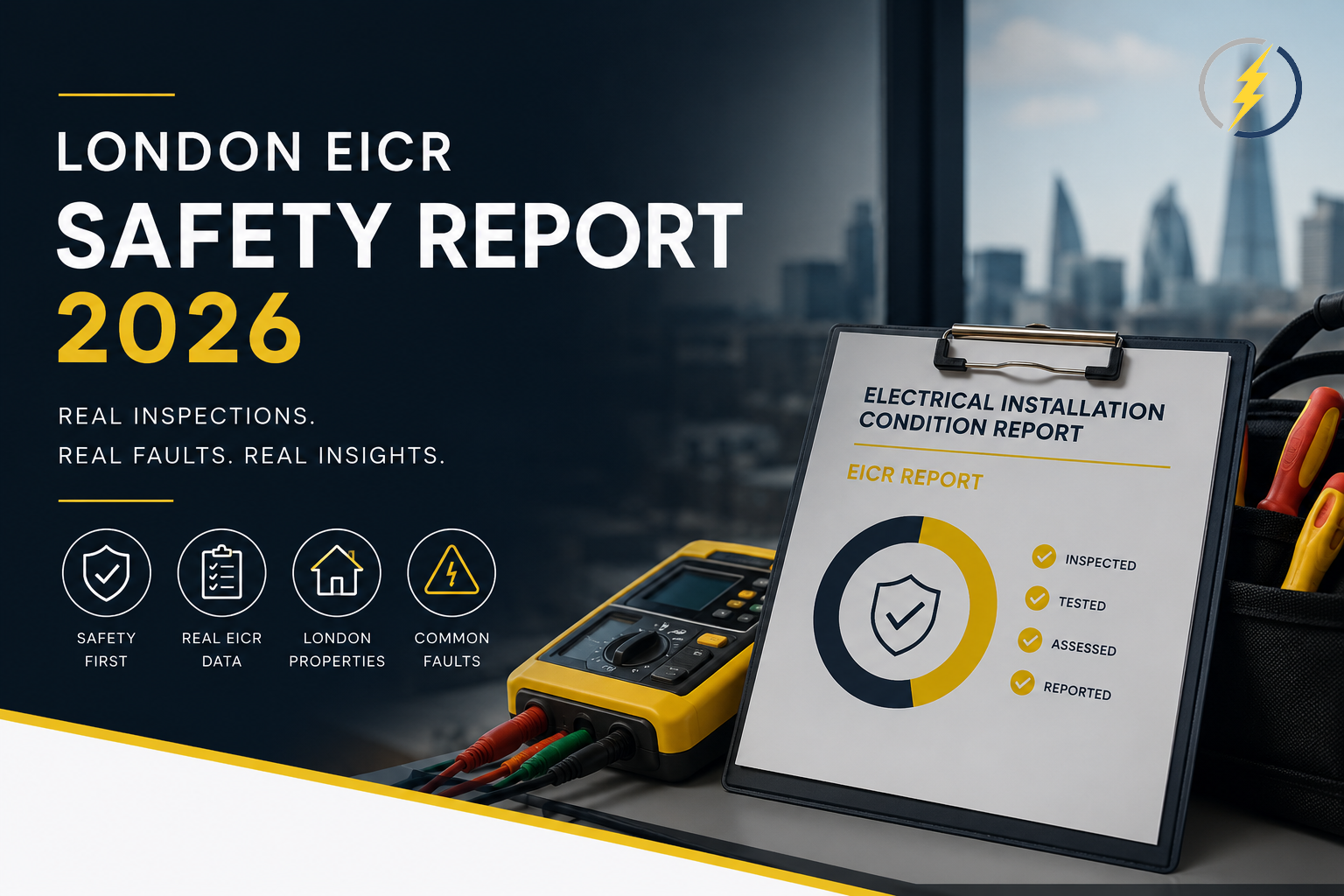
Use the image already created:
File name: london-eicr-safety-report-2026-real-electrical-faults.png
Alt text: London EICR Safety Report 2026 showing real electrical inspection data, EICR faults and safety findings across London properties
Create a simple bar chart showing the most common fault categories. Use your real inspection data once available.
Suggested categories:
• RCD protection issues
• Damaged accessories
• Earthing or bonding concerns
• Consumer unit defects
• Bathroom electrical risks
• Further investigation required
Use the C1, C2, C3 and FI table from this article.
Create a downloadable PDF checklist or on-page box.
Create a downloadable sheet for agents and landlords.
Title: London Landlord EICR Readiness Checklist 2026
Include:
• Pre-inspection checklist
• Access details form
• Certificate name checklist
• Common fail points
• Evidence pack checklist
• Remedial work workflow
• Booking link
CTA text:
Download our London Landlord EICR Readiness Checklist before booking your inspection. It helps you prepare the property, avoid missing access details and reduce the chance of delays if remedial work is needed.
The biggest lesson from EICR inspections across London is simple: a property can look acceptable and still have electrical safety issues.
Sockets may work. Lights may turn on. Tenants may not complain. A property may have passed years ago. None of that proves the current electrical installation is safe for continued use.
A proper EICR gives landlords, homeowners and businesses a clearer view of the real condition of the electrical installation.
For landlords, it helps protect tenants and keep compliance records in order. For homeowners, it can reveal issues before sale, purchase or renovation. For commercial clients, it supports wider safety, insurance and operational risk management.
If your certificate is expired, your tenant is moving in soon, your property has not been tested for years, or you want a clear electrical safety report, book your inspection with London EICR Certificates.
You can start here:
Or review the main service page:
Clear answers about EICR inspections, failed reports, common electrical faults, landlord compliance, safety codes and how London property owners can reduce risk before booking an electrical inspection.
The London EICR Safety Report 2026 is an authority-style guide explaining the types of electrical faults commonly found during EICR inspections across London properties. It looks at failed EICR reports, common safety observations, landlord compliance risks and practical steps property owners can take before booking an inspection.
The report is designed for landlords, letting agents, homeowners, commercial property owners and property managers who want a clearer understanding of what electrical inspectors actually find during an EICR.
Common EICR faults in London properties include missing or inadequate RCD protection, damaged sockets and switches, poor circuit labelling, consumer unit defects, exposed live parts, bathroom electrical risks, missing bonding and issues that require further investigation.
Older flats, converted houses, HMOs, commercial units and properties with unclear electrical records often need more careful testing because hidden faults may not be visible during a normal viewing or tenancy inspection.
A London property can fail an EICR inspection if the report includes C1, C2 or FI observations. These codes mean the inspector has found danger present, potential danger or an issue that needs further investigation before the installation can be confirmed as safe for continued use.
A failed EICR does not always mean the property needs a full rewire. In many cases, the issue may be a damaged accessory, missing consumer unit blank, bonding concern, RCD protection issue or localised circuit defect.
C1 means danger present and normally requires immediate action. C2 means potentially dangerous and usually makes the report unsatisfactory. C3 means improvement recommended and does not normally fail the report by itself. FI means further investigation required and usually makes the report unsatisfactory until the issue is checked properly.
Understanding these codes is important because not every observation has the same level of urgency. A C3 recommendation is very different from a C1 or C2 safety issue.
Yes. A property can often receive a satisfactory EICR if the only observations are C3 improvement recommendations. A C3 means the installation could be improved, but it is not normally treated as an immediate safety failure on its own.
However, landlords and property owners should still take C3 observations seriously because they may become more important if the installation deteriorates, the property use changes or future electrical standards are considered during later inspections.
No. An EICR inspection includes the electrical testing, inspection and written report. If the report is unsatisfactory, remedial work is normally quoted separately after the inspection because the required repair work depends on the actual findings.
This is important for landlords to understand. The inspection identifies the condition of the electrical installation. The remedial quote explains what is needed to correct the issues and, where possible, bring the installation to a satisfactory outcome.
Landlords can reduce avoidable EICR issues by checking visible sockets, switches, lights, consumer unit access, tenant access arrangements and previous electrical records before the inspection. They should also report known faults before the electrician attends.
Useful preparation includes:
An EICR is important before a tenant moves in because it helps confirm whether the fixed electrical installation is safe for continued use. If the certificate has expired or the report is unsatisfactory, it can delay the tenancy, create agent compliance issues and increase pressure on the landlord.
Booking early is usually better than waiting until the final days before move-in. If remedial work is needed, early inspection gives the landlord time to correct the issue without disrupting the tenant start date.
Yes. Homeowners can use the report to understand the types of electrical issues that may appear before selling, buying or renovating a London property. Many electrical problems are hidden and may not be picked up during a basic property viewing.
An EICR can be especially useful before renovation because it helps identify electrical risks before new kitchens, bathrooms, flooring, plastering or decoration are completed. Finding electrical defects after cosmetic work can be more disruptive and expensive.
You can book an EICR inspection by providing the property address, name required on the certificate, access contact details, property type, number of bedrooms or commercial property details and your preferred appointment window.
London EICR Certificates provides EICR inspections for landlords, homeowners, letting agents, block managers and commercial clients across London. Once the inspection is completed, the report will confirm whether the electrical installation is satisfactory or whether remedial work or further investigation is required.
Book your electrical safety inspection with London EICR Certificates and get a clear EICR report for landlords, homeowners, agents and commercial properties.
Book Your EICR Inspection Online

Find answers to common questions about EICR certificates and electrical safety inspections in London. Visit our FAQ page on EICRcertificates.com for more information.
