


Commercial Lease Handover EICR London: Electrical Checks Before Taking or Returning Premises
EICR Certificate
16 July 2026
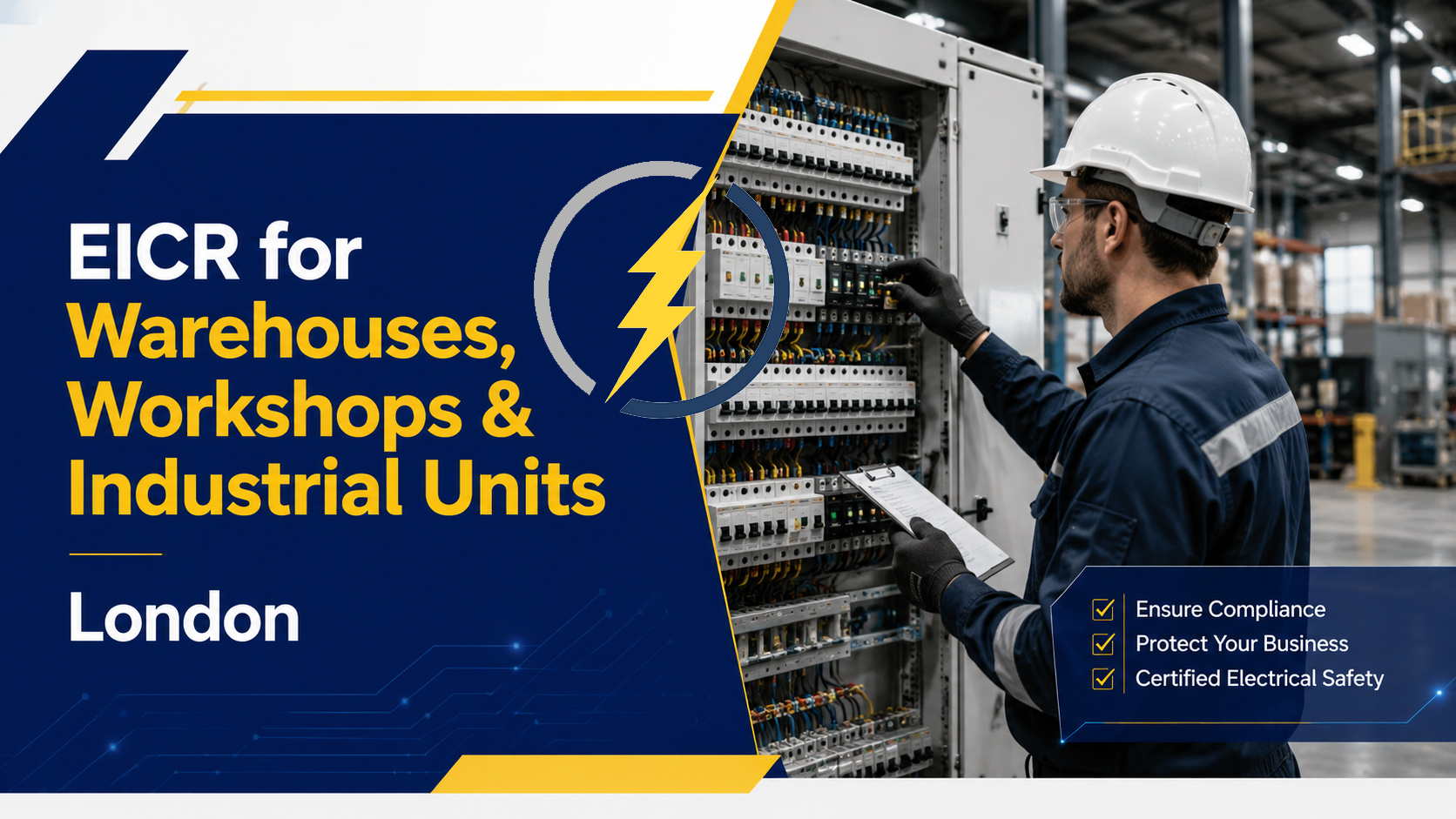
Warehouses, workshops and industrial units place very different demands on their electrical installations than ordinary homes or small offices. Three-phase supplies, heavy machinery, distribution equipment, high-level lighting, loading areas, temporary extensions and continuous operational use can all increase electrical risk.
An EICR for warehouses in London provides a structured assessment of the fixed electrical installation. It helps the property owner, commercial landlord, tenant or facilities manager understand whether the installation is safe for continued use, where deterioration has occurred and what remedial action may be required.
For busy industrial premises, this is not simply a paperwork exercise. Electrical defects can interrupt production, damage equipment, endanger employees and leave a business unable to use important areas of its premises.
London EICR Certificates provides professional commercial EICR inspections across London for warehouses, workshops, depots, factories, storage facilities and other industrial properties. We can also quote for the necessary remedial work following a failed EICR, helping clients move from inspection to resolution through one coordinated service.
An Electrical Installation Condition Report, normally shortened to EICR, is produced after the inspection and testing of an existing fixed electrical installation.
For an industrial property, the inspection may cover equipment such as:
• Main switchgear and incoming supplies
• Three-phase distribution boards
• Sub-distribution boards
• Protective devices and circuit breakers
• Earthing and bonding arrangements
• Fixed socket outlets
• Internal and external lighting circuits
• Fixed wiring supplying machinery
• Isolators and local switching arrangements
• Fire alarm and emergency lighting supplies
• Office, welfare and kitchen circuits
• Loading-bay and yard electrical installations
The precise scope will depend on the building, its electrical design and the limitations agreed before testing begins.
The objective is to assess the condition of the electrical installation at the time of inspection. The report records the installation details, test results, observed defects, agreed limitations and the inspector’s overall assessment.
An EICR is different from an Electrical Installation Certificate. An installation certificate is normally issued for new electrical work or a new installation. An EICR assesses the condition of an existing installation after it has been in service.
Businesses unfamiliar with the report can use our guide explaining how to read and understand an EICR.
Industrial environments can accelerate the deterioration of electrical equipment.
Dust may collect around enclosures and equipment. Moisture can enter external or poorly protected accessories. Forklifts and stored materials can damage cables, conduits and socket outlets. Machinery may place sustained loads on circuits that were originally designed for a different purpose.
Over time, the installation may also be altered by different contractors. New machines are connected, production layouts change, extra sockets are added and temporary supplies gradually become permanent.
This can create an installation that works operationally but contains hidden weaknesses.
Common examples include:
• Unlabelled circuits
• Incorrect protective devices
• Damaged cable containment
• Poorly secured wiring
• Inadequate earthing
• Missing protective bonding
• Signs of overheating
• Exposed live parts
• Defective isolators
• Poor alterations
• Insufficient protection against electric shock
• Inadequate protection in wet or dusty areas
An EICR is one of the most effective ways to obtain documented evidence about the condition of the fixed installation.
There is no single rule stating that every commercial warehouse must obtain an EICR on the same fixed date or at an identical interval.
However, businesses and dutyholders must ensure that workplace electrical systems are maintained so that they do not create danger. This obligation applies to commercial and industrial premises under the Electricity at Work Regulations.
The practical question is therefore not simply whether the words “EICR certificate” appear in a particular lease or regulation. The important question is whether the responsible parties can demonstrate that the electrical installation is being properly inspected, maintained and managed.
An EICR may be requested or required by:
• A commercial landlord
• A tenant taking responsibility under a lease
• A managing agent
• A facilities-management company
• An insurer
• A mortgage lender
• A purchaser or solicitor
• A health-and-safety adviser
• An accreditation or compliance scheme
• A principal contractor
• A company’s internal risk-management policy
Commercial tenants may also have responsibilities relating to maintenance, workplace safety and the protection of staff and visitors. The exact division of responsibility between landlord and tenant normally depends on the lease.
Where responsibility is unclear, both parties should review the lease before commissioning work. They should establish who controls the electrical installation, who arranges maintenance and who must fund any required repairs.
The correct inspection interval depends on the installation and the conditions in which it operates.
A clean, lightly used storage warehouse will not necessarily present the same level of risk as a vehicle workshop, manufacturing facility or dusty production unit. The environment, equipment, maintenance history and previous inspection results should all influence the next inspection date.
Factors that may justify more frequent inspection include:
• Continuous or extended operating hours
• Heavy electrical loads
• Harsh industrial conditions
• High levels of dust
• Damp or corrosive environments
• Frequent alterations
• Outdoor equipment
• Ageing switchgear
• Previous unsatisfactory reports
• Repeated circuit faults
• Machinery regularly moved or replaced
• Public or employee access to electrical areas
The competent person completing the inspection should recommend the next inspection date based on the condition and use of the installation.
Waiting until a business experiences overheating, repeated tripping or loss of supply is not a sensible maintenance strategy.
A commercial or industrial EICR combines visual inspection with electrical testing.
The engineer will first need to understand the installation. This can involve reviewing distribution-board schedules, identifying supplies, confirming how the premises are used and agreeing any operational limitations.
The inspection may then assess the following areas.
The engineer checks the visible condition of main switches, distribution boards, protective devices, enclosures and accessible terminations.
In an industrial property, there may be multiple boards serving separate sections of the building. Each board must be identified correctly so that circuits can be tested and recorded accurately.
Effective earthing is fundamental to electrical safety.
The inspection considers whether the installation has suitable earthing arrangements and whether protective bonding is present where required. Defective or missing conductors can prevent protective devices from operating correctly during a fault.
Protective devices must be appropriate for the circuit and installation.
The engineer may identify incorrectly rated breakers, unsuitable devices, obsolete equipment or situations where additional protection should be considered.
Accessible wiring, containment, conduit, trunking and cable supports are inspected for damage and deterioration.
Industrial buildings commonly contain long cable routes at high level or across production areas. Testing helps determine whether the electrical characteristics remain acceptable even where the entire cable route cannot be visually inspected.
Commercial sockets are often exposed to repeated use, impact damage and heavy loads.
The inspection may identify cracked accessories, signs of heat damage, loose equipment, unsuitable extensions or poor-quality alterations.
Many warehouses and workshops operate using three-phase supplies.
These may feed machinery, compressors, lifts, extraction systems, refrigeration equipment or industrial processing equipment. The inspection must account for the complexity and operational importance of these circuits.
Warehouse lighting is frequently installed at significant height.
The engineer may inspect accessible controls, distribution circuits, protective devices and visible wiring. Access equipment may be required where physical inspection of high-level equipment forms part of the agreed scope.
External sockets, lighting, gate equipment and loading-bay supplies are exposed to weather and accidental damage.
These areas need suitable protection for the conditions in which they are used.
An EICR normally concerns the fixed electrical installation.
It does not automatically include the full internal inspection or servicing of every machine connected to that installation. Machinery maintenance, portable appliance testing, emergency lighting testing, fire-alarm servicing and specialist control-system inspection may require separate services.
The distinction matters because a warehouse can have a satisfactory fixed installation while individual machines or appliances still require attention.
Before the appointment, the client should confirm whether they require only the fixed-wire EICR or additional electrical services. Our wider EICR services in London can be coordinated around the property’s requirements.
A large industrial EICR cannot always be handled like a small residential inspection.
Some electrical tests require circuits to be isolated. This may interrupt lighting, machinery, computer systems, alarms, refrigeration or access-control equipment. The inspection therefore needs proper planning.
Before attending, we may ask for:
• The full property address
• The approximate floor area
• The building use
• Normal operating hours
• The number of distribution boards
• Confirmation of three-phase supplies
• Available electrical drawings
• Existing board schedules
• Previous EICR reports
• Details of critical equipment
• Site contact information
• Induction requirements
• Parking or loading arrangements
• Access-equipment requirements
• Preferred shutdown periods
Where the site cannot tolerate interruption during normal working hours, the inspection may need to be phased or completed during an agreed shutdown period.
The better the information supplied at quotation stage, the more accurately the inspection can be planned.
Every EICR should state its extent and any limitations.
A limitation is not automatically a problem. It is an honest record of something that could not be inspected or tested during the visit.
Examples may include:
• Locked rooms
• Inaccessible high-level equipment
• Machinery that could not be isolated
• Circuits serving critical processes
• Areas blocked by stock
• Hidden wiring
• Distribution boards controlled by another tenant
• Sections outside the client’s legal responsibility
However, limitations should not be used to avoid inspecting important parts of the installation without justification.
Where significant areas cannot be accessed, the report may not provide enough information for the client’s intended purpose. This is why access and shutdown arrangements must be discussed in advance.
Industrial premises often develop faults gradually.
A socket may be repeatedly struck by equipment. A temporary supply may remain in use for years. An old distribution board may continue operating despite containing obsolete or unsuitable components.
Typical observations include:
Sockets positioned near workbenches, machinery and loading areas can become cracked, loose or heat damaged.
Conduit, tray and trunking may become detached, corroded or physically damaged.
Missing or inaccurate schedules make maintenance and emergency isolation more difficult.
Additional equipment may have been connected without confirming the capacity of the original circuit.
Discolouration, damaged insulation or heat marks can indicate loose connections or excessive loading.
Accessories may not provide suitable protection against moisture, dust or impact.
Damaged enclosures can make live electrical components accessible.
Industrial units are often modified by several occupiers over many years. Not every alteration is completed to an acceptable standard.
Missing, loose or undersized protective conductors can significantly affect fault protection.
Old equipment is not automatically unsafe simply because of its age. However, its condition, available protection, compatibility and maintainability must be assessed.
Where defects are found, the report records observations using classification codes.
A C1 observation indicates danger present. Immediate action is required.
A C2 observation identifies a potentially dangerous condition requiring urgent remedial work.
An FI observation means further investigation is required without delay because the inspector could not determine the safety of part of the installation.
A C3 observation is an improvement recommendation. A C3 alone does not normally make the report unsatisfactory, although the recommendation should still be considered.
An EICR containing a C1, C2 or FI classification will normally be assessed as unsatisfactory.
The report should be treated as a technical risk document, not merely a pass-or-fail certificate. Each observation needs to be understood in the context of the premises and the equipment it affects.
An unsatisfactory result does not automatically mean that the building needs to be rewired.
Some properties require a small number of focused repairs. Others may need substantial work because the installation has deteriorated or been altered extensively.
The correct approach is to examine each observation and determine:
What the defect is
Where it is located
What risk it presents
Whether further investigation is required
What repair is technically appropriate
Whether the work needs a shutdown
What certification should be issued after completion
Our failed EICR remedial work service provides clients with a route from the initial report to an itemised quotation and completed repairs.
Where possible, remedial work should be prioritised around risk and operational impact. Dangerous conditions cannot simply wait for a convenient date, while lower-priority improvements may sometimes be planned into a broader maintenance programme.
A single failed component does not normally justify replacing an entire installation.
However, repeated defects across several boards or circuits can indicate a wider problem.
For example, an ageing industrial unit might have:
• Several damaged distribution boards
• Inadequate circuit schedules
• Deteriorated containment
• Poorly executed alterations
• Insufficient protective measures
• Obsolete equipment
• Repeated overheating
• Inadequate capacity for current machinery
In that situation, completing isolated repairs without considering the installation as a whole may be inefficient.
The client may need a staged upgrade plan rather than a series of emergency call-outs. This could involve replacing distribution equipment, separating circuits, improving identification, upgrading containment or redesigning supplies for machinery.
The EICR helps establish the starting point. It does not replace the detailed design required for major electrical works.
Consider a medium-sized London distribution warehouse operating six days per week.
The building contains a main three-phase board, four sub-distribution boards, high-level lighting, loading-bay supplies, office circuits and several pieces of fixed equipment. The company cannot shut down the entire site during working hours.
A sensible inspection plan would begin with a review of available drawings and board schedules. The engineer and facilities manager would then identify which circuits could be isolated during quieter periods.
Testing could be completed in stages:
• Office circuits before staff arrival
• Warehouse lighting in sections
• Loading-bay supplies outside dispatch periods
• Non-critical equipment during planned downtime
• Critical systems during an agreed shutdown
Suppose the inspection identifies damaged accessories near the loading bay, missing circuit descriptions, signs of overheating at one board and an ineffective protective conductor on a machinery supply.
The dangerous and potentially dangerous defects would require priority attention. Other improvements, such as circuit labelling and replacement of worn accessories, could then be incorporated into a structured remedial programme.
This approach reduces disruption while still producing meaningful evidence about the installation.
A vehicle workshop may begin with a relatively simple electrical installation.
Over time, compressors, lifts, welding equipment, heaters, diagnostic tools and additional sockets are installed. Different contractors may complete each modification.
When an EICR is eventually arranged, the engineer discovers that several circuits are poorly labelled, one isolator is damaged, workshop sockets show signs of heavy use and a circuit supplying recently installed equipment does not have appropriate documentation.
The report does not simply state that the workshop has “failed.” It provides a structured record of the defects and test results.
The business can then separate immediate safety repairs from longer-term improvements.
This is more useful than waiting for repeated tripping or equipment failure to reveal that the installation is no longer suited to the way the workshop operates.
An empty industrial unit may appear straightforward because there is no active business inside it.
In practice, vacant properties can contain undocumented alterations left by previous tenants. Machinery may have been removed while cables and isolators remain. Distribution boards may contain abandoned circuits, missing blanks or inaccurate schedules.
Before a new tenant signs the lease, an EICR can help establish the condition of the installation.
The inspection may identify:
• Redundant circuits
• Damaged equipment
• Missing circuit information
• Defects requiring repair
• Areas requiring further investigation
• Capacity questions relating to the incoming tenant
This gives both parties a clearer record of the electrical condition before occupation.
It can also prevent disputes about whether a defect existed before the new tenancy began.
The cost of an industrial EICR cannot usually be determined from floor area alone.
Two warehouses of identical size can contain completely different electrical installations. One may have a single distribution board and basic lighting. The other may contain extensive three-phase equipment, multiple boards, external supplies and production machinery.
The quotation may be influenced by:
• Property size
• Number of distribution boards
• Number of circuits
• Three-phase supplies
• Access requirements
• High-level equipment
• Operating hours
• Required shutdowns
• Previous documentation
• Site induction requirements
• Congestion-zone charges
• Parking or loading costs
• Need for phased visits
• Report complexity
For smaller premises with clear installation details, a quotation may be prepared from photographs and property information.
For large or complex industrial sites, a preliminary site visit may be advisable.
Clients can review the factors affecting EICR certificate costs or contact us with site details for a commercial quotation.
Industrial inspection and testing requires more than the ability to complete a domestic certificate.
The electrician must understand three-phase systems, commercial distribution equipment, safe isolation, complex circuit arrangements and the operational consequences of testing.
The contractor should also be able to explain:
• The proposed inspection scope
• Expected limitations
• Likely shutdown requirements
• What information is needed before attendance
• How results will be reported
• How remedial work will be quoted
• What certification will be provided after repairs
A suspiciously low quotation may reflect a limited scope that does not match the actual size and complexity of the installation.
The objective should be a useful, defensible report—not simply the cheapest certificate available.
Good preparation can significantly improve the inspection.
Before the engineer arrives:
• Clear access to distribution boards
• Identify locked electrical rooms
• Remove stock blocking equipment
• Locate previous reports
• Provide available circuit schedules
• Advise staff about possible interruptions
• Identify critical machinery
• Arrange authorised shutdowns
• Confirm the responsible site contact
• Explain induction and permit procedures
• Arrange suitable access equipment where needed
The engineer should not be expected to move heavy machinery, dismantle operational production lines or isolate critical systems without authorisation.
Where access has not been prepared, parts of the inspection may need to be recorded as limitations or completed during a return visit.
London EICR Certificates supports:
• Warehouse owners
• Commercial landlords
• Industrial tenants
• Facilities managers
• Managing agents
• Property-management companies
• Logistics businesses
• Workshops
• Factories
• Storage operators
• Distribution centres
• Trade premises
• Mixed office and industrial sites
Our service can include initial inspection, clear reporting, explanation of observations and quotations for required remedial work.
We cover commercial and industrial properties across the capital. You can review the London areas we cover or view examples of our electrical work through our completed projects.
To prepare an accurate quotation, send us:
• The full site address
• The approximate property size
• A description of the business activity
• The number of distribution boards
• Photographs of the main electrical boards
• Details of three-phase equipment
• Preferred inspection dates
• Site operating hours
• Any previous EICR
• Information about parking and access
We will review the information and advise whether the inspection can be quoted directly or whether a preliminary site assessment is appropriate.
You can book an EICR online or contact London EICR Certificates to arrange commercial electrical inspection and testing for your warehouse, workshop or industrial unit.
A properly planned EICR gives the responsible person more than a certificate. It provides a documented assessment of the installation, identifies defects before they develop into larger failures and gives the business a practical basis for electrical maintenance and remedial planning.
Practical answers for warehouse owners, commercial landlords, industrial tenants, workshop operators and facilities managers arranging fixed-wire electrical testing across London.
Workplace electrical installations must be maintained so that they do not create danger. An EICR provides documented evidence of the condition of the fixed electrical installation and can help landlords, tenants and dutyholders demonstrate that electrical safety is being properly managed.
An EICR may also be requested by an insurer, managing agent, lender, purchaser, facilities-management company or health-and-safety adviser. The precise responsibility for arranging the inspection may depend on the commercial lease and who controls the electrical installation.
The correct interval depends on the installation, building use, environment, maintenance history and previous inspection results. Warehouses exposed to heavy loads, dust, moisture, frequent alterations or continuous operation may require more frequent inspection than a lightly used storage building.
The competent person completing the EICR should recommend the next inspection date based on the actual condition and use of the installation.
The inspection can include main switchgear, three-phase distribution boards, sub-distribution boards, fixed wiring, circuit protection, earthing, protective bonding, socket outlets, lighting circuits, isolators and fixed supplies serving machinery.
External lighting, loading-bay electrics, yard supplies, office areas, welfare facilities and other fixed electrical systems may also form part of the agreed inspection scope.
An EICR primarily concerns the fixed electrical installation. It may assess the fixed circuit supplying machinery, but it does not automatically include a complete internal inspection, service or safety assessment of every machine connected to that circuit.
Machinery testing, portable appliance testing, emergency lighting testing and specialist control-system inspections may need to be arranged separately.
Some electrical tests require circuits or distribution boards to be safely isolated. This can temporarily interrupt lighting, machinery, refrigeration, computer systems, access controls or other equipment.
For operational premises, shutdowns should be agreed in advance. Large sites may be tested in phases or during quieter periods to reduce disruption to the business.
In many cases, yes. The inspection can often be planned around the site's operating schedule, with circuits tested in stages and non-critical areas isolated first.
However, complete testing may still require temporary isolation of certain circuits. Critical machinery and essential services should be identified before the appointment so a safe inspection plan can be agreed.
Common findings include damaged sockets, poorly labelled circuits, deteriorated cable containment, loose equipment, signs of overheating, damaged isolators, inadequate earthing, missing protective bonding and unsuitable alterations.
Industrial properties may also contain obsolete distribution equipment, overloaded circuits, poorly protected external accessories or fixed wiring damaged by forklifts, machinery, stock movement or harsh environmental conditions.
An EICR containing a C1, C2 or FI observation will normally be assessed as unsatisfactory. The report should identify the location and nature of each defect so that suitable remedial action can be planned.
A failed EICR does not automatically mean the whole building needs to be rewired. Some installations require targeted repairs, while others need a staged upgrade because defects are present across several circuits or distribution boards.
Our failed EICR remedial work service can provide an itemised quotation and complete the required electrical repairs.
A C1 observation means danger is present and immediate action is required. A C2 identifies a potentially dangerous condition requiring urgent remedial work.
A C3 means improvement is recommended but the observation alone does not normally make the report unsatisfactory. FI means further investigation is required without delay.
Our guide to understanding an EICR report explains the observation codes, limitations and overall inspection result.
The cost depends on the size and complexity of the electrical installation rather than floor area alone. Important factors include the number of distribution boards, number of circuits, three-phase supplies, operating hours, shutdown requirements and site access.
High-level equipment, induction procedures, access equipment, parking, congestion charges and phased attendance may also affect the quotation.
Review our EICR certificate cost guide or send photographs and site details for a tailored commercial quotation.
Responsibility usually depends on the terms of the commercial lease. The landlord may remain responsible for the main installation or building-wide supplies, while the tenant may be responsible for electrical systems serving the occupied unit.
Both parties should review the lease and establish who controls the installation, who arranges maintenance and who pays for inspection and remedial work before commissioning the EICR.
Yes. An EICR completed before purchase, lease commencement or tenant occupation can help establish the condition of the fixed electrical installation.
It may reveal redundant circuits, undocumented alterations, damaged equipment, inaccurate board schedules or defects left by a previous occupier. This can help reduce later disputes over responsibility and repair costs.
We normally require the full site address, approximate floor area, building use, operating hours, number of distribution boards and details of any three-phase equipment.
Photographs of the main electrical boards, previous EICRs, circuit schedules, access requirements and information about critical machinery can help us prepare a more accurate quotation.
Distribution boards and electrical rooms should be accessible. Stock should be moved away from equipment, locked areas should be opened and previous electrical records should be made available.
Staff should be advised about possible interruptions, critical machinery should be identified and any required permits, inductions or access equipment should be arranged before the engineer attends.
Yes. London EICR Certificates provides commercial electrical inspection and testing for warehouses, workshops, factories, storage premises, logistics centres, depots and mixed industrial buildings across London.
Our service can include the initial commercial EICR inspection , clear reporting, explanation of observations and quotations for required remedial work.
Send us the property address, approximate size, number of distribution boards, site operating hours and photographs of the electrical equipment. We will review the installation details and prepare a tailored commercial EICR quotation.


Find answers to common questions about EICR certificates and electrical safety inspections in London. Visit our FAQ page on EICRcertificates.com for more information.
