
London Landlord Electrical Compliance Report 2026: EICR, PAT, Fire Safety, EPC and Gas Safety Explained

Are you a homeowner, landlord, or business owner in London? Ensuring the safety and compliance of your property’s electrical installations is crucial, and that’s where an Electrical Installation Condition Report (EICR) certificate comes in. But, how do you obtain one? Our step-by-step guide provides all the information you need to follow to get your EICR certificate. From finding a qualified electrician to scheduling the inspection and addressing any issues highlighted in the report, our guide covers everything you need to know. Don’t risk the safety of your property – read our guide and obtain your EICR certificate today!

Compliance and Regulations,EICR Certificates,EICR Faults & Failures,EICR Guide,Property Management,Tenant Safety

London Landlord Electrical Compliance Report 2026: EICR, PAT, Fire Safety, EPC and Gas Safety Explained

Home / Archive by category "EICR Certificates"
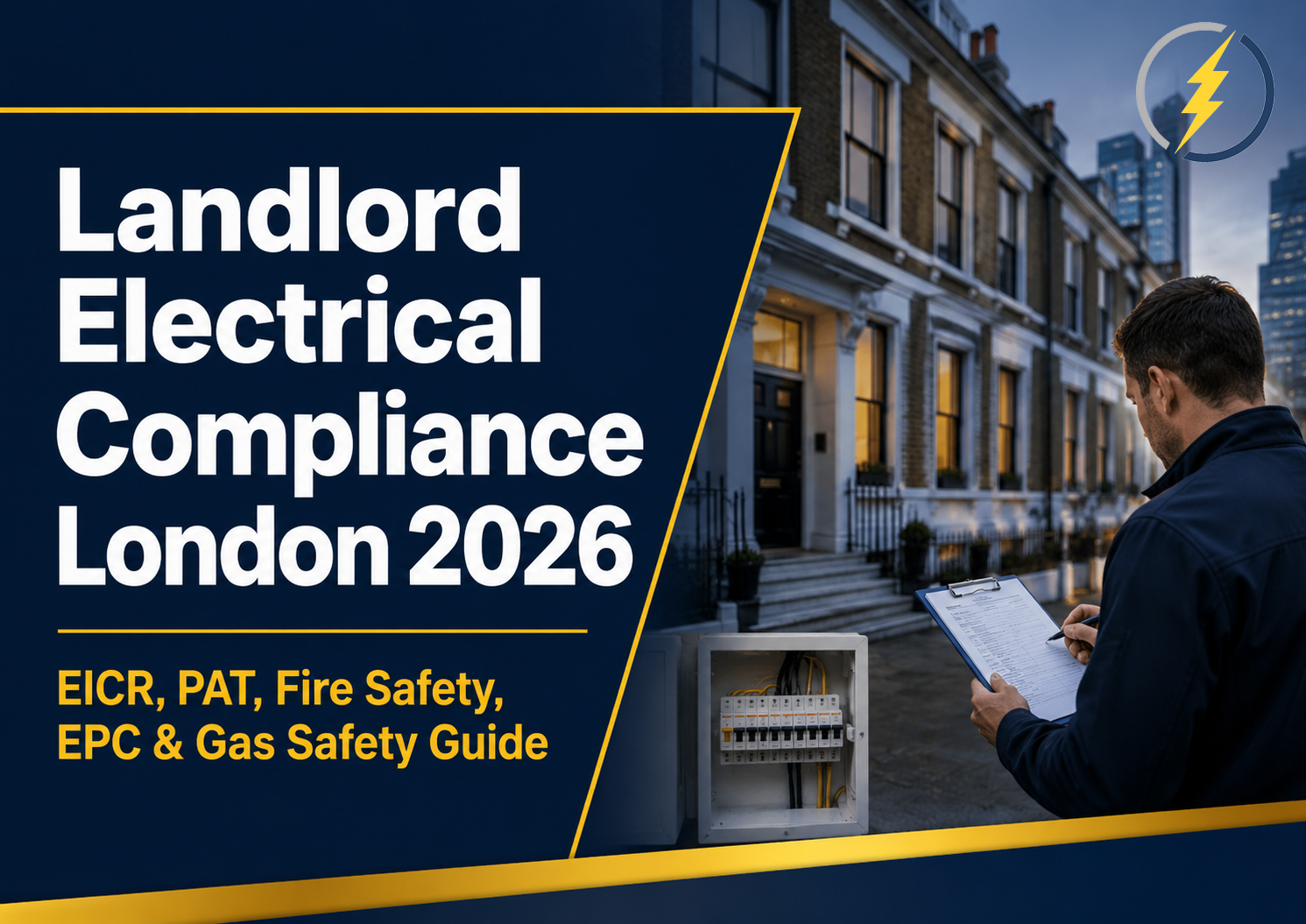
Landlord electrical compliance London 2026 guide covering EICR, PAT testing, fire safety, EPC and gas safety

For London landlords, electrical compliance is no longer something that can be treated as a last-minute admin task before a tenant moves in. In 2026, landlords, letting agents and property managers are expected to keep proper records, understand inspection dates, deal quickly with failed reports and prove that rental properties are safe.

Most landlords know they need an EICR certificate. Fewer landlords understand how that EICR fits into the wider compliance picture, including PAT testing, gas safety certificates, fire safety duties, EPC rules, MEES requirements and HMO licensing conditions.

This guide explains the main landlord compliance checks London property owners need to understand in 2026, with a particular focus on electrical safety, EICR certificates and practical booking steps. If you own or manage a rental flat, HMO, serviced apartment, commercial unit or portfolio of properties in London, this article will help you see what needs checking, when to book it and where mistakes usually happen.

At London EICR Certificates, we help landlords, homeowners, letting agents and businesses arrange professional electrical safety inspections across London. You can learn more about our EICR certificates for landlords in London, check our EICR certificate cost guide or book your EICR inspection online when you are ready.

What landlord electrical compliance means in London in 2026

Landlord electrical compliance means making sure the fixed electrical installation in a rental property is safe, correctly inspected and properly documented. The main document used for this is the Electrical Installation Condition Report, commonly known as an EICR.

An EICR is not just a certificate. It is a technical inspection report that assesses the condition of the electrical installation, including consumer units, circuits, earthing, bonding, sockets, switches, lighting points, protective devices and visible safety risks. The final result is normally marked as either satisfactory or unsatisfactory.

For landlords, this matters because an unsatisfactory report may mean the property has issues that need remedial work before it can be considered electrically safe. Common failed EICR issues include:

• Missing RCD protection
• Damaged sockets or accessories
• Exposed live parts
• Missing main bonding
• Incorrect circuit labelling
• Signs of overheating
• Poor earthing or high impedance readings
• Unsafe consumer unit condition
• Borrowed neutrals or circuit faults
• Bathroom fittings not suitable for the zone

If your rental property needs an inspection, our EICR services in London explain how the process works and what is normally checked during the visit.

The main compliance certificates London landlords should know

A London landlord may need several different certificates or checks depending on the property type, tenancy, appliances, heating system and building use.

Here is the basic landlord compliance map:

Compliance area What it checks Typical relevance for landlords
EICR certificate Fixed electrical installation Rental flats, houses, HMOs, commercial units
PAT testing Portable electrical appliances supplied by landlord Furnished rentals, HMOs, serviced accommodation
Gas safety certificate Gas appliances, flues and pipework Properties with gas boilers, gas cookers or gas fires
EPC Energy performance rating Letting, selling and MEES compliance
Fire safety checks Alarms, escape routes, fire doors, furnishings Rental properties, HMOs, blocks and commercial spaces
Emergency lighting testing Backup lighting in escape routes Commercial units, HMOs, communal areas
Remedial electrical work Fixes after failed EICR Required when report is unsatisfactory

The mistake many landlords make is dealing with these one by one, only when an agent, tenant, council or buyer asks. A better approach is to run a compliance calendar with expiry dates and evidence stored for each property.

This is especially important for portfolio landlords and letting agents managing multiple London properties. If one property has a missing EICR, expired gas certificate or outdated EPC, the issue can delay a tenancy, cause a failed compliance check or create problems during a property sale.

EICR certificates for rental properties

An EICR certificate is one of the most important electrical safety documents for landlords. It checks whether the fixed electrical installation is safe for continued use.

For a normal rental flat or house, the inspection usually covers:

• Consumer unit and protective devices
• Earthing and bonding
• Circuit condition
• Socket outlets and switches
• Lighting circuits
• RCD protection
• Signs of overheating or damage
• Electrical safety risks around bathrooms, kitchens and utility areas
• Labelling and accessibility of circuits
• Test results recorded by the electrician

A landlord should not assume the property will automatically pass because there have been no tenant complaints. Many serious electrical issues are hidden until testing is carried out. For example, a property can look tidy but still fail because of poor earthing, missing bonding, reversed polarity, faulty RCD protection or unsafe consumer unit condition.

For a dedicated landlord-focused explanation, use our EICR certificates for landlords in London page. If you are comparing prices, our EICR certificate cost in London page explains how property size, access, number of circuits and type of premises can affect the final cost.

What happens if an EICR fails?

A failed EICR does not always mean the property needs a full rewire. It means the electrician has found one or more issues that make the report unsatisfactory. The next step is to review the observations and arrange suitable remedial work.

EICR observations are usually coded. The most important codes are:

• C1: Danger present. Immediate action required.
• C2: Potentially dangerous. Urgent remedial action required.
• FI: Further investigation required.
• C3: Improvement recommended, but not normally a fail on its own.

A report with C1, C2 or FI observations is usually unsatisfactory. A report with only C3 observations may still be satisfactory, depending on the inspection findings.

Typical remedial works after a failed EICR can include replacing damaged sockets, improving bonding, fitting RCD protection where required, replacing unsafe consumer unit parts, correcting circuit faults, fixing exposed live parts or further testing unknown circuit issues.

If your property fails, our remedial work for failed EICR certificates page explains how we help landlords move from failed report to compliant electrical condition.

PAT testing for landlords

PAT testing stands for Portable Appliance Testing. It is different from an EICR.

An EICR checks the fixed electrical installation. PAT testing checks portable appliances, such as kettles, microwaves, fridges, lamps, extension leads and other electrical equipment supplied by the landlord.

PAT testing is especially useful for:

• Furnished rental properties
• HMOs
• Serviced accommodation
• Airbnb and short-term lets
• Student accommodation
• Staff accommodation
• Commercial rental units where appliances are supplied
• Properties where appliances are heavily used by multiple occupants

For example, if a landlord supplies a furnished flat in Canary Wharf with a fridge freezer, washing machine, microwave, kettle and lamps, the fixed wiring may be covered by the EICR, but those portable appliances are a separate safety concern. PAT testing gives a clearer record that the supplied appliances have been visually checked and tested.

For landlords who provide appliances, a sensible approach is to keep PAT testing in the same compliance folder as the EICR, gas safety certificate and EPC.

You can link this article internally to your PAT service using PAT testing in London so visitors looking for appliance safety can move from information to booking.

EPC rules and MEES compliance

An EPC, or Energy Performance Certificate, rates a property’s energy efficiency. For landlords, EPC compliance matters because a property may need a valid EPC before being let, and minimum energy efficiency standards can affect whether a property can legally be rented.

Electrical compliance and EPC compliance are separate, but they often become connected during property management. A landlord preparing a property for a new tenancy may need to check the EICR, EPC, gas safety certificate, smoke alarms and appliance safety at the same time.

Common EPC and MEES issues for landlords include:

• Old or inefficient heating systems
• Poor insulation
• Single glazing
• Inefficient lighting
• Poor ventilation strategy
• Old electric heating
• Missing documentation for improvements
• EPC rating too low for rental requirements

For London landlords with older Victorian, Edwardian or converted flats, EPC improvements can become more complicated because of leasehold restrictions, listed building considerations or limited space for upgrades.

Although London EICR Certificates focuses mainly on EICR inspections, electrical testing and remedial work, the key business point for landlords is simple: do not treat certificates separately. Build a proper pre-tenancy compliance checklist so nothing is missed before marketing the property.

Gas safety certificates

A gas safety certificate is required where a rental property has gas appliances, such as a gas boiler, gas hob, gas fire or gas water heater. This is separate from the EICR.

The gas safety check should be carried out by a Gas Safe registered engineer. It checks whether gas appliances, flues and relevant pipework are safe. Landlords also need to keep records and provide the certificate to tenants within the required timescales.

The most common landlord mistake is assuming that because the boiler was serviced, everything is covered. A boiler service and a landlord gas safety record are connected but not always identical in purpose. Landlords should make sure they are asking for the correct landlord gas safety certificate and keeping the paperwork.

From a practical property-management point of view, gas safety and EICR should be tracked together, especially before a new tenancy starts. If the gas safety certificate is valid but the EICR is missing, the property may still have a compliance gap. If the EICR is satisfactory but the gas safety certificate has expired, there is still a separate issue.

Fire safety duties for landlords

Fire safety is another major part of landlord compliance. It can include smoke alarms, carbon monoxide alarms, escape routes, fire doors, furniture safety and additional requirements for HMOs or flats with communal areas.

For a standard rental property, landlords should think about:

• Smoke alarms on required storeys
• Carbon monoxide alarms where required
• Clear escape routes
• Safe electrical installation
• Safe supplied appliances
• Fire-safe furnishings where supplied
• No overloaded extension leads
• No unsafe DIY wiring
• Clear access to consumer units
• Tenant awareness of basic safety points

For HMOs, blocks of flats and commercial premises, fire safety can become more complex. Additional checks may include emergency lighting, fire alarm systems, fire doors, compartmentation, signage and fire risk assessments.

Electrical safety plays directly into fire risk. Overloaded sockets, damaged cables, overheating consumer units and poor circuit protection can all increase risk. This is why EICR testing should not be seen as paperwork only. It is part of a wider fire-prevention strategy.

For commercial landlords or businesses, connect this section to your Commercial EICR Certificates in London page.

HMO compliance and higher-risk rental properties

HMOs are usually higher risk than standard single-family rentals because more people use the property, more appliances are plugged in, and communal areas are used daily. A five-bedroom HMO with multiple tenants will normally place more pressure on the electrical installation than a one-bedroom flat occupied by one person.

HMO landlords should pay particular attention to:

• Consumer unit capacity
• Socket availability in bedrooms and communal areas
• Extension lead use
• Kitchen appliance load
• Emergency lighting
• Fire alarm systems
• Communal area lighting
• Earthing and bonding
• Tenant access to the consumer unit
• Appliance testing records
• Council licensing requirements

Case study example: A landlord in North London owns a five-bedroom HMO. The property has a valid gas certificate and an EPC, but the EICR identifies damaged accessories, missing RCD protection and overloaded circuits in the kitchen. The report is unsatisfactory. The landlord cannot solve the issue by simply filing the report away. They need remedial work, updated records and a clear audit trail showing that the issues were addressed.

If you already have an HMO page, this blog should internally link to it using anchor text such as “HMO EICR certificates in London” or “electrical safety checks for HMOs”.

Landlord compliance checklist before a new tenant moves in

Before a new tenant moves in, landlords should complete a simple compliance check. This prevents delays, avoids back-and-forth with agents and reduces the chance of missing an important document.

Use this checklist:

• Confirm the EICR is valid and satisfactory
• If the EICR is unsatisfactory, arrange remedial work and obtain evidence
• Check whether PAT testing is needed for supplied appliances
• Confirm gas safety certificate is valid if gas appliances are present
• Confirm EPC is valid and meets rental requirements
• Check smoke alarms are installed and working
• Check carbon monoxide alarms where required
• Review fire doors and escape routes where relevant
• Confirm the property address and certificate name are correct
• Keep digital copies of certificates
• Give required documents to the tenant or agent
• Record the next expiry date for each certificate

This is especially important in London because access can be difficult. Tenants, agents, concierge teams, parking, congestion charge zones and keys can all delay inspections. If the property is tenant-occupied, provide the access contact clearly before booking.

When booking with us, landlords can use our Book Online page or complete the required booking details through our EICR terms acceptance page.

Case study 1: The flat that looked safe but failed the EICR

A landlord in West London had a two-bedroom flat that looked well maintained. The tenant had never reported electrical issues. The sockets worked, the lights worked and the consumer unit did not appear damaged.

During the EICR inspection, the electrician found issues with circuit protection and bonding. The report was unsatisfactory because the installation did not meet the required safety standard for continued use.

The landlord was surprised because there had been no obvious warning signs. This is common. EICR testing is not just a visual check. It includes technical testing that can identify faults a tenant would not notice.

The practical lesson: do not wait for visible damage before arranging an electrical safety inspection. A property can look clean and still have hidden electrical risks.

Case study 2: The furnished rental with no appliance records

A landlord in East London supplied a furnished rental flat with a fridge, washing machine, microwave, kettle and several lamps. The EICR was satisfactory, but there was no record of appliance safety checks.

The letting agent asked for evidence that the supplied appliances were safe. The landlord then arranged PAT testing to create a clearer compliance record.

The practical lesson: an EICR does not cover portable appliances. If you supply appliances, PAT testing can help reduce risk and improve your paperwork.

Case study 3: The portfolio landlord with mixed certificate dates

A portfolio landlord had eight rental properties across London. Each property had different certificate expiry dates. Some EICRs were valid, one gas safety certificate was close to expiry, one EPC needed checking, and two furnished properties had no recent PAT testing.

This created unnecessary stress every time a tenancy changed. The solution was to build a simple compliance schedule with expiry dates, access contacts and document links.

The practical lesson: landlords with multiple properties should treat compliance like asset management, not paperwork. One missed certificate can delay a tenancy or create avoidable risk.

How much does landlord electrical compliance cost?

Costs depend on property size, number of circuits, location, parking, access, appliance count and whether remedial work is required.

For EICR certificates, the main price factors are:

• Number of bedrooms
• Property type, such as flat, house, HMO or commercial unit
• Number of consumer units
• Number of circuits
• Whether the property is occupied
• Parking and congestion zone costs
• Access complexity
• Whether out-of-hours attendance is needed
• Whether remedial work is required after inspection

A small one-bedroom flat is normally quicker to inspect than a large HMO or commercial premises with multiple distribution boards. A property with one modern consumer unit is usually simpler than a property with old wiring, multiple boards and poor labelling.

For more detail, link readers to your EICR certificate cost guide. If a landlord wants to estimate the cost of inspection before booking, they can also use your EICR price tools where relevant.

Why London landlords should not leave EICR booking until the last minute

Last-minute EICR bookings are common in London. A tenant is moving in, an agent requests the report, a sale is progressing, or a council asks for evidence. The problem is that an EICR can fail.

If the report is unsatisfactory, the landlord may then need:

• A remedial quote
• Tenant access for the repair visit
• Parts ordered
• Follow-up testing
• An updated certificate or confirmation of remedial completion
• Evidence for the agent, tenant or council

This is why landlords should book early. If the inspection passes, the process is simple. If it fails, there is still time to fix the issue before the tenancy or deadline becomes urgent.

For urgent situations, use internal links to your emergency and fast-booking posts where relevant. For standard bookings, push users towards book your EICR inspection online.

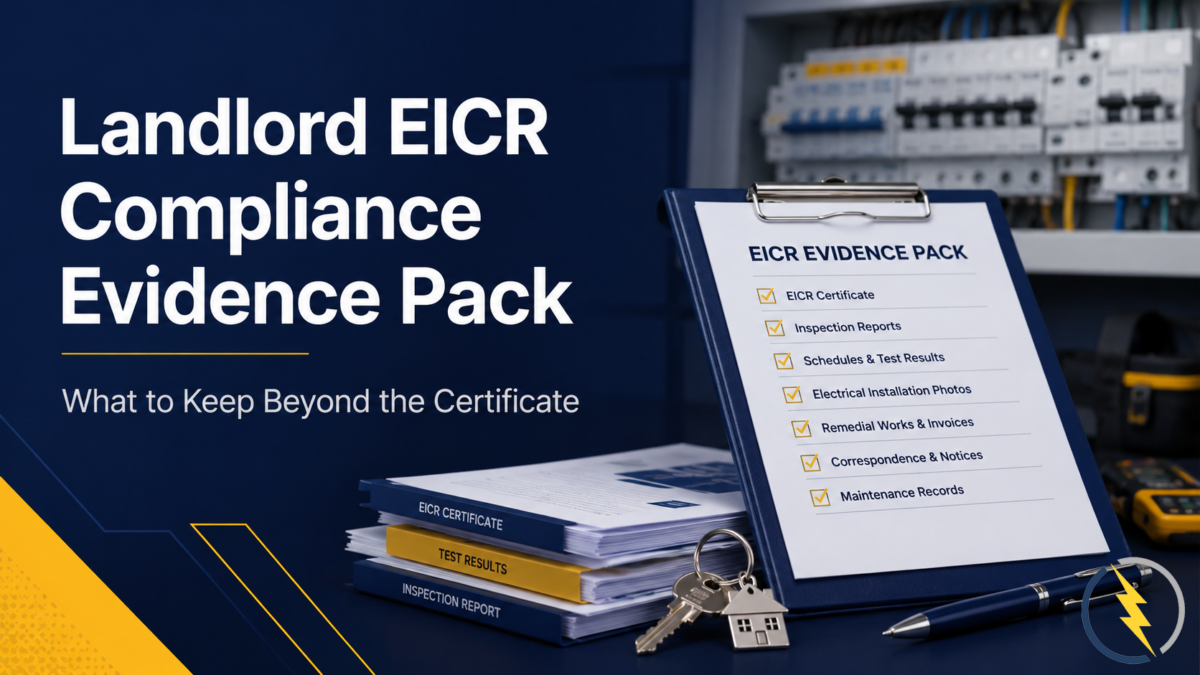
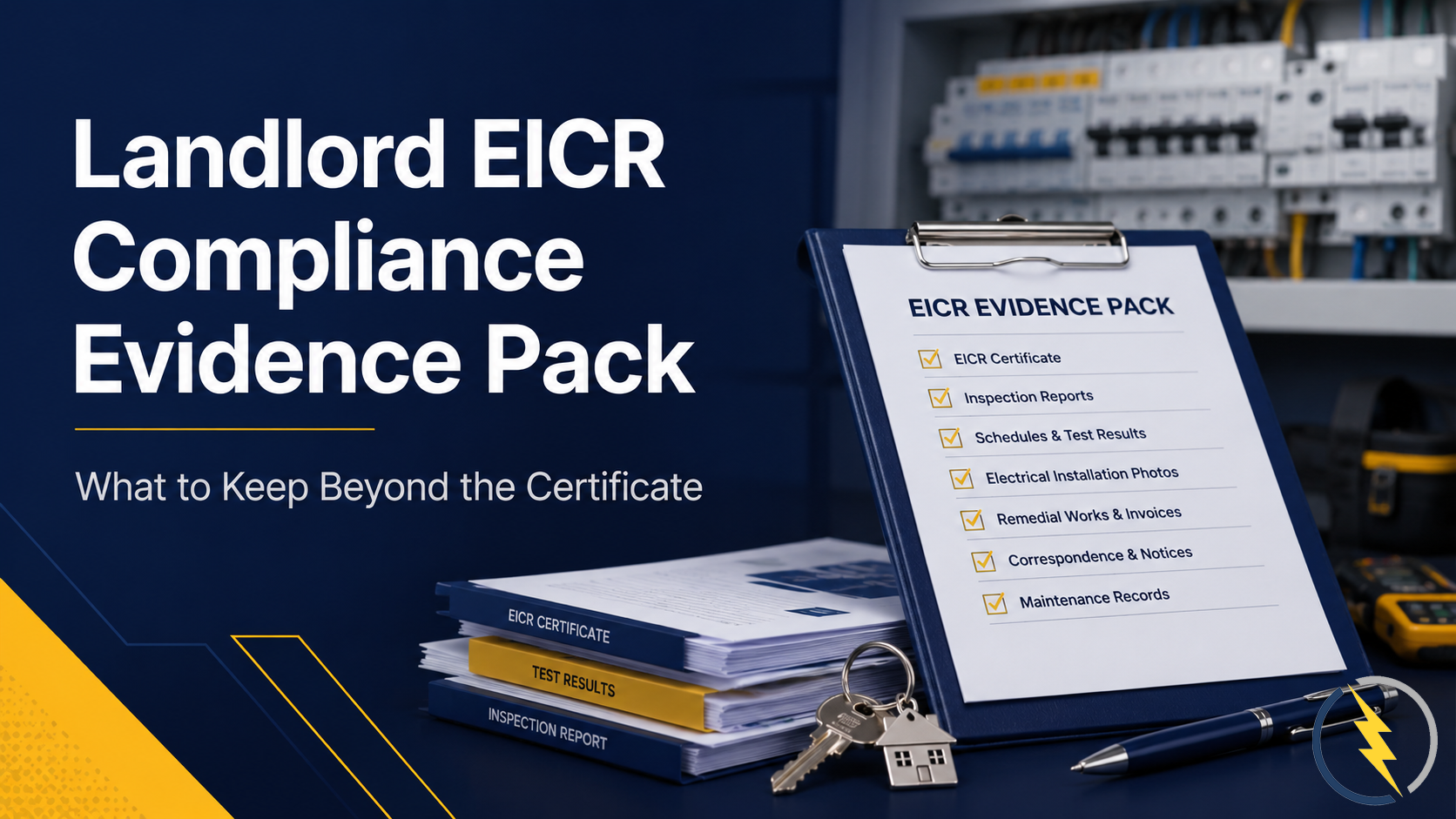
What documents should landlords keep?

Landlords should keep a clear compliance folder for each property. This can be a Google Drive folder, Dropbox folder, property management software folder or local digital file. The main point is that the documents must be easy to find when needed.

A strong landlord compliance folder should include:

• Latest EICR report
• Remedial work evidence, if the EICR was previously unsatisfactory
• Gas safety certificate, if relevant
• EPC certificate
• PAT testing records, if appliances are supplied
• Smoke alarm and carbon monoxide alarm check notes
• Fire safety records, if relevant
• HMO licence documents, if relevant
• Tenant access notes
• Contractor invoices
• Next renewal dates

For letting agents, this system is even more important. Agents need to respond quickly when tenants, landlords or councils request documents.

How London EICR Certificates can help

London EICR Certificates provides professional EICR inspections and electrical safety reports across London. We help landlords, homeowners, letting agents, property managers and businesses arrange fixed-price electrical inspections with clear booking details and straightforward communication.

Our services include:

• EICR certificates for landlords
• EICR certificates for homeowners
• Commercial EICR inspections
• EICR testing in London
• Electrical safety reports
• Failed EICR remedial work
• PAT testing in London
• Help with urgent or tenant move-in inspections
• Electrical compliance support for property managers and agents

If you need an inspection for a rental property, start with our EICR certificates for landlords in London page. For general inspection information, visit our EICR services in London. If the property is commercial, use our Commercial EICR Certificates in London page.

Final landlord compliance advice for 2026

The best landlords do not wait until something goes wrong. They keep certificates organised, book inspections before deadlines, respond quickly to failed reports and understand that EICR, PAT, gas safety, EPC and fire safety are connected parts of the same compliance system.

For London rental properties, the most important electrical safety step is making sure the fixed installation is inspected by a qualified person and that any failed EICR observations are handled properly. A satisfactory EICR gives landlords, tenants and agents more confidence that the property is electrically safe for continued use.

If your EICR is due, your tenant is moving in, your agent is requesting compliance documents or your property has failed a previous inspection, London EICR Certificates can help you move quickly and keep the process clear.

Book your inspection through our Book Online page or visit our EICR certificate cost page to understand typical pricing before booking.

Landlord Compliance FAQs

Landlord Electrical Compliance London 2026 FAQs

Clear answers for London landlords, letting agents and property managers arranging EICR certificates, PAT testing, EPC checks, fire safety records and gas safety certificates.

Do London landlords need an EICR certificate in 2026?

Yes. London landlords need to make sure the fixed electrical installation in a rental property is safe and properly inspected. The standard document used for this is an Electrical Installation Condition Report, usually called an EICR.

An EICR checks the wiring, consumer unit, circuits, earthing, bonding, sockets, switches and other fixed electrical parts of the property. If the report is satisfactory, it gives the landlord a clearer record that the electrical installation is suitable for continued use.

Is PAT testing the same as an EICR?

No. PAT testing and EICR testing are different. An EICR checks the fixed electrical installation, while PAT testing checks portable electrical appliances supplied by the landlord.

For example, an EICR may check the sockets and circuits, but PAT testing may check appliances such as kettles, microwaves, lamps, washing machines, fridges and extension leads.

Should furnished rental properties have PAT testing?

PAT testing is strongly recommended where a landlord supplies electrical appliances. This is especially important for furnished flats, HMOs, serviced accommodation, student lets and properties where multiple tenants use the same appliances.

It helps landlords keep better safety records and shows that supplied appliances have been checked, not just the fixed wiring.

What happens if my rental property fails the EICR?

If your EICR is unsatisfactory, the report will usually include one or more C1, C2 or FI observations. These indicate danger, potential danger or the need for further investigation.

The landlord should arrange suitable remedial work or further testing, then keep evidence that the issue has been corrected. A failed EICR does not always mean the property needs a full rewire, but it does mean the issue should not be ignored.

Can a property pass an EICR with C3 observations?

Yes, a property can often still receive a satisfactory EICR if the only observations are C3 improvement recommendations. A C3 means improvement is recommended, but it is not normally treated as an immediate fail on its own.

C1, C2 and FI observations are more serious and usually make the report unsatisfactory.

Do landlords need a gas safety certificate as well as an EICR?

Yes, if the rental property has gas appliances, a landlord will usually need a landlord gas safety certificate as well as an EICR. These are separate checks carried out by different types of qualified professionals.

The EICR covers the fixed electrical installation. The gas safety certificate covers gas appliances, flues and relevant gas pipework.

Do landlords need an EPC before renting a London property?

In most cases, landlords need a valid Energy Performance Certificate before letting a property. The EPC gives the property an energy efficiency rating and is connected to minimum energy efficiency standards.

EPC compliance is separate from electrical safety compliance, but landlords should manage both as part of the same pre-tenancy compliance checklist.

What fire safety checks should London landlords consider?

Landlords should consider smoke alarms, carbon monoxide alarms where required, safe escape routes, safe electrical installations, supplied appliance safety and fire-safe furnishings where applicable.

HMOs, blocks of flats and commercial premises may need extra fire safety measures such as emergency lighting, fire alarm systems, fire doors, signage and fire risk assessments.

How long does an EICR inspection take?

The inspection time depends on the size and complexity of the property. A small flat with one consumer unit is normally quicker than a large house, HMO, commercial unit or property with multiple boards and many circuits.

Access, parking, tenant availability and circuit labelling can also affect how smoothly the inspection runs.

How can I book an EICR certificate in London?

You can book an EICR inspection by providing the property address, certificate name, access contact, property type, number of bedrooms and preferred appointment window.

London EICR Certificates provides EICR inspections for landlords, homeowners, letting agents, property managers and commercial premises across London.

Need an EICR certificate for a London rental property?

Book a fixed-price electrical safety inspection with London EICR Certificates and get clear reporting for landlords, agents and property managers.

Book Your EICR Inspection Online

Please Submit Details Below

For your convenience, you can also fill out our online contact form below. Please provide as much detail as possible, and a member of our team will get back to you promptly.
Select Certificate Type:
Tags :
EICR Certificates,EICR Inspection
Share This :

EICR for Care Homes, Supported Living & Healthcare Properties in London

Are you a homeowner, landlord, or business owner in London? Ensuring the safety and compliance of your property’s electrical installations is crucial, and that’s where an Electrical Installation Condition Report (EICR) certificate comes in. But, how do you obtain one? Our step-by-step guide provides all the information you need to follow to get your EICR certificate. From finding a qualified electrician to scheduling the inspection and addressing any issues highlighted in the report, our guide covers everything you need to know. Don’t risk the safety of your property – read our guide and obtain your EICR certificate today!

Compliance and Regulations,EICR Certificates,EICR Faults & Failures,EICR Guide,Property Management,Tenant Safety

EICR for Care Homes, Supported Living & Healthcare Properties in London

Home / Archive by category "EICR Certificates"
EICR for care homes supported living and healthcare properties in London

Care homes, supported living properties and healthcare premises have a much higher duty of care than a standard residential property. These buildings are not just places where people sleep. They are occupied, managed and relied upon every day by residents, staff, visitors, carers, contractors and, in many cases, people who may be vulnerable, elderly, disabled or medically dependent.

That is why an Electrical Installation Condition Report, commonly known as an EICR, should never be treated as a basic tick-box certificate for this type of property.

If you manage a care home, supported living accommodation, assisted living property, private healthcare clinic, dental practice, therapy centre or similar healthcare premises in London, your electrical installation needs to be safe, properly maintained and suitable for the way the building is used. A professional EICR helps identify electrical risks before they become dangerous, disruptive or expensive.

At London EICR Certificates, we provide professional EICR services in London for residential, landlord and commercial properties, including higher-risk buildings where access, occupancy and compliance must be managed carefully. This guide explains what care home and healthcare property operators need to know in 2026, including what an EICR checks, common failures, costs, preparation, remedial work and how to book a compliant inspection.

Why EICRs Matter for Care Homes, Supported Living and Healthcare Properties

An EICR is important for every property, but it is especially important where the people inside the building may not be able to react quickly in an emergency.

In a care home or supported living property, electrical issues can create serious risks. A damaged socket in a resident’s room, an overloaded circuit in a laundry area, poor RCD protection in a bathroom zone or a poorly labelled distribution board can all become major problems if ignored.

These properties also tend to have heavier electrical usage than normal homes. A typical care or supported living setting may include:

• Resident bedrooms with multiple electrical appliances
• Communal lounges and dining rooms
• Commercial or semi-commercial kitchens
• Laundry rooms with high-load equipment
• Assisted bathing areas
• Nurse call systems
• Office and admin areas
• External lighting
• Fire alarm panels and emergency systems
• Mobility equipment charging points
• Medical or care-related equipment
• Plant rooms and distribution boards

This means the electrical installation is often under constant demand. Even where the property looks clean and well managed, hidden electrical defects can exist behind sockets, inside distribution boards, above ceilings or within older circuits.

A properly completed EICR gives the duty holder, manager or property owner a clear written report showing whether the installation is satisfactory or whether remedial work is required.

What Is an EICR for a Care Home or Healthcare Property?

An EICR is a formal inspection and test of the fixed electrical installation within a property. It is different from PAT testing, which looks at portable appliances. An EICR focuses on the electrical wiring, circuits, consumer units, distribution boards, earthing, bonding and fixed electrical infrastructure.

For care homes, supported living and healthcare properties, the inspection usually needs to be more carefully planned than a standard flat or small rental property. Access must be arranged properly, disruption must be reduced, and the electrician must understand that residents or patients may be present during the inspection.

During the inspection, a qualified electrician will usually check areas such as:

• Main incoming electrical supply
• Consumer units and distribution boards
• Circuit protection devices
• RCD protection
• Earthing and bonding arrangements
• Socket outlets
• Lighting circuits
• Bathroom and wet-room electrical safety
• Kitchen and laundry circuits
• Signs of overheating or thermal damage
• Circuit labelling and identification
• Previous alterations or additions
• Electrical accessories in resident or patient areas
• Insulation resistance and continuity
• Polarity and earth fault loop impedance

The final EICR report will usually classify observations using codes such as C1, C2, C3 or FI.

A C1 means danger is present and immediate action is required. A C2 means potentially dangerous and normally makes the report unsatisfactory. FI means further investigation is needed and also usually results in an unsatisfactory report until resolved. A C3 means improvement is recommended but does not normally make the report unsatisfactory by itself.

For care homes and healthcare premises, even a “small” electrical defect should be reviewed seriously because the use of the building increases the consequences of failure.

Is an EICR Required for Care Homes and Supported Living Properties in London?

The exact legal position depends on the property type, ownership structure, tenancy arrangement and how the building is operated.

For example, a supported living property used as rented accommodation may fall under landlord electrical safety duties. A care home or healthcare premises may also have wider duties under health and safety obligations, insurance requirements, CQC-related expectations, fire risk management and workplace safety responsibilities.

In practice, most responsible operators treat a valid EICR as an essential compliance document.

This is especially important where the property is:

• Used by vulnerable residents
• Registered or inspected as a care environment
• Operated by a company, charity, housing provider or care provider
• Occupied by staff as a workplace
• Used for supported accommodation
• Subject to insurance compliance checks
• Managed by a landlord, housing association or property company
• Due for sale, lease, refinancing, audit or inspection

If you operate this type of building in London, you should not wait until there is an incident, insurance query or inspection request before checking the electrical installation. A planned EICR is usually cheaper, safer and less disruptive than an emergency inspection after a problem has already occurred.

For businesses and care providers that need a formal commercial electrical safety inspection, our Commercial EICR Certificates in London service is the most relevant starting point.

What Does an EICR Inspection Check in a Care Home or Healthcare Building?

A care home or healthcare EICR is not only about checking whether the lights turn on. The inspection looks at whether the fixed electrical installation is safe for continued use.

The electrician will assess the condition of circuits and protective devices, but also how suitable the installation is for the building’s current use. This matters because many London properties have changed use over time. A converted townhouse may now be a supported living property. A former office may now be a clinic. A residential building may have been adapted into assisted living accommodation.

In these cases, the electrical installation may have been altered several times by different contractors over many years. That is where problems often appear.

Common checks include:

• Whether distribution boards are accessible and safely enclosed
• Whether circuits are correctly labelled
• Whether RCD protection is present where required
• Whether socket outlets are damaged, loose or overloaded
• Whether circuits show signs of overheating
• Whether bathroom and wet-room electrics are suitable
• Whether main protective bonding is present and adequate
• Whether older wiring shows signs of deterioration
• Whether previous additions were installed safely
• Whether any exposed live parts or missing blanks exist
• Whether the earthing arrangement is safe
• Whether test results are within acceptable limits

In larger care homes or healthcare properties, the inspection may need to be completed in phases. Some testing may involve temporary circuit isolation, so planning is important. The goal is to complete the inspection properly while keeping disruption to residents, patients and staff as low as possible.

Common Electrical Risks Found in Care Homes and Supported Living Properties

Care homes, supported living and healthcare premises often have recurring electrical risks because of the way the buildings are used.

One of the most common issues is damaged socket outlets. In resident rooms, lounges and staff areas, sockets may be used constantly for chargers, TVs, medical devices, cleaning equipment and daily appliances. Over time, sockets can become loose, cracked or overheated.

Another common issue is poor circuit labelling. In an emergency, staff or contractors need to know which circuit controls which area. If a distribution board is badly labelled, old, handwritten or incorrect, safe isolation becomes harder and fault finding takes longer.

Older consumer units and distribution boards can also cause problems. Some older boards may have missing blanks, poor enclosure integrity, mixed components, weak labelling or limited RCD protection. In a normal property this is already a concern. In a care setting it becomes more serious because safe operation and quick response matter.

Other common EICR failures include:

• Missing or inadequate RCD protection
• No main protective bonding or undersized bonding
• Damaged accessories in resident rooms
• Overloaded kitchen or laundry circuits
• Poor insulation resistance readings
• High earth fault loop impedance readings
• Loose connections inside distribution boards
• Signs of overheating
• Incorrect polarity
• Exposed conductors
• Unsuitable fittings in bathroom or wet areas
• Poorly completed previous alterations
• Extension leads used as permanent solutions
• Old wiring with deteriorated insulation
• Unclear separation between residential and commercial circuits

If your property has already failed an EICR or you have received an unsatisfactory report, we can also help with EICR remedial work after the inspection has been completed and the defects are clearly identified.

How Often Should Care Homes and Healthcare Premises Have an EICR?

The inspection frequency depends on the type of premises, the use of the building, the condition of the installation, the previous report recommendation and the risk profile of the property.

A care home or healthcare property is usually considered higher risk than a standard domestic home because it may be occupied 24/7, used by vulnerable people, operated as a workplace and subject to stronger compliance expectations.

The previous EICR should state the recommended date for the next inspection. However, operators should also consider arranging an earlier inspection if:

• The property has changed use
• New residents or tenants are moving in
• The building has had electrical alterations
• There has been water damage or a leak
• There have been repeated tripping issues
• Sockets or circuits show signs of damage
• There is no previous EICR available
• The current certificate is expired
• The property is being audited, sold or refinanced
• An insurer, landlord, managing agent or compliance officer requests one

For supported living providers and care operators managing several properties, the best approach is to keep an EICR register with expiry dates, inspection notes, remedial status and next action dates. This helps avoid last-minute panic when a certificate is requested.

EICR Cost for Care Homes and Supported Living Properties in London

The cost of an EICR for a care home, supported living property or healthcare premises in London depends on the size and complexity of the building.

A small supported living house with a single consumer unit will usually cost less than a larger care home with multiple distribution boards, three-phase supply, communal areas, commercial kitchen circuits, laundry equipment and plant rooms.

The main pricing factors include:

• Number of circuits
• Number of distribution boards
• Single-phase or three-phase supply
• Size of the property
• Number of bedrooms or resident rooms
• Access requirements
• Whether the property is occupied
• Whether out-of-hours inspection is required
• Whether previous reports are available
• Whether testing needs to be phased
• Whether parking or congestion charges apply
• Whether urgent turnaround is needed

For a clear overview of general EICR pricing, you can visit our EICR certificate cost page. For care homes and healthcare premises, we normally recommend sending the property details first so the inspection can be priced properly.

Useful details include:

• Full property address
• Property type
• Number of bedrooms or resident rooms
• Number of floors
• Number of distribution boards
• Whether the supply is single-phase or three-phase
• Whether it is occupied
• Any preferred inspection date
• Site contact details
• Any previous EICR if available

This prevents underquoting, delays and confusion on the day of the inspection.

What Happens If a Care Home EICR Is Unsatisfactory?

An unsatisfactory EICR does not automatically mean the property needs a full rewire. It means the inspection has identified one or more issues that make the electrical installation unsuitable for continued use without further action.

The report may include C1, C2 or FI observations. These need to be reviewed and addressed properly.

For care homes and supported living properties, remedial planning is especially important because works may affect residents, staff routines, kitchens, laundry areas, bedrooms or clinical rooms. The work may need to be staged to reduce disruption.

A practical remedial process usually looks like this:

• Review the EICR report
• Identify urgent C1 or C2 risks
• Clarify any FI observations
• Prepare a remedial quotation
• Agree access and working times
• Complete urgent repairs first
• Retest affected circuits where required
• Issue confirmation once defects are resolved
• Keep the report and remedial evidence on file

At London EICR Certificates, we can inspect the property, issue the EICR report and, where required, provide a separate remedial quotation. This is important because the EICR report itself is not a remedial quote. The report identifies the condition of the installation. Remedial pricing is provided after the inspection when the defects are known.

For property managers and operators, this creates a clearer process and avoids guessing costs before the inspection has taken place.

How to Prepare Your Care Home or Supported Living Property for an EICR

Good preparation makes the inspection smoother, faster and less disruptive.

Before the electrician attends, make sure the site contact knows where the main intake position, consumer units and distribution boards are located. If access is restricted, arrange keys or staff assistance in advance.

You should also prepare:

• Previous EICR reports if available
• Electrical installation certificates for recent works
• Access to plant rooms and electrical cupboards
• Access to resident rooms where possible
• Access to kitchens, laundry rooms and communal areas
• A list of known electrical issues
• Details of any sensitive areas
• Best times for inspection
• Site contact name and phone number
• Parking instructions
• Any restrictions around resident care routines

If the property is occupied by vulnerable residents, it may be best to plan the inspection around quieter times of day. For larger buildings, phased inspections may be more practical.

The more information you provide before booking, the easier it is to allocate the correct time and engineer.

If you want a smoother booking process, you can book an EICR online or send the property details to our team so we can advise the best next step.

Case Study Example: Supported Living EICR Inspection in London

A supported living provider in London contacted us because one of their managed properties had no recent EICR available. The property was a converted house used as shared supported accommodation. It had multiple resident bedrooms, communal areas, a kitchen, laundry appliances and staff office space.

The provider needed the inspection completed with minimal disruption because residents were living in the property.

Before attending, we requested the key property details, including the address, number of rooms, access contact and whether previous reports were available. No previous report could be provided, so the inspection had to start from the current condition of the installation.

During the EICR, several issues were identified:

• Poor circuit labelling at the consumer unit
• Loose socket accessories in two rooms
• Limited RCD protection on some circuits
• Signs of overheating on one heavily used circuit
• Missing information about previous alterations
• A damaged external light fitting
• Bonding that required further checking

The report was issued as unsatisfactory because potentially dangerous issues required action. After the inspection, the provider received a remedial quotation. The works were then arranged in a way that avoided unnecessary disruption to residents.

Once the remedial work was completed and the relevant items were retested, the provider had clear documentation showing the inspection, defects, corrective action and improved electrical safety position.

This is the correct approach. For care homes, supported living and healthcare premises, the goal is not just to “get a certificate”. The goal is to identify risk, act responsibly and keep proper evidence.

EICR for Healthcare Properties and Clinics

Healthcare properties can include private clinics, dental practices, therapy rooms, treatment centres and medical consulting spaces. These premises often have electrical equipment, patient areas, staff areas and stricter expectations around safety and maintenance.

An EICR can help identify whether the fixed electrical installation is suitable for continued use. It also supports wider premises management, insurance compliance and health and safety responsibilities.

Healthcare premises may also have areas with higher electrical demand or more sensitive usage, such as treatment rooms, sterilisation areas, reception desks, staff rooms and equipment storage areas.

Common issues in healthcare-style properties include:

• Overloaded sockets in treatment rooms
• Poorly labelled circuits
• Old distribution boards
• Limited RCD protection
• Damaged trunking or accessories
• DIY additions
• Poor separation of circuits
• Electrical cupboards used for storage
• No clear record of previous electrical work

A healthcare property should be inspected by someone who understands both electrical testing and the need to work professionally in occupied premises.

EICR for Supported Accommodation and Social Care Housing

Supported accommodation can sit between residential and commercial use. This makes electrical safety especially important because the duty holder may be a landlord, care provider, housing association, managing agent, charity, company or local authority contractor.

The property may look like a normal house or flat, but the way it is used can create higher risk. There may be more occupants, more appliances, more staff visits and more wear on sockets, switches and circuits.

For supported living providers managing multiple homes across London, a single missed EICR renewal can create a compliance problem. A better system is to maintain a central spreadsheet or compliance tracker showing:

• Property address
• EICR date
• Expiry or next inspection date
• Report status
• Remedial status
• Engineer details
• Certificate file location
• Notes for access or future inspection

This gives management a clear overview and reduces the risk of expired certificates being discovered too late.

Why Choose London EICR Certificates?

London EICR Certificates provides professional electrical inspection services across London for landlords, homeowners, commercial clients and managed properties.

For care homes, supported living and healthcare premises, our service is designed to be practical and organised. We understand that access, communication and planning are just as important as the inspection itself.

We can help with:

• EICR inspections for care homes
• EICR certificates for supported living properties
• Commercial EICR inspections
• EICR reports for healthcare premises
• Electrical safety inspections for managed properties
• Remedial quotations after failed EICRs
• Multi-property booking support
• London-wide coverage
• Clear report handling
• Fast booking process

We also provide helpful resources if you need to understand your report in more detail. If you already have a certificate and are unsure what the codes mean, read our guide on how to read an EICR report.

If you still have questions, our FAQ page covers common EICR questions, booking issues and certificate information.

Book a Care Home, Supported Living or Healthcare EICR in London

If you manage a care home, supported living property or healthcare premises in London, do not leave electrical compliance until the last minute. These buildings carry a higher responsibility because the people using them may be vulnerable, dependent on staff support or unable to respond quickly to electrical danger.

A professional EICR gives you a clear written record of the condition of the fixed electrical installation. If the property is satisfactory, you have evidence. If it is unsatisfactory, you know what needs attention and can arrange remedial action properly.

To request a quote, send us:

• Full property address
• Property type
• Number of bedrooms, treatment rooms or resident rooms
• Number of floors
• Number of consumer units or distribution boards, if known
• Whether the property is occupied
• Site contact details
• Preferred date or time window
• Any previous EICR report, if available

You can start by visiting our EICR services in London page, reviewing our commercial EICR certificate service, or going directly to book your EICR online.

For care homes, supported living and healthcare buildings, electrical safety is not something to guess. Get the inspection completed properly, keep your records in order and deal with issues before they become urgent.

Care Home Electrical Safety

EICR for Care Homes, Supported Living & Healthcare Properties FAQs

Clear answers for care home operators, supported living providers, healthcare premises, facilities managers and property owners who need an EICR certificate in London.

Do care homes in London need an EICR?

Care homes should have a current Electrical Installation Condition Report as part of responsible electrical safety management. The exact requirement can depend on the property type, registration, insurance conditions, tenancy structure and wider health and safety duties, but a valid EICR is strongly recommended because care homes accommodate vulnerable residents and usually have high electrical demand.

Is an EICR required for supported living properties?

In many cases, supported living properties need an EICR because they are used as rented accommodation, managed housing or social care accommodation. Even where the exact legal position depends on the setup, providers should keep a valid EICR to evidence that the fixed electrical installation has been professionally inspected and tested.

How often should a care home have an EICR?

The inspection frequency depends on the previous EICR recommendation, the building use, the condition of the electrical installation and the overall risk profile of the premises. Care homes, supported living properties and healthcare buildings are higher-risk environments because they may be occupied 24 hours a day and used by vulnerable people, so managers should follow the retest date on the report and consider earlier inspection after alterations, leaks, faults or changes of use.

What does an EICR check in a care home or healthcare property?

An EICR checks the fixed electrical installation, including consumer units, distribution boards, circuits, sockets, lighting, earthing, bonding, RCD protection, circuit labelling, polarity, insulation resistance and signs of overheating or damage. In care homes and healthcare premises, particular attention is often given to resident rooms, wet areas, communal spaces, kitchens, laundry areas, staff areas and electrical cupboards.

How much does an EICR cost for a care home in London?

The cost depends on the size of the property, number of circuits, number of distribution boards, whether the supply is single-phase or three-phase, access arrangements, number of resident rooms, parking, congestion zones and whether the inspection must be completed urgently or outside normal working hours. Larger care homes and healthcare premises usually need a tailored quotation.

Can a care home remain open if the EICR is unsatisfactory?

An unsatisfactory EICR means the report has identified issues such as C1, C2 or FI observations that require action. A C1 indicates immediate danger, C2 means potentially dangerous and FI means further investigation is required. The duty holder should take urgent professional advice, arrange remedial work and keep evidence of corrective action. Whether specific areas remain in use depends on the severity and location of the defects.

What are common EICR failures in care homes and supported living properties?

Common failures include damaged sockets, poor circuit labelling, missing RCD protection, overloaded circuits, old consumer units, loose connections, signs of overheating, inadequate bonding, damaged bathroom fittings, high earth loop impedance readings, poor insulation resistance, exposed conductors and unsafe previous electrical alterations.

Do healthcare clinics and dental practices need an EICR?

Healthcare clinics, dental practices and treatment rooms should maintain safe fixed electrical installations. An EICR provides formal evidence that the installation has been inspected and tested. It can support insurance records, health and safety files, property management duties and general compliance expectations for premises used by patients, staff and visitors.

What information is needed to book an EICR for a care home?

To book an EICR for a care home, supported living property or healthcare premises, provide the full property address, property type, number of rooms, number of floors, number of consumer units or distribution boards if known, site contact details, access arrangements, preferred inspection date and any previous EICR report. This helps price and plan the inspection properly.

Can London EICR Certificates complete remedial work after a failed care home EICR?

Yes. London EICR Certificates can provide remedial work support after an unsatisfactory EICR. The inspection report identifies the defects, and a separate remedial quotation can then be prepared. This allows care home operators, supported living providers and healthcare property managers to understand the issues, approve the works and keep evidence of corrective action.

Need an EICR for a care home, supported living property or healthcare premises in London?

Book a professional EICR inspection and get a clear electrical safety report for your care, supported living or healthcare property.

Book Your EICR
```

Please Submit Details Below

For your convenience, you can also fill out our online contact form below. Please provide as much detail as possible, and a member of our team will get back to you promptly.
Select Certificate Type:
Tags :
EICR Certificates,EICR Inspection
Share This :

EICR for Short-Term Lets and Serviced Accommodation in London 2026

Are you a homeowner, landlord, or business owner in London? Ensuring the safety and compliance of your property’s electrical installations is crucial, and that’s where an Electrical Installation Condition Report (EICR) certificate comes in. But, how do you obtain one? Our step-by-step guide provides all the information you need to follow to get your EICR certificate. From finding a qualified electrician to scheduling the inspection and addressing any issues highlighted in the report, our guide covers everything you need to know. Don’t risk the safety of your property – read our guide and obtain your EICR certificate today!

Compliance and Regulations,EICR Certificates,EICR Faults & Failures,EICR Guide,Property Management,Tenant Safety

EICR for Short-Term Lets and Serviced Accommodation in London 2026

Home / Archive by category "EICR Certificates"
EICR guide for short-term lets, Airbnb properties and serviced accommodation in London 2026.

Short-term lets have changed the London property market. A flat in Kensington can operate as an Airbnb during the summer. A Canary Wharf apartment can be used for corporate guests. A converted townhouse in Chelsea can be run as serviced accommodation. A landlord may use one property for long-term tenants during part of the year and short-stay guests during another period.

But one thing has not changed: electrical safety still matters.

If you own, manage or operate a short-term let, Airbnb, holiday rental, serviced apartment or corporate accommodation unit in London, an EICR certificate is one of the most important documents you can have. It protects your guests, supports your insurance position, gives you evidence of due diligence and helps show that the electrical installation has been professionally inspected.

This guide explains what short-term let operators need to know about EICR certificates in London in 2026, when an inspection is needed, what can go wrong, how much it may cost, and how to book the right type of electrical safety inspection for your property.

What Is an EICR Certificate?

An EICR stands for Electrical Installation Condition Report.

It is a formal inspection and test of the fixed electrical installation inside a property. This usually includes the consumer unit, circuits, sockets, lighting, earthing, bonding, protective devices and visible signs of electrical deterioration or unsafe installation work.

An EICR is not the same as a quick visual check. A proper EICR must be carried out by a competent electrical professional using the correct testing equipment. The report will normally classify defects using codes such as:

• C1: Danger present, immediate action required
• C2: Potentially dangerous, urgent remedial action required
• C3: Improvement recommended
• FI: Further investigation required

If a property receives C1, C2 or FI observations, the report is usually classed as unsatisfactory. That means the electrical installation has not passed in its current condition and remedial work may be needed.

For a short-term let or serviced apartment, this matters because guests are not familiar with the property. They may use kitchen appliances, heating controls, sockets, chargers, hairdryers, extension leads and lighting in ways the owner cannot fully control. A safe electrical installation is not optional from a risk-management point of view.

If you need a professional inspection, our main EICR services in London page explains how our inspection and certificate process works.

Do Short-Term Lets Need an EICR in London?

The answer depends on how the property is being used, but in practical terms, most responsible short-term let operators should treat an EICR as essential.

If the property is let as a private rented property, landlords in England are generally expected to have the electrical installation inspected and tested at least every five years, unless the report recommends a shorter interval. For traditional tenancies, the landlord electrical safety rules are clear.

Short-term lets can be more complex because they may fall between residential letting, holiday accommodation, serviced accommodation, corporate housing and commercial operation. However, this does not mean electrical safety can be ignored.

In 2026, the sensible position for London operators is simple:

• If guests, tenants or paying occupants stay in the property, keep a valid EICR.
• If the property is used for Airbnb, Booking.com, serviced accommodation or corporate lets, keep a valid EICR.
• If you manage multiple short-let units, keep an EICR register for every property.
• If the property has had electrical work, water damage, a failed inspection or a change of use, consider a fresh inspection.
• If your current EICR is missing, expired or unsatisfactory, deal with it before accepting more bookings.

This is not only about legal wording. It is about evidence. If there is an incident, complaint, guest injury, insurance claim or council enquiry, the first question is likely to be: what proof do you have that the electrical installation was safe?

For landlords specifically, we recommend reading our dedicated page on EICR certificates for landlords in London.

Short-Term Lets, Airbnb and Serviced Accommodation: What Is the Difference?

The terms often overlap, but from a compliance perspective they are not always the same.

A short-term let usually means a residential property rented to guests for short stays. This may be a full flat, house or individual room.

An Airbnb property is a type of short-term let advertised through Airbnb, although many hosts also list on Booking.com, Vrbo, Expedia, Houst, direct booking websites or property management platforms.

Serviced accommodation usually means a furnished property offered with hotel-style features such as cleaning, linen changes, utilities, Wi-Fi, guest support and flexible stays. These properties are often used by business travellers, contractors, relocation clients, insurance relocation guests or families needing temporary accommodation.

Corporate lets are often used for professionals, project teams, consultants or executives staying in London for weeks or months.

From an electrical safety point of view, all of these property types share the same core risk: people are paying to stay in a property they do not own, do not maintain and do not fully understand. That increases the operator’s responsibility to keep the electrical installation safe, tested and properly documented.

Why EICR Certificates Matter More for Short-Term Lets

Short-term let properties often experience heavier use than normal homes.

A normal tenant may live in a property for years and report issues as they appear. A short-term guest may stay for three nights, use every appliance, overload sockets, move furniture, plug in travel adaptors, use multiple chargers and then leave without reporting minor electrical issues.

This creates several risks.

First, wear and tear happens faster. Sockets, switches, lighting accessories and appliances can be used by many different people every month.

Second, small issues are easier to miss. A loose socket, flickering light, warm plug top or damaged switch may be ignored by guests.

Third, operators often rely on cleaners or property managers to report visible problems. Cleaners can spot obvious damage, but they cannot test circuits, RCDs, earthing or bonding.

Fourth, insurance may be harder to defend if the property is operated commercially but electrical safety records are weak.

Fifth, bad guest reviews can damage revenue. A guest who experiences tripping electrics, faulty sockets or unsafe-looking wiring may leave a public review that reduces booking performance.

An EICR helps reduce these risks by giving you a formal electrical condition report, not just a visual opinion.

London’s 90-Night Rule and Why Compliance Records Matter

In London, entire-home short-term letting is subject to the well-known 90-night rule. If a property is used for short-term letting for more than 90 nights in a calendar year, planning permission may be required.

This rule is separate from electrical safety, but it matters because short-term let activity in London is under increasing scrutiny. Councils, neighbours, managing agents, freeholders and building management companies are paying more attention to how properties are used.

If your property is being operated as short-term accommodation, you should assume your paperwork may be questioned at some point. That paperwork may include:

• EICR certificate
• Gas safety certificate, where relevant
• Fire risk assessment or fire safety records
• PAT testing records, where portable appliances are supplied
• Smoke alarm and heat alarm checks
• Emergency lighting records, where relevant
• Planning or leasehold permissions
• Insurance documents
• Guest safety information
• Maintenance logs

An EICR does not solve planning compliance, lease restrictions or fire safety duties. But it is a key part of a professional compliance file.

If your short-term let is becoming more commercial in nature, you should also review our Commercial EICR Certificates in London page.

Is an EICR the Same as an Electrical Safety Certificate?

Many property owners search for “electrical safety certificate” when they actually need an EICR.

In most rental and short-let situations, the EICR is the document that confirms the condition of the fixed electrical installation. It is commonly called an electrical safety certificate, landlord electrical certificate, EICR certificate or electrical installation condition report.

The wording can be confusing, but the key point is this: you need a proper inspection report, not a casual letter or invoice saying the property “looks safe”.

A professional EICR should clearly show:

• Property address
• Client or certificate name
• Date of inspection
• Details of the electrical installation
• Inspection limitations
• Test results
• Observations and codes
• Overall satisfactory or unsatisfactory outcome
• Inspector details
• Recommended next inspection date

For more detail on reading the report, link internally to our guide on how to read and understand an EICR report.

When Should a Short-Term Let Operator Book an EICR?

You should book an EICR before guests occupy the property if you do not already have a valid satisfactory report.

You should also consider booking one in the following situations:

• You are launching a new Airbnb or serviced apartment.
• You have taken over management of an existing short-term let.
• The current EICR is expired or missing.
• The previous report was unsatisfactory.
• Electrical remedial work has recently been completed.
• The consumer unit has been changed.
• There has been water damage, a leak or damp near electrics.
• Guests have reported tripping circuits, burning smells or flickering lights.
• You are switching from long-term rental to short-term letting.
• You are preparing compliance documents for an agent, freeholder or insurer.
• You are managing several properties and need consistent records.

A short-term let is a customer-facing property. Do not wait for a guest complaint before checking the electrics.

Case Study 1: Airbnb Flat in Central London With Repeated Tripping

A host in Central London was operating a one-bedroom Airbnb flat. The property had strong occupancy and good reviews, but guests repeatedly complained that the power tripped when the kettle, heater and microwave were used together.

At first, the host assumed it was normal because the property was old. The cleaner reset the consumer unit several times between stays. Eventually, a guest left a review saying the electrics felt unsafe.

An EICR inspection found overloaded circuits and issues at the consumer unit. The report was unsatisfactory and remedial work was needed before the operator could confidently continue accepting bookings.

The business lesson is clear: electrical problems affect revenue. One visible safety issue can damage guest confidence, review score and future booking conversion.

Case Study 2: Serviced Apartment Operator With Multiple Units

A serviced accommodation operator managed eight flats across East London and Canary Wharf. Some properties had EICRs, some had old certificates, and some had no clear records because they had been onboarded quickly from different landlords.

The operator wanted to secure more corporate bookings but was asked for compliance documents by a relocation client.

The solution was to create a property-by-property EICR schedule. Each flat was inspected, reports were stored centrally, and any failed observations were dealt with through remedial work.

This made the operator look more professional and reduced risk across the portfolio. It also helped the business respond quickly when clients requested safety documents.

For operators managing several properties, our Book Online page can be used to start the booking process quickly.

Case Study 3: Short-Let Property Failed Due to Missing RCD Protection

A landlord converted a previously long-term rental flat into short-term accommodation. The property looked modern, with new furniture, fresh paint and professional photos. However, the electrical installation had not been properly tested for years.

The EICR identified lack of suitable RCD protection for certain circuits and other safety observations. The property did not pass.

This is a common problem. A property can look premium in photos but still have electrical defects behind the scenes. Interior design does not prove electrical safety.

The landlord arranged remedial work, then received the correct documentation. That allowed the property to be marketed with stronger confidence.

If your property fails, our remedial work for failed EICR certificates page explains the next step.

Common Electrical Issues Found in Short-Term Let EICRs

Short-term lets and serviced apartments can fail EICR inspections for many reasons. Common issues include:

• No RCD protection on required circuits
• Damaged sockets or switches
• Loose accessories caused by heavy guest use
• Poor DIY alterations
• Overloaded circuits
• Consumer unit defects
• Missing blanks on consumer units
• Poor earthing or bonding
• Incorrect circuit labelling
• Damaged lighting fittings
• Unsafe bathroom electrical accessories
• Signs of overheating
• Poorly installed extractor fans or kitchen appliances
• Extension leads being used as permanent wiring
• Old wiring unsuitable for current use patterns

Some issues are simple to fix. Others require more detailed investigation. The important point is to identify them before guests are affected.

EICR and PAT Testing: Do Short-Term Lets Need Both?

An EICR checks the fixed electrical installation. PAT testing checks portable electrical appliances.

For short-term lets and serviced accommodation, both can be relevant.

The EICR may cover the consumer unit, circuits, sockets and fixed wiring. PAT testing may cover supplied appliances such as:

• Kettle
• Toaster
• Microwave
• TV
• Lamps
• Iron
• Hairdryer
• Portable heater
• Extension lead
• Coffee machine
• Washing machine, depending on setup
• Fridge or other movable appliances, depending on classification

If guests use appliances supplied by the host, you should consider whether appliance safety checks are also appropriate. A safe installation is important, but an unsafe appliance can still create risk.

You can internally link here to your PAT testing page if you want to push that service alongside EICR inspections.

How Much Does an EICR Cost for Short-Term Lets in London?

The cost of an EICR depends on the property type, size, number of bedrooms, number of circuits, location, access arrangements and whether it is residential or commercial-style serviced accommodation.

Typical factors that affect price include:

• Studio, one-bedroom, two-bedroom or larger property
• Number of consumer units
• Number of circuits
• Whether the property is a flat, house, HMO or commercial premises
• Congestion charge or parking restrictions
• Urgency of booking
• Access through a guest, cleaner, concierge, agent or key safe
• Whether out-of-hours attendance is required
• Whether the property has complex electrical systems

For a clear breakdown, link users to your EICR Certificate Cost page.

Important: the inspection cost is separate from remedial work. An EICR can pass or fail. If it fails, remedial work is usually quoted separately after the inspection because the electrician must first identify the actual defects.

This is a key trust point. Nobody can honestly price unknown remedial work before properly inspecting the installation.

What Happens If the EICR Fails?

If the EICR is unsatisfactory, the report will list the observations and codes.

For short-term let operators, the next step should be quick and organised. You should not ignore a failed EICR while continuing to accept bookings as normal.

The usual process is:

• Review the EICR observations.
• Identify C1, C2 and FI items.
• Request a remedial quote.
• Complete the required remedial work.
• Obtain evidence that the issue has been corrected.
• Keep all reports and invoices in your compliance file.
• Update your property manager, agent or client if needed.

A failed EICR is not the end of the world. It is a warning system. It tells you what needs attention before the issue becomes more serious.

For stronger conversion, add a call-to-action here: if your EICR has failed, send us the report and we can review the observations and provide a remedial quotation where possible.

Why Serviced Accommodation Needs a More Professional Compliance Approach

Serviced accommodation is often operated like a hospitality business, even when the property itself is residential.

Guests expect hotel-level reliability. They expect lights, sockets, Wi-Fi, heating, appliances and access systems to work correctly. Corporate clients may also expect compliance documents before agreeing to place staff or contractors in the accommodation.

This means serviced accommodation operators need a more structured approach than a normal homeowner.

A strong compliance folder should include:

• Current EICR certificate
• Gas safety certificate, where applicable
• PAT testing records
• Fire safety documentation
• Smoke and heat alarm checks
• Emergency contact process
• Maintenance log
• Appliance manuals
• Guest safety instructions
• Insurance details
• Cleaning and inspection records
• Records of remedial electrical work

This helps protect the operator, the guest and the property owner.

The Insurance Angle: Why Documentation Matters

Insurance companies may ask questions after an incident. If there is an electrical fire, injury, damaged appliance, power issue or guest complaint, documentation becomes important.

An EICR can help show that the fixed electrical installation was professionally inspected. It does not guarantee that no future problem can ever happen, but it provides evidence that the owner or operator took reasonable steps to check electrical safety.

For short-term lets, this is particularly important because the property may have a higher number of occupants across the year than a normal home. More guests usually means more usage, more plug-in devices, more appliance use and more wear.

A professional operator should be able to answer three questions quickly:

• When was the electrical installation last inspected?
• Was the report satisfactory?
• If it failed, were the remedial works completed?

If you cannot answer these questions, your compliance file is weak.

EICR Before Launching a New Airbnb or Short-Term Let

If you are preparing a property for Airbnb or serviced accommodation, the EICR should not be an afterthought.

Many operators spend money on:

• Interior design
• Photography
• Furniture
• Linen
• Smart locks
• Wi-Fi
• Listing optimisation
• Cleaning systems
• Guest messaging
• Channel manager software

But they forget the electrical installation. This is a mistake.

Before taking professional photos or accepting bookings, check the electrics. If the EICR fails, you can deal with the issue before guests arrive. If it passes, you can store the certificate and operate with more confidence.

This is especially important if the property is older, recently refurbished, inherited, converted, bought at auction or previously occupied by long-term tenants.

EICR for Rent-to-Rent and Management Agreements

Many short-term let operators do not own the property. They operate through rent-to-rent, management agreements, guaranteed rent arrangements or serviced accommodation contracts.

This creates an important question: who is responsible for the EICR?

The answer depends on the agreement, but from a business perspective, the operator should never assume someone else has handled it. Before taking bookings, ask for the current EICR certificate and check whether it is:

• In date
• For the correct property
• Satisfactory
• Complete
• Issued by a competent person
• Supported by remedial evidence if previous issues existed

If the landlord cannot provide it, the operator should arrange one or require the landlord to arrange one before the property goes live.

For property managers and agents, this is a simple onboarding rule: no valid EICR, no live listing.

Short-Term Lets in Blocks of Flats

Many London short-term lets are flats inside managed blocks. This creates extra complications.

The EICR for the flat normally covers the electrical installation inside the individual property. It does not usually cover landlord communal areas, risers, plant rooms, corridors, emergency lighting or shared systems.

If you operate a serviced apartment inside a block, you may need to consider both:

• The electrical safety of the individual flat
• The building’s wider compliance arrangements

For example, a guest may use communal corridors, lifts, entry systems and shared lighting before entering the apartment. The freeholder or building manager may control some of those areas, but operators should still understand the compliance position, especially when dealing with premium guests or corporate clients.

What Guests Notice When Electrics Are Poor

Guests may not understand EICR reports, but they do notice electrical problems.

Common guest complaints include:

• Lights flickering
• Sockets loose or not working
• Breakers tripping
• USB sockets failing
• No power to kitchen appliances
• Bathroom extractor fan not working
• Burning smell near a plug or appliance
• Extension leads everywhere
• Old consumer unit visible in cupboard
• Heating controls not working
• No clear instructions when power trips

These issues affect reviews, refund requests and repeat bookings. In short-term accommodation, safety and guest experience are connected.

A well-maintained electrical installation helps reduce operational friction.

Practical EICR Checklist for Short-Term Let Operators

Before booking or reviewing an EICR, use this simple checklist:

• Do you have a current satisfactory EICR?
• Is the property address correct on the report?
• Is the certificate name correct?
• Is the report less than five years old, or within the recommended retest date?
• Are there any C1, C2 or FI observations?
• If remedial work was required, do you have proof it was completed?
• Has the property had electrical work since the last report?
• Has there been a leak, damp issue or fire risk concern?
• Are guests reporting electrical faults?
• Are you supplying portable appliances that may need checking?
• Is the property used more heavily than a normal home?
• Is the property being used for serviced accommodation, not just occasional letting?

If the answer to any of these questions raises concern, book an inspection.

Why Choose London EICR Certificates?

London EICR Certificates helps landlords, homeowners, short-term let hosts, serviced accommodation operators and commercial property owners arrange professional electrical safety inspections across London.

We understand that short-term let properties need speed, accuracy and clear communication. Access can involve guests, cleaners, concierges, estate agents, managing agents or key safes. We are used to dealing with London properties where parking, congestion charge, tenant access and tight booking windows matter.

Our service is built for property owners who need clear documentation without unnecessary delay.

We can help with:

• EICR inspections in London
• Landlord electrical safety certificates
• EICR certificates for short-term lets
• EICR certificates for Airbnb properties
• Serviced apartment electrical safety reports
• Commercial EICR inspections
• Failed EICR remedial quotations
• EICR cost guidance
• Booking support for agents and property managers

To arrange an inspection, use our Book Online page or review our full EICR services.

Final Thoughts: Treat Your Short-Term Let Like a Professional Property Business

Short-term letting in London is no longer a casual side activity for many operators. It is a regulated, visible and competitive property business.

Guests expect safe accommodation. Councils are paying attention to short-term letting. Freeholders and managing agents are asking more questions. Insurers may want evidence. Corporate clients often expect professional documentation.

A valid EICR certificate is one of the simplest ways to show that electrical safety has been taken seriously.

If you operate an Airbnb, short-term let, serviced apartment or corporate accommodation unit in London, do not wait until there is a problem. Check your current report, confirm it is satisfactory and keep your records organised.

If you do not have a valid EICR, or if your current certificate has expired, book a professional inspection before your next guest issue becomes a bigger compliance problem.

London EICR Certificates can help you inspect the property, issue the report and advise on the next steps if remedial work is needed.

Book your inspection today through our online booking page and keep your short-term let safe, compliant and ready for guests.

Short-Term Let Electrical Safety

EICR for Short-Term Lets and Serviced Accommodation FAQs

Clear answers for Airbnb hosts, serviced apartment operators, landlords, property managers and short-term rental owners who need an EICR certificate in London.

```
Do I need an EICR for a short-term let in London?

In most cases, yes, you should have a valid EICR if your property is being used as a short-term let, Airbnb, serviced apartment or paid guest accommodation. The exact legal position can depend on how the property is let, but from a safety, insurance and due diligence point of view, a current EICR is strongly recommended before accepting guests.

Is an EICR required for Airbnb properties in London?

Airbnb hosts are expected to provide safe accommodation for guests. An EICR helps prove that the fixed electrical installation has been professionally inspected and tested. Even where the property is not a standard long-term tenancy, having a satisfactory EICR is a sensible compliance document for London Airbnb hosts.

How often should a serviced apartment have an EICR?

Many rental properties require electrical inspection at least every five years, unless the report recommends a shorter period. Serviced accommodation can experience heavier use than a normal home, so operators should check the recommended retest date on the report and consider earlier inspection if there are frequent guest changes, electrical complaints, refurbishments or high appliance usage.

Is a short-term let treated as residential or commercial for EICR purposes?

It depends on the property and how it is operated. A single flat used occasionally as an Airbnb may be closer to a residential inspection, while a professionally managed serviced apartment, aparthotel-style unit or multi-property short-let portfolio may need a more commercial approach. When booking, explain how the property is used so the correct inspection scope can be considered.

Can I accept guests if my EICR has failed?

If the EICR is unsatisfactory, you should take the report seriously before accepting further guests. C1, C2 or FI observations can indicate danger, potential danger or the need for further investigation. The safest approach is to arrange remedial work, keep evidence of the repairs and make sure the property is electrically safe before continuing to operate.

What electrical problems commonly affect short-term lets?

Common issues include loose sockets, damaged switches, tripping circuits, missing RCD protection, overloaded circuits, old consumer units, poor earthing or bonding, unsafe bathroom fittings, damaged lighting and extension leads being used as permanent wiring. These problems can affect guest safety, reviews, insurance and compliance records.

Do I need PAT testing as well as an EICR?

An EICR checks the fixed wiring and electrical installation. PAT testing checks portable appliances such as kettles, microwaves, lamps, irons, hairdryers, TVs and other plug-in items supplied to guests. Many short-term let and serviced accommodation operators choose to keep both EICR and PAT testing records for stronger safety documentation.

How much does an EICR cost for a short-term let in London?

The cost depends on the property size, number of bedrooms, number of circuits, consumer units, location, access arrangements and whether the property is residential or more complex serviced accommodation. Parking, congestion charge zones and urgent appointments can also affect the final cost. The EICR inspection is separate from any remedial work if the report fails.

Can you arrange an EICR through a cleaner, concierge, tenant or property manager?

Yes. Many short-term let properties are accessed through cleaners, concierges, managing agents, key safes, tenants or property managers. When booking, provide the full property address, access contact, phone number, certificate name and any entry instructions so the inspection can be arranged without unnecessary delays.

Should I get an EICR before listing my property on Airbnb or Booking.com?

Yes, it is better to complete the EICR before the property goes live. If the inspection finds safety issues, you can deal with them before guests arrive. If the property passes, you have a useful compliance document ready for your records, insurer, property manager, landlord, freeholder or corporate client.

Need an EICR for a short-term let or serviced apartment in London?

Book a professional EICR inspection and get a clear electrical safety report for your Airbnb, short-let, corporate let or serviced accommodation property.

Book Your EICR
```

Please Submit Details Below

For your convenience, you can also fill out our online contact form below. Please provide as much detail as possible, and a member of our team will get back to you promptly.
Select Certificate Type:
Tags :
EICR Certificates,EICR Inspection
Share This :

Commercial EICR Certificates in London Help Businesses Identify Electrical Risks Before They Become Expensive Problems

Are you a homeowner, landlord, or business owner in London? Ensuring the safety and compliance of your property’s electrical installations is crucial, and that’s where an Electrical Installation Condition Report (EICR) certificate comes in. But, how do you obtain one? Our step-by-step guide provides all the information you need to follow to get your EICR certificate. From finding a qualified electrician to scheduling the inspection and addressing any issues highlighted in the report, our guide covers everything you need to know. Don’t risk the safety of your property – read our guide and obtain your EICR certificate today!

EICR Certificates

Commercial EICR Certificates in London Help Businesses Identify Electrical Risks Before They Become Expensive Problems

Home / Archive by category "EICR Certificates"
Commercial EICR Certificates in London Help Businesses Identify Electrical Risks Before They Become Expensive Problems

Commercial EICR certificates in London show owners what hides inside their wiring, helping them stop outages, protect equipment and avoid fire risk while keeping the premises compliant and trading.

Key Takeaways:

  • A serious fault can close a business before anyone notices the warning signs.

  • Poor earthing and tired cables stay out of sight, sometimes for years.

  • Commercial EICR certificates in London rank each fault by how dangerous it is.

  • A current certificate backs insurance claims and keeps the firm legal.

  • Booking early costs a fraction of an emergency repair after a breakdown.

Trouble in a commercial electrical system usually starts small and stays quiet. A connection works loose, a cable ages past its best, yet the lights still come on each morning. Commercial EICR certificates in London pull that hidden trouble into the open, so owners learn about a fault while it is still cheap to fix.

Most faults give little warning. A breaker that keeps tripping, a flicker when heavy machinery kicks in, a socket that runs warm to the touch. Small things, easy to ignore. Through commercial EICR certificates in London, trained inspectors test what the eye misses and write every weakness down in a report an owner can actually use.

What Hidden Faults Cost a Working Business

  • Downtime That Stops the Tills: A circuit that fails mid-trade hits the wallet fast. Stock in the chillers starts to warm, the card machines die, and an electrician arrives on an emergency rate nobody budgeted for. Lose one busy afternoon and a fortnight of profit can vanish with it. A planned check finds that weak spot first, well before it drops the whole floor.

  • Wear That Eats Into Costly Kit: Dodgy voltage and weak earthing wear down machinery from the inside, and the damage shows up far too late. Servers, motors, fridge compressors, all take a hit when supply quality slips. Buying replacements costs far more than dealing with the root fault. Inspectors point to the conditions shortening a machine’s life so the cause gets sorted, not the symptom.

Inside a Proper Commercial Inspection

  • What the Testing Really Involves: A real inspection runs deeper than a walk-round with a torch. Insulation resistance, earth continuity, the way protective devices react under load, all of it gets measured. Distribution boards are opened and checked. Inspectors hold each circuit against the wiring rules in force today. That work sits on BS 7671, the British standard covering electrical installations nationwide.

  • Reading What the Report Says: Findings come ranked, so nobody guesses at priorities. C1 flags real danger, C2 marks something potentially dangerous, C3 suggests an improvement worth making. A list of faults with no grading leaves an owner none the wiser. The coding shows plainly what demands action this week and what can sit for a while, keeping spend and safety in step.

  • Fitted to How the Site Works: No two commercial premises put the same demand on their wiring. A busy kitchen pushes circuits hard in one direction, a server room in quite another, a shop floor brings its own load patterns. A decent assessment reads the actual use rather than ticking through a one-size sheet. That difference is what separates a useful report from a rubber stamp.

Where Compliance and Profit Meet

  • Why Owners and Landlords Take It Seriously: Insurers keep raising the bar, and many now want proof of recent electrical testing before settling a claim. Let a certificate lapse and a business can find itself exposed at the worst possible moment. Duties under the Electricity at Work Regulations 1989 land squarely on the employer, and ignoring them brings consequences well past a fine.

    Regular testing pays a business back in ways that show up fast:

    • Insurance claims hold up better when a valid report proves the firm did its homework.

    • Worn parts get caught on a set schedule, so breakdowns stop arriving as nasty surprises.

    • Lease negotiations run easier once a buyer or tenant sees current proof of safe wiring.

    • Workers and visitors stay clear of shock and fire risk buried inside old cabling.

  • The Real Price of Leaving It: Putting an inspection off almost never saves a penny. A fault that a planned visit could have settled for a small sum comes back later as a three-in-the-morning emergency at triple the cost. Sometimes it brings a shut building and a week of lost takings too. Sorting a known weakness early stays the cheaper road every time.

Stay a Step Ahead of the Next Fault

Electrical safety is never a one-off tick on a list. Premises running on tested, certified wiring keep their people, their stock and their good name safe. Sharp operators treat inspection like routine upkeep, not a panic after the lights go out. Arrange a qualified electrical assessment for the building soon, and a quiet liability becomes real peace of mind before the next fault decides the timing.

Featured Image Source: https://media.gettyimages.com/id/1149195162/photo/electrician-testing-voltage.jpg

Please Submit Details Below

For your convenience, you can also fill out our online contact form below. Please provide as much detail as possible, and a member of our team will get back to you promptly.
Select Certificate Type:
Tags :
EICR Certificates
Share This :

EICR Certificate for Mortgage and Property Sale in London

Are you a homeowner, landlord, or business owner in London? Ensuring the safety and compliance of your property’s electrical installations is crucial, and that’s where an Electrical Installation Condition Report (EICR) certificate comes in. But, how do you obtain one? Our step-by-step guide provides all the information you need to follow to get your EICR certificate. From finding a qualified electrician to scheduling the inspection and addressing any issues highlighted in the report, our guide covers everything you need to know. Don’t risk the safety of your property – read our guide and obtain your EICR certificate today!

Compliance and Regulations,EICR Certificates,EICR Faults & Failures,EICR Guide,Property Management,Tenant Safety

EICR Certificate for Mortgage and Property Sale in London

Home / Archive by category "EICR Certificates"
EICR certificate for mortgage and property sale in London with electrical safety report, house keys and compliance checklist

When you are selling, buying, mortgaging or remortgaging a property in London, the electrical installation is not always the first thing people think about. Most attention goes to the mortgage offer, valuation, searches, survey, leasehold documents, deposit funds and completion date.

Then, sometimes at the worst possible time, someone asks for an electrical report.

It may be the buyer. It may be the buyer’s solicitor. It may be a surveyor who has seen an old fuse board, visible electrical defects or signs of previous DIY electrical work. It may be a lender wanting additional comfort before funds are released. In some cases, it may be the seller who wants to avoid delays by getting the electrical safety report ready before questions are raised.

This is where an EICR certificate becomes important.

An EICR, also known as an Electrical Installation Condition Report, is a formal inspection and test of the fixed electrical installation inside a property. It checks whether the installation is safe for continued use and identifies any electrical defects, risks or non-compliances that may need attention.

At London EICR Certificates, we help homeowners, buyers, landlords, estate agents and property professionals arrange fast, professional EICR inspections across London. If you need an EICR Certificate in London for a mortgage, remortgage, sale, purchase or solicitor request, we can help you book the inspection and receive a clear digital report.

Do You Need an EICR Certificate for a Mortgage or Property Sale?

In most normal property sales, an EICR certificate is not automatically required by law in the same way it is required for many rented properties. However, that does not mean it will never be requested.

A buyer, solicitor, lender, surveyor or managing agent may still ask for an electrical safety report if they want evidence that the property’s electrical installation has been checked.

This is especially common when:

• The property has an old fuse board or consumer unit
• The installation looks dated
• The property has been extended or renovated
• The seller cannot provide paperwork for previous electrical work
• The buyer’s survey raises electrical concerns
• The property is being purchased as a rental investment
• The property is being remortgaged for buy-to-let purposes
• The property is empty, inherited or has unknown electrical history
• The buyer wants reassurance before exchange or completion

So the practical answer is this: you may not legally need an EICR to sell every property, but you may still need one to satisfy buyer, solicitor, surveyor or lender concerns.

That is why many property owners now arrange an EICR inspection in London before a sale becomes delayed.

Why Buyers Ask for an Electrical Report

A buyer wants confidence before committing to a major purchase. In London, where property prices are high and older buildings are common, electrical safety can become a serious concern.

A buyer may ask for an EICR because they want to know:

• Is the electrical installation safe?
• Is the fuse board modern and properly protected?
• Are there any C1, C2, C3 or FI observations?
• Is remedial work likely after completion?
• Could the property need rewiring?
• Are there hidden costs that should be negotiated before exchange?
• Is the property suitable to rent out after purchase?

This is particularly important for buyers purchasing older flats, period houses, converted properties, ex-council flats, HMOs, commercial units or buy-to-let investments.

A standard homebuyer survey may comment on the visible condition of electrics, but it does not normally include full electrical testing. If the surveyor notices an older consumer unit, exposed wiring, loose accessories, poor bonding, damaged fittings or signs of DIY alterations, they may recommend a specialist electrical inspection.

That specialist inspection is normally an EICR.

If you are a buyer and you want to understand what the report will actually show, our guide on how to read an EICR report explains the key sections, fault codes and safety observations in plain English.

Why Solicitors May Request an EICR

Solicitors are not electricians, but they deal with risk, documentation and legal enquiries during a property transaction. If a buyer’s solicitor sees that electrical work has been carried out without clear certification, they may raise questions.

They may ask for:

• Electrical Installation Certificate for new electrical work
• Minor Works Certificate for smaller electrical alterations
• Building control sign-off for notifiable works
• EICR certificate to confirm the current electrical condition
• Evidence that remedial electrical work has been completed

This often happens when the seller mentions previous refurbishment work, kitchen upgrades, bathroom works, extension works, rewiring, consumer unit changes, EV charger installation or new circuits.

If the seller cannot provide the original certificate for the work, the solicitor may ask for an EICR as a practical way to assess the present condition of the installation.

An EICR does not replace every missing historic certificate, but it can provide a current professional assessment of whether the fixed electrical installation is safe for continued use. This can help answer enquiries and reduce uncertainty.

For sellers, this matters because unanswered solicitor enquiries can delay exchange. For buyers, it gives a clearer picture before committing.

Why Lenders or Mortgage Providers May Be Concerned

Mortgage lenders are mainly interested in whether the property is suitable security for the loan. They may not always ask for an EICR directly, but electrical issues can appear through the valuation or survey process.

A lender may become concerned if the survey suggests the property has:

• Unsafe or visibly outdated electrics
• Possible fire risk
• Poorly maintained electrical systems
• Uncertified electrical alterations
• Conditions affecting habitability
• Significant works needed before occupation or letting

For standard residential purchases, a lender may simply note that further specialist reports are recommended. For buy-to-let, commercial, mixed-use or unusual properties, the level of scrutiny can be higher.

This is why getting an EICR early can be useful. It gives buyers, sellers and lenders a proper electrical condition report rather than relying on assumptions from a visual survey.

EICR vs Electrical Safety Certificate vs Electrical Installation Certificate

This is where many property transactions become confusing. People often use the phrase “electrical certificate” loosely, but different certificates mean different things.

An EICR certificate is an Electrical Installation Condition Report. It checks the condition of the existing electrical installation. It is usually used for landlords, buyers, homeowners, commercial properties and anyone who needs to know whether the current installation is safe.

An Electrical Installation Certificate is normally issued after new electrical installation work, such as a new consumer unit, new circuit, extension wiring or rewire.

A Minor Electrical Installation Works Certificate is usually issued after smaller electrical work, such as adding a socket or light point to an existing circuit.

An electrical safety certificate is a broad phrase people use online. In many cases, when buyers, landlords, agents or solicitors say they need an electrical safety certificate, they actually mean an EICR.

For property sale, mortgage or remortgage situations, the most commonly requested current-condition document is usually the EICR.

If you are unsure which document you need, our EICR services page explains the inspection process and what is included.

Is an EICR Legally Required When Selling a Property?

For a normal owner-occupied sale, an EICR is not usually a blanket legal requirement. However, a property sale is not only about minimum legal requirements. It is also about buyer confidence, solicitor enquiries, survey comments and negotiation.

A buyer can still request an EICR before exchange.

A solicitor can still raise electrical safety enquiries.

A surveyor can still recommend an electrical inspection.

A lender can still request further information if concerns are raised.

If the property is already rented, the position is different. Landlords in England must comply with electrical safety requirements for rental properties. If the property is being sold with tenants in situ, the buyer or their solicitor may ask for the current EICR certificate to confirm compliance.

For landlords and buy-to-let property owners, our dedicated page for EICR Certificates for Landlords in London explains the rental compliance side in more detail.

EICR for Remortgage: When Can It Be Needed?

A remortgage is usually simpler than a sale because there is no buyer, but electrical questions can still arise.

This is more likely if:

• The lender requests a valuation or inspection
• The property has been converted or extended
• The property is being moved onto a buy-to-let mortgage
• The property has tenants
• The property has been refurbished without full paperwork
• The lender has concerns about condition or safety
• The property is commercial, mixed-use or HMO-style accommodation

A remortgage can become time-sensitive, especially if the current fixed-rate mortgage deal is ending. If an electrical report is requested late, delays can become expensive.

In those cases, booking a fast EICR test in London can help provide the documentation needed to move the application forward.

EICR for Property Sale: Why Sellers Should Consider It Early

Most sellers wait until someone asks. That is understandable, but it can create avoidable pressure.

If the buyer asks for an EICR one week before exchange, the seller then has to arrange access, book an electrician, wait for the report and potentially deal with remedial work if the report is unsatisfactory.

That can create delays.

A proactive seller may choose to book an EICR before the property is listed or early in the sale process, especially if the property is older, tenanted, recently renovated or likely to attract detailed enquiries.

This can help because:

• You can answer buyer questions quickly
• You reduce uncertainty around electrical safety
• You can deal with defects before negotiation
• You avoid last-minute panic before exchange
• You show the property has been professionally checked
• You make the transaction feel more organised

For sellers, a satisfactory EICR can become a useful document in the sale pack. For buyers, it provides reassurance. For agents, it can help prevent unnecessary back-and-forth.

What Happens If the EICR Is Unsatisfactory?

An EICR can be satisfactory or unsatisfactory.

A satisfactory report means no C1, C2 or FI observations have been recorded. There may still be C3 recommendations, but these are improvement recommendations rather than immediate reasons for the report to fail.

An unsatisfactory report means the electrician has found one or more issues that require attention. These may include C1, C2 or FI observations.

Common reasons for unsatisfactory EICR reports include:

• No RCD protection where required
• Damaged sockets, switches or accessories
• Exposed live parts
• Poor earthing or bonding
• Incorrect circuit labelling
• High earth fault loop impedance readings
• Borrowed neutrals
• Poor continuity readings
• Overloaded circuits
• Consumer unit defects
• Bathroom electrical safety issues
• Signs of overheating or unsafe alterations

If the report is unsatisfactory, the next step is usually remedial work. Once the required remedial work has been completed, evidence can be provided to show that the defects have been addressed.

At London EICR Certificates, we can inspect the property, issue the EICR report and, if the property fails, provide a clear quote for remedial work for failed EICR certificates.

Can a Failed EICR Affect a Property Sale?

Yes, it can affect the sale, but it does not always stop the sale.

A failed EICR may lead to:

• Buyer asking for remedial work before exchange
• Buyer requesting a price reduction
• Solicitor asking for evidence of repairs
• Lender or surveyor asking for further clarification
• Delay while the seller arranges remedial work
• Buyer becoming nervous about wider property condition

The outcome depends on the severity of the findings.

A few minor remedial items may be simple to resolve. More serious issues, such as unsafe consumer units, poor earthing, lack of RCD protection, significant wiring defects or potential rewire concerns, may have a bigger impact.

This is why timing matters. If you leave the EICR until the last stage of the sale, even small issues can become stressful because everyone is working against a deadline.

How Much Does an EICR Cost for a Property Sale in London?

The cost of an EICR in London depends on the property type, size, number of circuits, location, access requirements and whether it is residential or commercial.

A small flat is usually quicker to inspect than a large house, HMO, commercial premises or property with multiple distribution boards.

Factors that affect the cost include:

• Number of bedrooms
• Number of consumer units
• Number of circuits
• Property type
• Age and complexity of installation
• Whether the property is occupied or empty
• Parking and congestion charge requirements
• Commercial or residential use
• Access limitations

For a more detailed breakdown, see our EICR Certificate Cost page, which explains pricing factors for London properties.

If you are selling, buying or remortgaging and need a quick quote, the best approach is to provide the full property address, property type, number of bedrooms, access contact and any deadline from your solicitor or lender.

How Long Does an EICR Take?

The inspection time depends on the size and complexity of the property.

As a general guide:

• Studio or 1-bedroom flat: often around 1 to 2 hours
• 2-bedroom flat: often around 2 hours
• 3-bedroom property: often 2 to 3 hours
• Larger homes: longer depending on circuits and access
• Commercial properties: depends heavily on size and distribution boards

The report is usually prepared digitally after the inspection. If a transaction is time-sensitive, tell us when booking so we can prioritise the appointment and reporting process where possible.

For urgent cases, it is better to book early rather than waiting until the solicitor, buyer or lender is chasing.

What Information Do We Need to Book Your EICR?

To book an EICR certificate for a mortgage, remortgage or property sale, we usually need:

• Full property address
• Property type
• Number of bedrooms or approximate size
• Name to appear on the certificate
• Access contact name and phone number
• Preferred appointment day or time window
• Whether the property is occupied, empty or tenanted
• Any solicitor, lender or buyer deadline
• Any known electrical concerns
• Parking or access instructions

If the property is tenanted, we can normally liaise with the tenant, agent or access contact once the booking details are confirmed.

You can start the booking process through our Book Online page.

Case Study: Buyer Requested an EICR Before Exchange

A seller in London had accepted an offer on a two-bedroom flat. The transaction was moving forward until the buyer’s survey noted that the consumer unit looked older and recommended an electrical inspection.

The buyer’s solicitor asked whether the seller could provide an up-to-date EICR certificate. The seller did not have one because the property had been owner-occupied and had not been rented.

The issue could have delayed exchange. The seller arranged an EICR inspection. The report identified a small number of observations, and the seller was able to provide the report to the buyer’s solicitor. Because the findings were clear and not unexpected, the buyer was able to make an informed decision rather than relying on uncertainty.

The key point is not that every EICR removes every negotiation issue. The key point is that it replaces guesswork with a proper electrical safety report.

Case Study: Remortgage Delayed by Missing Electrical Evidence

A property owner was remortgaging a London flat that had previously been used as a rental property. During the process, questions were raised about electrical safety compliance and whether the property had a valid EICR.

The owner had misplaced older paperwork and could not confirm the latest inspection date. Rather than delaying the remortgage application further, they arranged a new EICR inspection.

The report gave the owner a current document to provide when requested. It also highlighted some recommended improvements, which allowed the owner to plan future maintenance properly.

For remortgage situations, this is often the main benefit. You get a clear document showing the current condition of the electrical installation instead of trying to rely on missing, outdated or incomplete paperwork.

EICR for Buyers: Should You Arrange One Before Completion?

If you are buying a property, an EICR can be a sensible due diligence step, especially if the property is older, has visible electrical concerns or will become a rental property after purchase.

An EICR before completion can help you understand:

• Whether the electrical installation is safe
• Whether remedial work is likely
• Whether the consumer unit needs upgrading
• Whether there are issues that could affect rental compliance
• Whether electrical costs should be considered before exchange
• Whether you are comfortable proceeding

For buyers, the cost of an inspection can be small compared with the cost of discovering serious electrical issues after completion.

If you are buying a property and the seller allows access, arranging an EICR before exchange can help you make a better-informed decision.

EICR for Homeowners: Not Just for Landlords

Many people think EICR certificates are only for landlords. That is not correct.

Homeowners may also book an EICR for:

• Property sale preparation
• Mortgage or remortgage enquiries
• Buying a property
• Renovation planning
• Insurance concerns
• Peace of mind
• Older electrical installations
• After water leaks or suspected damage
• Before major electrical upgrades

Our dedicated page for EICR Certificates for Homeowners in London explains why homeowners use EICR inspections even when there is no rental compliance requirement.

EICR for Commercial Property Sale or Refinance

Commercial property transactions can require even more electrical documentation than residential sales.

A commercial buyer, tenant, landlord, solicitor or lender may ask about the condition of the electrical installation, especially for offices, retail units, restaurants, workshops, clinics, warehouses and mixed-use buildings.

Commercial EICR inspections can be more detailed because the electrical systems may include multiple distribution boards, emergency lighting connections, three-phase supplies, commercial kitchens, server rooms, plant rooms or higher electrical loads.

If you are selling, buying, leasing, refinancing or managing a commercial premises, see our Commercial EICR Certificates in London page for more relevant information.

What Makes a Good EICR Report for Property Transactions?

For a property sale, mortgage or remortgage, the report needs to be clear, professional and usable.

A good EICR report should include:

• Correct property address
• Correct client or certificate name
• Date of inspection
• Details of the electrical installation
• Inspection schedule
• Test results
• Observations and classification codes
• Overall satisfactory or unsatisfactory outcome
• Engineer details
• Clear recommendations where defects are found

For property transactions, accuracy matters. A wrong address, missing name or unclear observation can cause unnecessary questions from solicitors, agents or buyers.

That is why we ask for booking details clearly before attending the property.

When Should You Book the EICR?

The best time depends on your position.

If you are selling, book before or shortly after listing if the property is older, has tenants, has recent electrical work, or is likely to raise questions.

If you are buying, request access for an EICR before exchange if the survey raises electrical concerns or if you want clarity before committing.

If you are remortgaging, book as soon as the lender, broker or surveyor asks for electrical information.

If you are a landlord selling with tenants in situ, make sure your current EICR is available and valid before the buyer’s solicitor asks for it.

Waiting until the last minute can create avoidable pressure.

Why Choose London EICR Certificates?

London EICR Certificates provides professional electrical safety inspections across London for homeowners, landlords, buyers, sellers, estate agents, letting agents and businesses.

We can help with:

• EICR certificates for property sales
• EICR certificates for mortgage or remortgage requests
• EICR reports for buyers and homeowners
• Landlord electrical safety certificates
• Commercial EICR inspections
• Failed EICR remedial work
• Fast booking across London
• Clear digital reports
• Practical advice after the inspection

We understand that property transactions can be stressful. If a buyer, solicitor or lender is asking for an electrical report, you usually need clear answers quickly. Our role is to inspect the property, issue the report and explain the next steps clearly if any defects are found.

Book an EICR Certificate for Mortgage or Property Sale in London

If you need an EICR certificate for a mortgage, remortgage, property sale or buyer enquiry, do not wait until the transaction becomes delayed.

Book the inspection early, get the report ready and give buyers, solicitors or lenders the electrical safety information they need.

You can arrange your inspection through our Book Online page, or visit our main EICR Certificate London page to learn more about our services.

A clear EICR report can help reduce uncertainty, support smoother communication and give everyone involved in the property transaction a better understanding of the electrical installation.

Property Sale Electrical Reports

EICR Certificate for Mortgage and Property Sale FAQs

Clear answers for London homeowners, buyers, sellers and landlords who need an EICR certificate for a mortgage, remortgage, solicitor request or property sale.

Do I legally need an EICR certificate to sell my property in London?

In most standard owner-occupied property sales, an EICR certificate is not automatically required by law. However, a buyer, solicitor, lender or surveyor may still request an electrical safety report if they have concerns about the age, safety or condition of the electrical installation. If the property is rented or sold with tenants in place, the current landlord EICR position becomes much more important.

Can a solicitor ask for an EICR before exchange?

Yes. A solicitor may ask for an EICR if electrical safety questions are raised during the conveyancing process. This can happen when previous electrical work has no certificate, the survey mentions old electrics, or the buyer wants confirmation that the installation has been professionally inspected before exchange.

Do mortgage lenders ask for electrical reports?

Mortgage lenders do not always ask for an EICR directly, but they may request further information if a survey or valuation highlights electrical concerns. This is more likely with older properties, buy-to-let properties, commercial premises, HMOs, converted flats or buildings with visible electrical defects.

Do I need an EICR for a remortgage?

Not always. For many simple residential remortgages, an EICR may not be requested. However, it can be needed if the property is rented, being moved onto a buy-to-let mortgage, has had electrical work without clear paperwork, or if the lender asks for additional safety evidence.

Can a failed EICR delay a property sale?

Yes. If the EICR is unsatisfactory, the buyer or solicitor may ask for remedial work, a price adjustment or written confirmation that defects have been corrected. A failed EICR does not always stop a sale, but it can create extra negotiation and delay if it is discovered late in the transaction.

Should I get an EICR before putting my property on the market?

It can be a smart move, especially if the property is older, rented, recently refurbished, has an old consumer unit or has limited electrical paperwork. Having the EICR ready early can help answer buyer questions quickly and reduce the risk of delays before exchange.

What is the difference between an EICR and an electrical installation certificate?

An EICR checks the current condition of an existing electrical installation. An Electrical Installation Certificate is normally issued after new electrical work, such as a rewire, new circuit or consumer unit replacement. For property sales and mortgage enquiries, the document most commonly requested is usually an EICR because it confirms the present condition of the installation.

Can a buyer arrange an EICR before completion?

Yes, if the seller agrees to provide access. Buyers often arrange an EICR before exchange or completion when they want to understand the condition of the electrics before committing. This is especially useful for older London properties, investment purchases, flats with old fuse boards, or homes that may need electrical upgrades.

How quickly can I get an EICR certificate in London?

Appointment availability depends on the property location, size and access arrangements, but many London EICR inspections can be booked quickly. If the report is needed for a mortgage, remortgage, solicitor enquiry or property sale deadline, it is best to mention this when booking so the inspection can be prioritised where possible.

What happens if remedial work is needed after the EICR?

If the EICR is unsatisfactory, the report will list the observations and classification codes. Remedial work may then be required to correct the safety issues. Once completed, evidence of the remedial work can be provided, which can help satisfy buyer, solicitor, landlord or lender concerns.

Need an EICR for a property sale, mortgage or solicitor request?

Book a professional EICR inspection in London and get a clear electrical safety report for your property transaction.

Book Your EICR

Please Submit Details Below

For your convenience, you can also fill out our online contact form below. Please provide as much detail as possible, and a member of our team will get back to you promptly.
Select Certificate Type:
Tags :
EICR Certificates,EICR Inspection
Share This :

Will Your London Property Fail Its EICR? 12 Real Scenarios Landlords Should Check First

Are you a homeowner, landlord, or business owner in London? Ensuring the safety and compliance of your property’s electrical installations is crucial, and that’s where an Electrical Installation Condition Report (EICR) certificate comes in. But, how do you obtain one? Our step-by-step guide provides all the information you need to follow to get your EICR certificate. From finding a qualified electrician to scheduling the inspection and addressing any issues highlighted in the report, our guide covers everything you need to know. Don’t risk the safety of your property – read our guide and obtain your EICR certificate today!

Compliance and Regulations,EICR Certificates,EICR Faults & Failures,EICR Guide,Property Management,Tenant Safety

Will Your London Property Fail Its EICR? 12 Real Scenarios Landlords Should Check First

Home / Archive by category "EICR Certificates"
Will your London property fail its EICR? Professional EICR inspection checklist and consumer unit for London landlords.

If you own or manage a rental property in London, one question can create immediate stress:

Will the property pass its EICR, or will it fail?

Most landlords only think about an EICR certificate when a tenant is moving in, a letting agent requests one, a council asks for proof, or an existing certificate is close to expiry. The problem is that electrical faults rarely announce themselves clearly. A property can look clean, modern and fully functional, yet still fail an Electrical Installation Condition Report because of hidden wiring defects, missing protection, poor earthing, damaged accessories or unsafe consumer unit arrangements.

This guide works like a practical EICR failure simulator for London landlords. Instead of giving another generic explanation of electrical safety rules, we will walk through 12 realistic scenarios we regularly see across London flats, houses, HMOs and commercial properties. For each scenario, we explain the likely risk, whether it may lead to a failed EICR, what type of EICR code may appear, and what the landlord or property owner should do next.

If you already know you need an inspection, you can book your EICR certificate online through our booking page here: Book an EICR Certificate in London. If you are still comparing options, our main EICR Services in London page explains what is included in our inspection and report.

What Is an EICR and Why Can a Property Fail?

An EICR, or Electrical Installation Condition Report, is a formal inspection and test of the fixed electrical installation inside a property. It is not just a quick visual check. A qualified electrician checks whether the installation is safe for continued use, whether protective devices are suitable, whether circuits are correctly arranged, and whether any defects create danger or potential danger.

For landlords in England, rental properties generally require electrical inspection and testing at least every 5 years, unless the previous report recommends an earlier inspection. A satisfactory EICR is an important part of landlord electrical safety compliance, especially before a new tenancy, renewal, council inspection, HMO licence review or property management handover.

An EICR can fail if the report is marked “unsatisfactory”. This usually happens when the electrician records one or more observations coded as C1, C2 or FI.

Here is a simple breakdown.

EICR Code Meaning Does it usually fail the report? Typical action
C1 Danger present Yes Immediate action needed
C2 Potentially dangerous Yes Remedial work required
FI Further investigation required Yes Investigation required before safety can be confirmed
C3 Improvement recommended No Improvement advised but not normally a fail on its own

A C3 observation can still matter commercially. If you are selling, refinancing, applying for a licence or dealing with a cautious managing agent, even “improvement recommended” items may create follow-up questions. But from a basic EICR pass/fail point of view, C1, C2 and FI are the main problem codes.

For a deeper explanation of report codes, you can also read our guide on how to read and understand an EICR report.

Quick Risk Chart: What Usually Causes a Failed EICR?

The table below gives a practical view of common failure causes. This is not a guaranteed result because every property must be inspected properly, but it gives landlords a useful pre-check.

Property issue Failure risk Possible code Why it matters
Exposed live parts Very high C1 Immediate electric shock risk
No RCD protection where required High C2 or C3 depending on situation Increased shock risk
Missing main earthing or bonding High C2 Fault protection may not operate correctly
Burnt sockets or accessories High C2 Fire risk and overheating
Damaged consumer unit cover Medium to high C2 Access to live parts possible
Borrowed neutrals High FI or C2 Circuit safety cannot be confirmed
Overloaded circuits Medium to high C2 or FI Fire and overheating risk
Poor circuit labelling Low to medium C3 or FI Safe isolation and testing can be affected
Old fuse board Medium C2 or C3 depending on defects Age alone is not always a fail
Bathroom fittings not suitable Medium to high C2 Water and electricity risk
No previous certificate Compliance risk Not a defect itself The installation still needs testing
DIY electrical work Medium to high FI or C2 Quality and safety may be unknown

Scenario 1: “The Property Looks Modern, So It Should Pass”

This is one of the most common landlord assumptions. The flat may have new flooring, painted walls, modern spotlights, a clean kitchen and good-looking sockets. On the surface, everything appears well maintained. But EICR testing is not based on appearance alone.

A modern-looking London flat can still fail because of hidden issues behind the consumer unit, poor circuit arrangements, incorrect earthing, no RCD protection, loose connections, borrowed neutrals or unsafe additions made during previous refurbishments.

Likely EICR result: Depends on testing, but cosmetic condition does not guarantee a pass.

Possible codes: C2, FI or C3 depending on the defect.

Example: A landlord in Battersea prepares a flat for a new tenant. The property has been freshly decorated and all sockets work. During testing, the electrician finds poor continuity on one circuit and signs of previous DIY alteration. The report cannot confirm the circuit is safe without further investigation. This may result in an FI code, making the EICR unsatisfactory until investigated.

What to do next: Do not rely on decoration, age or visual condition. Book a proper EICR before the tenancy deadline. If the property has recently been renovated, ask whether any electrical work was certified. If there are issues after the inspection, our EICR remedial work service can help bring the installation back to a satisfactory standard.

Scenario 2: “The Fuse Board Is Old, But Everything Works”

An old fuse board does not automatically mean the property will fail. However, older consumer units often increase the chance of defects being recorded, especially where modern protection is missing or where the installation has been altered over time.

The key question is not simply “is the fuse board old?” The real questions are:

• Are there exposed live parts?
• Is the enclosure damaged?
• Is there suitable circuit protection?
• Is RCD protection present where required?
• Are cables correctly terminated?
• Is the installation safe for continued use?

Likely EICR result: Could pass with C3 recommendations, or fail if there are dangerous or potentially dangerous defects.

Possible codes: C2 or C3, sometimes C1 if live parts are exposed.

Case study example: A 2-bedroom rental flat in Fulham has an older fuse board with rewireable fuses. The tenant reports no problems. During the EICR, the electrician finds missing blanks, poor labelling and no RCD protection to specific circuits. Depending on the exact arrangement and risk, the report may include C2 observations, especially where shock protection is inadequate.

What to do next: If your fuse board is old, do not wait until the day before a tenant moves in. Arrange the inspection early. If the board needs upgrading, factor in time for remedial work and retesting.

For pricing guidance before booking, see our EICR Certificate Cost in London page.

Scenario 3: “The Property Passed 5 Years Ago, So It Should Pass Again”

This is not guaranteed. A previous satisfactory EICR is useful, but it does not freeze the electrical installation in time. Over 5 years, tenants may overload sockets, accessories may become damaged, moisture may affect fittings, circuits may be altered, and previous hidden issues may become more visible under current inspection standards.

A property can pass one EICR and fail the next one.

Likely EICR result: Uncertain until tested.

Possible codes: C2, FI or C3 depending on what has changed.

Example: A landlord in Kensington had a satisfactory EICR in 2021. In 2026, the property is inspected again before renewal. The electrician finds damaged sockets, loose terminations and a bathroom fitting that is unsuitable for its zone. The new report is unsatisfactory because the current installation condition has changed.

What to do next: Treat every EICR renewal as a fresh safety check. If your current certificate is expiring soon, book early rather than waiting for the exact expiry date.

Scenario 4: “The Tenant Is Moving in Tomorrow and I Need an EICR Today”

This is a high-pressure scenario. It is also one of the most avoidable. When a tenant is moving in and the landlord does not have a valid EICR, there is no time buffer if the property fails. Even a small C2 or FI observation can delay paperwork, create agent pressure and cause awkward conversations with the tenant.

Likely EICR result: The inspection may be completed, but a failed result can create immediate compliance problems.

Possible codes: Any, depending on the condition.

Risk level: High because timing is the issue.

Case study example: A landlord in Clapham books an urgent EICR the day before a new tenancy. The electrician finds missing bonding and a damaged socket. The landlord expected a certificate the same day, but the report is unsatisfactory and remedial work is required before a satisfactory certificate can be issued.

What to do next: If you are close to a move-in date, book urgently and be prepared for possible remedials. For last-minute bookings, use our Book Online page or contact us directly. We regularly help landlords, tenants and agents arrange fast EICR inspections across London.

Scenario 5: “There Is No RCD Protection, But the Sockets Work Fine”

This is a classic misunderstanding. Electrical safety is not only about whether the socket works. A socket can power a kettle, charger or vacuum cleaner and still fail an EICR because the installation lacks suitable protection against electric shock.

RCD protection is especially important for socket outlets, bathroom circuits, outdoor equipment and many modern electrical arrangements. Whether lack of RCD protection becomes C2 or C3 depends on the specific installation, use, circuit type and current guidance applied by the inspector.

Likely EICR result: Medium to high failure risk.

Possible codes: C2 or C3 depending on context.

Example: A rented flat in Islington has a consumer unit with no RCD protection on socket circuits. The tenant uses extension leads and portable appliances throughout the property. During inspection, the lack of suitable additional protection may be recorded as potentially dangerous.

What to do next: Do not argue that “it works”. An EICR is about safety under fault conditions, not only normal operation. If the report fails due to RCD issues, our electricians can quote for remedial work after the inspection.

Scenario 6: “The Bathroom Light Works, So It Must Be Safe”

Bathrooms are higher-risk areas because water and electricity are close together. An unsuitable light fitting, exposed wiring, damaged extractor fan, poor IP rating, unsafe shaver socket or incorrect circuit protection can lead to failure.

Likely EICR result: Medium to high failure risk if bathroom fittings are unsuitable.

Possible codes: C2 or C3.

Case study example: A landlord in Chelsea has a bathroom with standard downlights installed years ago. The lights work, but they are not suitable for the bathroom zone and there is no appropriate protection. The electrician records the issue because the installation may create a shock risk.

What to do next: Before an EICR, visually check bathroom fittings for damage, missing covers, loose fans, cracked accessories and signs of moisture. Do not replace fittings yourself unless you are competent and the work is properly certified where required.

Scenario 7: “There Is Missing Main Bonding, But Nobody Has Mentioned It Before”

Main protective bonding is one of the most important safety features in many installations. It helps reduce electric shock risk by connecting extraneous conductive parts, such as gas and water pipework, to the electrical earthing system where required.

Missing or inadequate bonding can be a serious EICR issue.

Likely EICR result: High failure risk.

Possible code: C2.

Example: A landlord owns a ground-floor flat in Wandsworth. The tenant has no electrical complaints. During the EICR, the electrician checks the main bonding and finds that bonding to the gas pipe is missing or cannot be verified. The property may receive a C2 observation because the fault protection arrangement is incomplete.

What to do next: If you have access to the meter cupboard or service intake, check whether bonding conductors are visible, but do not assume anything. The electrician must verify properly. If bonding is missing, remedial work is usually required before the report can become satisfactory.

Scenario 8: “The Letting Agent Only Asked for a Certificate, Not Repairs”

This happens often. A landlord books an EICR because the agent asks for “the electrical certificate”. The landlord expects a PDF certificate, but the inspection finds defects. The electrician cannot issue a satisfactory report just because the agent needs one.

An EICR is an inspection report, not a guaranteed pass certificate.

Likely EICR result: Depends on condition.

Possible codes: Any.

Risk level: Commercially high because the agent may block marketing or tenancy progression until the issue is resolved.

Case study example: An estate agent in Central London asks a landlord for an EICR before listing the property. The inspection finds a damaged consumer unit cover and several loose accessories. The report is unsatisfactory, so the agent cannot simply use it as proof of compliance until remedials are completed.

What to do next: Tell your agent that the EICR is booked, but allow a time buffer in case remedial work is required. If you manage multiple properties, our EICR Certificates for Landlords in London page is the best starting point.

Scenario 9: “The Property Is Commercial, So It Is Different”

Commercial EICRs are often more complex than domestic inspections. Offices, shops, cafés, restaurants, salons, warehouses and shared workspaces can have larger boards, more circuits, three-phase supplies, emergency lighting, commercial kitchens, server rooms, high equipment loads and more operational disruption.

Commercial properties may also have tenant alterations, poorly documented fit-out work, overloaded circuits or old distribution boards.

Likely EICR result: Higher complexity, higher chance of FI or C2 if documentation and access are poor.

Possible codes: C2, FI or C3.

Commercial example: A small restaurant in Central London books an EICR after years of equipment changes. The kitchen has added fridges, ovens, extraction equipment and extra sockets over time. Testing identifies overloaded circuits and unclear circuit labelling. The report may require further investigation or remedial work before a satisfactory result can be issued.

What to do next: For business premises, plan the inspection around trading hours and make sure the electrician has access to distribution boards, locked cupboards, plant areas, kitchens and basement rooms. Our Commercial EICR Certificates in London service is designed for offices, shops, landlords and business owners who need proper documentation.

Scenario 10: “The Property Has Had Recent Electrical Work”

Recent electrical work should make a property safer, but only if the work was carried out correctly. Poorly completed additions, uncertified alterations, incorrect cable routes, poorly terminated conductors, mixed circuit arrangements or borrowed neutrals can cause EICR problems.

Likely EICR result: Depends on workmanship and certification.

Possible codes: FI or C2.

Example: A landlord in Shoreditch had extra sockets installed for a tenant working from home. No certificate was provided. During the EICR, the electrician finds unusual wiring behaviour and cannot confirm the circuit is correctly arranged without additional investigation. This could lead to FI.

What to do next: Keep all electrical certificates and installation records. If you do not have them, tell the electrician before the inspection. If faults are found, arrange proper remedial work rather than patch repairs.

Scenario 11: “The Tenant Has Been Using Lots of Extension Leads”

Extension leads are not part of the fixed installation in the same way as the wiring inside walls, but heavy extension lead use can indicate that the property does not have enough suitable socket outlets for modern use. It can also expose overheating, poor loading and tenant safety risks.

Likely EICR result: Extension leads alone may not fail the fixed wiring report, but related issues might.

Possible codes: C3, C2 or FI depending on what is found.

Example: A 1-bedroom flat in Canary Wharf has only a few socket outlets in the living room. The tenant has a workstation, heater, router, TV and chargers connected through multiple adaptors. The electrician may recommend improvements and may identify signs of overheating or socket damage.

What to do next: Before an inspection, ask tenants about electrical issues, tripping, burning smells, warm sockets or flickering lights. If sockets are damaged or overloaded, arrange inspection before the issue becomes more expensive.

Scenario 12: “The Landlord Cannot Find the Previous EICR”

Not having the old report does not automatically mean the electrical installation will fail. However, it creates a compliance and management issue. Without the previous certificate, you may not know when the next inspection was due, what limitations were recorded, whether C3 improvements were recommended, or whether any previous remedial work was completed.

Likely EICR result: Unknown.

Compliance risk: High if the property is rented and no valid report can be produced.

Example: A landlord inherits a London property and believes there was an EICR “a few years ago”. The letting agent asks for the report, but nobody can find it. In this situation, the safest step is usually to book a new inspection rather than rely on memory.

What to do next: If the property is rented, being marketed or changing tenants, book a new EICR. You can also use our EICR Certificate Cost page to estimate the likely inspection cost before arranging a visit.

EICR Failure Probability Table for London Landlords

This table gives a simple risk rating for the 12 scenarios above.

Scenario Likelihood of EICR issue Urgency Best next step
Modern-looking property but untested wiring Medium Medium Book inspection before tenancy deadline
Old fuse board Medium to high Medium Inspect early and allow time for remedials
Passed 5 years ago Medium Medium Treat renewal as a fresh inspection
Tenant moving in tomorrow High Very high Book urgent EICR immediately
No RCD protection Medium to high High Inspect and quote remedials if needed
Bathroom electrical concerns Medium to high High Check fittings and test properly
Missing bonding High High Arrange remedial work if confirmed
Agent needs certificate Medium High Book before marketing or move-in
Commercial property Medium to high Medium Plan access and downtime
Recent uncertified electrical work Medium to high High Provide records or investigate
Heavy extension lead use Medium Medium Check sockets and loading
Missing previous EICR High compliance risk High Book new EICR

What Happens If Your EICR Fails?

If your EICR is unsatisfactory, the next step depends on the codes and observations. The electrician should provide a report explaining the defects. In many cases, remedial work can be quoted after the inspection. Once the necessary work is completed, the property can be retested or certified as appropriate.

A failed EICR does not always mean a full rewire. Many failed reports are caused by targeted defects such as damaged accessories, missing bonding, lack of protection, poor labelling, unsafe fittings or specific circuit faults. However, some older or poorly altered properties may require more substantial work.

Here is a practical breakdown.

EICR outcome What it means What you should do
Satisfactory No C1, C2 or FI observations Keep the report and diarise renewal
Unsatisfactory with C1 Immediate danger Make safe urgently
Unsatisfactory with C2 Potentially dangerous Arrange remedial work
Unsatisfactory with FI Safety cannot be confirmed Arrange further investigation
Satisfactory with C3 Improvement recommended Consider upgrades, especially before future letting or sale

If you already have a failed report and need help understanding the next step, visit our Remedial Work for Failed EICR Certificates page. If you want to estimate potential remedial costs before speaking to us, you can also use our failed EICR remedial cost estimator tool here: Failed EICR Remedial Cost Estimator.

Case Study 1: The “Perfect” Flat That Failed Before a New Tenancy

A landlord in West London contacted us because a tenant was due to move in within a few days. The flat looked excellent: clean walls, modern kitchen, new flooring and no visible electrical damage. The landlord expected a quick certificate.

During the inspection, the electrician found that the consumer unit arrangement was not as straightforward as expected. Some circuit labelling was unclear, socket testing showed problems, and there were concerns that required further investigation. The property did not receive a satisfactory report on the first visit.

The issue was not that the landlord had ignored the property. The issue was that visual presentation and electrical safety are not the same thing.

Lesson: Book the EICR before the final tenancy deadline. A nice-looking flat can still have hidden defects.

Best internal link for this situation: EICR Certificates for Landlords in London.

Case Study 2: The Commercial Unit With Too Many Changes Over Time

A small commercial unit in London had been used by different tenants over several years. Each tenant made small changes: extra sockets, different equipment, new lighting and altered layouts. Nobody had a complete set of records.

When the EICR was arranged, the electrician had to inspect a more complicated installation than the owner expected. Some circuits were poorly labelled, parts of the installation were difficult to trace, and several observations required follow-up.

Lesson: Commercial EICRs need planning. Access, documentation and circuit identification matter.

Best internal link for this situation: Commercial EICR Certificates in London.

Case Study 3: The Landlord Who Thought a C3 Was a Fail

Not every issue on an EICR automatically means the report has failed. A landlord contacted us worried because their report included improvement recommendations. The report was still satisfactory because the observations were coded C3 only.

However, the C3 items were still worth considering. If the landlord ignored them for another 5 years, they could become more serious later, especially if the property use changed or the installation deteriorated.

Lesson: C3 is not usually a fail, but it is not useless information. It is a warning that improvement is recommended.

Best internal link for this situation: How to Read an EICR Report.

How to Reduce the Risk of a Failed EICR Before the Electrician Arrives

You cannot fully self-certify your property, but you can reduce avoidable problems before the inspection.

Use this pre-inspection checklist:

• Make sure the electrician has access to the consumer unit.
• Clear cupboards, storage and furniture blocking electrical boards.
• Tell the tenant about the appointment and allow enough time.
• Check for cracked sockets, broken switches and loose accessories.
• Look for signs of burning, overheating or flickering lights.
• Find any previous EICR, installation certificates or remedial records.
• Provide access to meter cupboards, basements, loft areas or plant rooms if relevant.
• Do not hide known electrical issues from the electrician.
• Do not attempt DIY electrical repairs before the inspection.
• Book early if a tenant move-in, sale, refinance or agent deadline is approaching.

For homeowners who are not legally required to arrange the same landlord checks but still want peace of mind, our EICR Certificates for Homeowners in London page explains when an inspection is useful before buying, selling, renovating or investigating electrical concerns.

How London EICR Certificates Can Help

London EICR Certificates provides professional EICR inspections for landlords, homeowners, estate agents, letting agents, commercial property owners and businesses across London.

We can help with:

• EICR inspections for rental properties
• Electrical Installation Condition Reports for homeowners
• Commercial EICR certificates for offices, shops and business premises
• Failed EICR remedial work quotes
• Urgent EICR bookings where availability allows
• EICR reports sent digitally
• Clear guidance on C1, C2, C3 and FI observations
• Support for landlords managing multiple properties
• Practical advice before tenant move-in or agent deadlines

If you need a straightforward inspection, start with our EICR Services in London page. If you are a landlord, use our dedicated Landlord EICR Certificates in London page. If your property has already failed, go directly to EICR Remedial Work.

Should You Wait Until the Certificate Expires?

No, not if the property is rented, being marketed or about to change tenants.

Waiting until the last minute creates three problems:

• You may not get the appointment slot you want.
• If the EICR fails, you may not have time for remedial work.
• Agents, tenants or councils may request the report before you have it ready.

A better approach is to book the inspection before the deadline and keep the report safely stored. If the property passes, you have peace of mind. If it fails, you still have time to resolve it properly.

Final Answer: Will Your London Property Fail Its EICR?

The honest answer is: you cannot know until it is inspected and tested.

But you can estimate the risk. If your property has an old consumer unit, missing RCD protection, no visible bonding, damaged sockets, bathroom electrical concerns, recent uncertified electrical work, unclear circuit labelling or no previous report, the chance of an unsatisfactory EICR is higher.

The safest step is to book the inspection early, understand the report properly, and deal with any remedial work before it becomes urgent.

If you want to arrange an EICR inspection in London, you can book online here: Book Your EICR Inspection.

London EICR Certificates can inspect your property, issue the report, explain any observations clearly, and provide remedial work support if the report is unsatisfactory.

London EICR Guide

Frequently Asked Questions About Failed EICR Certificates in London

These answers explain what London landlords, homeowners and property managers need to know before booking an EICR inspection, especially if the property may fail.

1. Can a London property fail an EICR even if everything works?

Yes. A property can still fail an EICR even if the lights, sockets, boiler and appliances appear to work normally. An EICR checks the safety of the fixed electrical installation, not just whether electricity is present. Hidden issues such as missing RCD protection, poor earthing, damaged wiring, unsafe bathroom fittings, overloaded circuits or borrowed neutrals can make the report unsatisfactory.

2. What usually causes a failed EICR in London rental properties?

Common reasons include no RCD protection, missing main bonding, damaged sockets, loose accessories, exposed live parts, unsafe consumer unit covers, poor circuit labelling, overloaded circuits, bathroom electrical issues, failed continuity readings and defects requiring further investigation. Older London properties, converted flats and properties with previous DIY electrical work can carry a higher risk.

3. Does an old fuse board automatically fail an EICR?

No. An old fuse board does not automatically fail an EICR. The electrician must assess whether the installation is safe for continued use. However, older fuse boards are more likely to have missing protection, damaged parts, exposed live areas, poor labelling or outdated circuit arrangements. These issues may lead to C2, FI or C3 observations depending on the condition.

4. What EICR codes make the report unsatisfactory?

A report is usually unsatisfactory if it contains C1, C2 or FI observations. C1 means danger is present and immediate action is required. C2 means the issue is potentially dangerous and remedial work is needed. FI means further investigation is required because the electrician cannot confirm the installation is safe without additional checks. C3 means improvement is recommended but does not normally fail the report on its own.

5. Can I rent out my property if the EICR has failed?

If the EICR is unsatisfactory, the defects must be dealt with properly. For rental properties, landlords must make sure the electrical installation is safe and that required remedial or investigative work is completed within the correct timeframe. If you are close to a tenant move-in date, it is better to book the EICR early so there is time to complete any remedial work before the tenancy becomes urgent.

6. What happens after a failed EICR certificate?

After a failed EICR, the electrician should provide a report showing the observations and codes. The next step is to review the defects, quote for remedial work if required, complete the necessary repairs or investigations, and then provide confirmation that the installation has been made safe. In many cases, a failed EICR does not mean the property needs a full rewire. It may only need targeted remedial work.

7. How can landlords reduce the risk of a failed EICR?

Landlords can reduce avoidable issues by giving the electrician clear access to the consumer unit, checking for broken sockets and switches, locating previous certificates, warning tenants in advance, clearing access to meter cupboards and reporting known electrical problems before the appointment. However, only a qualified inspection and test can confirm whether the installation is satisfactory.

8. Is no RCD protection always an EICR fail?

Not always. Lack of RCD protection depends on the circuit type, installation condition, property use and risk involved. In some cases it may be coded C2, which fails the report. In other cases it may be coded C3 as an improvement recommendation. The electrician must assess the actual installation rather than applying a blanket rule.

9. Should I book an EICR before a new tenant moves in?

Yes. If you do not already have a valid satisfactory EICR, you should book the inspection before the new tenant moves in. Leaving it until the last minute is risky because the property may fail and require remedial work. Early booking gives you time to inspect, repair if needed, and provide the certificate to the tenant or letting agent without pressure.

10. Can London EICR Certificates help if my property fails?

Yes. London EICR Certificates can carry out the inspection, issue the report, explain any C1, C2, C3 or FI observations, and provide a remedial work quote if the report is unsatisfactory. We help landlords, homeowners, estate agents and commercial property owners across London arrange EICR inspections and resolve failed report issues efficiently.

Need an EICR Inspection in London?

Book a professional EICR inspection and get clear guidance if your property passes or fails.

Book EICR Online

Please Submit Details Below

For your convenience, you can also fill out our online contact form below. Please provide as much detail as possible, and a member of our team will get back to you promptly.
Select Certificate Type:
Tags :
EICR Certificates,EICR Inspection
Share This :

EICR for London Property Auctions: Why Buyers Should Check Electrical Safety Before Bidding

Are you a homeowner, landlord, or business owner in London? Ensuring the safety and compliance of your property’s electrical installations is crucial, and that’s where an Electrical Installation Condition Report (EICR) certificate comes in. But, how do you obtain one? Our step-by-step guide provides all the information you need to follow to get your EICR certificate. From finding a qualified electrician to scheduling the inspection and addressing any issues highlighted in the report, our guide covers everything you need to know. Don’t risk the safety of your property – read our guide and obtain your EICR certificate today!

Compliance and Regulations,EICR Certificates,EICR Faults & Failures,EICR Guide,Property Management,Tenant Safety

EICR for London Property Auctions: Why Buyers Should Check Electrical Safety Before Bidding

Home / Archive by category "EICR Certificates"
EICR for London property auctions showing an electrical installation condition report, auction gavel and property model before bidding

Buying a property at auction in London can feel like a smart move. The catalogue looks promising, the guide price looks attractive, and the property may appear to offer strong potential for renovation, resale or rental income.

But auction properties often come with one major problem: limited certainty.

The legal pack may tell you about title, lease terms, searches, special conditions and completion deadlines, but it usually does not give you a full picture of the electrical installation. A property can look acceptable during a viewing while still having unsafe wiring, old fuse boards, missing RCD protection, damaged accessories, poor earthing, overloaded circuits, DIY electrical work or hidden defects that only become clear during a proper Electrical Installation Condition Report.

That is why an EICR for London property auctions can be one of the most important checks a buyer makes before bidding.

An EICR, also known as an Electrical Installation Condition Report, is designed to assess the safety and condition of the fixed electrical installation. For auction buyers, it is not just a compliance document. It is a risk-control tool. It can help you understand whether the property is likely to pass, fail or require remedial work before it can be rented, refurbished or safely occupied.

At London EICR Certificates, we help buyers, landlords, property investors, letting agents and commercial property owners arrange EICR inspections, understand failed reports and plan remedial work across London. If you are considering an auction property, electrical safety should be part of your due diligence before you commit your money.

Why Auction Properties Carry Higher Electrical Risk

Not every auction property is a problem property. Some are sold because the owner wants speed, the seller is restructuring assets, or the property is part of a probate or portfolio sale.

However, auction properties often include homes and buildings that have not been fully maintained, modernised or inspected for some time. In London, this can include Victorian terraces, ex-local authority flats, converted houses, basement flats, older leasehold apartments, empty homes, repossessed properties, commercial units and mixed-use buildings.

The electrical risk is higher because many auction properties are sold as seen. You may only have limited access, limited viewing time and a short period to complete after the auction. If the property has been empty, neglected, tenanted for years or altered by different owners, there may be no clear electrical history.

Common risks include:

• Old consumer units with no modern RCD protection
• Damaged sockets, switches or light fittings
• Poor DIY electrical alterations
• Missing circuit identification
• No clear record of previous testing
• Poor earthing or bonding
• Electrical work carried out without certificates
• Bathroom fittings that may not be suitable for the location
• Overloaded circuits from later additions
• Old wiring hidden behind walls, ceilings and floorboards
• Commercial or communal electrical areas that have not been properly maintained

A standard viewing will not confirm these issues. Even a general property viewing cannot tell you whether a circuit is safe, whether protective devices operate correctly, whether insulation resistance is acceptable or whether the installation has defects that would cause an unsatisfactory EICR.

That is where an EICR becomes valuable.

What Is an EICR and Why Does It Matter Before Bidding?

An EICR is a formal inspection and test of the fixed electrical installation. It checks whether the electrical system is safe for continued use and highlights defects using observation codes.

The main EICR codes are:

• C1: Danger present. Immediate action required.
• C2: Potentially dangerous. Urgent remedial action required.
• FI: Further investigation required without delay.
• C3: Improvement recommended.

An EICR becomes unsatisfactory if it includes C1, C2 or FI observations. C3 observations do not usually make the report unsatisfactory, but they still show areas where improvement is recommended.

For auction buyers, these codes matter because they can affect your real purchase cost. A property may appear cheap at auction, but if the EICR reveals multiple C2 issues, a consumer unit problem, missing bonding or significant investigation work, your total project cost can increase quickly.

This is especially important if you intend to rent the property after purchase. Landlords in England must ensure that electrical installations in rented homes are inspected and tested by a qualified person at least every 5 years, and the property must meet electrical safety standards. If an auction purchase is going to become a rental property, the EICR cannot be treated as an afterthought.

You can read more about rental property requirements on our EICR Certificates for Landlords in London page.

Can You Get an EICR Before Bidding at Auction?

Sometimes, yes. Sometimes, no.

It depends on access, timing, the auction house, the seller and the condition of the property.

If the auction property is available for viewing and the seller allows access for inspection, you may be able to arrange an EICR before the auction date. This is ideal because it gives you better information before setting your maximum bid.

However, some auction properties have restricted access. They may be tenanted, empty with limited keys, in poor condition, unsafe to enter, or only available during short viewing slots. In those cases, you may not be able to complete a full EICR before bidding.

If a full EICR is not possible before bidding, you should still think carefully about electrical risk. You may be able to:

• Ask whether there is an existing EICR
• Request previous electrical certificates
• Check whether the property has been rented recently
• Inspect the visible consumer unit during viewing
• Look for signs of old wiring or poor DIY work
• Budget for an EICR immediately after completion
• Include a realistic allowance for remedial work
• Avoid bidding as if the electrical installation is automatically safe

If you win the property, you should arrange an EICR as soon as practical after completion, especially before tenants move in, before refurbishment starts, or before reconnecting and using parts of the installation heavily.

If you already own or are about to complete on a London property, you can book through our EICR services page or use our Book Online page.

Why the Legal Pack May Not Tell You Enough About Electrical Safety

Auction legal packs are important. They normally include documents such as title information, special conditions, searches, lease details where applicable and other legal information supplied by the seller.

But the legal pack is not the same as an electrical safety inspection.

A legal pack may tell you what you are buying legally, but it may not tell you whether the consumer unit is safe, whether circuits are overloaded, whether bonding is missing, whether the property has dangerous defects or whether an electrician would classify the installation as satisfactory.

This creates a common trap for auction buyers. They carefully review legal documents, stamp duty, finance, lease terms and comparable values, but they forget to price electrical risk.

Then, after completion, they discover that the property needs urgent work before it can be rented, insured, refurbished or safely occupied.

The most dangerous assumption is this:

“The property has electricity, so the electrics must be fine.”

That is not how electrical safety works. Lights switching on and sockets working do not prove that the installation is safe. A circuit can operate and still have serious defects.

An EICR gives you a structured safety assessment. Without it, you are guessing.

Common Electrical Problems Found in London Auction Properties

London has a wide range of property types, and each one brings different risks.

In older converted flats, we often see issues linked to historic alterations, shared supplies, unclear circuit routes, old consumer units or limited access to parts of the installation.

In Victorian and Edwardian houses, the risks may include ageing wiring, old accessories, previous DIY additions, extensions or loft conversions that were not properly certified.

In ex-local authority flats, there may be older distribution equipment, limitations around communal areas, access issues and historic electrical layouts that need careful inspection.

In empty or probate properties, the installation may not have been tested for years. Some areas may have been unused, damaged or altered without clear records.

In commercial auction properties, there may be more complex risks, including three-phase supplies, emergency lighting, distribution boards, shop fit-out alterations, office partition wiring, kitchen equipment circuits, or previous tenant installations that were never fully removed.

Common EICR observations in auction properties can include:

• No RCD protection for relevant circuits
• Damaged sockets or switches
• Missing blanks in consumer units
• Missing or inadequate earthing and bonding
• Poor circuit labelling
• Exposed live parts
• High Ze or earthing concerns
• Borrowed neutrals
• Incorrectly installed accessories
• Poor bathroom electrical protection
• Evidence of overheating
• Poor insulation resistance readings
• Unverified circuits requiring further investigation
• Consumer unit not suitable for continued use
• DIY additions with poor workmanship

If your auction property already has a failed report, our remedial work for failed EICR certificates page explains how we help move a property from unsatisfactory towards compliance.

How Electrical Defects Can Affect Your Auction Budget

Auction buyers often calculate the obvious costs:

• Purchase price
• Auction fees
• Legal fees
• Stamp duty
• Finance costs
• Refurbishment costs
• Letting or resale costs

But electrical remedial work is often underestimated.

A buyer may budget for decorating, flooring and a new kitchen, but forget that the property may need electrical safety work before it can be rented or safely occupied.

The cost can vary significantly depending on the fault.

A small repair, such as replacing a damaged socket or improving labelling, may be relatively minor. But more serious issues, such as missing bonding, RCD upgrades, consumer unit problems, high Ze readings, borrowed neutrals, poor circuit continuity or extensive unsafe wiring, can be more expensive and disruptive.

The key issue is not only the repair cost. It is also timing.

If you complete on an auction property and need tenants in quickly, a failed EICR can delay rental income. If you are planning a refurbishment, electrical defects may need to be addressed before plastering, decorating or kitchen installation. If you are using bridging finance, delays can become expensive.

That is why the EICR should be part of the investment calculation, not something you leave until the end.

For a wider overview of inspection pricing, see our guide to EICR certificate cost in London.

Case Study 1: Auction Flat Bought for Rental Use

A landlord buys a 2-bedroom leasehold flat at auction in South London. The guide price looked attractive, and the property appeared mainly cosmetic. The buyer planned to decorate, replace carpets and rent it within 4 weeks of completion.

After completion, an EICR inspection is arranged. The report comes back unsatisfactory with several C2 observations. The consumer unit is older, some circuits lack suitable RCD protection, and the bonding arrangement needs attention.

The landlord now has two problems.

First, remedial work must be completed before the property can be safely let. Second, the planned rental date has to be pushed back because the electrical work needs to be coordinated before final decoration.

This does not make the property a bad purchase, but it changes the numbers. The buyer should have allowed for electrical safety work in the auction budget.

Lesson: if the plan is buy-to-let, the EICR should be considered before bidding or immediately after completion.

Case Study 2: Developer Buys a House Requiring Refurbishment

A small developer buys a London terrace house at auction. The property needs a new kitchen, bathroom, flooring and decoration. During viewing, the electrics appear old but functional.

After completion, the developer books an EICR before starting the refurbishment. The inspection identifies several issues, including poor circuit identification, old accessories, missing RCD protection and signs that previous electrical additions were not completed to a good standard.

Because the developer arranged the EICR early, the electrical work can be planned before plastering and decorating. This avoids opening newly finished walls later and helps the refurbishment run in the correct order.

Lesson: for refurbishment projects, an EICR early in the process can prevent expensive rework.

Case Study 3: Commercial Auction Unit With Previous Tenant Alterations

An investor buys a small commercial unit at auction in Central London. The property was previously used by a tenant who had installed extra sockets, lighting and equipment supplies.

The buyer wants to lease the unit again quickly. An EICR is arranged and identifies concerns around previous alterations, circuit labelling and distribution equipment. Some parts require further investigation before the new tenant can safely occupy the unit.

This affects the letting timeline, but it also protects the buyer. Without the inspection, the new tenant may have inherited unsafe or unclear electrical arrangements.

For commercial properties, the risk can be higher because previous tenants often adapt the electrical installation for their own use. When the tenant leaves, the property may not be returned to a clean, safe and clearly documented condition.

If you are buying a shop, office, restaurant, warehouse or mixed-use premises, our Commercial EICR Certificates in London service is designed for business and investor requirements.

Should Auction Buyers Always Book an EICR?

If you can arrange an EICR before bidding, it can give you valuable information before you commit. If you cannot arrange it before bidding, you should strongly consider booking one immediately after completion.

This is especially important if:

• The property is old or visibly dated
• The consumer unit looks old
• The property has been empty
• The property was previously rented
• You plan to rent it out
• You plan to refurbish it
• You plan to resell it
• You are buying a flat in a converted building
• You are buying a commercial or mixed-use property
• There is no recent electrical paperwork
• The legal pack does not include a valid recent EICR
• You noticed damaged sockets, exposed cables or poor DIY work during viewing

An EICR is not a guarantee that every future electrical issue will be discovered forever, but it is a professional inspection and test of the fixed installation at the time of inspection. It gives you a much clearer picture than visual assumptions.

EICR Before Auction vs EICR After Completion

The best option is to complete an EICR before bidding, but this is not always possible.

Here is a practical comparison.

EICR before bidding

This gives you better information before setting your maximum bid. It may help you negotiate, avoid overpaying or budget properly. The challenge is access and timing.

Best for:

• High-value purchases
• Buy-to-let investments
• Properties that look electrically dated
• Commercial units
• Buyers with enough time before auction
• Properties where the seller allows inspection access

EICR after completion

This is often more realistic. Once you own the property, you can arrange access properly and get the inspection completed before tenants, trades or heavy use of the installation.

Best for:

• Auction properties with restricted access
• Refurbishment projects
• Empty properties
• Properties bought with short deadlines
• Buyers who could not inspect before bidding

The key is not to leave it too late. Do not complete refurbishment, fit a kitchen, decorate everything and only then discover electrical defects. That order can create unnecessary cost.

How an EICR Helps Landlords Buying at Auction

Many London auction buyers are landlords or investors. For them, an EICR is not optional if the property is going into the rental market.

Before a property is let, the electrical installation needs to be safe and compliant. If an EICR is unsatisfactory, remedial work or further investigation may be required.

A landlord buying at auction should think about EICR timing as part of the letting plan.

Before tenants move in, ask:

• Is there a valid EICR?
• Is the report satisfactory?
• Does the report match the current condition of the property?
• Has any electrical work been carried out since the last report?
• Are there C1, C2 or FI observations?
• Has remedial work been completed and documented?
• Is the certificate suitable to provide to tenants or agents?

If you use a letting agent, they may request an EICR before listing or before move-in. If you are self-managing, you still need to protect yourself and the tenant.

Our EICR Certificates for Landlords in London page explains how we support rental compliance, certificates and landlord booking requirements.

How an EICR Helps Home Buyers and Owner-Occupiers

Not every auction buyer is a landlord. Some buyers purchase auction properties to live in, renovate or hold long term.

Even if you are not renting the property out, an EICR can still be useful. It helps you understand whether the electrical installation is safe for your own use and whether upgrades should be planned before decoration or refurbishment.

This matters because many owner-occupiers spend money on visible improvements first, such as kitchens, bathrooms, flooring and paint. Electrical work is less visible, but it can affect safety and future renovation decisions.

If you are buying a London auction property as your home, an EICR can help answer practical questions:

• Is the consumer unit suitable?
• Are the circuits safe for continued use?
• Are there urgent defects?
• Is further investigation needed?
• Should electrical work be completed before decoration?
• Are there signs of poor DIY work?
• Is the installation likely to need upgrading soon?

Our EICR Certificates for Homeowners in London service is suitable for buyers who want peace of mind before or after purchase.

Electrical Red Flags to Look for During an Auction Viewing

A viewing is not a substitute for an EICR, but it can help you spot warning signs.

During a viewing, look for:

• Very old fuse board or rewireable fuses
• Missing labels on the consumer unit
• Broken socket fronts
• Loose switches
• Burn marks or overheating signs
• Exposed cables
• Extension leads used permanently
• DIY trunking and surface cables everywhere
• Poorly fitted lights
• Damaged bathroom fittings
• No visible RCD protection
• Old rubber or fabric-looking cable, where visible
• Signs of water damage near electrical accessories
• Multiple consumer units or unclear supply arrangements
• Commercial alterations that look temporary or improvised

Do not rely on these signs alone. Some unsafe issues are hidden. Some installations look tidy but still fail testing. Others look dated but may not be as dangerous as they appear.

The point of a viewing is to decide whether the electrical risk needs urgent professional attention. In auction property, the answer is often yes.

What Happens If the Auction Property Fails the EICR?

If your auction property fails the EICR, the next step depends on the observations.

A C1 observation means danger is present and immediate action is required. A C2 observation means the issue is potentially dangerous and needs urgent remedial work. An FI observation means further investigation is required without delay because the inspector cannot confirm safety without more testing or investigation.

Once remedial work is completed, the electrician can provide appropriate documentation for the work carried out. Depending on the situation, you may also need confirmation that the installation is now satisfactory.

For landlords, timing matters because the property should not be rented with unresolved unsatisfactory electrical safety issues.

If your report has failed, we can help review the observations and provide remedial advice. Our remedial work for failed EICR certificates page explains the process.

You can also read our guide on how to read and understand an EICR report if you are unsure what the observations mean.

How to Budget for Electrical Work Before Bidding

The safest approach is to treat electrical safety as part of your purchase budget.

Before bidding, create a realistic allowance for:

• EICR inspection
• Possible remedial work
• Further investigation if needed
• Consumer unit upgrades if required
• Bonding improvements
• Repairs to damaged accessories
• Electrical work before refurbishment
• Reinspection or certification where applicable
• Parking and congestion costs if relevant
• Delays to rental or resale timeline

Do not bid to the absolute top of your budget without leaving room for hidden defects. Auction properties can be profitable, but only when the risk is priced properly.

A simple rule: if there is no recent satisfactory EICR, assume there may be electrical costs until proven otherwise.

Why Electrical Safety Can Affect Resale and Letting

Electrical safety does not only affect immediate repair cost. It can affect your exit strategy.

If you plan to resell the property, buyers may ask questions about the condition of the electrics, especially if the property has been refurbished. Having proper inspection records and remedial documentation can make the sale process cleaner.

If you plan to let the property, a satisfactory EICR is often essential before tenancy. Letting agents, tenants and compliance checks may require proof.

If you plan to refinance, a property with unresolved safety issues may create complications during valuation or lender review, depending on the property condition and lender requirements.

For investors, the EICR is not just a certificate. It is part of asset management.

London-Specific Auction Property Risks

London properties have some specific electrical risk patterns.

Many properties have been altered repeatedly over decades. A house may have been converted into flats, extended into a loft, split into bedsits, used as an HMO, changed from residential to commercial, or adapted for short-let use.

Each change may have involved electrical work. Not all of it will have been properly recorded.

London also has many older buildings, limited access routes, basement areas, communal supplies, shared freehold arrangements, leasehold restrictions and parking challenges. These can affect how quickly an inspection or remedial work can be completed.

For flats, access to meters, risers, communal cupboards or main intake areas may be restricted. For commercial units, previous tenant fit-outs may leave confusing or unsafe wiring. For older houses, hidden wiring routes may make investigation more involved.

That is why a London auction buyer should not use a generic national assumption. Local property type matters.

When Commercial Auction Buyers Need an EICR

Commercial auction buyers should take electrical safety seriously. A shop, office, restaurant, salon, warehouse or mixed-use unit may have a more complex electrical installation than a standard flat.

Risks can include:

• Previous tenant alterations
• Three-phase equipment
• Commercial kitchen circuits
• Emergency lighting interaction
• Distribution board issues
• Poor circuit schedules
• Old shop-fit wiring
• Overloaded socket circuits
• Damaged accessories in customer or staff areas
• Electrical supplies left behind by former tenants

If you are buying a commercial unit at auction, an EICR can help you understand whether the property is safe for your intended use. A unit that was previously a shop may not be suitable for a café, salon, office or clinic without electrical assessment and possible upgrades.

Our Commercial EICR Certificates in London page explains how we support business premises and commercial property owners.

Should You Trust an Existing EICR in the Auction Pack?

If the auction pack includes an EICR, that is useful, but you should still review it carefully.

Check:

• Is it recent?
• Is it satisfactory or unsatisfactory?
• Who carried it out?
• Does it cover the whole property?
• Does it match the current layout?
• Were limitations noted?
• Were any circuits inaccessible or not tested?
• Were remedial works completed after the report?
• Has any electrical work happened since the report?
• Does it include the correct address and property details?

A report can be valid in principle but still not tell the full current story if the property has changed since the inspection.

For example, if a property was tested before refurbishment, but later had kitchen, bathroom, lighting or heating changes, the older report may not reflect the current installation.

If in doubt, ask a qualified electrician to review the report or arrange a fresh inspection.

How London EICR Certificates Can Help Auction Buyers

London EICR Certificates helps buyers, landlords, homeowners, agents and businesses with electrical safety inspections across London.

For auction property buyers, we can help with:

• Pre-bid EICR inspections where access is available
• Post-completion EICR inspections
• Landlord EICR certificates before letting
• Commercial EICR reports for auction units
• Failed EICR review and remedial advice
• Remedial work for C1, C2 and FI observations
• EICR reports for homeowners and buyers
• Fast booking across London
• Digital reports sent by email
• Clear pricing and practical advice

If you are buying at auction, you do not need to guess the electrical risk. Book an inspection, understand the condition and plan your budget properly.

You can start with our EICR Services page, check our EICR Certificate Cost guide, or book directly through our Book Online page.

Practical Auction Buyer Checklist Before Bidding

Before bidding on a London auction property, use this electrical safety checklist:

• Ask if there is a recent EICR
• Check whether the EICR is satisfactory or unsatisfactory
• Review any C1, C2, C3 or FI observations
• Look at the consumer unit during viewing if possible
• Ask whether electrical works have been carried out recently
• Check whether certificates are available for recent works
• Consider whether the property will be rented after purchase
• Budget for inspection and possible remedial work
• Arrange an EICR before bidding if access allows
• If pre-bid access is not possible, book an EICR immediately after completion
• Do not complete decoration before checking whether electrical work is needed
• For commercial units, check whether previous tenant alterations may need review
• For flats, consider access to meters, risers and communal electrical areas
• For older houses, assume hidden electrical issues may exist until tested

This checklist can help you avoid one of the most common auction mistakes: buying based only on the visible condition of the property.

Final Advice: Buy Smart, Not Blind

A London auction property can be a strong investment, but only if you understand the risks before you bid.

Electrical safety is one of the easiest things to underestimate because many defects are hidden. A property can have working lights and sockets while still having an unsatisfactory electrical installation. For landlords, investors and commercial buyers, this can affect compliance, rental start dates, refurbishment order, remedial costs and overall project returns.

An EICR gives you clarity. It helps you identify risk, budget properly and make better decisions before or after purchase.

If you are considering a London auction property, London EICR Certificates can help you inspect the installation, understand the report and plan any remedial work needed.

Book your EICR inspection today through our Book Online page or visit our EICR Services page to learn more.

Auction Buyer Electrical Safety FAQs

EICR for London Property Auctions: Frequently Asked Questions

Buying a property at auction can move fast. These FAQs explain when an EICR is useful, what electrical risks to check before bidding, and how London EICR Certificates can help buyers, landlords and investors avoid expensive surprises.

Do I need an EICR before buying a property at auction in London?

You are not always legally required to get an EICR before buying, but it is strongly recommended if access is available. Auction properties are often sold with limited information, and an EICR can reveal unsafe wiring, old consumer units, missing RCD protection, poor bonding or hidden defects before you commit to the purchase.

Can I arrange an EICR before auction day?

Yes, but only if the seller or auction house allows access before the auction. Some properties have viewing slots where an inspection may be possible, while others have restricted access. If you cannot arrange an EICR before bidding, it is sensible to budget for one immediately after completion.

Why is electrical safety more risky with auction properties?

Many auction properties are older, vacant, repossessed, inherited, poorly maintained or previously rented. Some may have DIY electrical alterations, old wiring, damaged accessories or no recent electrical paperwork. A property can appear acceptable during a viewing but still fail an EICR once properly tested.

Is the auction legal pack enough to confirm electrical safety?

No. The legal pack helps with legal due diligence, but it does not replace an Electrical Installation Condition Report. It may include searches, title documents and lease information, but it usually will not confirm whether the fixed electrical installation is safe, satisfactory or likely to need remedial work.

What happens if the auction property fails the EICR?

If the report includes C1, C2 or FI observations, the EICR will normally be classed as unsatisfactory. This means remedial work or further investigation is required. For landlords, this is especially important because the property should not be rented out with unresolved unsatisfactory electrical safety issues.

What are common EICR failures in London auction properties?

Common failures include missing RCD protection, old consumer units, damaged sockets, loose switches, poor circuit labelling, missing gas or water bonding, high Ze readings, borrowed neutrals, overloaded circuits, poor DIY wiring and bathroom electrical fittings that are not suitable for the location.

Should landlords buying at auction get an EICR before renting the property?

Yes. If you buy an auction property and plan to rent it out, you should arrange an EICR before tenants move in. Landlords need to ensure the electrical installation is safe and compliant, and a satisfactory EICR is often required before a letting agent or tenant proceeds.

Can an EICR help me estimate refurbishment costs?

Yes. An EICR can help identify electrical problems before you start refurbishment. This is important because electrical work is usually best completed before plastering, decorating, flooring or kitchen installation. Finding defects early can prevent extra cost and delays later.

How soon should I book an EICR after winning an auction property?

Ideally, book the EICR as soon as possible after completion, especially if the property will be rented, refurbished or occupied quickly. Early inspection helps you identify urgent defects, plan remedial work and avoid delaying your rental, resale or renovation schedule.

Can London EICR Certificates help with auction property inspections and remedial work?

Yes. London EICR Certificates can carry out EICR inspections for auction properties, explain failed reports, provide remedial advice and help landlords, buyers and investors move the property towards a satisfactory electrical safety certificate.

Buying a London auction property?

Book an EICR inspection before renting, refurbishing or committing more money to the project.

Book EICR Online

Please Submit Details Below

For your convenience, you can also fill out our online contact form below. Please provide as much detail as possible, and a member of our team will get back to you promptly.
Select Certificate Type:
Tags :
EICR Certificates,EICR Inspection
Share This :

EICR for Restaurants, Cafés and Commercial Kitchens in London

Are you a homeowner, landlord, or business owner in London? Ensuring the safety and compliance of your property’s electrical installations is crucial, and that’s where an Electrical Installation Condition Report (EICR) certificate comes in. But, how do you obtain one? Our step-by-step guide provides all the information you need to follow to get your EICR certificate. From finding a qualified electrician to scheduling the inspection and addressing any issues highlighted in the report, our guide covers everything you need to know. Don’t risk the safety of your property – read our guide and obtain your EICR certificate today!

Compliance and Regulations,EICR Certificates,EICR Faults & Failures,EICR Guide,Property Management,Tenant Safety

EICR for Restaurants, Cafés and Commercial Kitchens in London

Home / Archive by category "EICR Certificates"
EICR for restaurants, cafés and commercial kitchens in London electrical safety guide

Restaurants, cafés, takeaways and commercial kitchens rely on electricity every minute of the working day. From ovens, fridges and extraction systems to sockets, lighting, till systems, coffee machines, dishwashers and food-preparation equipment, the electrical installation is one of the most important parts of a food business.

When the electrical system is safe, the business runs smoothly. When it is unsafe, overloaded, damaged or poorly maintained, the risk is much bigger than inconvenience. A faulty electrical installation can lead to failed inspections, fire hazards, insurance problems, equipment downtime, emergency callouts and, in serious cases, temporary closure.

That is why an Electrical Installation Condition Report, usually called an EICR, is especially important for restaurants, cafés and commercial kitchens in London.

An EICR is not just another certificate to keep in a file. It is a detailed electrical safety inspection that checks the condition of the fixed wiring, distribution boards, circuits, earthing, bonding, RCD protection, consumer units, protective devices and other parts of the electrical installation. For food businesses, this matters because the electrical system is often under heavier demand than in normal offices or residential properties.

At London EICR Certificates, we help landlords, business owners, managing agents, restaurant operators and commercial tenants arrange professional EICR inspections across London. If you operate a food business and need a commercial EICR certificate in London, this guide explains what you need to know before booking.

What Is an EICR for a Restaurant, Café or Commercial Kitchen?

An EICR for a restaurant, café or commercial kitchen is an electrical safety inspection of the fixed electrical installation within the premises.

This is different from simply checking whether appliances turn on. It is also different from PAT testing, which focuses on portable electrical appliances. An EICR looks deeper into the wiring and electrical infrastructure of the building.

During an EICR, the electrician checks items such as:

• Distribution boards and consumer units
• Circuit protection
• Earthing and bonding
• RCD protection
• Socket circuits
• Lighting circuits
• Kitchen circuits
• Electrical accessories
• Signs of overheating
• Damaged wiring or exposed conductors
• Incorrect alterations
• Overloaded circuits
• Suitability of the installation for continued use

In a restaurant or commercial kitchen, this is particularly important because many premises use high-load equipment every day. A domestic-style electrical setup is often not suitable for a busy food business, especially where multiple appliances operate at the same time.

If you are unsure whether your property needs a domestic or commercial inspection, you can review our main EICR services in London page for a wider explanation of how inspections work.

Why Food Businesses in London Need to Take EICR Testing Seriously

A restaurant electrical installation is exposed to a harder working environment than many other commercial properties.

In a standard office, the electrical system may mainly support computers, lighting, printers and small kitchen facilities. In a restaurant or café, the electrical system may support refrigeration, food preparation, hot water, coffee equipment, dishwashers, ovens, extraction systems, tills, EPOS systems, emergency lighting, outdoor signage and customer-area lighting.

That creates a higher level of risk.

Food premises also combine several risk factors:

• Heat from cooking equipment
• Steam and moisture
• Grease and oil contamination
• Cleaning chemicals
• High daily usage
• Multiple appliances running together
• Staff frequently plugging and unplugging equipment
• Tight spaces behind counters and kitchen units
• Extension leads or adaptors used under pressure
• Older wiring in converted retail premises

This is why EICR testing for restaurants and cafés should not be treated as an afterthought. A failed or unsafe electrical installation can affect trading, insurance, landlord relationships and staff safety.

A properly completed EICR gives the business owner or responsible person a clear picture of the electrical condition of the premises. It identifies urgent dangers, potentially dangerous issues, recommended improvements and areas needing further investigation.

Is an EICR Legally Required for Restaurants and Cafés?

There is no single rule that says every restaurant must have an EICR every year. However, commercial premises must still be electrically safe.

Business owners, employers, landlords and duty holders have responsibilities under workplace safety legislation and general health and safety obligations. In practice, an EICR is one of the most recognised ways to demonstrate that the fixed electrical installation has been inspected by a competent person.

For restaurants and cafés, an EICR may be required or requested by:

• Commercial landlords
• Freeholders
• Managing agents
• Insurance companies
• Fire-risk assessors
• Health and safety consultants
• Licensing or compliance teams
• Mortgage lenders or property buyers
• Franchise operators
• Internal company compliance departments

If you lease a restaurant or café unit, your lease may place responsibility for electrical safety on either the landlord, the tenant or both, depending on the wording. Many commercial leases require the tenant to keep the electrical installation safe and provide testing records when requested.

If you own the building and rent it to a restaurant operator, you may also need to show that the property is safe at the point of lease, renewal or handover.

For a wider overview of business-related inspections, see our page on commercial EICR certificates in London.

How Often Should a Restaurant or Commercial Kitchen Have an EICR?

The recommended inspection frequency depends on the type of property, usage, age of installation and level of risk.

For many commercial premises, EICR testing is often carried out every 5 years. However, restaurants, cafés and commercial kitchens may require more frequent checks depending on the working environment and risk profile.

A busy commercial kitchen may have higher electrical wear because of:

• Heat exposure
• Moisture
• Heavy appliance use
• Regular cleaning and movement of equipment
• Frequent staff changes
• Extensions and alterations over time
• Multiple contractors adding equipment
• Repairs carried out under time pressure

If the previous EICR recommends a shorter interval, the next inspection should follow that recommendation. For example, if the report says the installation should be re-inspected in 3 years, the business should not wait 5 years.

You should also consider arranging an EICR when:

• Taking over a restaurant premises
• Signing a new commercial lease
• Opening a new café or takeaway
• Expanding kitchen equipment
• Installing new cooking or refrigeration equipment
• After electrical faults, burning smells or repeated tripping
• After water leaks or fire damage
• Before insurance renewal
• Before selling or refinancing a commercial unit
• When no valid EICR certificate is available

If your current certificate is missing, expired or unclear, it is better to arrange a fresh inspection rather than assume the installation is safe.

Common Electrical Risks Found in Restaurants and Commercial Kitchens

Restaurants and commercial kitchens often fail EICR inspections for repeat patterns. These issues are common because food premises are busy, equipment-heavy and frequently adapted over time.

Overloaded circuits

One of the most common problems is overloading. This happens when too much equipment is connected to circuits that were not designed for that level of demand.

Examples include:

• Multiple fridges on one circuit
• Ovens and hot-holding equipment sharing overloaded supplies
• Extension leads powering heavy kitchen appliances
• Coffee machines, grinders and dishwashers running from limited socket points
• Counter equipment added without checking circuit capacity

Overloading can cause overheating, nuisance tripping, damaged cables and increased fire risk.

Damaged sockets and accessories

In commercial kitchens, sockets are often exposed to impact, moisture, cleaning activity and heat. Cracked sockets, loose faceplates, burn marks or damaged switches should never be ignored.

A damaged socket in a dry office is already a concern. A damaged socket near a kitchen preparation area, dishwasher, sink or wet-cleaning zone is a more serious risk.

Poor RCD protection

RCD protection is a key safety feature designed to reduce the risk of electric shock. Many older installations do not have suitable RCD protection on all necessary circuits.

In food premises where staff use electrical equipment in areas exposed to moisture, poor RCD protection can become a significant issue.

Inadequate earthing or bonding

Main earthing and bonding help keep the installation safe if a fault occurs. Missing or inadequate bonding can lead to serious safety concerns, especially where metal pipework, water services, gas services and commercial kitchen equipment are present.

If an EICR finds missing or inadequate bonding, this often needs urgent attention.

Heat-damaged wiring

Commercial kitchens produce heat, and electrical wiring should not be exposed to conditions it was not designed for. Heat-damaged cables, poor routing near hot equipment or wiring affected by grease and heat can be dangerous.

DIY alterations

Restaurants often change layouts. New counters are installed. Coffee machines move position. Extra fridges are added. Kitchen equipment is upgraded. Sometimes these changes involve quick electrical modifications by unqualified or unsuitable contractors.

An EICR may uncover poorly installed additions, mixed circuit arrangements, incorrect protective devices, unsafe joints or incomplete labelling.

Poor circuit labelling

A commercial kitchen needs clear circuit identification. If a fault occurs during trading hours, staff and contractors need to know what circuit controls what equipment. Poor labelling can slow down fault finding and increase disruption.

Water damage

Water leaks, washing areas, cleaning routines and refrigeration drainage can affect electrical accessories and wiring. If water has entered sockets, switches, consumer units or cable routes, an EICR may be needed before the system is considered safe.

EICR Codes Explained for Food Business Owners

An EICR uses observation codes to classify issues found during the inspection.

The most important codes are:

• C1: Danger present, immediate action required
• C2: Potentially dangerous, urgent remedial action required
• FI: Further investigation required without delay
• C3: Improvement recommended

If a restaurant EICR receives a C1, C2 or FI observation, the report will usually be unsatisfactory. That means the electrical installation has not passed the inspection and remedial work or further investigation is required.

C3 observations do not normally make the report unsatisfactory by themselves, but they should still be considered, especially in high-use commercial premises.

For business owners, this is important because an unsatisfactory EICR may affect insurance, lease compliance and risk-management records. It can also create practical urgency if the fault affects key equipment, customer areas or kitchen operations.

If your food premises has failed an EICR, our team can provide guidance on EICR remedial work after a failed report and help you understand the next step.

EICR and Fire Risk in Restaurants

Electrical fire risk is a major concern in food businesses.

Restaurants and commercial kitchens already carry fire risks from cooking equipment, extraction systems, hot surfaces, oil, grease and gas appliances where applicable. If the electrical installation is also unsafe, the overall risk increases.

Electrical problems that can contribute to fire risk include:

• Overloaded circuits
• Loose connections
• Heat-damaged cables
• Damaged sockets
• Poorly installed equipment supplies
• Incorrect protective devices
• Arcing faults
• Inadequate distribution board condition
• Old or deteriorated wiring
• Extension leads used permanently
• Poor cable management behind kitchen equipment

A fire-risk assessor may ask to see current electrical testing records. An EICR can support the fire-risk assessment by showing that the fixed electrical installation has been checked.

It is also useful evidence for internal risk management. If a fire, electrical incident or insurance claim occurs, the business may need to demonstrate that reasonable steps were taken to maintain electrical safety.

EICR and Restaurant Insurance

Insurance is one of the biggest reasons restaurants, cafés and commercial kitchens should take EICR testing seriously.

Many commercial insurance policies expect the business to maintain electrical systems in safe working order. Some insurers may specifically ask for an EICR, especially for higher-risk premises or older buildings.

Insurance-related issues may arise when:

• A fire claim involves electrical equipment or wiring
• The premises has no recent electrical testing record
• The business ignored previous defects
• Remedial works were recommended but not completed
• The installation was altered without proper inspection
• The policy required evidence of compliance

An EICR does not guarantee an insurance claim will be accepted, but it can provide valuable evidence that the business took electrical safety seriously.

If your insurer has asked for an electrical certificate, do not wait until the last minute. Commercial premises can take longer to inspect than residential properties, especially when access to distribution boards, kitchens and service areas needs to be arranged around trading hours.

EICR Cost for Restaurants, Cafés and Commercial Kitchens in London

The cost of an EICR for a restaurant, café or commercial kitchen in London depends on the size and complexity of the premises.

Pricing can be affected by:

• Number of distribution boards
• Number of circuits
• Property size
• Kitchen size
• Access restrictions
• Trading hours
• Whether testing must be done outside normal hours
• Condition of the installation
• Whether previous reports are available
• Whether circuits are clearly labelled
• Whether equipment needs to be isolated or moved

A small café with one consumer unit and a simple layout will usually cost less than a large restaurant with multiple boards, basement kitchens, outdoor signage, cold rooms, storage areas and customer seating areas.

For a deeper breakdown of general pricing, you can read our guide to EICR certificate cost in London. For restaurants and commercial kitchens, the best option is usually to request a specific quote based on the premises.

When comparing prices, do not choose purely on the cheapest quote. A commercial kitchen inspection needs proper time, testing, documentation and professional judgement. A rushed inspection may miss important risks, cause problems later or create disputes with insurers, landlords or agents.

Why a Cheap Commercial Kitchen EICR Can Cost More Later

Food businesses are under constant cost pressure. Rent, wages, stock, energy, insurance and repairs all add up. It is understandable that owners look for a competitive EICR price.

However, the cheapest inspection is not always the best value.

A poor-quality or rushed EICR can cause problems such as:

• Incomplete testing
• Weak documentation
• Missed faults
• Poor circuit descriptions
• Confusing observations
• No useful remedial guidance
• Problems with landlords or insurers
• Delays if the report is challenged
• Extra cost for another inspection later

A proper EICR should give you clarity. It should help you understand whether the installation is satisfactory, what defects exist, what needs urgent action, and what improvements are recommended.

For commercial kitchens, clarity is essential because downtime can be expensive. If a restaurant has to close a kitchen area, cancel bookings or stop using key equipment, the business can lose more in one day than the cost of a proper inspection.

Case Study: Failed EICR in a London Café

A small café in London contacted an electrician after experiencing repeated tripping during morning service. The issue usually happened when the coffee machine, dishwasher and under-counter fridges were running at the same time.

At first, the problem was treated as an appliance issue. Staff unplugged equipment, reset the board and carried on trading. However, the issue became more frequent.

An EICR inspection found several problems:

• Socket circuits were overloaded
• Some equipment had been added without reviewing circuit capacity
• A damaged socket was hidden behind a preparation counter
• Circuit labelling was poor
• RCD protection needed review
• There were signs of heat stress at one accessory

The report was unsatisfactory because potentially dangerous conditions were found.

The café owner was initially frustrated because they expected a simple certificate. However, the report gave them a clear route to fix the problem properly rather than constantly resetting tripped circuits.

After remedial work, the café had safer circuits, clearer labelling and less disruption. The owner also had a better record for insurance and landlord compliance.

The lesson is simple: if a food business is already experiencing tripping, overheating, burning smells or unreliable power, an EICR is not just paperwork. It can identify the underlying risk before it becomes a bigger and more expensive problem.

Case Study: Restaurant Lease Renewal and Missing EICR

A restaurant operator preparing for lease renewal was asked by the landlord’s managing agent to provide a current EICR. The business could not find one. The previous certificate was either missing or had expired.

Because the lease renewal was time-sensitive, the operator needed a quick commercial EICR inspection.

During the inspection, the electrician found that the installation was mostly serviceable, but several issues needed attention:

• Old circuit labels were inaccurate
• One damaged accessory needed replacement
• Kitchen equipment circuits needed clearer identification
• Bonding needed verification
• Some minor improvements were recommended

The report helped the operator respond properly to the landlord. Instead of arguing over missing documents, they had a current professional report and a clear list of actions.

This is a common scenario in London. Restaurants and cafés often focus on daily trading, and certificates only become urgent when someone asks for them. The better approach is to keep EICR records current before a lease, insurance or compliance deadline creates pressure.

Case Study: Commercial Kitchen After Water Leak

A commercial kitchen experienced a water leak from pipework above a preparation area. The leak was stopped, but water had affected nearby sockets and wiring routes.

The business wanted to reopen quickly. However, switching everything back on without inspection would have been risky.

An EICR and targeted electrical checks helped identify which parts of the installation needed further attention. Some accessories had to be replaced, and the affected circuits were checked before continued use.

For restaurants and food premises, water and electricity should always be treated seriously. If there has been a leak, flood, fire, overheating incident or electrical smell, do not rely on visual checks alone.

Who Is Responsible for the EICR in a Rented Restaurant Premises?

Responsibility depends on the lease and the arrangement between landlord and tenant.

In many commercial leases, the tenant is responsible for maintaining the internal electrical installation during the lease term. However, the landlord may still retain responsibility for certain shared supplies, incoming mains, communal areas or structural parts of the building.

Common responsibility scenarios include:

• Tenant responsible for the restaurant’s internal electrical installation
• Landlord responsible for main supply or shared areas
• Managing agent requesting the EICR as part of building compliance
• Tenant required to provide certificates before lease renewal
• Landlord arranging the inspection and recovering cost through service charge
• Responsibility split between demised premises and communal areas

The key point is not to assume. Check the lease, ask the managing agent and keep written records.

If you operate in a mixed-use building with flats above, communal areas, shared risers or landlord-controlled supplies, the EICR arrangement may need careful planning.

What Happens If a Restaurant EICR Fails?

If the EICR is unsatisfactory, the report will identify the observations and codes.

The next step depends on the severity of the issues.

For C1 issues, immediate action is required because danger is present. The electrician may need to make the situation safe straight away.

For C2 issues, urgent remedial work is usually required because the condition is potentially dangerous.

For FI observations, further investigation is needed without delay because the inspector cannot confirm safety without additional checks.

For C3 observations, improvement is recommended, but the report may still be satisfactory if there are no C1, C2 or FI items.

After remedial work is completed, the contractor can provide appropriate confirmation, and where required, the EICR outcome can be supported with evidence of the defects being corrected.

London EICR Certificates can help food businesses understand the failed items and arrange remedial quotations where needed. You can also visit our page on EICR remedial work after a failed report if your report has already failed.

How to Prepare Your Restaurant or Café for an EICR

Good preparation helps the inspection run more smoothly.

Before the engineer arrives, try to prepare the following:

• Access to distribution boards
• Previous EICR reports if available
• Details of any known electrical issues
• Access to kitchen areas
• Access to basement or plant rooms if relevant
• Details of landlord or managing agent requirements
• Contact details for the person on site
• Preferred inspection window
• Information about trading hours
• Any restrictions on isolating circuits

Some testing may require circuits to be turned off temporarily. For a food business, this needs planning. Fridges, freezers, kitchen equipment, tills and lighting may be affected during parts of the inspection.

If your business trades during the day, it may be better to arrange inspection outside peak hours, before opening, after closing, or during quieter times where possible.

Restaurant Areas That Should Be Considered During an EICR

A restaurant or café EICR should not only focus on the main kitchen. The whole fixed electrical installation within the inspected area needs consideration.

This may include:

• Main kitchen
• Prep kitchen
• Bar area
• Coffee counter
• Customer seating area
• Toilets
• Basement storage
• Cold rooms
• Staff rooms
• Office area
• External signage
• Outdoor seating power supplies
• Lighting circuits
• Emergency lighting supplies where relevant
• Distribution boards
• Plant areas
• Cellar or stockroom
• Extraction-related supplies

The more complex the premises, the more important accurate circuit identification becomes.

EICR vs PAT Testing for Restaurants

Many restaurant owners confuse EICR testing with PAT testing.

They are not the same.

PAT testing checks portable electrical appliances. This may include items such as kettles, microwaves, extension leads, countertop equipment and moveable electrical appliances.

An EICR checks the fixed electrical installation. This includes wiring, circuits, distribution boards, earthing, bonding and fixed accessories.

A restaurant may need both, depending on its risk assessment, insurance requirements and compliance processes.

For example:

• PAT testing may identify a faulty portable appliance
• EICR testing may identify unsafe fixed wiring or circuit protection

Both are useful, but one does not replace the other.

EICR and Emergency Lighting, Fire Alarms and Extraction Systems

An EICR focuses on the fixed electrical installation, but restaurants may also need separate checks for systems such as emergency lighting, fire alarms, extraction systems and gas safety where applicable.

These systems may be linked to electrical supplies, but they are not all fully covered by a standard EICR in the same way.

For a food business, a full compliance approach may involve:

• EICR testing
• PAT testing
• Emergency lighting testing
• Fire alarm maintenance
• Fire-risk assessment
• Gas safety checks where gas appliances are used
• Extraction system cleaning and maintenance
• Insurance documentation
• Landlord compliance records

The EICR is one important part of the wider safety picture.

Why London Food Premises Are Often Higher Risk

London has many older commercial properties. Restaurants and cafés often operate from converted shops, period buildings, basements, mixed-use premises and units with several previous occupiers.

That creates several common issues:

• Old wiring mixed with newer alterations
• Previous tenants adding equipment without proper records
• Limited space for modern electrical infrastructure
• Basement kitchens with moisture issues
• Shared supplies in older buildings
• Difficult access to boards and risers
• High energy demand in small premises
• Multiple contractors modifying the property over time

A restaurant may look modern from the customer area, but the electrical installation behind the scenes may tell a different story.

An EICR helps reveal the real condition of the installation rather than relying on appearance.

Why EICR Reports Matter for Landlords and Managing Agents

If you are a commercial landlord or managing agent with restaurant tenants, EICR documentation is important for risk management.

Food businesses can be higher-risk tenants from an electrical perspective because of intensive equipment use, heat, water and operational pressure.

A current EICR can help landlords and agents:

• Confirm the electrical condition of the premises
• Support lease compliance
• Reduce disputes at handover
• Identify tenant alterations
• Support insurance documentation
• Plan remedial works
• Protect the building and other occupiers
• Maintain better compliance records

If a tenant leaves and a new restaurant operator moves in, an EICR can also help establish the baseline condition of the electrical installation before the new fit-out starts.

Why EICR Reports Matter for Restaurant Operators

For restaurant operators, an EICR can protect the business operationally as well as legally.

A good EICR can help you:

• Reduce fire and electric shock risk
• Keep better compliance records
• Respond to landlord requests
• Support insurance renewal
• Identify issues before breakdowns
• Plan remedial works properly
• Avoid emergency disruption
• Improve staff and customer safety
• Understand whether the installation can support your equipment

This is especially important if you are opening a new site. Before investing heavily in kitchen equipment, signage, counters and interior design, you need to know whether the electrical installation is suitable.

If the electrical supply or circuits are inadequate, it is better to discover that before opening, not during the first busy weekend.

What Information Should Be Included in a Proper Commercial EICR?

A proper commercial EICR should be clear, detailed and usable.

It should normally include:

• Property address
• Client details
• Inspection date
• Details of the installation inspected
• Supply characteristics
• Earthing arrangement
• Distribution board details
• Circuit schedule
• Test results
• Observations and codes
• Overall assessment
• Recommended next inspection date
• Engineer details
• Limitations where applicable

Limitations are important. If parts of the premises cannot be accessed or circuits cannot be fully tested because of business operations, this should be recorded.

For restaurants and cafés, good communication before inspection helps reduce unnecessary limitations.

Booking an EICR for a Restaurant, Café or Commercial Kitchen in London

If you need to book an EICR for a food business in London, the best approach is to provide clear details from the start.

Helpful details include:

• Business type
• Property address
• Approximate size
• Number of floors
• Number of distribution boards if known
• Type of kitchen
• Trading hours
• Access contact
• Whether the business is currently trading
• Whether there are known faults
• Whether previous reports are available
• Whether the certificate is needed for landlord, insurance or compliance purposes

This helps the team provide a more accurate quote and arrange the inspection properly.

You can book your EICR online or contact London EICR Certificates directly for commercial premises support.

Why Choose London EICR Certificates for Restaurant and Café EICRs?

London EICR Certificates provides electrical inspection services across London for landlords, homeowners, businesses, managing agents and commercial property owners.

For restaurants, cafés and commercial kitchens, we understand that speed, clarity and disruption control matter. A food business cannot afford unnecessary delays, unclear reports or poor communication.

Our service is suitable for:

• Restaurants
• Cafés
• Coffee shops
• Takeaways
• Commercial kitchens
• Dark kitchens
• Bakeries
• Food-preparation units
• Small food factories
• Bars with kitchen areas
• Mixed-use commercial premises
• Landlord-owned restaurant units
• Managing agent portfolios

We can help with EICR inspections, failed report explanations, remedial quotations and certificate support.

If your premises needs a commercial electrical safety inspection, start with our commercial EICR certificates in London service page or use the booking page to request an appointment.

Practical Checklist for Food Business Owners

Before booking or preparing for your EICR, use this checklist:

• Check whether your current EICR is valid
• Find your last report if available
• Confirm whether your landlord or insurer has specific requirements
• Check your lease for electrical responsibilities
• Make sure distribution boards are accessible
• Tell staff that some circuits may need to be isolated
• Avoid booking during peak trading if possible
• Prepare details of known electrical issues
• Keep records of any remedial works completed
• Do not ignore burning smells, tripping or damaged sockets

If your current report is unsatisfactory, do not delay. Electrical defects in food premises can escalate quickly because the installation is used heavily every day.

Final Thoughts: An EICR Is Business Protection, Not Just Compliance

For restaurants, cafés and commercial kitchens in London, an EICR is more than a certificate. It is a practical safety check that can protect staff, customers, equipment, insurance position and business continuity.

Food businesses rely on electricity to trade. If the installation is unsafe, overloaded or poorly maintained, the risk is not theoretical. It can affect daily operations, insurance, fire safety and landlord compliance.

A professional EICR gives you clear evidence of the condition of your electrical installation. It helps identify hidden problems before they become serious. It also gives landlords, business owners and managing agents a structured way to manage electrical safety.

If you run a restaurant, café, takeaway or commercial kitchen in London and need an EICR, London EICR Certificates can help you arrange a professional inspection and clear report.

Book your inspection through our online EICR booking page or visit our EICR services in London page to learn more about how we help commercial and residential clients across the city.

Restaurant & Commercial Kitchen EICR FAQs

Frequently Asked Questions About EICR for Restaurants, Cafés and Commercial Kitchens in London

Clear answers for restaurant owners, café operators, takeaway businesses, commercial landlords and managing agents who need to understand EICR testing, electrical safety, insurance requirements and fire-risk compliance.

```
Do restaurants and cafés in London need an EICR certificate?

Restaurants and cafés are not always covered by one single rule saying an EICR must be completed every year, but the electrical installation must be kept safe. In practice, an EICR is one of the strongest ways to prove the fixed wiring, circuits, consumer units, earthing, bonding and protective devices have been professionally inspected. Commercial landlords, insurers, managing agents, fire-risk assessors and lease agreements may also request a current EICR certificate.

How often should a restaurant or commercial kitchen have an EICR?

Many commercial premises are inspected every 5 years, but restaurants, cafés and commercial kitchens may need more frequent testing depending on usage, installation condition and risk level. Food businesses use heavy electrical equipment, refrigeration, extraction, lighting, coffee machines, ovens and dishwashers, so the electrical system can deteriorate faster than in a standard office. Always follow the next inspection date stated on your previous EICR report.

What does an EICR check in a commercial kitchen?

An EICR checks the fixed electrical installation, including distribution boards, circuits, sockets, lighting, earthing, bonding, RCD protection, cable condition, protective devices, signs of overheating, circuit labelling and general safety. In commercial kitchens, the electrician will pay close attention to high-load circuits, moisture exposure, damaged accessories, overloaded sockets and equipment supplies that may have been altered over time.

Is an EICR the same as PAT testing for a restaurant?

No. An EICR checks the fixed electrical installation of the premises, such as wiring, consumer units, circuits and socket outlets. PAT testing checks portable electrical appliances, such as kettles, extension leads, countertop equipment and movable appliances. A restaurant, café or takeaway may need both, but PAT testing does not replace a proper commercial EICR inspection.

Can a restaurant fail an EICR?

Yes. A restaurant EICR can fail if the report includes C1, C2 or FI observations. C1 means danger is present and immediate action is required. C2 means the issue is potentially dangerous and urgent remedial work is needed. FI means further investigation is required without delay. Common failure reasons include overloaded circuits, damaged sockets, poor RCD protection, missing bonding, heat-damaged wiring and unsafe alterations.

What happens if my commercial kitchen EICR is unsatisfactory?

If your commercial kitchen EICR is unsatisfactory, the report will list the defects and their classification codes. You will usually need remedial work or further investigation before the installation can be considered satisfactory. London EICR Certificates can explain the failed items, provide a remedial quotation where required and help you move towards a satisfactory electrical safety report.

Can an EICR affect restaurant insurance?

Yes. Many commercial insurers expect business owners to maintain electrical systems in a safe condition. If there is a fire, electrical fault or insurance claim, the insurer may ask for evidence of electrical inspection and maintenance. A current EICR can help show that the business took reasonable steps to manage electrical safety. An expired, missing or ignored failed EICR may create problems during a claim.

How much does an EICR cost for a restaurant or café in London?

The cost depends on the size and complexity of the premises, number of distribution boards, number of circuits, access requirements, trading hours and whether the inspection needs to be completed outside normal working hours. A small café with one board will usually cost less than a large restaurant with multiple kitchens, basement areas, outdoor signage, cold rooms and several distribution boards.

Can an EICR be done while the restaurant is open?

Sometimes, but it depends on the layout and testing requirements. Some parts of the inspection may require circuits to be isolated temporarily, which can affect fridges, freezers, kitchen equipment, tills, lighting or extraction systems. For busy restaurants and cafés, it is often better to arrange the inspection before opening, after closing or during a quieter trading period to reduce disruption.

How do I book an EICR for a restaurant, café or commercial kitchen in London?

You can book by providing the property address, business type, approximate size, number of distribution boards if known, access contact, preferred inspection time and whether the certificate is needed for a landlord, insurer, lease renewal or compliance request. London EICR Certificates covers restaurants, cafés, takeaways, food premises and commercial kitchens across London.

Book Your EICR Online
```

Please Submit Details Below

For your convenience, you can also fill out our online contact form below. Please provide as much detail as possible, and a member of our team will get back to you promptly.
Select Certificate Type:
Tags :
EICR Certificates,EICR Inspection
Share This :

Tenant Moving In Tomorrow? Emergency EICR Certificates in London

Are you a homeowner, landlord, or business owner in London? Ensuring the safety and compliance of your property’s electrical installations is crucial, and that’s where an Electrical Installation Condition Report (EICR) certificate comes in. But, how do you obtain one? Our step-by-step guide provides all the information you need to follow to get your EICR certificate. From finding a qualified electrician to scheduling the inspection and addressing any issues highlighted in the report, our guide covers everything you need to know. Don’t risk the safety of your property – read our guide and obtain your EICR certificate today!

Compliance and Regulations,EICR Certificates,EICR Faults & Failures,EICR Guide,Property Management,Tenant Safety

Tenant Moving In Tomorrow? Emergency EICR Certificates in London

Home / Archive by category "EICR Certificates"
Emergency EICR certificates in London for landlords with tenants moving in soon

Emergency EICR Certificates in London

When a tenant is due to move into a London rental property, the last thing any landlord or letting agent wants is a missing electrical safety certificate holding up the check-in. Keys are ready, inventory is booked, tenancy paperwork is signed, and then someone asks the awkward question:

“Do we have a valid EICR certificate?”

If the answer is no, the situation becomes urgent very quickly.

An Electrical Installation Condition Report, known as an EICR, is not just another document for the file. For most private rented properties in England, landlords must have a valid electrical safety report in place and must provide it to the tenant. For London landlords, this becomes even more important because move-in dates are often tight, tenants expect everything to be ready, and agents will usually not want to proceed without the correct paperwork.

This guide explains what to do if your tenant is moving in tomorrow, this week, or very soon, and you need an emergency EICR certificate in London.

At London EICR Certificates, we help landlords, estate agents, property managers, homeowners, and commercial clients book fast EICR inspections across London. If you need to arrange an urgent inspection, you can use our Book Online page or check our EICR certificate cost page before booking.

What Is an Emergency EICR Certificate?

An emergency EICR certificate is not a separate type of certificate. It is a standard EICR inspection arranged urgently because the landlord, agent, buyer, tenant, or property manager needs the electrical safety report quickly.

This usually happens when:

• A new tenant is moving in shortly
• The landlord forgot the previous EICR had expired
• The letting agent requests the certificate before check-in
• A tenancy renewal is blocked by missing compliance paperwork
• A property has failed checks before handover
• A council, insurer, agent, or solicitor requests proof of electrical safety
• A landlord discovers the certificate cannot be found
• A previous EICR was done years ago and may no longer be valid
• The property has had electrical work and now needs updated inspection evidence

If your tenant is moving in tomorrow or this week, the goal is simple: book the inspection as quickly as possible, give the engineer correct access information, and receive the report by email after the inspection has been completed.

For landlords, our dedicated EICR certificates for landlords in London page explains the service in more detail.

Why This Becomes a Serious Issue Before Tenant Check-In

Before a tenant moves into a rental property, the landlord needs to make sure the property is legally safe and ready for occupation. Electrical safety is one of the main compliance areas.

A missing EICR can cause problems with:

• Letting agent compliance checks
• Tenant check-in appointments
• Inventory handover
• Property management onboarding
• Council licensing checks
• HMO documentation
• Landlord insurance records
• Tenancy renewal files
• Deposit and legal documentation
• Future disputes if an electrical issue is later reported

In practice, many landlords only realise there is a problem when the agent asks for the certificate at the final stage. This is why urgent EICR bookings are common in London, especially for flats, HMOs, managed lets, Airbnb-style rentals, and high-turnover properties.

If you are not sure whether your property already has a valid report, read our guide on how to read and understand an EICR report.

Can a Tenant Move In Without an EICR?

For most private rented properties, landlords are expected to have a valid electrical safety report and provide it to the tenant. If you do not have one, you should not treat it as a minor admin issue.

The key risk is not only whether the tenant physically moves in. The real problem is that the landlord may be exposed if:

• The tenant asks for the certificate and you cannot provide it
• The local authority requests evidence
• There is an electrical fault after move-in
• The letting agent refuses to proceed without the document
• A complaint is made
• Insurance questions are raised after an incident
• The property later fails and remedial work should have been done earlier

If you are already at the point where the tenant is due to move in, the practical solution is to book the EICR immediately. Do not delay it because you are unsure whether it will pass. Even if the report is unsatisfactory, you will then know exactly what needs to be corrected and can arrange remedial work properly.

Our remedial work for failed EICR certificates page explains what happens if the inspection identifies C1, C2, FI, or other issues.

What Happens During an Urgent EICR Inspection?

An EICR inspection checks the condition of the fixed electrical installation in the property. This includes the consumer unit, circuits, protective devices, earthing, bonding, socket circuits, lighting circuits, and other relevant parts of the installation.

The engineer will normally need access to:

• The consumer unit or fuse board
• Sockets
• Light switches
• Accessible electrical points
• Meter cupboard or intake position where relevant
• Any outbuildings or additional circuits included in the inspection
• Communal or landlord-controlled areas if applicable

For a standard London flat, the inspection can often be completed within a few hours depending on the size and condition of the property. Larger houses, HMOs, commercial premises, or properties with multiple consumer units may take longer.

Once the inspection is complete, the report is prepared and sent by email. If the property passes, the report will confirm a satisfactory result. If it fails, the report will list the observations and codes, and remedial work will usually be needed before a satisfactory certificate can be issued.

For general service details, visit our EICR services page.

Same-Week EICR for London Landlords

Same-week EICR appointments are useful when a landlord has a fixed tenancy start date. In London, tenants often move quickly, especially in areas where rental demand is high. Missing documents can create unnecessary friction between landlord, tenant, and agent.

A same-week EICR is especially useful for:

• New tenancy starting in the next few days
• Tenant check-in already booked
• Property going live on the rental market
• Agent requiring compliance documents
• Landlord switching managing agents
• Airbnb or short-let property being converted to a standard tenancy
• Recently refurbished property needing a final compliance check
• Property buyer planning to rent out immediately after completion

The earlier you book, the better. Same-day or next-day appointments depend on engineer availability, property location, access arrangements, parking, and the size of the inspection.

For quick booking, use our Book Online page and provide the full property address, access contact, certificate name, property type, number of bedrooms, and preferred time slot.

Case Study 1: Landlord Forgot the EICR Before Move-In

A landlord in South West London contacted us because a tenant was due to move in the next morning. The letting agent had requested the EICR certificate during final paperwork checks, but the landlord realised the previous report had expired.

The property was a two-bedroom flat with one consumer unit. The tenant was not yet in occupation, but the agent had keys and could provide access.

The issue:
• Tenant check-in booked for the following day
• Agent required the EICR before key release
• Landlord could not locate a valid certificate
• Property had no recent electrical inspection record

The solution:
• Inspection was booked urgently
• Agent access details were confirmed
• Engineer inspected the consumer unit, circuits, sockets, lighting, and bonding
• Report was prepared and sent by email after completion

The result:
The landlord had the necessary electrical safety report available for the tenancy file, and the agent could continue with the check-in process.

This type of situation is very common. The key is not to panic, but to book quickly and provide accurate access details.

Case Study 2: EICR Failed Before New Tenant Arrival

A landlord in East London booked an urgent EICR because a new tenant was moving in within the week. The inspection found issues that needed remedial work before the property could receive a satisfactory report.

The issue:
• Missing or inadequate RCD protection on certain circuits
• Old accessories showing signs of wear
• Labelling at the consumer unit was unclear
• The landlord assumed the property would pass because there had been no tenant complaints

The solution:
• The EICR identified the specific issues
• A remedial quote was provided
• The landlord approved the required work
• Once the remedial work was completed, a satisfactory certificate could be issued

The lesson:
A property can look fine visually and still fail an EICR. That is why waiting until the day before tenant move-in is risky. If the property fails, remedial work may be required before the compliance issue is fully closed.

If your report has failed, our EICR remedial work page explains the next step.

Case Study 3: Letting Agent Needed Fast Compliance for Portfolio Landlord

A property manager contacted us regarding several London rental flats. Some certificates were valid, some had expired, and some could not be found. A new tenant was moving into one of the properties within days, so that property became urgent.

The issue:
• Multiple properties under management
• Mixed certificate status
• One urgent check-in deadline
• Agent needed a clear process for future bookings

The solution:
• The urgent property was prioritised first
• Certificate name and property details were confirmed in writing
• Access was arranged through the tenant/agent
• Other portfolio properties were reviewed separately

The result:
The immediate move-in issue was handled, and the agent had a better system for managing future EICR renewals.

This is one reason we recommend landlords and agents keep a proper compliance tracker. If you manage multiple properties, do not wait until a tenant move-in exposes a missing certificate.

What If the Property Fails the EICR?

If the property fails, the report will usually be marked unsatisfactory. This does not mean the inspection was wasted. It means the inspection has identified electrical safety issues that need attention.

Common reasons a property may fail include:

• No RCD protection where required
• Damaged sockets or switches
• Exposed live parts
• Missing bonding
• Poor earthing arrangements
• Incorrect circuit labelling
• Signs of overheating
• Unsafe consumer unit condition
• High earth fault loop impedance readings
• Borrowed neutrals
• Poor continuity readings
• Incorrect protective devices
• Water damage near electrics
• DIY electrical alterations

The EICR report will classify issues using observation codes. The most important codes are:

• C1: Danger present, immediate action required
• C2: Potentially dangerous, urgent remedial action required
• FI: Further investigation required
• C3: Improvement recommended

C1, C2, and FI observations normally prevent a satisfactory report being issued until the issue is resolved. C3 observations are recommendations and do not normally make the report unsatisfactory by themselves.

If you need help understanding a failed report, our EICR code cheatsheet can help explain common fault codes.

Why Landlords Should Not Wait Until the Last Day

Many urgent EICR problems happen because landlords assume the certificate can be arranged instantly. Sometimes it can be arranged quickly, but there are several practical issues that can delay the process.

Possible delays include:

• No access to the property
• Tenant or agent unavailable
• Engineer availability already booked
• Parking restrictions
• Congestion charge area
• Meter cupboard locked
• Consumer unit blocked by furniture
• Property has multiple fuse boards
• The property fails and remedial work is required
• Report details need correcting because information was supplied incorrectly

The best approach is to arrange the EICR as soon as the property is being prepared for a new tenancy. Ideally, do it before marketing the property or before the tenancy agreement is finalised.

However, if you are already in an urgent position, the next best action is to book immediately and give complete information.

What Information Do We Need to Book an Emergency EICR?

To avoid delays, provide the following details when booking:

• Full property address
• Certificate name
• Landlord or agent contact details
• Access contact name and phone number
• Property type
• Number of bedrooms
• Number of consumer units if known
• Whether the property is occupied or vacant
• Preferred appointment date and time slot
• Parking information if available
• Any known electrical issues
• Whether the tenant is moving in and when

Incomplete information causes delays. For urgent jobs, accuracy matters. If the certificate name or address is wrong, it may need correction. If access details are wrong, the engineer may not be able to complete the inspection.

You can submit booking details through our Book Online page.

Emergency EICR for Letting Agents

Letting agents often need fast EICR certificates because they are the people coordinating check-in dates, landlord instructions, tenant expectations, compliance records, and contractor access.

For agents, a fast EICR service helps with:

• New tenancy onboarding
• Managed property compliance
• Last-minute landlord instructions
• Expired certificate problems
• Missing certificate files
• Tenancy renewal checks
• Portfolio compliance clean-up
• Pre-marketing checks

Agents need speed, but they also need correct paperwork. A cheap or rushed inspection that produces poor documentation can create bigger problems later. The report must be properly completed, clear, and usable for the tenancy file.

If you are an agent managing multiple properties, it is better to create a repeatable process: book early, confirm access, collect certificate details, and keep renewal dates recorded.

Emergency EICR for HMOs and Shared Houses

HMOs and shared houses often carry higher compliance pressure than standard single-family lets. If a tenant is moving into an HMO room, the landlord or manager should be especially careful with electrical safety paperwork.

HMOs may involve:

• Multiple occupied rooms
• Shared kitchens
• Shared bathrooms
• Communal lighting
• Fire alarm interfaces
• Emergency lighting in some cases
• More electrical load
• More tenant turnover
• More council scrutiny

If you need an EICR for an HMO, you should allow enough time for access to all relevant areas. If bedrooms are locked or tenants are unavailable, inspection may be limited.

For more detail, visit our HMO EICR certificates in London page.

Emergency EICR for Commercial Tenants

Although this blog focuses mainly on rental homes and landlord compliance, urgent EICR inspections are also common for commercial units.

Commercial urgency usually happens when:

• A new commercial tenant is taking occupation
• A lease requires electrical safety evidence
• A landlord is handing over a shop, office, or unit
• An insurer requests an electrical condition report
• A managing agent requests compliance documentation
• A business wants proof the installation is safe before opening

Commercial EICRs can take longer than domestic inspections because the installation may be larger, more complex, or include three-phase supplies, distribution boards, emergency lighting, plant rooms, or specialist equipment.

For commercial properties, use our Commercial EICR certificates in London page.

How Much Does an Emergency EICR Cost in London?

The cost of an EICR certificate in London depends on the property type, size, number of bedrooms, number of consumer units, location, access requirements, and whether additional work is needed.

For example, a small one-bedroom flat with one consumer unit is normally simpler than a large house, HMO, shop, restaurant, office, or commercial unit with multiple distribution boards.

The inspection price usually covers the inspection and the EICR report. Remedial work is normally quoted separately if the property fails.

This is important: an EICR inspection does not guarantee a pass. The engineer must inspect and test the installation honestly. If the installation is unsafe or does not meet the required standard, the report may be unsatisfactory and remedial work may be needed.

To check pricing, visit our EICR certificate cost page.

Can You Get the Certificate the Same Day?

In some cases, the report can be sent quickly after the inspection, depending on the job, engineer schedule, report complexity, and office processing. However, same-day certificate delivery should not be assumed unless confirmed.

Several things can affect report turnaround:

• Size of property
• Number of circuits
• Number of consumer units
• Whether issues are found
• Whether further investigation is required
• Whether the engineer needs to clarify observations
• Whether certificate details were provided correctly
• Whether the job was completed late in the day

For urgent bookings, make it clear that your tenant is moving in and that the report is time-sensitive. This helps the team understand the urgency.

What If the Tenant Is Already Moving In?

If the tenant is already moving in and the certificate is missing, book the inspection immediately. Do not ignore the issue. You should also keep written evidence that you are arranging the inspection and taking steps to resolve the compliance gap.

Practical steps:

• Book the EICR as soon as possible
• Inform the agent if one is involved
• Confirm access with the tenant
• Keep written records of the booking
• Arrange remedial work quickly if the property fails
• Send the report to the tenant/agent once available
• Store the report safely for future renewals

This is not ideal, but quick action is better than delay.

Why Choose London EICR Certificates?

London EICR Certificates is built around fast, clear, professional electrical safety reporting for London properties. We understand that landlords and agents often need more than just an inspection. They need correct paperwork, quick communication, realistic time slots, and a clear route if the property fails.

Our service is suitable for:

• Landlords
• Letting agents
• Estate agents
• Property managers
• Homeowners
• Buyers
• Sellers
• HMO landlords
• Commercial landlords
• Office managers
• Retail and hospitality premises

We can help with:

• EICR inspections
• Landlord electrical safety certificates
• Domestic EICR reports
• Commercial EICR certificates
• Failed EICR remedial quotes
• EICR booking support
• EICR cost guidance
• Electrical safety compliance advice

You can start from our main EICR services page or go directly to Book Online.

Best Time to Book an EICR Before a New Tenant Moves In

The best time to book an EICR is before the property is advertised or as soon as the current tenant gives notice. This gives you enough time to:

• Complete the inspection
• Receive the report
• Arrange remedial work if needed
• Re-test where required
• Provide the certificate to the tenant or agent
• Avoid check-in delays

For landlords, the ideal compliance timeline is:

• 2 to 4 weeks before move-in: book EICR if no valid certificate exists
• 1 to 2 weeks before move-in: complete any remedial work if needed
• Before check-in: provide certificate to tenant/agent
• After completion: store report and renewal date safely

Emergency EICR bookings are useful, but they should be the backup option, not the normal strategy.

Common Mistakes Landlords Make

Landlords often make the same mistakes before a new tenancy starts.

The most common are:

• Assuming the old certificate is still valid
• Not checking the certificate expiry date
• Believing an Electrical Installation Certificate is the same as an EICR
• Thinking a previous pass means the property will always pass
• Waiting until the tenant move-in date
• Not providing access details
• Forgetting about remedial work timing
• Not sending the report to the tenant
• Using old paperwork from a previous owner
• Assuming the agent has everything on file

These mistakes are avoidable. A simple check before the tenancy starts can prevent last-minute stress.

Emergency EICR Checklist Before Tenant Check-In

Before your tenant moves in, check the following:

• Do you have a valid EICR certificate?
• Is the certificate for the correct property address?
• Is the certificate in the correct landlord/company name?
• Is the report satisfactory?
• Are there any C1, C2, or FI observations?
• Has any required remedial work been completed?
• Has the tenant or agent received the report?
• Is the report stored safely?
• Do you know the next renewal date?
• Is the property electrically safe for occupation?

If any of these answers are unclear, book an inspection or ask for professional advice.

Final Advice: Do Not Let a Missing EICR Delay the Tenancy

If your tenant is moving in tomorrow or this week and you do not have a valid EICR certificate, act immediately. This is not something to leave until after check-in.

A fast EICR inspection gives you clarity. If the property passes, you have the report for the tenancy file. If it fails, you know exactly what needs to be fixed and can arrange remedial work properly.

For London landlords and agents, this is about more than compliance. It protects the tenant, reduces legal risk, helps the tenancy start smoothly, and shows that the property is being managed professionally.

Need an urgent EICR certificate before your tenant moves in?

Book your inspection through our Book Online page, check our EICR certificate cost page, or learn more about our EICR certificates for landlords in London service.

London EICR Certificates can help you move quickly, stay compliant, and get the right report in place before check-in.

Emergency EICR FAQ

Emergency EICR Before Tenant Move-In: Common Landlord Questions

If your tenant is moving in soon and you need an urgent EICR certificate in London, these questions explain what to do, what can delay the process, and how to get your electrical safety report arranged quickly.

```
Can I book an emergency EICR certificate in London before my tenant moves in?

Yes. If your tenant is moving in soon, you can book an urgent EICR inspection before check-in. Availability depends on the property location, access, engineer schedule, property size, and whether the inspection is domestic, HMO, or commercial. You can arrange a fast booking through our Book Online page.

Can a tenant move in without a valid EICR certificate?

For most private rented properties in England, landlords are expected to have a valid electrical safety report and provide it to the tenant. If the certificate is missing or expired, the safest step is to book an EICR inspection immediately and keep clear written records of the booking and any remedial action required.

How quickly can I get an EICR certificate before tenant check-in?

In many cases, urgent and same-week EICR inspections can be arranged, subject to availability. Report turnaround depends on the size of the property, number of circuits, number of consumer units, whether faults are found, and whether the correct certificate details were provided at booking.

What happens if the property fails the emergency EICR?

If the property fails, the report will usually be marked unsatisfactory and will list the observations and fault codes. C1, C2, and FI observations normally need action before a satisfactory certificate can be issued. We can provide a remedial work quote after the inspection. See our EICR remedial work page for details.

Is an emergency EICR more expensive than a normal EICR?

The price depends on the property type, size, number of bedrooms, number of consumer units, access requirements, location, and urgency. Remedial work is normally quoted separately if the inspection fails. You can review pricing guidance on our EICR certificate cost page.

What information do I need to provide for a fast EICR booking?

You should provide the full property address, certificate name, access contact, phone number, property type, number of bedrooms, number of consumer units if known, parking details, preferred appointment time, and the tenant move-in deadline. Correct details help avoid delays and certificate errors.

Can the letting agent provide access for the EICR inspection?

Yes. A letting agent, property manager, tenant, concierge, key safe, or landlord can provide access as long as the engineer can reach the consumer unit and the areas required for inspection. For urgent jobs, the access contact must be available and aware of the appointment.

Do I need a new EICR for every new tenant?

Not always. If the existing EICR is still valid, satisfactory, and covers the current installation, a new inspection may not be required simply because the tenant changes. However, if the certificate has expired, cannot be found, is unsatisfactory, or the property has had electrical changes, a new EICR may be needed.

Can I use an old EICR from the previous owner or landlord?

You may be able to use an existing valid EICR if it is satisfactory, accurate, and clearly relates to the same property and installation. However, if the report is expired, missing pages, incorrect, unsatisfactory, or electrical work has been carried out since, it is safer to arrange a new inspection.

How do I book an urgent EICR certificate in London?

You can book an urgent EICR inspection by submitting your property and access details through our online booking page. For landlords, we also recommend reading our EICR certificates for landlords page so you understand the inspection, certificate, and remedial process.

```

Please Submit Details Below

For your convenience, you can also fill out our online contact form below. Please provide as much detail as possible, and a member of our team will get back to you promptly.
Select Certificate Type:
Tags :
EICR Certificates,EICR Inspection
Share This :

EICR London Hub: Your One-Stop Guide for Certificates, Costs, Failed Reports and Remedial Work

Are you a homeowner, landlord, or business owner in London? Ensuring the safety and compliance of your property’s electrical installations is crucial, and that’s where an Electrical Installation Condition Report (EICR) certificate comes in. But, how do you obtain one? Our step-by-step guide provides all the information you need to follow to get your EICR certificate. From finding a qualified electrician to scheduling the inspection and addressing any issues highlighted in the report, our guide covers everything you need to know. Don’t risk the safety of your property – read our guide and obtain your EICR certificate today!

Compliance and Regulations,EICR Certificates,EICR Faults & Failures,EICR Guide,Property Management,Tenant Safety

EICR London Hub: Your One-Stop Guide for Certificates, Costs, Failed Reports and Remedial Work

Home / Archive by category "EICR Certificates"
A London landlord checking a computer screen for EICR compliance status and booking options to ensure tenant safety.

Finding clear EICR advice in London should not feel complicated. Yet for many landlords, homeowners, letting agents, property managers and business owners, it does.

One website says one thing about EICR certificate cost. Another explains landlord rules but says nothing about failed reports. Another lets you book an inspection but gives no useful guidance on C1, C2, C3 or FI codes. Some pages talk about legal compliance, but they do not explain what happens after the report is issued. Others mention remedial work but do not help you understand whether the quote is reasonable, urgent or even necessary.

That is exactly why London EICR Certificates has been built as more than just a booking website.

Our aim is simple: to become one of London’s most useful EICR information hubs, giving property owners one reliable place to understand electrical safety certificates, book inspections, check prices, read guides, understand failed reports, compare remedial options and take the next practical step.

Whether you need an EICR certificate in London, want to check the cost of an EICR certificate, need help after a failed report, or want to book your EICR online, this website is designed to help you move from confusion to action.

Why London Property Owners Need One Reliable EICR Resource

EICR stands for Electrical Installation Condition Report. It is a formal inspection of the fixed electrical installation in a property. In simple terms, it checks whether the wiring, consumer unit, earthing, bonding, sockets, circuits and protective devices are safe for continued use.

For landlords in England, EICRs are not optional. Rental properties must have valid electrical safety checks carried out by a competent person at required intervals. Homeowners may need an EICR before selling, after buying, following renovation work, after water damage or simply to check the safety of an older installation. Businesses, commercial landlords and managing agents often need EICRs for insurance, compliance, lease obligations and workplace safety.

The problem is that most people do not think about an EICR until something urgent happens.

A tenant is moving in next week.
A letting agent asks for the certificate.
A council requests proof of compliance.
A previous report has expired.
A property sale is delayed.
An insurer asks for evidence.
A report comes back unsatisfactory.
A C2 fault needs remedial work.
A landlord is not sure whether they can legally rent the property.

At that point, people do not need vague explanations. They need clear answers, realistic pricing, proper guidance and a fast route to booking.

That is where a dedicated EICR hub matters.

What Makes London EICR Certificates Different?

London EICR Certificates is not just a page with a phone number. The website has been structured to answer the full EICR journey from start to finish.

That includes:

• What an EICR certificate is
• Who needs one
• How much an EICR costs in London
• How to book an inspection
• What happens during the test
• How long the report takes
• What different EICR codes mean
• What to do after a failed EICR
• How remedial work is priced
• What landlords, homeowners and commercial clients need to know
• How EICR rules apply across different London property types
• How to prepare for an inspection
• How to understand the final report

The website already contains a wide range of EICR blog content, guides, tools and service pages, including the newly created EICR London one-stop guide listed in the blog sitemap.

That matters because Google and AI search systems increasingly look for websites that demonstrate topical depth. A thin service page alone is not enough. A strong website needs useful service pages, supporting guides, FAQs, tools, local pages, examples and practical answers.

Our EICR Services Page: The Starting Point

For most customers, the best place to start is the main EICR services page.

This page explains the core service: professional EICR inspections across London for landlords, homeowners, businesses, letting agents and property managers.

From an SEO and customer journey point of view, this is the central commercial page. It should be internally linked from every major blog post where someone is likely ready to book or compare providers.

This blog post should link to it naturally because many readers will arrive looking for information, but their real need is action. They may start by searching “what is an EICR certificate” or “failed EICR what happens next”, but once they understand the issue, they need a reliable inspection or remedial route.

That is the purpose of a strong content hub: it informs first, then converts.

EICR Certificate Cost: Clear Pricing Matters

One of the biggest questions people ask is cost.

Searches such as “EICR certificate cost”, “EICR cost London”, “cost of EICR certificate”, “landlord electrical safety certificate cost” and “commercial EICR cost” are high-intent keywords. These people are not casually browsing. They are usually comparing providers and deciding who to book.

That is why your EICR certificate cost page is one of the most important commercial pages on the website.

A strong cost page should explain:

• Typical EICR prices in London
• Why flats, houses and commercial units are priced differently
• How the number of bedrooms or circuits affects cost
• Why cheap EICRs can become expensive if the inspection is poor
• What is included in the price
• Whether remedial work is included or separate
• Whether VAT, parking or congestion charges apply
• How quickly the report is issued
• How to book

The website also has supporting blog posts around EICR costs, including guides on average prices, commercial property costs, landlord certificate costs and bedroom-based cost breakdowns. This gives Google more context and gives customers a better route to make a decision.

A customer who lands on a cost blog post should be internally guided towards the main EICR certificate cost page and then towards online booking.

EICR Price Calculator: Turning Visitors Into Enquiries

A calculator is powerful because it changes the user from passive reader to active buyer.

Many websites explain pricing, but fewer help the customer estimate the cost based on their property. A properly placed EICR calculator can support SEO, improve dwell time and increase conversions.

Your website includes an EICR price calculator, which should be promoted heavily across relevant blog posts. It should appear naturally in articles about cost, booking, landlords, commercial properties, HMO inspections, Airbnb properties and urgent EICR scenarios.

For example:

“Before booking, you can use our EICR price calculator to estimate the likely inspection cost based on your property type.”

That sentence works because it helps the reader and creates a direct conversion path.

The calculator also feeds AI search because it tells search engines that the website does not just provide static content. It provides practical tools that help users complete tasks.

Failed EICR Reports: Where Many Customers Need the Most Help

A large number of customers do not search for EICR services before the inspection. They search after receiving a failed report.

This is a major opportunity.

Failed EICR searches are usually urgent and commercially valuable. A landlord, agent or homeowner may search:

• Failed EICR what to do next
• C2 code EICR meaning
• C1 EICR fault
• FI meaning on EICR report
• No RCD failed EICR
• Missing bonding EICR
• High Ze EICR failed
• EICR remedial work cost London
• Can I rent with failed EICR?

Your website already has many blog posts covering specific failed EICR issues, including C1, C2, C3, FI, bonding, RCD, polarity, overloaded circuits, consumer unit problems and other common observations. The sitemap shows a wide range of failed EICR and code-specific articles, including “EICR failed full codes explained London”, “C2 meaning in EICR”, “C1 meaning in EICR”, “C3 meaning EICR London” and “FI meaning in EICR report London”.

This is exactly the right strategy.

A general failed EICR page helps broad searches. Specific code pages capture long-tail searches. Then all those pages should link back to the main remedial work for failed EICR certificates page.

That is how you build an internal SEO engine.

EICR Remedial Work: From Problem to Solution

Many customers misunderstand remedial work.

They think a failed EICR means the whole property needs rewiring. In many cases, that is not true. A failed EICR may relate to missing bonding, lack of RCD protection, damaged accessories, incorrect labelling, exposed conductors, poor earthing, old consumer unit issues or specific circuit faults.

Some issues are urgent. Some are advisory. Some require investigation. Some can be corrected quickly.

Your EICR remedial work page should be treated as one of the highest-value pages on the website because it captures customers who already have a problem and need a contractor.

A strong remedial work section should explain:

• What happens after an unsatisfactory EICR
• The difference between C1, C2, C3 and FI observations
• Which codes usually prevent a satisfactory certificate
• Why remedial quotes vary
• Why photos of the consumer unit may be needed
• Why some faults require further investigation
• When a new satisfactory certificate can be issued
• Whether the same company can do the remedial work
• How quickly remedials can be booked

This blog post should feed users to the remedial page naturally:

“If your report has come back unsatisfactory, our EICR remedial work service can help you understand the faults, quote the required corrections and arrange the next step towards a satisfactory certificate.”

EICR Guides for Landlords

Landlords are one of the main audiences for EICR services in London.

A landlord does not only need an inspection. They need to avoid legal issues, tenant delays, letting agent problems, council enforcement, invalid insurance and failed move-in dates.

Your dedicated EICR certificates for landlords page should be the main landing page for landlord-focused internal links.

Relevant blog posts should link to it when discussing:

• Rental property compliance
• New tenancies
• Expired certificates
• Tenant access problems
• Failed EICRs
• 28-day remedial requirements
• Letting agent requests
• HMO certificates
• Airbnb and short lets
• Council enforcement
• Renters’ rights and compliance

Example internal link sentence:

“For rental properties, our EICR certificates for landlords in London service is designed to help landlords book quickly, receive the report by email and deal with any required remedial work.”

That sentence supports SEO and conversion without sounding forced.

EICR Guides for Homeowners

Homeowners search differently from landlords.

They may not be worried about statutory rental compliance. They may be buying, selling, renovating, checking old wiring, dealing with a water leak or trying to understand whether their home is electrically safe.

Your EICR certificates for homeowners page should target this audience directly.

Homeowner-focused content should explain:

• Why an EICR is useful before buying a property
• Why old London properties often need electrical checks
• Why a passed EICR can give peace of mind
• What an unsatisfactory report means for a homeowner
• Whether an EICR is needed after building work
• What to do if lights, sockets or circuits seem unsafe
• Why electrical safety matters before sale or renovation

Example:

“If you own your property and want a clearer picture of the electrical condition, our EICR certificates for homeowners in London page explains when a safety check is worth arranging.”

Commercial EICR Certificates

Commercial EICRs are different from domestic inspections.

A commercial premises may have more circuits, three-phase supplies, emergency lighting, distribution boards, office equipment, server rooms, kitchens, plant rooms or tenant areas. The inspection may need to be planned around business opening hours, access restrictions and operational risk.

Your commercial EICR certificates in London page should be linked from articles covering offices, restaurants, retail, warehouses, schools, block management, communal areas and business compliance.

Commercial users often care about:

• Insurance requirements
• Business continuity
• Staff and visitor safety
• Lease compliance
• Planned maintenance
• Fixed wiring testing
• Compliance documentation
• Risk reduction
• Fast reporting

Example internal link:

“For offices, shops, restaurants and managed buildings, our commercial EICR certificates in London service supports businesses that need clear reporting and practical next steps.”

How to Read an EICR Report

One of the biggest weaknesses in the EICR market is that many customers receive a report but do not understand it.

They see technical phrases such as:

• C1 danger present
• C2 potentially dangerous
• C3 improvement recommended
• FI further investigation
• No RCD protection
• High Ze
• Missing bonding
• Reversed polarity
• Poor CPC continuity
• Ring final continuity failed
• Consumer unit cover missing
• Incorrect circuit labelling

That is why your guide on how to read an EICR report is valuable.

This page should be internally linked from every failed EICR blog post, every code explanation and the main remedial work page.

A good internal link sentence would be:

“If you are not sure what the observations mean, start with our guide on how to read and understand an EICR report before deciding what action to take.”

This supports both users and AI search because it creates a clear explanatory hub.

EICR Code Cheatsheet and Compliance Checker

Tools are becoming more important for SEO.

A normal blog post answers a question. A tool helps the user complete a task.

Your website now includes useful EICR tools such as the EICR code cheatsheet and the EICR compliance checker. These should become major internal assets.

The code cheatsheet can help users understand common observations from a report. The compliance checker can help landlords and property owners understand whether they may need action.

These tools should be promoted inside the blog post like this:

“If your report has a code you do not understand, use our EICR code cheatsheet to check what the observation may mean. If you are unsure whether your property is compliant, try our EICR compliance checker before booking.”

This is excellent for AI search because it positions the website as a practical answer source, not just a sales page.

London Area EICR Support

London is not one simple market. A landlord in Chelsea may have a very different property from a landlord in Canary Wharf, Fulham, Clapham, Hampstead, Battersea, Kensington, Shoreditch or Tower Hamlets.

That is why local area content matters.

Your website has built out a large London coverage structure, including central, east, west, south and north London pages, plus individual area pages. The sitemap includes many area URLs across London, showing that the website covers a wide local footprint.

This gives you an advantage for local SEO if the pages are properly unique, internally linked and not too repetitive.

The challenge is duplicate content. A previous duplicate content scan showed 23% duplicate content and only 27% unique content across scanned pages, with many location pages showing high match percentages.

That means the strategy should not only be “create more pages”. The better strategy is:

• Keep building topical authority
• Make every local page more unique
• Add local property examples
• Mention common local property types
• Add area-specific access and parking notes
• Add internal links to relevant guides
• Avoid copy-paste introductions
• Use real project-style examples where possible

This blog post helps because it creates a central hub that links to the most important service, cost, remedial and area pages instead of creating another thin location page.

Case Study 1: Landlord With Expired EICR Before New Tenant Move-In

A landlord in London discovers that their EICR certificate has expired just before a new tenant is due to move in.

The letting agent asks for an updated certificate. The landlord searches online and finds multiple pages giving different information. Some explain the law. Some sell cheap certificates. Some do not explain timing. The landlord needs a direct route.

On our website, the correct journey would be:

First, read the guide on expired or missing EICR certificates.
Then check the landlord service page.
Then use the cost page or calculator.
Then book online.
If the report fails, move to the remedial work page.

This is exactly why a one-stop EICR hub is useful. The customer does not need to leave the website to understand the process.

They can move from question to quote to booking to remedial action.

Case Study 2: Failed EICR With C2 Faults

A landlord receives an unsatisfactory report with several C2 observations. The report mentions no RCD protection, missing bonding and incorrect labelling.

The landlord does not know whether the property needs a full rewire or just targeted remedial work.

A strong EICR hub helps the landlord understand:

• C2 faults usually need correction for the report to become satisfactory
• Some issues can be fixed without rewiring the whole property
• Photos of the consumer unit may be needed for accurate pricing
• Further investigation may be needed for some observations
• After remedial work, a satisfactory certificate or confirmation can usually be issued depending on the situation

The user journey should be:

Read the failed EICR code guide.
Check the EICR code cheatsheet.
Read the EICR remedial work page.
Send the failed report and photos for a remedial quote.
Book the work.
Receive updated certification once completed.

This is practical content. It feeds users and AI systems with clear, connected answers.

Case Study 3: Commercial Office Needing EICR Before Insurance Renewal

A commercial tenant or building manager is asked by their insurer for evidence of fixed wiring inspection.

They search for commercial EICR London, office EICR London or electrical installation condition report London.

They do not need a landlord-style domestic page. They need commercial information.

The correct pathway is:

Read the commercial EICR guide.
Check whether the premises may need testing outside working hours.
Understand that larger sites may require a tailored quote.
Book a commercial inspection.
Use the report for insurance, compliance and maintenance planning.

That is why this blog post should link directly to commercial EICR certificates in London.

Why This Type of Blog Post Helps Google and AI Search

This blog post is not just for ranking one keyword.

It is a hub article designed to connect the website’s most important EICR topics.

Google uses content, internal links, page structure and topical relevance to understand what a website is about. AI search systems also need clear entity relationships. They need to understand that London EICR Certificates is connected to:

• EICR certificates
• Electrical Installation Condition Reports
• EICR cost
• Landlord electrical safety certificates
• Commercial EICR testing
• Failed EICR reports
• Remedial work
• EICR codes
• London service areas
• Booking
• Compliance tools
• Property safety guidance

A hub page makes those relationships clearer.

Instead of dozens of disconnected blog posts, the website becomes a structured knowledge base.

The competitor analysis shows that competing websites have broader keyword visibility, with competitors ranking for far more organic keywords in the audit snapshot. A strong hub-and-spoke strategy is the right way to close that gap without creating random duplicate content.

How This Blog Should Internally Link Across the Website

This post should not sit alone.

After publishing, link to it from:

• Homepage
• EICR services page
• EICR certificate cost page
• Remedial work page
• FAQ page
• Blog page
• EICR code cheatsheet
• EICR compliance checker
• Landlord EICR page
• Homeowner EICR page
• Commercial EICR page
• Areas we cover page
• Failed EICR blog posts
• Cost blog posts
• Booking guide blog posts

The anchor text should be varied and natural.

Good anchor examples:

• EICR London hub
• complete EICR guide for London
• one-stop EICR certificate guide
• EICR questions and answers
• London EICR resource hub
• guide to EICR costs, reports and remedial work
• EICR certificate help in London

Avoid using the exact same anchor every time. That looks artificial.

What Customers Can Do on Our Website

The real strength of London EICR Certificates is that users can do more than read.

They can:

• Learn what an EICR certificate is
• Check if they need one
• Understand landlord requirements
• Compare domestic and commercial EICRs
• Estimate likely cost
• Book online
• Read EICR report guidance
• Understand failed report codes
• Check remedial work options
• Find London area coverage
• Contact the team for practical help

That is the exact experience a strong service website should provide.

The customer should not have to search five websites to answer one EICR question.

Book Your EICR Certificate in London

If you already know you need an inspection, the fastest route is to book your EICR certificate online.

If you are still comparing options, start with our EICR services page or check the EICR certificate cost guide.

If your report has already failed, go directly to our EICR remedial work page.

If you are a landlord, visit our landlord EICR certificates page.

If you own your home, visit our homeowner EICR certificates page.

If you manage a business, office, shop, restaurant or commercial premises, visit our commercial EICR certificates page.

Final Thoughts: One Website for EICR Answers, Booking and Remedial Support

EICR compliance can feel confusing when information is scattered.

That is why London EICR Certificates is being built as a complete EICR resource for London property owners, not just another certificate booking website.

The goal is simple: help people understand the problem, check the cost, book the inspection, read the report, fix any issues and stay compliant.

From EICR certificates and landlord electrical safety checks to failed reports, C2 faults, commercial inspections, remedial work, cost guides, calculators and local London support, everything is being connected in one place.

Please Submit Details Below

For your convenience, you can also fill out our online contact form below. Please provide as much detail as possible, and a member of our team will get back to you promptly.
Select Certificate Type:
Tags :
EICR Certificates,EICR Inspection
Share This :

The Most Expensive Part of Delaying EICR Testing London Is Not the Inspection Cost. It Is the Last-Minute Panic After Failure.

Are you a homeowner, landlord, or business owner in London? Ensuring the safety and compliance of your property’s electrical installations is crucial, and that’s where an Electrical Installation Condition Report (EICR) certificate comes in. But, how do you obtain one? Our step-by-step guide provides all the information you need to follow to get your EICR certificate. From finding a qualified electrician to scheduling the inspection and addressing any issues highlighted in the report, our guide covers everything you need to know. Don’t risk the safety of your property – read our guide and obtain your EICR certificate today!

Compliance and Regulations,EICR Certificates,EICR Faults & Failures,EICR Guide,Property Management,Tenant Safety

The Most Expensive Part of Delaying EICR Testing London Is Not the Inspection Cost. It Is the Last-Minute Panic After Failure.

Home / Archive by category "EICR Certificates"
delaying eicr testing

Delaying EICR testing London might feel like managing costs, but the real financial damage comes when an unsatisfactory inspection forces landlords into urgent remedial works, retesting fees, and lost rental income all at once.

Key Takeaways:

  • EICR testing London scheduled proactively keeps landlords in control of their compliance timeline and avoids pressure-driven decisions.
  • An unsatisfactory inspection result triggers urgent remedial costs, retesting fees, and potential fines before a certificate is issued.
  • Void periods caused by compliance failure cost far more than the original inspection fee.
  • Early fault discovery means repairs happen at standard rates, not emergency call-out prices.
  • Booking ahead gives property owners time to address faults without disrupting tenants or stalling a sale.

Most property owners put off electrical inspections because another cost feels like one too many. It goes on the list and stays there. What forces the issue is rarely a safety concern. It tends to be a deadline. A letting agent asking for paperwork, a sale requiring compliance proof, an insurer requesting documentation. That is exactly when EICR testing London stops feeling optional.

EICR testing London puts the electrical safety picture in front of property owners on their own schedule, not someone else’s. Booking the inspection before any letting, sale, or licensing application arrives means remedial work, if needed, can be planned at normal rates without time pressure. That is a much more manageable position than finding faults with a certificate deadline already counting down.

When the Certificate Is Needed by Yesterday

  • The Letting Deadline That Changes Everything: A sale or letting falls through when the buyer or tenant asks for electrical compliance documentation and there is no valid certificate. The inspection gets booked urgently. The engineer arrives. Then the report comes back unsatisfactory and the entire process stalls. Now there is no certificate, no letting, and a list of remedial works to fund before anything can move forward.
  • Insurance and Licensing Add Their Own Pressure: Some landlords discover the issue not at the point of letting, but when applying for a licence or renewing building insurance. An insurer who finds no valid EICR on record may reject a claim after an electrical incident. A licensing authority may require compliance documentation before issuing a licence. Both situations leave the landlord with limited options and very little time to sort it.

What the Bill Actually Looks Like When Everything Stacks Up

  • The First Cost That Arrives Is Rarely the Last: The initial inspection fee is not the problem. The problem is what follows an unsatisfactory result. Urgent electrician rates are higher than standard ones. Remedial works on older wiring can take days. Then the property needs retesting before a certificate can be issued, which means another appointment, another wait, and another fee on top.

The costs that pile up during a delay-driven failure tend to look something like this:

  • Urgent call-out fees for electricians available at short notice, which are considerably higher than a planned inspection cost.
  • Remedial works across multiple circuits or fittings, potentially running to several hundred pounds depending on the age and condition of the wiring.
  • Retesting fees to confirm repairs are satisfactory before any certificate can be issued.
  • Void period losses if the property cannot be legally let between the unsatisfactory report date and the retest pass.

Potential financial penalties if a licensing authority requires compliance documentation within a set timeframe and it is not produced.

  • The Void Period Is the Cost Nobody Budgets For: A single missed month of rental income in London often exceeds the combined total of the original inspection, remedial work, and retesting. That is the figure most landlords do not calculate when they put the inspection off. The property sits empty, generating nothing, while tradespeople and paperwork catch up to where they should have been months earlier.

Faults Found Early Are Faults That Cost Less to Fix

    • Timing Changes the Price of Every Electrical Repair: Faults discovered during a proactively booked inspection sit in a very different financial position. Landlords can get quotes, compare electricians, and schedule remedial work around a tenancy gap or existing tenant access. None of that flexibility is available when the clock is already running and a letting or sale depends on getting a pass fast.
    • C1 and C2 Code Repairs Cost Less When Time Is on Your Side: An unsatisfactory EICR does not always mean expensive work. Some C2 issues are relatively minor. But identified early, they can be addressed at a reasonable cost and on a manageable timeline. Left until the pressure of a letting or sale, even a straightforward fix becomes a rushed job, often charged at premium rates simply cause urgency has entered the equation.

Stop Carrying a Risk That Keeps Growing

  • Act Before the Deadline Forces Your Hand: Electrical compliance is one of those obligations that gets cheaper the earlier it is sorted. An inspection booked ahead of any deadline, with certified engineers and a report issued within 24 hours, means landlords hold all the information they need before any external pressure builds. Book the inspection now and take control of the cost before there is a reason not to.

    Featured Image Source: https://media.gettyimages.com/id/1467597014/photo/man-measures-the-current-in-outlet.jpg?s=612×612&w=0&k=20&c=1Rn0Tvvj4kesvk0dAMOOnApEwShXODRNdntUFl68yBs=

Please Submit Details Below

For your convenience, you can also fill out our online contact form below. Please provide as much detail as possible, and a member of our team will get back to you promptly.
Select Certificate Type:
Tags :
EICR Certificates,EICR Inspection
Share This :

London EICR Risk Index 2026: Which Boroughs Are Most Likely to Fail an Electrical Safety Inspection?

Are you a homeowner, landlord, or business owner in London? Ensuring the safety and compliance of your property’s electrical installations is crucial, and that’s where an Electrical Installation Condition Report (EICR) certificate comes in. But, how do you obtain one? Our step-by-step guide provides all the information you need to follow to get your EICR certificate. From finding a qualified electrician to scheduling the inspection and addressing any issues highlighted in the report, our guide covers everything you need to know. Don’t risk the safety of your property – read our guide and obtain your EICR certificate today!

Compliance and Regulations,EICR Certificates,EICR Faults & Failures,EICR Guide,Electrical Installation,Property Management,Tenant Safety

London EICR Risk Index 2026: Which Boroughs Are Most Likely to Fail an Electrical Safety Inspection?

Home / Archive by category "EICR Certificates"
London EICR Risk Index 2026 showing Tower Bridge and the London skyline for a guide on boroughs most likely to fail an electrical safety inspection.

Latest EICR Guide

Electrical safety risk is not spread evenly across London. A modern flat in Canary Wharf, a converted Victorian property in Camden, an HMO in Newham, a student rental in Southwark and a high-end period property in Kensington can all need an EICR certificate, but the reasons they may fail are very different.

That is why we created the London EICR Risk Index 2026.

This is not a government failure ranking and it is not a claim that one borough is automatically unsafe. It is a practical risk guide for landlords, homeowners, estate agents, property managers and commercial property owners who want to understand where EICR failure risk may be higher across London.

An Electrical Installation Condition Report, often called an EICR certificate, checks the safety and condition of a property’s fixed electrical installation. It can identify issues such as damaged accessories, poor earthing, missing bonding, no RCD protection, overloaded circuits, high resistance readings, old consumer units, borrowed neutrals, unsafe bathroom electrics and other defects that may result in an unsatisfactory report.

For London landlords, this matters because a valid EICR is not just a document. It is part of rental compliance, tenant safety, insurance confidence and property risk management.

If you are preparing to rent, sell, manage or refurbish a property, this guide will help you understand which boroughs may carry a higher electrical safety inspection risk, why those risks exist and what you can do before booking an inspection.

For full service details, you can also visit our EICR services in London page.

What Is the London EICR Risk Index?

The London EICR Risk Index is a practical scoring guide that looks at the main property factors that may increase the chance of an EICR inspection finding electrical defects.

The index considers:

  • Older housing stock
  • Converted flats and maisonettes
  • High rental density
  • HMO and multi-occupancy use
  • Period buildings with altered wiring
  • High tenant turnover
  • Commercial premises and mixed-use buildings
  • Previous DIY electrical work
  • Poor maintenance history
  • Consumer unit age and RCD protection
  • Water ingress, damp or leak history
  • Local property types common in each borough

The aim is simple: help property owners understand risk before they get surprised by a failed EICR report.

An EICR can fail for many reasons. Some faults are obvious, such as broken sockets or exposed wiring. Others are hidden until proper testing is carried out, such as a borrowed neutral, high earth fault loop impedance, poor CPC continuity, missing bonding or an insulation resistance problem.

If your report has already failed, our remedial work for failed EICR certificates page explains how we help property owners move from an unsatisfactory report to a safer, compliant installation.

Why Some London Boroughs Have Higher EICR Failure Risk

London is a complicated electrical safety market. The city has some of the oldest housing stock in the UK, thousands of converted properties, large rental portfolios, high-value period homes, office blocks, commercial kitchens, shops, schools, HMOs, flats above shops and mixed-use buildings.

Two properties in the same borough can have completely different electrical risk. However, certain borough-level patterns can increase the chance of problems being found during an electrical safety inspection.

The biggest risk factors are usually:

  • Age of the property
  • Quality of previous electrical work
  • Whether the property has been converted
  • Whether there are multiple tenants or multiple occupiers
  • Whether the consumer unit has modern protection
  • Whether bathrooms and kitchens have been upgraded properly
  • Whether the property has had leaks, damp or refurbishment work
  • Whether landlords have kept maintenance records

For landlords, the most important point is this: a property can look clean, modern and ready to rent but still fail an EICR because the issue is inside the fixed wiring or consumer unit.

That is why a visual check is not enough. A proper EICR certificate in London involves inspection and testing by a competent electrical engineer.

London Borough EICR Risk Table 2026

The table below is a practical guide based on common property risk factors. It is not an official government dataset. It is designed to help landlords and property managers think more clearly before booking an EICR inspection.

Borough / Area Type EICR Risk Level Common Risk Factors Typical Issues Found
Camden Very High Period conversions, older flats, HMOs, rental density Old consumer units, no RCD, mixed wiring, bonding issues
Westminster Very High Older buildings, high-value flats, commercial units, conversions Old circuits, access issues, overloaded boards
Kensington and Chelsea High Period homes, basement flats, luxury refurbishments Designer lighting faults, old wiring hidden behind finishes
Islington High Converted houses, rental flats, older stock RCD issues, borrowed neutrals, poor circuit labelling
Hackney High Mixed old and new properties, HMOs, high rental turnover Damaged accessories, DIY wiring, overloaded circuits
Tower Hamlets High Flats, commercial units, student lets, mixed-use buildings Consumer unit issues, poor maintenance, failed accessories
Newham High HMOs, rental properties, older terraces, high occupancy Missing bonding, overloaded circuits, damaged sockets
Southwark High Student lets, converted flats, council and private rentals Bathroom zone issues, old boards, poor documentation
Lambeth Medium to High Flats, older housing, rental density RCD problems, damaged accessories, earthing concerns
Haringey Medium to High Older houses, flat conversions, HMOs No RCD protection, bonding problems, old wiring
Brent Medium to High HMOs, older rental houses, converted buildings Overloaded circuits, poor labelling, damaged accessories
Ealing Medium Family rentals, flats, mixed housing stock Consumer unit upgrades, bonding, socket faults
Wandsworth Medium Flats, maisonettes, buy-to-let properties Kitchen and bathroom circuit defects
Hammersmith and Fulham Medium Period conversions, flats, commercial premises Older boards, lighting faults, inaccessible circuits
Greenwich Medium Newer flats and older houses mixed Board issues, failed accessories, missing documentation
Bromley Medium to Lower More houses, larger properties, mixed age stock Outdated installations, external wiring issues
Richmond upon Thames Medium to Lower Larger homes, period properties, lower density Old wiring in high-value homes, garden/outbuilding circuits
City of London Commercial Risk Offices, retail, mixed-use premises Distribution board issues, emergency lighting, commercial circuits

This table should be used as a warning guide, not a fixed prediction. The actual outcome of an EICR depends on the condition of the electrical installation, not only the postcode.

Highest-Risk Borough Group: Camden, Westminster, Islington, Hackney and Tower Hamlets

These boroughs often carry higher EICR failure risk because they contain a heavy mix of older buildings, converted flats, high rental density and properties that may have gone through many small changes over time.

A Camden maisonette, for example, may have had several generations of electrical work carried out by different contractors. A Westminster flat may look premium inside but still have old wiring hidden behind finished walls. A Hackney rental may have high tenant turnover, damaged accessories and evidence of unrecorded alterations.

Common issues in these areas include:

  • No RCD protection on required circuits
  • Old or damaged consumer units
  • Incorrect circuit labelling
  • Missing main protective bonding
  • Loose sockets or switches
  • Poor bathroom electrical protection
  • DIY electrical alterations
  • Mixed wiring from different periods
  • Insulation resistance problems
  • Borrowed neutral faults

For landlords in these boroughs, booking early is important. Do not leave the EICR until the day before a tenant moves in. If the report fails, you may need remedial work before a satisfactory certificate can be issued.

Landlords can read more about rental compliance on our EICR certificates for landlords in London page.

Why Period Properties Often Fail EICR Inspections

Many London properties were built long before modern electrical demand existed. A period building may now contain:

  • Electric showers
  • Induction hobs
  • Washing machines
  • Tumble dryers
  • Underfloor heating
  • Smart lighting
  • EV charging arrangements
  • Home office equipment
  • Multiple tenant appliances
  • Additional sockets and extensions

The problem is not always the age of the building itself. The problem is usually the way electrical systems have been altered over time.

A Victorian terrace that has been split into flats may have circuits added in stages. A Georgian property may have wiring hidden in difficult areas. A basement flat may have moisture issues. A luxury refurbishment may have designer lighting but poor access to inspect junction boxes or hidden transformers.

This is why high-end properties still fail. Expensive interiors do not guarantee safe electrics.

If you own a flat, house or high-value residential property, our EICR certificates for homeowners in London page explains when homeowners should consider an electrical inspection even when they are not legally required to hold a landlord certificate.

EICR Failure Risk in HMOs and Multi-Occupancy Properties

HMOs usually carry higher electrical safety risk because there are more occupants, more appliances and more daily electrical load.

A standard one-bedroom flat may have one tenant. A licensed HMO may have five or six occupiers using kettles, chargers, heaters, laptops, washing machines and kitchen appliances. The electrical installation works harder, and any weak points become more important.

Common HMO EICR issues include:

  • Overloaded socket circuits
  • Damaged sockets in bedrooms
  • Extension lead abuse
  • Poor kitchen electrical condition
  • Missing bonding
  • Incorrect consumer unit arrangements
  • Fire safety and electrical safety overlap
  • Poor previous maintenance
  • Lack of clear circuit labelling
  • Communal area electrical faults

In boroughs such as Newham, Brent, Haringey, Tower Hamlets and parts of Southwark, HMO and high-occupancy rental properties can be a major reason why EICR risk increases.

If you manage an HMO, you should not treat an EICR as a last-minute certificate. It should be part of your planned compliance routine.

Commercial EICR Risk: Offices, Shops, Restaurants and Mixed-Use Buildings

Commercial properties have different electrical risks from residential rentals. A commercial EICR may involve distribution boards, three-phase supplies, office circuits, kitchen equipment, emergency systems, plant rooms, server equipment, retail lighting, air conditioning supplies and high daily usage.

The boroughs with heavier commercial activity, such as City of London, Westminster, Camden, Southwark, Tower Hamlets and Hammersmith and Fulham, often have a different type of EICR risk.

Commercial defects may include:

  • Overloaded distribution boards
  • Poor circuit identification
  • Damaged containment
  • Inadequate access to electrical panels
  • Missing labels
  • High load circuits with poor protection
  • Old commercial lighting circuits
  • Unsafe alterations by previous tenants
  • Lack of documentation after fit-outs
  • Issues caused by repeated shop or office refurbishments

A shop, café, office or commercial unit may change tenant several times, and each tenant may alter the layout. Over time, this can create a messy electrical history.

For business owners, landlords and managing agents, our Commercial EICR Certificates in London page explains how commercial inspections are handled.

Case Study 1: Camden Converted Flat With Hidden Wiring Problems

A landlord in Camden prepared a two-bedroom converted flat for a new tenancy. The flat looked presentable. The kitchen had been updated, the bathroom was modern and the walls had recently been painted.

The landlord expected the EICR to pass easily.

During testing, several issues were identified. The consumer unit was old, several circuits had no RCD protection, the circuit labels were unclear and there were signs that previous electrical work had been added without proper documentation.

The property received an unsatisfactory EICR.

The issue was not that the landlord had ignored the property. The issue was that the flat had gone through several changes over many years, and the hidden electrical installation had not kept pace with modern safety standards.

The landlord booked remedial work, the defects were corrected and a satisfactory certificate was issued before the tenant moved in. The key lesson is simple: converted flats in older London buildings should be tested early, not at the last minute.

Case Study 2: East London HMO With Overloaded Circuits

A landlord managing an HMO in East London booked an EICR because the previous certificate was expiring. The tenants had reported occasional tripping, but no major issue had been investigated.

During inspection, the engineer found overloaded socket use, damaged accessories in bedrooms and poor circuit identification. The kitchen had multiple high-demand appliances and the consumer unit arrangement was not ideal for the way the property was being used.

The EICR did not pass.

For HMO landlords, this is a common problem. A property may have been safe for a normal family rental but may become higher risk when used by multiple unrelated occupiers. The electrical installation has to match the real use of the building.

This is why HMO landlords should treat EICR testing as risk management, not paperwork.

Case Study 3: Commercial Unit in Central London After Tenant Fit-Outs

A small commercial unit in Central London had changed tenants several times. One tenant used it as a retail shop. Another used it as a beauty studio. The latest tenant wanted to use it as an office and consultation space.

Each fit-out had added or moved lighting, sockets and equipment.

When the EICR was carried out, the main issue was not one obvious dangerous defect. It was the lack of clarity. Some circuits were poorly labelled, previous alterations were difficult to trace and access to parts of the installation was limited.

This type of commercial EICR risk is common in London. When a unit changes use, the electrical installation should be reviewed properly. A commercial landlord who assumes the old setup is still suitable may face delays, tenant disputes or insurance concerns later.

Common EICR Failure Codes Landlords Should Understand

An EICR report usually uses observation codes. These help explain the severity of the issue.

The main codes are:

Code Meaning Result
C1 Danger present Unsatisfactory
C2 Potentially dangerous Unsatisfactory
FI Further investigation required Unsatisfactory
C3 Improvement recommended Usually satisfactory, but improvement advised

A C1 issue is the most serious and usually means immediate action is required. A C2 issue means the installation is potentially dangerous and needs remedial work. FI means the inspector cannot confirm safety without further investigation. C3 means improvement is recommended but does not normally fail the report by itself.

If you want to understand report wording and codes in more detail, read our guide on how to read and understand an EICR report.

The Most Common Reasons London Properties Fail an EICR

Across London, common causes of unsatisfactory EICR reports include:

  • No RCD protection where required
  • Missing or inadequate main bonding
  • Damaged sockets or switches
  • Exposed live parts
  • Old or damaged consumer units
  • Incorrect circuit labelling
  • High Ze or poor earth fault loop impedance
  • Poor CPC continuity
  • Borrowed neutral faults
  • Bathroom electrical fittings not suitable for zones
  • Overloaded circuits
  • DIY electrical work
  • Loose connections
  • Signs of overheating
  • Water damage near electrical points
  • Unsafe external wiring

Some of these issues can be fixed quickly. Others require more investigation or planned remedial work.

The cost depends on the defect, access, parts required and the complexity of the installation. For pricing guidance, visit our EICR certificate cost page.

EICR Risk Score Sheet for London Landlords

Use this quick score sheet before booking an inspection. It will not replace an EICR, but it can help you identify risk.

Question Risk Points
Is the property more than 40 years old? 10
Has it been converted into flats or rooms? 15
Is it an HMO or high-occupancy rental? 15
Is the consumer unit old or without modern RCD protection? 20
Are there damaged sockets, switches or light fittings? 10
Has there been DIY or undocumented electrical work? 15
Has there been a leak, damp issue or water damage? 10
Is the previous EICR missing, expired or unsatisfactory? 15
Are circuits poorly labelled? 10
Is the property commercial or mixed-use? 10

Score guide

Score Risk Level Recommended Action
0 to 20 Lower Risk Still book an EICR if required, but major defects may be less likely
21 to 50 Medium Risk Book early and allow time for possible remedial work
51 to 80 High Risk Expect possible defects and prepare budget for repairs
81+ Very High Risk Book urgently and do not leave inspection until tenant move-in

This is especially useful for landlords, letting agents and property managers who handle multiple properties across London.

Borough-by-Borough Risk Commentary

Camden

Camden has a strong mix of period houses, converted flats, student lets, HMOs and rental properties. This combination creates higher EICR failure risk, especially where older wiring has been altered over time.

Likely issues include old consumer units, missing RCD protection, bonding issues and poor circuit labelling.

Westminster

Westminster includes luxury flats, older mansion blocks, commercial premises, basement units and high-turnover rental properties. A property may look premium but still carry hidden electrical risks.

Common problems include old circuits, access limitations, consumer unit issues and poor records from previous works.

Kensington and Chelsea

This borough has many high-value homes and period properties. The risk often comes from hidden older wiring, designer lighting, basement works and complex refurbishments.

The lesson is clear: luxury finish does not guarantee electrical compliance.

Islington

Islington has many converted properties and rental flats. EICR issues often relate to older installations, mixed wiring, missing bonding, no RCD protection and unclear circuit arrangements.

Hackney

Hackney has a mix of older housing, newer flats, HMOs and high rental demand. High tenant turnover can increase wear and tear on sockets, switches and accessories.

Tower Hamlets

Tower Hamlets includes Canary Wharf flats, older East London housing, mixed-use buildings and commercial units. This creates a wide range of EICR risks, from landlord certificates to commercial electrical inspections.

Newham

Newham has many rental properties, HMOs and family homes with high occupancy. Overloaded circuits, damaged accessories and missing bonding can be common concerns.

Southwark

Southwark includes student accommodation, flats, commercial premises, older housing and riverside developments. The risk profile is mixed, but rental density and converted stock can increase the chance of failed EICR findings.

Lambeth

Lambeth has many flats, rental homes and older properties. Common defects include RCD issues, damaged fittings, bathroom electrical concerns and consumer unit age.

Brent and Haringey

Both boroughs contain a strong mix of rental properties, converted houses and HMOs. EICR failure risk often increases where there is high occupancy or poor maintenance history.

How to Reduce the Chance of Failing an EICR

You cannot guarantee a pass without proper inspection and testing, but you can reduce obvious risk.

Before booking, check:

  • Are sockets and switches visibly damaged?
  • Does the consumer unit look old or poorly labelled?
  • Are there signs of burning, overheating or buzzing?
  • Do lights flicker or circuits trip regularly?
  • Are bathroom lights and fans suitable for bathroom zones?
  • Are there extension leads used permanently?
  • Has there been a leak near electrics?
  • Has any DIY electrical work been carried out?
  • Do you have the previous EICR report?
  • Was remedial work completed after the last inspection?

If you already know there are problems, it may be better to discuss them before the appointment. This helps avoid delays and makes the booking process smoother.

You can book your EICR online if your property is ready for inspection.

Why Last-Minute EICR Bookings Create Problems

Many landlords book an EICR only when an agent asks for it, a tenant is about to move in or a certificate is discovered to be expired.

That is risky.

If the EICR fails, the landlord may need remedial work before the property can be considered satisfactory. Depending on the issue, this can affect move-in dates, tenancy paperwork, agent compliance and tenant confidence.

A last-minute EICR can become expensive if it causes:

  • Delayed tenancy start
  • Lost rental income
  • Emergency remedial work
  • Agent pressure
  • Tenant complaints
  • Extra administration
  • Compliance stress

The better approach is to book early, especially in higher-risk boroughs or older properties.

What Happens If Your London Property Fails an EICR?

If your property fails, the report will usually list observations with codes. The next step is to review the defects and arrange suitable remedial work.

The process is usually:

  1. EICR inspection is carried out
  2. Report is issued
  3. Unsatisfactory items are identified
  4. Quote for remedial work is prepared
  5. Defects are corrected
  6. Certification or confirmation is issued
  7. Satisfactory EICR can be completed where applicable

Not every failure means a full rewire. Many EICR failures are caused by specific defects that can be corrected without replacing the entire electrical installation.

However, where an installation is very old, poorly altered or unsafe, more extensive work may be needed.

Our failed EICR remedial work service helps landlords and property owners fix issues properly.

How Much Does an EICR Certificate Cost in London?

The cost of an EICR certificate in London depends on several factors, including property type, size, number of circuits, location, access, parking, congestion zone considerations and whether the property is residential or commercial.

A small flat is usually simpler than a large house, HMO, restaurant, office or commercial building. Commercial EICRs may require more time because there can be more circuits, distribution boards and operational restrictions.

Cost factors include:

  • Number of bedrooms or rooms
  • Number of circuits
  • Consumer unit accessibility
  • Property use
  • Residential or commercial status
  • Location and parking
  • Whether out-of-hours work is needed
  • Complexity of the installation
  • Documentation available
  • Whether remedial work is required afterwards

For current pricing information, use our EICR certificate cost guide or visit the EICR price calculator.

EICR Risk for Letting Agents and Portfolio Landlords

Letting agents and portfolio landlords should manage EICRs as a system, not as individual emergencies.

A proper EICR compliance process should include:

  • Certificate expiry tracking
  • Property risk category
  • Previous report storage
  • Remedial work records
  • Tenant access notes
  • Landlord approval process
  • Contractor booking records
  • Completion evidence
  • Renewal reminders
  • High-risk property list

A portfolio with older flats in Camden, Newham, Brent, Islington and Southwark may need earlier planning than a portfolio of newer-build flats with recent certificates.

For agents, a missed EICR can become a reputational issue. For landlords, it can become a compliance and income issue.

Practical EICR Checklist Before Booking

Before booking your EICR inspection, prepare the following:

  • Full property address
  • Property type
  • Number of bedrooms or rooms
  • Tenant or access contact details
  • Parking or access instructions
  • Previous EICR report if available
  • Details of known electrical issues
  • Consumer unit location
  • Any recent electrical work details
  • Preferred appointment window
  • Name required on the certificate

This helps prevent booking delays and report errors.

If you are unsure what details are needed, check our FAQ page or book directly through our online booking page.

Final London EICR Risk Index Summary

The boroughs most likely to carry higher EICR failure risk in 2026 are usually those with older buildings, high rental density, many converted flats, HMOs, commercial units and properties with a long history of alteration.

Based on practical risk factors, the higher-risk borough group includes:

  • Camden
  • Westminster
  • Islington
  • Hackney
  • Tower Hamlets
  • Newham
  • Southwark
  • Kensington and Chelsea
  • Haringey
  • Brent

Medium-risk boroughs may still produce failed EICRs, especially where properties are old, poorly maintained, converted, commercial or heavily occupied.

The key message is simple: do not rely on appearance. A property can look clean and modern but still fail an electrical safety inspection.

If you are a landlord, homeowner, letting agent, property manager or commercial owner, the best approach is to book early, keep records and deal with electrical defects before they become urgent.

Need an EICR Certificate in London?

London EICR Certificates provides electrical safety inspections for landlords, homeowners, letting agents, property managers and commercial clients across London.

We can help with:

  • EICR certificates for landlords
  • Residential EICR inspections
  • Commercial EICR certificates
  • EICR testing for flats and houses
  • Failed EICR remedial work
  • Electrical safety reports
  • EICR certificate cost guidance
  • Fast booking across London

If you need an inspection, start with our EICR services in London page or book your EICR online.

A safer property starts with knowing the real condition of the electrical installation.

London EICR Risk Index 2026: Frequently Asked Questions for Landlords, Property Owners and Agents

1. What is the London EICR Risk Index 2026?

The London EICR Risk Index 2026 is a practical guide that looks at which London boroughs may have a higher chance of EICR failure based on property age, rental density, converted flats, HMOs, commercial use and common electrical safety issues. It is not an official government ranking. It is designed to help landlords, homeowners, letting agents and property managers understand electrical safety risk before booking an inspection.

2. Which London boroughs are most likely to have higher EICR failure risk?

Boroughs such as Camden, Westminster, Islington, Hackney, Tower Hamlets, Newham, Southwark, Kensington and Chelsea, Haringey and Brent may carry higher EICR failure risk because they often have older housing stock, high rental demand, converted flats, HMOs and mixed-use buildings. However, any property in any borough can fail if the electrical installation is unsafe or poorly maintained.

3. Does living in a high-risk borough mean my property will fail its EICR?

No. A high-risk borough does not automatically mean your property will fail. The final result depends on the condition of the electrical installation inside your specific property. A well-maintained older flat may pass, while a newer-looking property may fail because of hidden wiring defects, missing RCD protection, poor bonding or unsafe previous electrical work.

4. Why do older London properties often fail EICR inspections?

Older London properties often fail because the electrical installation may have been altered many times over the years. Common issues include old consumer units, missing RCD protection, poor earthing, inadequate bonding, damaged accessories, DIY wiring, outdated circuits and unclear labelling. Converted Victorian and Georgian properties can be especially complex because wiring may be hidden behind finished walls, ceilings and floors.

5. Are HMOs more likely to fail an EICR?

HMOs can have higher EICR failure risk because they usually have more occupants, more appliances and heavier daily electrical use. Common HMO issues include overloaded sockets, damaged bedroom accessories, poor kitchen electrics, missing bonding, old consumer units, extension lead misuse and unclear circuit arrangements. HMO landlords should book EICR inspections early and allow time for possible remedial work.

6. Can a luxury London property still fail an EICR?

Yes. Luxury finish does not guarantee electrical safety. High-end homes in areas such as Kensington, Chelsea, Mayfair, Belgravia and Westminster can still fail due to old hidden wiring, designer lighting faults, basement electrical issues, poor access to junction boxes, unsafe alterations or outdated consumer units. An EICR checks the fixed electrical installation, not just how modern the property looks.

7. What are the most common reasons a London property fails an EICR?

Common reasons include no RCD protection, missing main protective bonding, damaged sockets, exposed live parts, old consumer units, high Ze readings, poor CPC continuity, borrowed neutrals, unsafe bathroom fittings, overloaded circuits, loose connections, signs of overheating and undocumented DIY electrical work. Some issues are simple to repair, while others may need further investigation.

8. What should landlords check before booking an EICR?

Before booking, landlords should check whether the previous EICR is still valid, whether any electrical issues have been reported, whether sockets or switches are damaged, whether the consumer unit is accessible, whether tenants can provide access, and whether there has been recent electrical work, damp, leaks or refurbishments. Having these details ready helps avoid delays and makes the inspection process smoother.

9. What happens if my EICR fails before a new tenancy starts?

If your EICR fails before a new tenancy, the report will identify the defects and classify them using codes such as C1, C2 or FI. Remedial work will usually be required before a satisfactory outcome can be issued. This is why landlords should not leave the EICR until the last minute, especially before tenant move-in, renewal or agent compliance checks.

10. How can I reduce the risk of failing an EICR in London?

Availability depends on your property location, access arrangements and appointment slots. London EICR You can reduce risk by dealing with visible electrical defects early, keeping previous reports, fixing damaged sockets and switches, checking the consumer unit is accessible, avoiding DIY electrical work, investigating tripping circuits, addressing water leaks near electrics and booking the inspection before the certificate becomes urgent. The most reliable way to know the true condition of the installation is to book a professional EICR inspection.Certificates can help landlords arrange EICR inspections across London, including cases where the certificate has expired, gone missing or is needed urgently.

Please Submit Details Below

For your convenience, you can also fill out our online contact form below. Please provide as much detail as possible, and a member of our team will get back to you promptly.
Select Certificate Type:
Tags :
EICR Certificates,EICR Inspection
Share This :