
EICR Certificate
24 June 2026
EICR for Build-to-Rent, Co-Living and Managed Rental Blocks in London
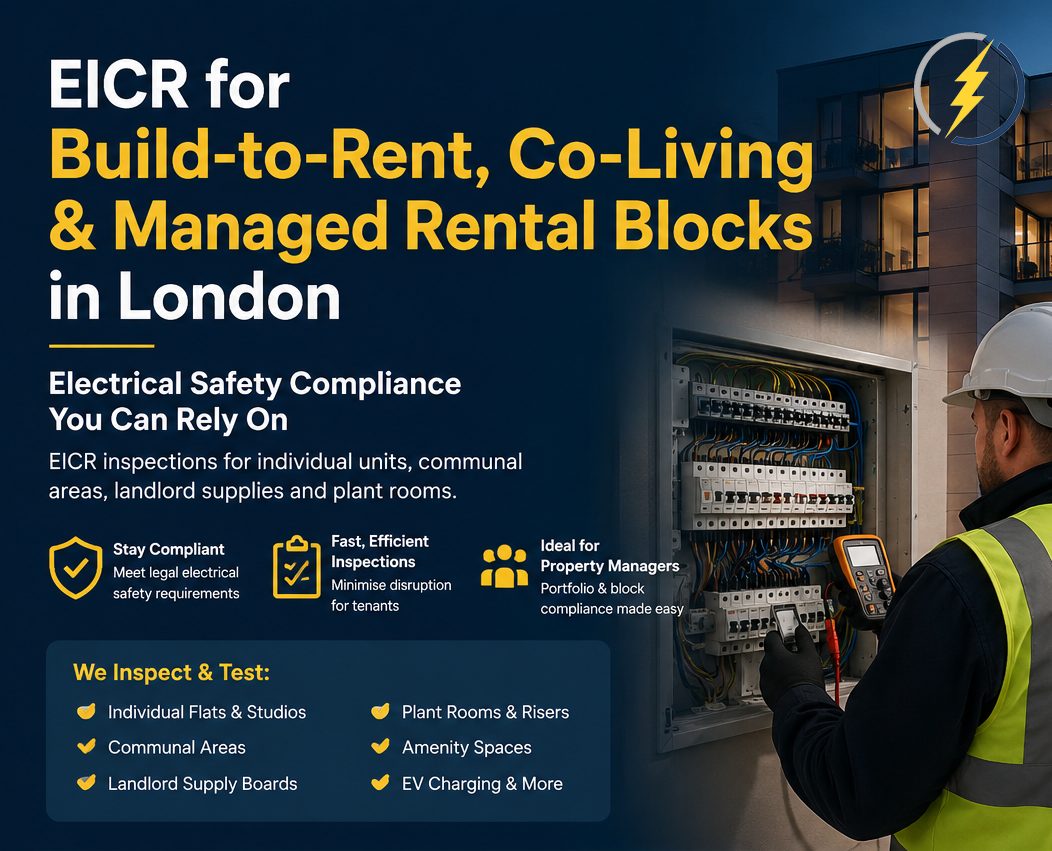
Build-to-Rent, co-living and professionally managed rental blocks are becoming a major part of the London property market. Instead of one landlord managing one flat, many operators now manage entire buildings, multi-unit developments, serviced rental blocks, co-living schemes and large residential portfolios.
That changes the way electrical safety needs to be managed.
A private landlord with one rental flat may only need one EICR certificate for one property. A Build-to-Rent operator, co-living provider, block manager or property management company may need to coordinate electrical inspections across dozens or hundreds of apartments, studios, shared kitchens, communal corridors, riser cupboards, plant rooms, landlord supply boards, amenity areas, reception spaces and commercial-style electrical systems.
That is why EICR compliance for managed rental buildings should not be treated as a simple certificate job. It should be treated as an organised compliance process.
At London EICR Certificates, we help landlords, property managers, letting agents, commercial clients and managed-property operators arrange professional EICR services in London for individual flats, landlord supply boards, communal areas, plant rooms, commercial spaces, co-living properties and Build-to-Rent blocks.
This guide explains how EICR testing works for Build-to-Rent, co-living and managed rental blocks in London, what areas may need inspection, what common defects are found, and how property managers can reduce compliance risk before problems become urgent.
What Is an EICR for a Managed Rental Building?
An EICR, or Electrical Installation Condition Report, is a formal inspection and test of the fixed electrical installation within a property. It checks whether the installation is safe for continued use and identifies defects, damage, deterioration, poor earthing, missing RCD protection, overloaded circuits, exposed live parts and other electrical safety concerns.
If you are arranging an EICR certificate London inspection, the objective is not only to obtain a certificate. The real purpose is to confirm whether the electrical installation is safe, correctly protected and suitable for the way the property is being used.
For a standard rented flat, the EICR normally covers the fixed electrical installation inside that flat. This usually includes the consumer unit, socket circuits, lighting circuits, cooker circuit, shower circuit, immersion heater circuit where applicable, fixed wiring, accessories, bonding and earthing arrangements.
For a managed rental building, the scope can be much wider.
A Build-to-Rent or co-living building may include private apartments, studio rooms, shared kitchens, communal lounges, corridors, stairwells, reception areas, gyms, laundry rooms, plant rooms, riser cupboards, landlord distribution boards, car park supplies, external lighting, EV chargers, access control systems and other fixed electrical installations.
The important point is simple: one EICR does not automatically cover every part of a building.
An EICR for one flat does not normally cover the communal hallway outside the flat. A communal-area EICR does not normally cover every rented unit. A commercial EICR for a reception, gym or amenity space may not cover the private apartments above it.
Before the inspection is booked, the property manager should be clear about exactly what needs to be inspected. This is where a properly planned electrical installation condition report London service becomes important, especially where a building contains both residential and shared electrical systems.
Why Build-to-Rent and Co-Living Properties Need a Different EICR Approach
Build-to-Rent and co-living properties are usually more operationally complex than standard rental homes. They have more residents, more electrical use, more access requirements, more shared facilities and more compliance records to manage.
A single rented flat may involve one tenant, one appointment and one certificate.
A managed rental block may involve multiple tenants, concierge access, key management, individual unit reports, landlord supply testing, plant room inspections, commercial-style distribution boards, shared amenities, multiple appointment windows and remedial works across different parts of the building.
The biggest risk is often not the technical inspection itself. It is poor coordination.
If the engineer cannot access several units, the inspection programme becomes incomplete. If the plant room key is unavailable, the landlord supply may not be tested. If the certificate names are wrong, reports may need correcting. If an unsatisfactory EICR is not followed up properly, the property manager may still have unresolved compliance risk.
For this reason, property managers should treat EICR testing London as a planned operational task, not a last-minute admin request.
A good EICR process for managed rental buildings should answer these questions before the engineer attends:
Which units need an EICR?
Which communal areas need inspection?
Are landlord supply boards included?
Are plant rooms and risers accessible?
Are shared kitchens, gyms or workspaces included?
Who is providing access?
Are tenants aware that power may need to be switched off briefly?
Who receives the reports?
Who approves remedial works if defects are found?
How will expiry dates be tracked after the inspection?
This is why managed rental properties need a more organised approach than a one-off domestic booking.
Areas That May Need EICR Testing in a Managed Rental Block
The correct inspection scope depends on the building layout, ownership structure, tenancy arrangements and electrical installation. However, most managed rental buildings should consider several key areas.
The main areas are individual rented units, communal areas, landlord supplies, plant rooms, shared facilities, amenity spaces and specialist electrical systems such as EV chargers or solar PV.
Missing one of these areas can create a compliance gap. For example, every individual flat may have a valid EICR, but the landlord supply board serving the communal corridors may still be untested. Equally, the communal areas may be inspected, but several rented studios may have expired or missing EICR certificates.
A proper managed-property EICR plan should separate the building into inspection zones and confirm who is responsible for each part.
For buildings with shared systems, landlords and managing agents should also review whether they need commercial EICR certificates in London, especially where the building includes reception areas, landlord distribution boards, plant rooms, co-working lounges, gyms, retail spaces or other non-domestic areas.
Individual Flats, Apartments and Studios
Each rented flat, apartment or studio normally needs its own EICR certificate. This is the main requirement for residential landlords and rental property operators.
The inspection normally reviews the fixed wiring and electrical installation inside the unit. This may include the consumer unit, socket circuits, lighting circuits, fixed appliances where relevant, circuit protection, bathroom electrical accessories, earthing, bonding and general installation condition.
Common issues inside rental units include missing RCD protection, damaged sockets, loose switches, poor circuit labelling, old consumer units, unsuitable bathroom lights, high earth loop impedance readings, poor continuity readings, borrowed neutrals, missing bonding and previous DIY electrical alterations.
In Build-to-Rent buildings, many units may have similar layouts and similar consumer units. This can be helpful because engineers can work through units in a structured way. However, it also means repeated defects are possible.
If one studio has an unsuitable bathroom fitting, other similar studios may have the same problem. If one consumer unit has poor labelling, other flats installed at the same time may also need attention. If one flat has limited RCD protection, other units with the same board type may require closer review.
For rental compliance, property managers should make sure every occupied unit has the correct EICR certificates for landlords in London, with the correct property address, certificate name and report date recorded accurately.
Communal Corridors, Stairwells and Entrances
Communal electrical installations are often overlooked because the main focus is usually on individual rented flats. This can create a serious compliance gap.
Communal corridors, stairwells, entrances, lobbies, riser cupboards, meter cupboards and shared lighting systems may be part of the landlord’s electrical installation. These areas are used by tenants, visitors, cleaners, contractors, delivery drivers and building staff, so electrical defects can affect many people.
Common communal-area issues include damaged light fittings, loose accessories, missing blanks in distribution boards, exposed cabling, poor labelling, water damage, old containment, overloaded circuits and poor access to electrical equipment.
A landlord supply EICR or commercial-style EICR may be required depending on the electrical layout.
For managed blocks, the guidance in EICR for communal areas in blocks of flats is highly relevant because the electrical responsibility may sit with the freeholder, management company or building operator rather than the individual flat landlord.
This is especially important in Build-to-Rent properties because the same operator may control both the individual flats and the shared electrical infrastructure.
Plant Rooms and Landlord Supply Boards
Plant rooms are high-priority areas in managed rental buildings. They may contain distribution boards, mechanical plant supplies, pumps, heating controls, ventilation equipment, water services, lift-related supplies or building management equipment.
A problem in a plant room can affect more than one flat. It can affect the operation of the entire building.
Common plant room defects include poor labelling, missing circuit schedules, dust or debris around electrical equipment, damaged containment, unsupported cables, signs of overheating, loose covers, unclear isolation points and outdated protective devices.
These areas should not be treated as back-of-house spaces that can be ignored. They often contain essential parts of the building’s electrical infrastructure.
A properly scoped EICR should confirm whether plant rooms and landlord supply boards are included. If they are not included, the property manager should understand why and whether a separate inspection is needed.
This is especially important for Build-to-Rent operators because investors, insurers, facilities managers and managing agents may all rely on accurate electrical safety records.
Where a building includes landlord distribution boards, communal lighting, plant rooms or commercial-style equipment, the inspection should be handled as part of a wider commercial EICR certificates in London compliance process rather than a basic domestic flat inspection only.
Shared Kitchens, Co-Living Lounges and Laundry Rooms
Co-living buildings often include shared kitchens, living rooms, laundry areas and communal workspaces. These spaces usually experience heavier electrical use than normal domestic rooms.
Residents may use kettles, microwaves, laptops, phone chargers, kitchen appliances, washing machines, dryers and sometimes portable heaters. Socket outlets and switches can become worn or damaged more quickly because many people use them every day.
Common issues in shared co-living areas include loose sockets, damaged switches, overloaded socket use, extension leads used permanently, poor appliance loading, unsuitable kitchen accessories, lack of RCD protection and wear caused by high occupancy.
These spaces should be inspected carefully because they are often the areas where electrical use is highest.
For co-living properties, the EICR should not only be seen as paperwork. It is part of operational safety, tenant management and preventative maintenance.
If repeated issues are found in shared kitchens or lounges, the property operator should consider whether the building needs stronger maintenance checks between formal EICR inspections.
Where several tenants use the same shared facilities daily, a professional electrical safety certificate London inspection helps identify risks before they become tenant complaints, emergency repairs or compliance issues.
Amenity Spaces in Build-to-Rent Developments
Modern Build-to-Rent buildings often include amenities such as gyms, cinema rooms, roof terraces, parcel rooms, receptions, co-working lounges, private dining rooms and resident lounges.
These spaces may not be purely domestic. They may involve more equipment, higher usage and commercial-style electrical arrangements.
A gym may include powered machines, ventilation and specialist equipment. A co-working space may include multiple socket outlets and containment. A laundry room may have several high-load appliances. A roof terrace may have external lighting and weather-exposed accessories.
These areas should be included in the electrical safety plan where they form part of the fixed installation.
For example, a co-working lounge in a Build-to-Rent block may have more in common with a small office than a normal domestic room. A laundry room with several machines may place more demand on circuits than a standard residential utility cupboard. A parcel room or reception desk may include access control, lighting, CCTV and socket circuits that need to be assessed properly.
This is why the inspection scope matters. A property manager should not assume that a domestic unit EICR covers every amenity area within the building.
Where the building contains these mixed-use areas, the operator should connect the inspection with commercial EICR certificates in London so the shared and higher-use electrical systems are considered properly.
EV Chargers, Solar Panels and Battery Storage
Some newer London developments include EV charging points, solar PV systems or battery storage. These systems can affect inspection scope, load assessment, labelling, isolation, earthing arrangements and distribution.
If the building has EV chargers, solar panels or battery storage, this should be mentioned before the EICR is booked. The engineer needs to understand the installation before attending.
For managed properties with charging points, the topic of EICR and EV chargers in London rental and commercial properties is directly connected because EV infrastructure can affect landlord supplies, car park circuits and overall electrical loading.
Where solar PV or battery systems are installed, property managers should also consider the guidance in EICR for solar panels and battery storage in London, because renewable systems can add complexity to inspection, isolation and labelling.
These systems are valuable building upgrades, but they should not sit outside the electrical safety record.
Common EICR Defects Found in Managed Rental Buildings
Managed rental buildings often produce two types of EICR problems.
The first is an individual defect. This could be one broken socket, one damaged switch, one poorly labelled board or one failed circuit reading.
The second is a repeated defect. This is more important for Build-to-Rent and co-living operators because the same issue may appear across many units or shared areas.
For example, if a group of flats were refurbished at the same time and one unit has poor circuit labelling, others may also have poor labelling. If one bathroom light fitting is unsuitable, other identical bathrooms may have the same issue. If one consumer unit lacks modern RCD protection, similar units may need review.
Common defects include missing RCD protection, old consumer units, damaged sockets, loose switches, poor circuit labelling, exposed live parts, missing blanks, poor earthing, missing bonding, high earth fault loop impedance, poor continuity, borrowed neutrals, signs of overheating, tenant alterations, overloaded socket use and damaged containment.
The EICR report may classify observations as C1, C2, C3 or FI.
A C1 means danger is present and immediate action is required.
A C2 means the issue is potentially dangerous and urgent remedial work is required.
An FI means further investigation is required because the inspector cannot confirm safety without additional checks.
A C3 means improvement is recommended, but it does not normally make the report unsatisfactory on its own.
For managed buildings, the property manager needs to understand not only the code but also the action required. If the report is unsatisfactory, a proper remedial work for failed EICR certificates process should be arranged so the building can move from report failure to practical resolution.
Case Study Example: 68-Unit Build-to-Rent Block in East London
A Build-to-Rent operator manages a 68-unit residential block in East London. The building includes one-bedroom flats, two-bedroom flats, communal corridors, a reception area, landlord supply boards, a bike store, a plant room and a shared co-working lounge.
The operator has EICR certificates for some flats, but the dates are inconsistent because the units were let at different times. Some certificates are due to expire within three months. Some certificates are missing from the management file. The communal landlord supply has not been tested recently.
The main issue is not just electrical safety. It is compliance control.
A structured approach would include creating a full unit schedule, checking which certificates are valid or missing, confirming access arrangements for occupied flats, booking inspections by floor or appointment window, testing the landlord supply separately, inspecting the plant room and communal areas, recording report outcomes against each unit and quoting remedial works where required.
In this type of building, the property manager needs more than a certificate. They need a clear record showing which flats are satisfactory, which areas have been inspected, which reports are unsatisfactory and which remedial works are still outstanding.
This is where professional EICR services in London become valuable because the inspection must be technically correct and administratively organised.
A cheap one-off inspection may not be enough for a multi-unit managed property if the reporting structure, access process and remedial follow-up are weak.
Case Study Example: Co-Living Property with Shared Facilities
A co-living operator manages a London property with 24 private rooms, shared kitchens, laundry facilities and communal lounge areas. The property has high occupancy and frequent resident turnover.
During inspection, several issues may be found. Socket fronts in shared areas may be loose. Some switches may be damaged. Kitchen circuits may be under heavy use. Extension leads may be used regularly. Distribution board labelling may be unclear. Bathroom fittings may need review.
In this type of building, the EICR should not only be seen as a legal document. It is part of operational building safety.
High-use buildings need better monitoring because electrical accessories are touched, moved, loaded and sometimes damaged more often than in a single household.
For co-living operators, the practical approach is to inspect before certificates expire, keep access arrangements clear, warn residents about short power interruptions, check shared kitchens carefully and treat repeated minor damage as a maintenance pattern.
If the operator also controls the building’s shared areas, the EICR should be planned alongside commercial EICR certificates in London rather than only individual room certificates.
This gives a more complete picture of the building’s electrical condition.
Case Study Example: Managed Block with Communal Electrical Defects
A managing agent looks after a block of privately rented flats. Each landlord arranges their own flat EICR, but the communal corridors, meter cupboard and landlord supply board are managed separately.
The flats may be compliant, but the communal areas may still have issues.
During inspection, the engineer may find missing blanks in a landlord distribution board, poor circuit labelling, damaged corridor lighting accessories and older containment in a riser cupboard.
This is common in London blocks. Everyone focuses on the flat certificates, but the shared electrical installation is not always given the same priority.
The responsibility should be separated clearly.
Individual landlords are normally responsible for the EICR for their own rented flat.
The freeholder, management company or building operator may be responsible for communal areas and landlord supply electrical installations.
Commercial operators may be responsible for reception areas, offices, plant rooms or amenity spaces.
This is why guides such as EICR for communal areas in blocks of flats are important for property managers, because the compliance risk often sits between individual flats and the shared building infrastructure.
How Property Managers Should Prepare Before Booking an EICR
Good preparation reduces failed visits, delays and extra cost.
Before booking, the property manager should prepare a clear inspection brief. This should include the full property address, list of units requiring inspection, certificate name required for each unit, tenant or access contact details, preferred appointment windows, concierge or key collection arrangements, parking or loading information, previous EICR reports if available, location of consumer units, location of landlord supply boards, access to riser cupboards, plant room access, details of communal areas, details of amenity spaces, known electrical issues, EV charger details, solar or battery system details and the report delivery contact.
For occupied flats, tenants should be told that the engineer may need to switch off power briefly during testing. This is important where tenants work from home or have sensitive equipment.
If there are servers, medical devices, alarms, specialist equipment or critical systems, they should be mentioned before the appointment.
For smoother booking, property managers should review what we need to book your EICR certificate in London before arranging attendance. This reduces missing details, wrong certificate names and avoidable delays.
How Long Does EICR Testing Take for Build-to-Rent and Co-Living Properties?
The time required depends on the number of units, size of the property, number of circuits, age of the installation, access arrangements and whether communal or commercial areas are included.
A small studio may be quicker to inspect than a large apartment with more circuits. A landlord supply board with multiple circuits may take longer than expected. A plant room or amenity area may require more detailed inspection.
The main factors affecting time include number of flats or rooms, number of circuits per unit, condition of consumer units, quality of labelling, access to electrical boards, age of installation, previous alterations, tenant availability, number of communal areas, number of landlord supply boards, presence of plant rooms, presence of EV chargers and whether further investigation is required.
For larger managed buildings, inspections are often best arranged in batches. For example, one floor per appointment window, or a group of units over several days.
This avoids overpromising and gives the property manager a more realistic plan.
Where many certificates are required, booking through an organised EICR testing London provider is more efficient than arranging separate one-off appointments for each flat.
Why Last-Minute EICR Booking Creates Risk
Many landlords and property managers leave EICR renewals too late. For single properties, this is inconvenient. For managed blocks, it can create serious operational pressure.
Last-minute booking can lead to missed tenant access, incomplete inspections, wrong certificate details, delayed reports, unplanned remedial costs, expired certificates, difficulty arranging engineers, pressure from letting agents, pressure from insurers, tenant move-in delays, owner complaints and compliance gaps.
The better approach is to start reviewing EICR expiry dates at least 60–90 days before they expire.
This gives enough time to inspect, issue reports, arrange remedial works if required and update the management file.
For a building with dozens of units, this is essential.
A simple compliance tracker should record the unit number, tenant status, certificate holder name, last EICR date, next due date, report outcome, C1/C2/FI observations, remedial quote status, remedial completion date and final satisfactory status.
This is basic compliance management, but many property operators still do not have it organised.
If you are unsure about pricing before booking, review EICR certificate cost in London so the inspection can be scoped correctly before attendance.
EICR Cost Considerations for Managed Rental Buildings
The cost of an EICR depends on property type, size, number of circuits, access requirements and inspection scope.
For managed rental buildings, pricing should be assessed properly because the work may include multiple elements. These can include individual flat EICRs, landlord supply testing, communal area inspection, plant room inspection, amenity space testing, commercial-style electrical testing, multiple engineer visits, access coordination, remedial quotations and retesting where required.
A single flat price is not always suitable for a full managed building.
However, grouping multiple inspections together may create a more efficient booking structure than arranging one property at a time.
For example, if a property manager needs EICRs for 25 flats, a landlord supply board and a shared lounge, the job should be priced around the actual inspection scope. The engineer needs to understand how many circuits are involved, what areas are included, what access is available and whether the property has any specialist electrical systems.
For transparent pricing guidance, the best supporting page is EICR certificate cost in London, especially where landlords or property managers want to understand what affects the cost of inspection.
What Happens If a Managed Rental Building Fails an EICR?
If an EICR is unsatisfactory, the next step depends on the observations and classification codes.
A C1 issue needs immediate action because danger is present.
A C2 issue needs urgent remedial action because it is potentially dangerous.
An FI observation needs further investigation because the inspector could not verify safety.
A C3 observation is an improvement recommendation and does not usually make the report unsatisfactory by itself.
For managed buildings, the key is prioritisation.
A C1 in a communal distribution board may require immediate isolation or urgent attendance. A C2 inside an occupied flat may require tenant coordination. An FI on a landlord supply board may require further testing before the building operator can properly understand the risk.
The property manager should not only ask how much the repair will cost. They should ask what the safety issue is, which area is affected, whether anything needs isolating, whether tenant access is required, whether the same issue may exist in other units, whether remedial works can be grouped efficiently and whether a satisfactory report can be issued after completion.
If the report is unsatisfactory, London EICR Certificates can help with remedial work for failed EICR certificates so the building operator has a clear route from inspection to resolution.
Why Managed Property Operators Should Use a Specialist EICR Provider
A normal domestic electrician may be able to inspect one flat. Managed rental blocks require stronger organisation.
For Build-to-Rent, co-living and managed buildings, the provider should understand residential EICR requirements, commercial EICR requirements, landlord supply testing, communal area inspection, tenant access coordination, multi-unit reporting, remedial work planning and clear communication with property managers.
The inspection itself must be technically competent, but the administration must also be accurate.
Wrong names, wrong addresses, missing unit numbers, unclear report references and poor communication can create unnecessary problems for property managers.
A professional provider should help the client understand what is being inspected, what is excluded, what defects were found, what action is required and what should happen next.
This is why property managers should use an organised EICR services in London provider rather than treating a managed rental building like a one-off domestic appointment.
Why London EICR Certificates Is a Strong Fit for Managed Rental Properties
London EICR Certificates works with landlords, homeowners, commercial clients, estate agents, letting agents, property managers and businesses across London.
For managed rental buildings, we can help with EICR certificates for individual flats, EICR testing for co-living properties, EICR inspections for Build-to-Rent blocks, landlord supply testing, commercial EICR certificates, communal area electrical inspections, plant room and distribution board inspections, electrical safety reports for rental portfolios, remedial work quotations after failed EICRs and clear booking support.
Our focus is practical compliance. We do not only issue a report and leave clients confused. Where issues are found, we explain the observations clearly and provide next steps where remedial work is required.
If you manage residential flats, shared rental accommodation or a full London rental block, we can help arrange the right inspection scope and reporting process.
For individual rental units, start with EICR certificates for landlords in London.
For landlord supplies, plant rooms, offices, gyms, receptions and shared facilities, use commercial EICR certificates in London.
For pricing guidance, review EICR certificate cost in London.
For failed reports, use remedial work for failed EICR certificates.
To arrange an inspection, use book an EICR online.
Practical Compliance Checklist for Property Managers
Before arranging EICR testing for a Build-to-Rent, co-living or managed rental block, the property manager should check whether they have a full list of units, correct certificate names, access contacts, tenant availability, previous reports, plant room access, riser cupboard access, landlord supply details, communal area details, amenity space details, EV charger information, solar or battery information and a process for approving remedial works.
The property manager should also confirm whether the inspection is only for individual flats or whether it also includes communal areas, landlord supplies and commercial-style spaces.
This distinction matters because a building can look compliant on paper while still having untested shared electrical systems.
A well-managed EICR programme should give the operator confidence that the correct areas were inspected, the reports were issued correctly, defects were understood and any remedial actions were tracked.
If this information is not organised, it is better to prepare before booking. This reduces missed access, incomplete testing and unnecessary delays.
Final Advice for Build-to-Rent, Co-Living and Managed Rental Blocks
EICR testing for Build-to-Rent, co-living and managed rental buildings should not be treated as a basic certificate task.
It should be handled as a structured compliance process.
The property manager needs to know which installations are covered, which units have valid certificates, which communal areas have been inspected, which reports are satisfactory, which defects require action and which remedial works are outstanding.
The best approach is simple.
Plan early.
Confirm the inspection scope.
Prepare access.
Inspect the right areas.
Track report outcomes.
Act quickly on C1, C2 and FI observations.
Keep records organised for future renewals.
For a single flat, a missed EICR can create a problem. For a managed rental building, poor EICR management can create multiple problems across tenants, owners, agents, insurers and compliance teams.
London EICR Certificates can help you arrange inspections for Build-to-Rent properties, co-living buildings, managed rental blocks and London property portfolios.
Whether you need one flat inspected, a full rental block tested, a landlord supply checked or remedial works quoted after an unsatisfactory report, our team can help.
To move from planning to booking, arrange your inspection through book an EICR online or review our main EICR services in London page.
EICR for Build-to-Rent, Co-Living and Managed Blocks FAQs
Clear answers for Build-to-Rent operators, co-living providers, property managers, managing agents and landlords arranging EICR inspections for flats, communal areas, landlord supplies and managed rental buildings in London.
Does a Build-to-Rent block need separate EICR certificates for each flat?
In most cases, yes. Each rented flat, apartment or studio normally needs its own EICR certificate because the fixed electrical installation inside that unit must be inspected and reported separately.
A Build-to-Rent building may also need separate inspection records for communal areas, landlord supplies, plant rooms, reception areas, gyms, lounges or other shared electrical systems. One certificate does not automatically cover the full building unless the inspection scope clearly states what was included.
Is an EICR required for co-living properties in London?
Yes. If the property is rented, the fixed electrical installation must be inspected and tested at the required interval. Co-living properties can be more complex than standard flats because they often include private rooms, shared kitchens, lounges, laundry rooms and communal circuits.
The inspection should be scoped properly so it is clear whether the report covers only private rooms, the whole property, shared areas, landlord supplies or any commercial-style spaces within the building.
Does a communal area need its own EICR?
Often, yes. Communal corridors, stairwells, entrances, riser cupboards, meter cupboards, plant rooms and landlord lighting circuits may form part of a separate landlord-controlled electrical installation.
An EICR for an individual flat will not usually cover the communal electrical installation. Property managers should check whether the communal supply, landlord distribution board and shared circuits have been inspected separately.
Who is responsible for EICR compliance in a managed rental block?
Responsibility depends on the ownership and management structure. Individual landlords may be responsible for EICRs inside their rented flats, while the freeholder, management company or building operator may be responsible for communal areas and landlord supplies.
In a Build-to-Rent building, the operator may control both the private rental units and the shared building systems. In that case, the operator should keep a clear compliance tracker showing which units and shared areas have valid reports.
What areas should be checked in a managed rental building EICR?
The inspection scope may include individual flats, studio rooms, consumer units, lighting circuits, socket circuits, shared kitchens, communal corridors, landlord supply boards, plant rooms, riser cupboards, meter rooms, gyms, receptions, laundry rooms and external lighting.
EV chargers, solar PV, battery storage, access control systems and mechanical plant supplies should also be mentioned before booking because they can affect the inspection scope and the time required.
Can one EICR certificate cover the whole building?
Only if the inspection scope clearly covers the whole relevant electrical installation. In many managed buildings, different parts of the property need separate reports because individual flats, communal areas, plant rooms and commercial-style spaces may be different electrical installations.
Property managers should avoid assuming that one report covers everything. The safer approach is to confirm the scope before attendance and make sure the report clearly identifies the areas inspected.
What are common EICR failures in Build-to-Rent and co-living buildings?
Common issues include missing RCD protection, damaged sockets, loose switches, poor circuit labelling, old consumer units, missing bonding, high earth loop impedance readings, borrowed neutrals, exposed live parts, missing blanks in distribution boards and signs of overheating.
In co-living and managed rental buildings, repeated defects are common because many units may have been wired or refurbished to the same specification. If one flat has a defect, similar units may need closer review.
How should property managers prepare for EICR testing?
Property managers should prepare a full unit list, certificate names, access contacts, tenant availability, previous reports, plant room access, riser cupboard access, landlord supply details, parking instructions and details of any shared facilities or specialist electrical systems.
Tenants should also be warned that power may need to be switched off briefly during testing. Good preparation reduces failed visits, delays, missing information and incomplete reports.
How long does EICR testing take for a managed rental block?
The time depends on the number of flats, number of circuits, access arrangements, condition of the installation and whether communal areas, plant rooms or landlord supplies are included.
A single studio may be relatively straightforward, but a full Build-to-Rent or co-living building may need inspections arranged in batches across several appointment windows or days. A clear scope should be agreed before booking.
What happens if a managed rental building fails the EICR?
If the report is unsatisfactory, the observations will usually include C1, C2 or FI codes. A C1 means danger is present and immediate action is required. A C2 means the issue is potentially dangerous and urgent remedial work is required. FI means further investigation is needed.
For managed buildings, the property manager should identify which area is affected, whether tenant access is needed, whether the same defect may exist elsewhere and whether remedial works can be grouped efficiently across multiple units or shared areas.
How do I book an EICR for a Build-to-Rent or co-living property in London?
To book properly, provide the full building address, number of units, areas requiring inspection, certificate names, access contact details, preferred appointment windows, concierge instructions, parking information and any known details about landlord supplies, plant rooms, EV chargers, solar systems or shared facilities.
London EICR Certificates can help with EICR inspections for individual rental units, Build-to-Rent blocks, co-living properties, communal areas, landlord supplies and commercial-style shared spaces across London.
Book a professional EICR inspection for flats, studios, communal areas, landlord supplies, plant rooms and managed rental buildings across London. Get clear reports, practical advice and remedial support if required.
Book Your EICR OnlinePlease Submit Details Below



24/7 Emergency Service
Find answers to common questions about EICR certificates and electrical safety inspections in London. Visit our FAQ page on EICRcertificates.com for more information.