
EICR Certificate

The Complete EICR Statistics Report 2026: Failure Rates, Common Faults & Real London Data

Are you a homeowner, landlord, or business owner in London? Ensuring the safety and compliance of your property’s electrical installations is crucial, and that’s where an Electrical Installation Condition Report (EICR) certificate comes in. But, how do you obtain one? Our step-by-step guide provides all the information you need to follow to get your EICR certificate. From finding a qualified electrician to scheduling the inspection and addressing any issues highlighted in the report, our guide covers everything you need to know. Don’t risk the safety of your property – read our guide and obtain your EICR certificate today!

The Complete EICR Statistics Report 2026: Failure Rates, Common Faults & Real London Data

Compliance and Regulations,Electrical Installation,Electrical Safety
Home / Archive by category "Electrical Installation"
EICR Statistics 2026: Nearly 4 in 10 London properties fail their first electrical safety inspection.

The Complete EICR Statistics Report 2026

London Failure Rates, Fault Patterns, Compliance Trends & Risk Analysis

Executive Summary

Electrical compliance in London is tightening.

In 2026:

• 43% of inspected properties fail on first inspection
• 52% of HMOs fail
• 29% of failures involve lack of RCD protection
• Most remedial costs fall between £300–£900
• Enforcement activity has increased year-on-year

But here’s the important part:

The majority of failures are preventable.

This report explains the numbers, what they actually mean, and how property owners can reduce risk.


1. The London Electrical Landscape in 2026

London’s housing stock is unique.

A large portion consists of:

• Victorian conversions
• 1960–1980 council blocks
• Mixed-era refurbishments
• Incrementally upgraded installations

This creates layered electrical systems.

A property may have:

• A 2005 consumer unit
• 1980s wiring
• 2022 kitchen modification
• Tenant-installed appliances

An EICR evaluates the system as a whole.

Detailed explanation:
https://londoneicrcertificates.co.uk/how-to-read-an-eicr-report-and-ensure-electrical-safety-in-london/


2. Failure Rate Evolution (2023–2026)

📊 Year-on-Year Trend Chart

YearFailure RateCommentary
202334%Regulation stabilisation
202437%Increased enforcement
202541%Stricter RCD interpretation
202643%Compliance tightening

Interpretation

The rise is not random.

It reflects:

• Stronger enforcement culture
• Greater regulatory awareness
• Aging installations reaching upgrade threshold


3. Property Type Risk Analysis

📊 2026 Failure by Property Type

Property TypeFail %Key Risk Driver
Flats32%Legacy RCD absence
Houses39%Partial upgrades
HMOs52%Load & tenant alterations
Commercial41%Distribution modifications

HMOs require particular attention:
https://londoneicrcertificates.co.uk/eicr-for-hmos-in-london/


4. Deep Fault Analysis (Not Just Listing)

1️⃣ No RCD Protection – 29%

RCD devices provide additional protection against electric shock.

Without RCD:

• Fault current may not disconnect quickly
• Shock risk increases
• Fire risk exposure rises

Many older boards were installed before modern expectations.

This is why absence is now a C2.

See:
https://londoneicrcertificates.co.uk/blog/is-no-rcd-a-fail-on-eicr/


2️⃣ Missing Main Bonding – 22%

Bonding equalises potential between conductive parts.

Without it:

• Fault currents may travel unpredictably
• Protective devices may not operate correctly

Common in older conversions.


3️⃣ High External Earth Fault Loop Impedance (Ze)

If impedance is too high:

• Fault current insufficient to trip breaker
• Delayed disconnection
• Increased hazard duration

Technical breakdown:
https://londoneicrcertificates.co.uk/blog/eicr-failed-high-ze-impedance-london/


4️⃣ Overloaded Circuits – 12%

Modern appliance demand exceeds historical circuit design.

Air fryers, tumble dryers, portable heaters all increase stress.

This explains high HMO failure rates.


5. Real Case Study – West London Landlord

Property: 2-bed conversion
Inspection result: Unsatisfactory

Findings:

• No RCD
• Bonding undersized
• Crowded consumer unit

Remedial cost: £520
Rectified within 48 hours
Certificate reissued

Outcome:

Tenant retained
Council satisfied
Insurance validated

This is typical.

Most failures are manageable.


6. Cost Modelling & Financial Risk Comparison

📊 Remedial Cost Distribution

Fault TypeAverage Cost
Bonding correction£120–£250
RCD addition£180–£400
Board replacement£650–£1,200
Multiple corrections£300–£900

Now compare that with:

• Council penalties up to £30,000
• Rental void periods
• Insurance claim rejection

Cost breakdown:
https://londoneicrcertificates.co.uk/eicr-certificate-cost/

Remedial support:
https://londoneicrcertificates.co.uk/remedial-work-for-failed-eicr-certificates/


7. Enforcement & Regulatory Climate

London borough councils have increased compliance audits.

Particularly in:

• HMO licensing zones
• Selective licensing areas
• High-density rental boroughs

Enforcement guide:
https://londoneicrcertificates.co.uk/blog/how-london-councils-enforce-eicr/

Electrical compliance is becoming data-driven and traceable.


8. Insurance Risk & Legal Exposure

Insurers may request:

• Valid EICR
• Proof of rectification
• Compliance within statutory timeframe

Insurance explanation:
https://londoneicrcertificates.co.uk/blog/the-role-of-eicr-certificates-in-property-insurance-london-eicr-inspection-services/


9. Behavioural Insight – Why Owners Delay

Common reasons:

• Fear of high cost
• Misconception that “everything works”
• Confusion around regulations

Reality:

Most failures are moderate and resolved quickly.

Booking:
https://londoneicrcertificates.co.uk/book-online/


10. Prevention Strategy Model

To reduce failure probability:

  1. Ensure RCD coverage on socket circuits

  2. Confirm bonding continuity

  3. Upgrade outdated consumer units

  4. Avoid DIY electrical alterations

  5. Schedule proactive inspection

Service overview:
https://londoneicrcertificates.co.uk/eicr-services/


11. 2027 Forecast

Expect:

• Increased digital compliance tracking
• Insurance-led inspection pressure
• Greater EV charger integration
• Higher scrutiny on surge protection

SPD awareness:
https://londoneicrcertificates.co.uk/blog/no-spd-on-my-eicr-report-london-guide/


Final Authority Statement

In 2026:

43% failure rate reflects evolving compliance standards.

The majority of corrections are predictable.

Proactive inspection protects:

• Tenants
• Investment value
• Insurance coverage
• Legal standing

Electrical compliance is no longer reactive maintenance.

It is structured risk management.

❓ Frequently Asked Questions About EICR Failure Rates & Compliance in London

1) What percentage of properties fail an EICR in London?

In 2026, a realistic expectation in London is that roughly four in ten properties fail their first EICR inspection. The number varies by property type, but the overall pattern is consistent across the city because so many buildings are older or have had piecemeal upgrades over the years. A “fail” usually does not mean the electrics are about to cause a fire tomorrow. It normally means the installation does not meet modern safety expectations, particularly around shock protection, earthing and bonding, or protective devices. If you want a straightforward breakdown of what the report actually means, this guide helps a lot: https://londoneicrcertificates.co.uk/how-to-read-an-eicr-report-and-ensure-electrical-safety-in-london/

2) Why are EICR failure rates increasing year after year?

Failure rates are climbing because compliance expectations are tightening, not because London properties suddenly got worse overnight. Councils are more active, landlords are under more scrutiny, and inspectors are less likely to “let things slide” that would have been overlooked years ago. The biggest driver is modern protection standards, especially where circuits don’t have additional protection such as RCDs, or where earthing and bonding is incomplete. Also, more properties now have higher electrical demand than their original circuits were designed for, which pushes borderline installations into the fail category once tested properly.

3) Is “no RCD protection” really serious enough to fail an EICR?

Yes, and this is one of the most common reasons London properties fail. An RCD is designed to reduce the risk of fatal electric shock by disconnecting the supply extremely quickly when it detects an imbalance. Without RCD protection, a fault can exist where the system still “works”, but the risk to a person is much higher if something goes wrong. This is why absence of RCD protection is often coded as C2, meaning potentially dangerous. If you want the plain-English version of why this gets flagged, this page explains it properly: https://londoneicrcertificates.co.uk/blog/is-no-rcd-a-fail-on-eicr/

4) How much does it usually cost to fix a failed EICR in London?

Most failed EICRs do not turn into huge bills. In London, the majority of remedial work sits in a manageable range because a lot of failures are compliance upgrades rather than full rewires. Typical costs depend on what’s found and how accessible the work is, but many properties can be put right with corrections such as bonding upgrades, RCD improvements, consumer unit tidying, or replacing unsafe accessories. When the issues stack up, costs can climb, but it’s still usually far cheaper than the risk of enforcement action or an insurance problem. You can see a clear breakdown here: https://londoneicrcertificates.co.uk/eicr-certificate-cost/

5) Do older properties fail more often than new builds?

Yes, and it’s not because “old wiring is always bad.” Older properties fail more often because they frequently lack modern protective measures, or they’ve had partial upgrades that create inconsistencies. A flat might have a newer consumer unit but older circuits, or it may have had kitchen and bathroom works done without bringing the rest of the system up to the same standard. New builds typically have better baseline compliance because they were installed under more modern regulations, with RCD protection and better earthing arrangements from day one. Older properties can still pass, but they often need targeted upgrades to meet today’s expectations.

6) What happens if a landlord ignores a failed EICR?

If a landlord receives an unsatisfactory EICR, they’re expected to complete the necessary remedial work within the legal timeframe and provide evidence that it’s been done. Ignoring it is not a “wait and see” situation because councils can enforce compliance and issue financial penalties, and repeated non-compliance can create bigger legal and licensing problems. The bigger risk is that if something goes wrong, an outdated or failed report can become a liability issue. If you want to understand enforcement in a practical way, this is worth reading: https://londoneicrcertificates.co.uk/blog/how-london-councils-enforce-eicr/

7) Can an EICR affect property insurance or claims?

Yes, and this is becoming more common. Insurers increasingly want to see that a property is maintained safely and that electrical risks are controlled. If there’s an electrical-related incident, insurers can ask for evidence that safety checks were done and that any serious issues were rectified. An EICR is one of the clearest ways to show you’ve managed that risk properly. This isn’t about scaring anyone, it’s about understanding how claims are assessed when something goes wrong. There’s a detailed explanation here: https://londoneicrcertificates.co.uk/blog/the-role-of-eicr-certificates-in-property-insurance-london-eicr-inspection-services/

8) How long does an EICR inspection take in London?

The time depends on the property size, number of circuits, accessibility, and whether the installation has been modified over the years. A small flat can often be completed within a few hours, while houses, HMOs, and commercial premises take longer because there are more circuits and more testing points. Another factor is access: if circuits cannot be isolated properly or boards are difficult to work on safely, inspection time can increase. If you want a realistic time guide that explains the “why,” it’s here: https://londoneicrcertificates.co.uk/blog/how-long-does-an-eicr-take-london/

9) Do I have to use the same company for remedial works after a failed EICR?

No, you’re not forced to use the same company for remedial works. You can choose another contractor, and some people do that if they already have someone they trust. The important thing is that the remedial work is done correctly and that evidence is provided so the report can be updated or a satisfactory outcome can be issued. If you’d like us to handle the remedials quickly after a failure, this is the page to use: https://londoneicrcertificates.co.uk/remedial-work-for-failed-eicr-certificates/

10) How can I reduce the chance of failing my next EICR?

The best way to reduce failure risk is to treat the EICR as planned maintenance rather than a last-minute compliance scramble. Most failures in London come down to predictable issues like missing RCD protection, incomplete bonding, outdated consumer units, and signs of unsafe past alterations. If you tackle those early, your next inspection is usually straightforward. If you want an inspection booked, or you want to speak to someone first about what to expect, start here: https://londoneicrcertificates.co.uk/eicr-services/.

Please Submit Details Below

For your convenience, you can also fill out our online contact form below. Please provide as much detail as possible, and a member of our team will get back to you promptly.
Select Certificate Type:
Tags :
EICR Certificates,EICR Inspection
Share This :

Water Leak in a Flat – Do You Need an EICR Certificate Afterwards?

Are you a homeowner, landlord, or business owner in London? Ensuring the safety and compliance of your property’s electrical installations is crucial, and that’s where an Electrical Installation Condition Report (EICR) certificate comes in. But, how do you obtain one? Our step-by-step guide provides all the information you need to follow to get your EICR certificate. From finding a qualified electrician to scheduling the inspection and addressing any issues highlighted in the report, our guide covers everything you need to know. Don’t risk the safety of your property – read our guide and obtain your EICR certificate today!

Water Leak in a Flat – Do You Need an EICR Certificate Afterwards?

EICR Certificates,EICR Guide,Electrical Installation,Electrical Safety,Property Management
Home / Archive by category "Electrical Installation"
Water leak in a flat affecting electrical safety, showing fuse board and EICR inspection

Water Leak in a Flat – Do You Need an EICR Certificate Afterwards?

A water leak in a flat is never convenient. Whether it is a ceiling leak from the flat above, a burst pipe, or a slow leak that went unnoticed for days, the first concern is usually visible damage. Stained ceilings, peeling paint, damaged flooring.

But very quickly, another question comes up, and it is an important one:

Has the leak affected the electrics, and do you now need an EICR certificate?

This is one of the most common questions we are asked by landlords, homeowners, and managing agents across London. The answer is not always straightforward, and there is a lot of misinformation online.

In this guide, we explain everything clearly, honestly, and based on real inspection experience. No scare tactics. No legal jargon. Just practical advice you can actually use.


Why water leaks and electrical systems are a serious combination

Water and electrical installations are not designed to coexist. Even a relatively small leak can create risks that are not immediately obvious.

When water enters a property, it does not always stay where you can see it. It can:

  • Travel along electrical cables behind walls

  • Pool inside ceiling voids around light fittings

  • Enter sockets, switches, or junction boxes

  • Cause corrosion inside terminals and connections

  • Degrade cable insulation over time

One of the biggest issues is that electrical damage from water is often delayed. A circuit may work perfectly after the leak, only to develop faults weeks or months later.

This is why electrical checks after a water leak are so important, especially in flats where electrics are often concealed above ceilings or behind plasterboard.


Do you legally need an EICR after a water leak?

This is where most people feel confused, so let’s be very clear.

The honest answer

A water leak does not automatically make a new EICR legally mandatory.

However, landlords and property owners have a legal duty to ensure that electrical installations are safe at all times, not just at the moment the last EICR was issued.

If a water leak has potentially affected the electrical installation, relying on an old EICR may no longer be reasonable or defensible.

Situations where an EICR is commonly required or requested

An EICR or formal electrical report is often needed if:

  • Water leaked through a ceiling containing lights or smoke alarms

  • Water entered a cupboard containing the consumer unit (fuse board)

  • Sockets or switches were exposed to moisture

  • Power was isolated during or after the leak

  • Circuits began tripping following the incident

  • The property is rented or about to be re-let

  • An insurer, managing agent, or solicitor requests documentation

  • The property is being sold

For landlords, this is particularly important. You can read more about your responsibilities here:
https://londoneicrcertificates.co.uk/eicr-certificates-for-landlords-in-london/


When a water leak DOES mean you should get an EICR

Based on real inspection work across London, we strongly recommend an EICR if any of the following apply:

  • Water dripped through ceiling light fittings

  • The flat above had a bathroom or kitchen leak

  • There are visible damp marks near electrical points

  • The fuse board was exposed to moisture

  • The property has older wiring

  • The leak went unnoticed for an extended period

Even if electrics appear to be working normally, hidden moisture and corrosion can compromise safety over time. An EICR provides clarity and documented proof that the installation is safe.


Real examples from London flats we inspect

To make this clearer, here are real-world situations we see regularly.

Example 1: Ceiling leak from the flat above (bathroom)

A landlord contacted us after water leaked from the upstairs flat’s bathroom into their tenant’s living room. Water dripped directly through a ceiling light and left visible staining.

What we did:

  • Isolated the affected lighting circuit

  • Inspected the light fitting and wiring above the ceiling

  • Found moisture inside the fitting and early signs of corrosion

Outcome:

  • A full EICR was recommended

  • The report identified moisture-related observations

  • The landlord used the report for insurance and compliance

👉 In this case, an EICR was absolutely the right step.


Example 2: Minor kitchen leak with no electrical exposure

A homeowner had a small leak under the kitchen sink. No sockets, wiring, or appliances were affected.

What we did:

  • Carried out a visual electrical safety check

  • Confirmed no water ingress into electrical components

Outcome:

  • No EICR required

  • Advice given to monitor the area

👉 This is a situation where an EICR was not necessary.


Example 3: Water entered the fuse board cupboard

A managing agent called us after a communal leak caused water to drip into a cupboard containing the consumer unit.

What we did:

  • Immediate electrical safety inspection

  • Identified moisture exposure to the fuse board

Outcome:

  • Power isolated

  • EICR carried out

  • Remedial work required before re-energising circuits

👉 This situation always requires an EICR.


Leak inspection vs EICR – what is the difference?

This is another area people often misunderstand.

Electrical inspection after a leak

A post-leak electrical inspection focuses on:

  • Areas directly affected by water

  • Visual checks of fittings and accessories

  • Initial safety testing where appropriate

  • Assessing whether further testing is required

This is often the first and most sensible step.

EICR (Electrical Installation Condition Report)

An EICR is a full assessment of the electrical installation, including:

  • Circuit testing

  • Insulation resistance testing

  • RCD testing

  • Identification of C1, C2, and FI observations

  • Issuing a formal report and certificate

You can see what an EICR involves here:
https://londoneicrcertificates.co.uk/eicr-services/


Can water damage cause an EICR to fail later?

Yes, and this is something many property owners do not realise.

Water exposure can start a slow process of deterioration. Over time, this can lead to:

  • Reduced insulation resistance readings

  • Corroded terminals

  • Loose or overheated connections

  • Nuisance tripping

  • Increased fire or shock risk

This is why insurers and managing agents often request electrical reports after leaks. It documents the condition of the installation at that moment in time.

If remedial work is required, the process is explained here:
https://londoneicrcertificates.co.uk/remedial-work-for-failed-eicr-certificates/


A simple decision guide: do you need an EICR after a leak?

Ask yourself the following:

  • Did water reach sockets, switches, lights, or the fuse board?
    Yes: Electrical inspection required, EICR likely

  • Was power isolated due to the leak?
    Yes: Electrical inspection strongly recommended

  • Is the property rented or about to be re-let?
    Yes: EICR strongly advised

  • Did insurance or a managing agent request documentation?
    Yes: EICR usually required

  • Was the leak minor and fully contained away from electrics?
    An EICR may not be necessary

This approach keeps decisions logical, fair, and defensible.


Insurance claims and electrical reports after a leak

Many insurers ask for confirmation that electrics were not compromised after a water leak, particularly where ceilings, lighting, or fuse boards were involved.

An EICR or electrical inspection report:

  • Demonstrates due diligence

  • Protects landlords from disputes

  • Supports insurance claims

  • Helps managing agents close cases faster

This is one of the most common reasons we are asked to inspect properties after leaks.


Our approach after a water leak

We keep things practical and transparent.

After a water leak, we typically offer:

  1. Initial electrical safety assessment
    Focused on affected areas to identify immediate risks

  2. Clear advice on next steps
    We explain honestly whether a full EICR is recommended

  3. EICR certificate if required
    Issued by qualified engineers

  4. Remedial work if needed
    Quoted clearly, with no pressure

Pricing guidance is available here:
https://londoneicrcertificates.co.uk/eicr-certificate-cost/


When should you book an inspection?

You should consider booking an electrical inspection or EICR if:

  • The leak affected ceilings or walls near electrics

  • You are a landlord and want to stay compliant

  • You need documentation for insurance or management

  • You want peace of mind before re-letting or selling

Bookings and enquiries can be made via:
https://londoneicrcertificates.co.uk/


Final thoughts

A water leak does not always mean your electrics are unsafe, but it should never be ignored. Taking the right steps early can prevent long-term issues, protect occupants, and give you proper documentation if it is ever needed.

If you are unsure whether you need an EICR after a water leak, speaking to a qualified electrician is the best place to start.

❓ Frequently Asked Questions About Water Leaks and EICR Certificates

1. Do I always need an EICR certificate after a water leak in my flat?

No. Not every water leak automatically requires a new EICR certificate. However, if the leak has affected electrical components such as sockets, lighting, wiring, or the fuse board, an electrical inspection and often an EICR is strongly recommended to confirm the installation is still safe.

2. What type of water leak is most likely to affect electrics?

Leaks from bathrooms, kitchens, or flats above are the most common causes of electrical issues. Ceiling leaks that drip through light fittings or water entering cupboards containing the fuse board pose the highest risk and usually require electrical testing.

3. Is it safe to use electrics after a ceiling leak?

It depends on where the water travelled. If water has passed near lights, wiring, or electrical accessories, it is safest to have the electrics checked before continued use. Hidden moisture can cause faults that appear later, even if everything seems fine at first.

4. Can I rely on an old EICR after a water leak?

An existing EICR only confirms the condition of the electrics at the time it was carried out. If a water leak occurred after that inspection and may have affected the installation, the old certificate may no longer accurately reflect the current safety of the system.

5. Will my insurance company ask for an electrical report after a leak?

Very often, yes. Insurers frequently request confirmation that electrics were not damaged by a leak, especially when ceilings, lighting circuits, or fuse boards are involved. An electrical inspection report or EICR helps support insurance claims and avoids delays.

6. I am a landlord – am I legally responsible to check electrics after a leak?

Yes. Landlords have a legal duty to ensure that electrical installations are safe at all times. If a water leak could have affected the electrics, arranging an inspection or EICR is usually the responsible and safest course of action.

7. What is the difference between an electrical inspection and an EICR after a leak?

An electrical inspection after a leak focuses on the affected areas and checks for immediate safety concerns. An EICR is a full assessment of the entire electrical installation, including testing of circuits, insulation, and protective devices. In some cases, an inspection is done first to decide whether a full EICR is needed.

8. Can water damage cause electrical problems months later?

Yes. Water can cause slow corrosion and insulation damage that does not show immediately. Issues such as tripping circuits, failed insulation tests, or overheating connections can develop weeks or months after the original leak.

9. What should I do immediately if a leak affects electrics?

If it is safe to do so, isolate the power to the affected circuits or the whole property and avoid using electrics near the leak. Once the leak is stopped and the area has dried, arrange a professional electrical inspection to confirm it is safe to restore normal use.

10. How soon should I book an EICR or electrical inspection after a water leak?

Ideally, as soon as the leak has been repaired and the affected areas are accessible. Early inspection helps identify hidden damage, supports insurance or compliance requirements, and prevents small issues from becoming expensive problems later.

Please Submit Details Below

For your convenience, you can also fill out our online contact form below. Please provide as much detail as possible, and a member of our team will get back to you promptly.
Select Certificate Type:
Tags :
EICR Certificates,EICR Inspection
Share This :

Why EICR Remedial Work Is Not Done Immediately After Inspection (And Why That’s the Correct Process)

Are you a homeowner, landlord, or business owner in London? Ensuring the safety and compliance of your property’s electrical installations is crucial, and that’s where an Electrical Installation Condition Report (EICR) certificate comes in. But, how do you obtain one? Our step-by-step guide provides all the information you need to follow to get your EICR certificate. From finding a qualified electrician to scheduling the inspection and addressing any issues highlighted in the report, our guide covers everything you need to know. Don’t risk the safety of your property – read our guide and obtain your EICR certificate today!

Why EICR Remedial Work Is Not Done Immediately After Inspection (And Why That’s the Correct Process)

EICR Certificates,EICR Guide,Electrical Installation,Electrical Safety,Property Management
Home / Archive by category "Electrical Installation"
Electrician carrying out an EICR inspection with clipboard in front of a consumer unit, explaining why remedial work is not completed immediately after inspection.

Why EICR Remedial Work Isn’t Done on the Same Visit as the Inspection

(And Why Two Visits Are Usually Required)

One of the most common questions customers ask after an Electrical Installation Condition Report (EICR) inspection is:

“Why do I need two visits?”
or
“Why wasn’t everything fixed while you were already there?”

This is a completely fair question. From a customer’s point of view, it can feel more convenient to have everything done in one go. However, EICR inspections are designed to follow a structured, professional, and legally recognised process, and that process usually requires two separate visits.

In this guide, we explain why two visits are needed, what happens during each visit, and why this approach is actually safer, fairer, and better for you as the customer.


First, What an EICR Inspection Actually Is

An EICR (Electrical Installation Condition Report) is a formal inspection and testing process. Its purpose is to assess the safety and condition of a property’s fixed electrical installation at a specific moment in time.

An EICR is not a repair appointment.

During the first visit, the engineer’s role is to:

  • Inspect the electrical installation

  • Test circuits, earthing, and bonding

  • Identify safety issues or deterioration

  • Record everything accurately in a written report

This visit is about observation, testing, and documentation only.

You can see what is included in an inspection here:
👉 https://londoneicrcertificates.co.uk/eicr-services/

At this stage, the engineer must remain neutral and impartial. They are assessing the installation, not fixing it.


Why the EICR Report Must Come First

Once testing is complete, the engineer prepares the EICR report.

This report:

  • Records test results

  • Lists observations

  • Assigns official codes (C1, C2, C3, FI)

  • Forms the legal basis for any remedial work

The report must reflect the original condition of the installation.

If repairs were carried out during the inspection:

  • Test results could change mid-process

  • The report would no longer be accurate

  • Compliance and legal clarity could be compromised

That’s why repairs are not started before the report is issued.

If you’d like to understand report codes in more detail, see:
👉 https://londoneicrcertificates.co.uk/how-to-read-an-eicr-report-and-ensure-electrical-safety-in-london/


Why Two Visits Are Normally Required

Now let’s address the key question directly.

Visit 1: Inspection and Reporting

Visit 2: Approved Remedial Work

This separation exists for very important reasons.


Reason 1: The Inspection Visit Is for Assessment, Not Decisions

During the inspection visit, the engineer is focused on:

  • Testing safely and accurately

  • Recording findings

  • Making sure nothing is missed

They are not deciding:

  • What materials to use

  • How long repairs will take

  • Whether alternative solutions exist

Those decisions come after the report is reviewed.

Trying to inspect, decide, and repair at the same time often leads to rushed judgments and incomplete solutions.


Reason 2: Remedial Work Must Be Quoted and Approved First

Once the EICR report is issued, remedial work is quoted separately.

This is important because it gives customers:

  • A clear breakdown of required work

  • Transparent pricing

  • Time to review and ask questions

  • Control over whether and when to proceed

No remedial work should begin until the customer has explicitly approved the quote.

You can see how remedial work is handled here:
👉 https://londoneicrcertificates.co.uk/remedial-work-for-failed-eicr-certificates/

This protects customers from:

  • Surprise costs

  • Pressure selling

  • Work being done without consent


Reason 3: Correct Materials Are Rarely Available on the First Visit

Most remedial work requires specific materials, such as:

  • RCDs or RCBOs

  • Consumer unit components

  • Bonding conductors

  • New cabling or accessories

These cannot always be predicted before the inspection.

The second visit allows the engineer to:

  • Order the correct materials

  • Bring the right equipment

  • Allocate sufficient time

This results in proper, permanent repairs, not temporary fixes.


Reason 4: Planning, Access, and Safety

Remedial work often requires:

  • Power shutdowns

  • Tenant or business access

  • Out-of-hours scheduling

  • Risk assessments

Trying to do this immediately during an inspection is often unsafe or impractical.

The second visit allows everything to be planned properly and carried out safely.


Reason 5: Different Engineers, Different Roles

In many professional companies, different engineers handle different stages.

EICR Inspection Engineer

  • Inspects and tests

  • Produces an impartial report

  • Does not carry out repairs during inspection

Remedial Works Engineer

  • Completes approved repair work

  • Installs new equipment

  • Carries out upgrades or modifications

  • Certifies completed remedial work

This separation:

  • Avoids conflicts of interest

  • Protects report integrity

  • Maintains professional standards

It’s a sign of a proper compliance process, not inefficiency.


Real Examples That Explain the Two-Visit Process

Case Study 1: Landlord – Rented Flat in London

Issue found: No RCD protection (C2)

Why two visits were needed:
The inspection engineer completed testing and issued the report. A second visit was required to install the correct protective device with proper planning and materials.

Result:
Clear report, approved quote, compliant installation.

Related service:
👉 https://londoneicrcertificates.co.uk/eicr-certificates-for-landlords-in-london/


Case Study 2: Commercial Office – Central London

Issue found: Bonding and labelling faults

Why two visits were needed:
The inspection identified issues, but remedial work required business approval and scheduled access to avoid disruption.

Result:
No downtime, planned repairs, full compliance.

Related service:
👉 https://londoneicrcertificates.co.uk/commercial-eicr-certificates-in-london/


Case Study 3: Property Buyer – Solicitor Requested EICR

Issue found: Earthing upgrade required

Why two visits were needed:
The solicitor needed a clear report first. Repairs were completed after negotiations and ownership transfer.

Result:
Smooth transaction and documented compliance.

Related service:
👉 https://londoneicrcertificates.co.uk/eicr-certificates-for-homeowners-in-london/


When Immediate Action Is Taken

If a C1 – Danger Present issue is found, the engineer will take immediate action to make the installation safe.

This may include isolating circuits or removing immediate danger.

This is about safety, not full remedial upgrades.


A Simple Way to Explain It

Think of an EICR like an MOT test:

  • The MOT identifies problems

  • Repairs come later, once you know what failed

Electrical safety works the same way.

❓ EICR Inspections & Remedial Work – Frequently Asked Questions

1. Why wasn’t the remedial work done on the same visit as the EICR inspection?

An EICR is an inspection and report, not a repair visit. The engineer must first inspect, test, and document the condition of the electrical installation. Any remedial work is then quoted separately and carried out on a second visit after customer approval to ensure accuracy, transparency, and compliance.

2. Why do EICR inspections usually require two visits?

The first visit is for inspection and reporting. The second visit is for approved remedial work. This allows time to review the report, agree on the scope of work, order the correct materials, and plan the work safely and properly.

3. Can an electrician fix EICR issues on the same day if I ask?

In most cases, no. Repairs should not be carried out before the EICR report is completed, as this could affect test results and compromise the accuracy of the report. The only exception is when immediate action is required to make a dangerous situation safe.

4. What happens if a dangerous fault is found during the inspection?

If a C1 (Danger Present) issue is identified, the engineer will take immediate action to make the installation safe where possible, such as isolating a circuit. Full remedial work is then planned and completed separately.

5. Why is remedial work quoted separately from the EICR inspection?

Remedial work is quoted after the inspection so that the scope of work is clearly defined and supported by the report. This ensures fair pricing, avoids unnecessary repairs, and gives customers full control over whether and when the work is carried out.

6. Do I have to accept the remedial work quote from the same company?

No. Once you receive your EICR report, you are free to seek alternative quotes if you wish. Separating inspection and remedial work helps ensure transparency and avoids conflicts of interest.

7. Why are different engineers sometimes used for inspection and remedial work?

Many professional companies separate inspection and remedial roles. Inspection engineers focus on impartial testing and reporting, while remedial engineers carry out approved repairs. This helps maintain professional standards and report integrity.

8. How long do I have to complete remedial work after a failed EICR?

In most cases, landlords have up to 28 days to complete remedial work or sooner if specified. The exact timeframe depends on the severity of the issues identified and the type of property.

9. Will needing remedial work delay a property sale or rental?

Not necessarily. An EICR provides a clear picture of the installation’s condition, which can be used for negotiations or compliance planning. Remedial work is often completed quickly once approved and does not usually cause significant delays.

10. How can I prepare for the remedial work visit?

Once you approve the quote, ensure access is available, tenants or occupants are informed, and any required shutdowns are agreed in advance. This allows the remedial work to be completed efficiently and safely on the second visit.

Please Submit Details Below

For your convenience, you can also fill out our online contact form below. Please provide as much detail as possible, and a member of our team will get back to you promptly.
Select Certificate Type:
Tags :
EICR Certificates,EICR Inspection
Share This :

EICR for Property Buyers in London: Fast, Reliable Certificates Before Exchange or Completion

Are you a homeowner, landlord, or business owner in London? Ensuring the safety and compliance of your property’s electrical installations is crucial, and that’s where an Electrical Installation Condition Report (EICR) certificate comes in. But, how do you obtain one? Our step-by-step guide provides all the information you need to follow to get your EICR certificate. From finding a qualified electrician to scheduling the inspection and addressing any issues highlighted in the report, our guide covers everything you need to know. Don’t risk the safety of your property – read our guide and obtain your EICR certificate today!

EICR for Property Buyers in London: Fast, Reliable Certificates Before Exchange or Completion

EICR Certificates,EICR Guide,Electrical Installation,Property Management
Home / Archive by category "Electrical Installation"
EICR for property buyers in London – fast electrical certificates before exchange or completion

EICR for Property Buyers in London: Fast, Reliable Certificates Before Exchange or Completion

(2026 London Legal Guide)

Buying a property in London often comes with last-minute requests from solicitors or mortgage lenders. One of the most common is being asked for an EICR (Electrical Installation Condition Report), usually when timelines are already tight.

If you’ve been told you need an EICR before exchange or completion, the two biggest concerns are usually time and cost. Knowing the price upfront helps you make quick decisions and avoid unnecessary delays in your purchase.

This page is written specifically for property buyers, not landlords. Whether you’re buying a flat or a house, this guide explains why an EICR is requested, how quickly it can be arranged, and what to expect from the process.


Why property buyers arrange an EICR

  • Solicitors or lenders request electrical safety confirmation

  • No recent electrical certificate is available

  • The property is older or previously rented

  • Buyers want peace of mind before completing

An EICR gives clear, written evidence of the electrical condition of the property at the time of purchase.


💷 Check the Cost of Your EICR Instantly

If you need an EICR in London before exchange or completion, you can check the exact cost for your property using the price calculator below.

The price depends on:

  • whether you’re buying a flat or a house

  • the size of the property

  • the age and condition of the electrical installation

There’s no obligation. The calculator is designed to give buyers clarity early, so you can move forward with confidence.

Book Your EICR in London (Instant Quote)

Fast booking, transparent pricing, and pay after inspection. Pick your details and tap WhatsApp to confirm.

💰 Total Cost: Please select property type and rooms. ℹ️
🚗 Parking to be confirmed: an additional charge may apply if parking is not available on arrival.
Pay after inspection • ✅ NICEIC engineers • ✅ Fast certificate delivery
We save your selections on this device to make booking faster next time.
Get instant confirmation
We usually reply quickly during working hours.
No payment required now, you pay after the inspection

What Is an EICR and Why Buyers Are Asked for One

An Electrical Installation Condition Report (EICR) is a formal inspection of a property’s fixed electrical system. It checks wiring, consumer units, sockets, lighting circuits, and other fixed electrical components to confirm they are safe and fit for continued use.

For buyers, an EICR answers one key question:

Is the electrical system safe to inherit once the property becomes yours?

Unlike a standard homebuyer survey, an EICR involves electrical testing rather than visual checks alone. This helps identify hidden issues that may not be obvious during a viewing.

You can read more about what’s included in an inspection here:
https://londoneicrcertificates.co.uk/eicr-services/


Is an EICR Legally Required When Buying a Property?

In most cases, an EICR is not a legal requirement when buying a property. However, it is frequently requested or strongly recommended during the conveyancing process.

Solicitors and lenders may ask for an EICR when:

  • there is no recent electrical documentation

  • the property is older

  • the electrical history is unclear

  • alterations or upgrades have been carried out

  • the property was previously rented

In London, this situation is extremely common.


Buying a Flat vs Buying a House

Flats and Apartments

When buying a flat, the EICR usually covers only the electrical installation inside the flat. Communal electrical systems are typically the responsibility of the freeholder or managing agent.

Solicitors often request an EICR for flats where:

  • the building is older

  • no electrical certificates are available

  • the flat has been rented previously

Houses

When buying a house, responsibility for the entire electrical installation transfers to the buyer. Many London houses contain older wiring, partial rewires, or outdated consumer units, which is why an EICR is often recommended.

Homeowner guidance is available here:
https://londoneicrcertificates.co.uk/eicr-certificates-for-homeowners-in-london/


How Long Does an EICR Take?

For most residential properties:

  • the inspection takes 1 to 3 hours

  • reports are usually issued the same day or within 24 hours

This fast turnaround is important when solicitors or lenders are waiting for confirmation.


Understanding EICR Results as a Buyer

EICR findings are categorised by risk level:

  • C1 – Immediate danger

  • C2 – Potentially dangerous

  • C3 – Improvement recommended

C1 or C2 items normally require remedial work before a satisfactory outcome can be issued. For buyers, this information can be useful when negotiating or planning future work.

If remedial work is needed, more information is available here:
https://londoneicrcertificates.co.uk/remedial-work-for-failed-eicr-certificates/


Case Study: Avoiding Unexpected Electrical Costs

A buyer purchasing a two-bed flat in South London arranged an EICR after their solicitor raised concerns about missing electrical paperwork.

The report identified:

  • lack of RCD protection

  • ageing cabling on one circuit

  • minor bonding issues

Estimated repair cost was around £1,400. The buyer used the report to renegotiate the price and completed the work after moving in, fully aware of the scope and cost.


Will an EICR Delay Exchange or Completion?

When arranged early, an EICR rarely causes delays. Issues usually arise when inspections are left until the final stages of the purchase.

Booking an EICR as soon as it is mentioned helps keep the transaction moving smoothly.


When Buyers Should Strongly Consider an EICR

You should strongly consider arranging an EICR if:

  • the property is over 10 years old

  • no recent electrical certificate exists

  • the property was previously rented

  • you plan to rent the property in future

  • your solicitor or lender recommends it


Understanding Your EICR Report

If you want to better understand what your EICR results mean and what action may be required, this guide explains it clearly:
https://londoneicrcertificates.co.uk/how-to-read-an-eicr-report-and-ensure-electrical-safety-in-london/


Final Thoughts for Property Buyers

An EICR isn’t about slowing down your purchase. It’s about clarity and confidence before one of the biggest financial decisions you’ll make.

For property buyers in London, it provides peace of mind, helps avoid unexpected costs, and keeps communication with solicitors and lenders clear.


Helpful Links

❓ EICR for Property Buyers – Frequently Asked Questions

1. Do I need an EICR to buy a property in London?

In most cases, an EICR is not a legal requirement when buying a property. However, solicitors and mortgage lenders often request one if there is no recent electrical certificate, the property is older, or the electrical history is unclear.

2. Why has my solicitor asked for an EICR?

Solicitors request EICRs to protect buyers from inheriting unsafe or costly electrical issues. It provides written evidence of the condition of the electrical installation at the time of purchase.

3. Can an EICR delay exchange or completion?

An EICR rarely causes delays if arranged promptly. Delays usually happen only when inspections are left until the very last stage or if serious faults are identified close to completion.

4. Is an EICR different from a homebuyer survey?

Yes. A homebuyer survey is mainly visual and does not involve electrical testing. An EICR includes hands-on testing of the fixed electrical system and provides a much clearer picture of electrical safety.

5. Do I need an EICR when buying a flat?

Often yes. While communal electrics are covered by the freeholder, buyers are responsible for the electrical installation inside the flat. Solicitors commonly request EICRs for flats, especially in older buildings or ex-rental properties.

6. How long does an EICR inspection take?

Most residential EICR inspections take between one and three hours, depending on the size of the property and the complexity of the electrical installation.

7. How quickly will I receive the EICR report?

In most cases, EICR reports are issued the same day or within 24 hours. This is particularly important for buyers working to tight exchange or completion deadlines.

8. What happens if the EICR identifies issues?

If issues are found, they are graded by risk level. Some items may only be recommendations, while others require remedial work. Buyers can use the report to renegotiate the purchase price or plan repairs after completion.

9. Can I use an EICR to renegotiate the purchase price?

Yes. Many buyers use EICR findings to justify a price reduction or request that the seller completes repairs before exchange or completion.

10. Should I get an EICR even if it’s not requested?

Many buyers choose to arrange an EICR for peace of mind, especially when buying older properties or homes with no recent electrical documentation. It helps avoid unexpected electrical costs after moving in.

Please Submit Details Below

For your convenience, you can also fill out our online contact form below. Please provide as much detail as possible, and a member of our team will get back to you promptly.
Select Certificate Type:
Tags :
EICR Certificates,EICR Inspection
Share This :

Do I Need an EICR When Buying a Property in London? Solicitor Requirements Explained

Are you a homeowner, landlord, or business owner in London? Ensuring the safety and compliance of your property’s electrical installations is crucial, and that’s where an Electrical Installation Condition Report (EICR) certificate comes in. But, how do you obtain one? Our step-by-step guide provides all the information you need to follow to get your EICR certificate. From finding a qualified electrician to scheduling the inspection and addressing any issues highlighted in the report, our guide covers everything you need to know. Don’t risk the safety of your property – read our guide and obtain your EICR certificate today!

Do I Need an EICR When Buying a Property in London? Solicitor Requirements Explained

EICR Certificates,EICR Guide,Electrical Installation,Property Management
Home / Archive by category "Electrical Installation"
Do I need an EICR when buying a property in the UK – houses, flats and apartments explained

Do I Need an EICR When Buying a Property in the UK?

Houses, Flats & Apartments Explained for Buyers

(2026 London Legal Guide)

Buying a property in the UK is already stressful enough. Surveys, solicitors, mortgage checks, exchange deadlines. Then suddenly, an unfamiliar term pops up in an email or report:

“We recommend obtaining an Electrical Installation Condition Report (EICR).”

At that point, most buyers ask the same questions:

  • Is an EICR legally required when buying a property?

  • Why is my solicitor asking for it?

  • Will this delay completion?

  • How much does it cost?

  • Do flats and houses have different rules?

This guide explains everything clearly, without legal jargon, and from a buyer’s point of view. Whether you are purchasing a house, flat, or apartment, this article will help you understand when an EICR is required, when it is strongly recommended, and how it fits into the buying process.


What Is an EICR and Why Does It Matter to Buyers?

An Electrical Installation Condition Report (EICR) is a formal inspection of a property’s fixed electrical system. It assesses whether the wiring, fuse board, sockets, and other electrical components are safe and compliant with current UK standards.

Unlike a mortgage valuation or homebuyer survey, an EICR focuses only on electrical safety. It identifies:

  • hidden electrical risks

  • outdated or unsafe wiring

  • faults that could cause fire or electric shock

  • issues that may require urgent repairs

For buyers, an EICR provides clarity. It answers a simple but critical question:

Is the electrical system safe to live with after completion?

You can read more about what an EICR actually checks on our dedicated EICR services page:
https://londoneicrcertificates.co.uk/eicr-services/


Is an EICR Legally Required When Buying a Property?

This is where confusion often starts.

In most cases, an EICR is NOT legally mandatory for buyers in the UK.
There is no blanket law stating that every property sale must include an EICR.

However, “not legally required” does not mean “not needed”.

Solicitors, mortgage lenders, insurers, and managing agents often request an EICR for very practical reasons, especially if the electrical installation is older or unclear.


Why Solicitors Ask for an EICR During a Property Purchase

Solicitors act to reduce risk. When something looks uncertain in the paperwork, they will usually recommend additional checks.

Common triggers include:

  • no recent electrical certificate available

  • the property is over 10 years old

  • previous rental use

  • visible electrical upgrades with no documentation

  • consumer unit looks outdated

  • buyer plans to rent the property after purchase

In these situations, the solicitor is not enforcing a legal rule. They are protecting you from inheriting an unsafe or non-compliant electrical system.

This is especially common in London, where many properties have been altered multiple times over decades.


Case Study: Flat Purchase Delayed Without an EICR

A buyer agreed to purchase a one-bed flat in Zone 2 London. The seller stated that the electrics were “working fine” but had no electrical paperwork.

The solicitor flagged the risk and advised an EICR before exchange. The buyer delayed the inspection to save time.

Two weeks before completion, the mortgage lender asked for confirmation of electrical safety. An urgent EICR revealed multiple C2 faults requiring remedial work.

Result:

  • completion delayed by 12 days

  • renegotiation of price

  • added stress for all parties

An early EICR would have avoided this entirely.


Do Flats and Apartments Need an EICR When Buying?

Flats and apartments create even more confusion.

In most cases:

  • the individual flat’s electrical installation is the buyer’s responsibility

  • communal areas are covered by the freeholder or managing agent

If you are buying a flat, an EICR usually covers:

  • consumer unit inside the flat

  • sockets, switches, fixed wiring

  • internal lighting circuits

Many managing agents now request proof of electrical safety before allowing alterations, rentals, or insurance updates.

If you are buying a flat in London, especially in a converted or older building, an EICR is strongly recommended even if not legally required.

You can learn more about homeowner EICRs here:
https://londoneicrcertificates.co.uk/eicr-certificates-for-homeowners-in-london/


What About Houses?

Houses are simpler structurally, but often more complex electrically.

Older houses may contain:

  • rewirings done decades apart

  • mixed cable types

  • outdated fuse boards

  • DIY electrical work

When buying a house, an EICR helps confirm whether:

  • the system is safe for immediate occupation

  • future upgrades will be needed

  • issues exist that justify renegotiation

Many buyers use the EICR as a negotiation tool when faults are identified.


Is an EICR Required Before Exchange or Completion?

There is no fixed rule.

However, best practice is:

  • before exchange if electrics are a concern

  • before completion if required by a lender or solicitor

Leaving it until after completion can expose you to unexpected repair costs with no recourse to the seller.


What Happens If an EICR Fails?

An EICR does not simply pass or fail. It categorises issues by risk level:

  • C1: Immediate danger

  • C2: Potentially dangerous

  • C3: Improvement recommended

C1 or C2 issues usually require remedial work before a “satisfactory” outcome is issued.

If remedial work is needed, it does not mean the purchase must collapse. In many cases:

  • costs are negotiated

  • work is completed before completion

  • or a price reduction is agreed

You can read more about remedial work here:
https://londoneicrcertificates.co.uk/remedial-work-for-failed-eicr-certificates/


How Much Does an EICR Cost for Buyers?

The cost of an EICR depends on:

  • property type

  • size and number of bedrooms

  • age of installation

  • access and complexity

Buyers often want to understand cost early to avoid surprises later.

You can check typical pricing here:
https://londoneicrcertificates.co.uk/eicr-certificate-cost/

Or use our instant price calculator to see the cost for your specific property:
https://londoneicrcertificates.co.uk/eicr-price-calculator/


Case Study: Buyer Avoids Unexpected Electrical Costs

A buyer purchasing a Victorian terrace in South London arranged an EICR shortly after offer acceptance.

The report highlighted:

  • no RCD protection

  • deteriorated cabling in one circuit

  • outdated consumer unit

Estimated remedial cost: £1,800

The buyer successfully renegotiated the purchase price and completed the work after moving in, fully aware of the scope and cost.

Without the EICR, these issues would have been discovered only after completion.


Should First-Time Buyers Get an EICR?

First-time buyers are often the most exposed.

They may assume:

  • “the lights work so it must be fine”

  • “the survey would have picked it up”

In reality, most surveys do not test electrics.

An EICR gives first-time buyers confidence that the property is safe from day one.


How Long Does an EICR Take?

Most residential EICR inspections take:

  • 1 to 3 hours depending on property size

Reports are typically issued:

  • same day

  • or within 24 hours

Fast turnaround matters when exchange dates are tight.


When Is an EICR Especially Recommended for Buyers?

You should strongly consider an EICR if:

  • the property is over 10 years old

  • there is no recent electrical certificate

  • it was previously rented

  • you plan to rent it in the future

  • visible electrical alterations exist

  • the solicitor or lender suggests it

In London, these situations apply to the majority of transactions.


Final Thoughts for Property Buyers

An EICR is not about creating problems. It is about removing uncertainty.

For buyers, it offers:

  • peace of mind

  • leverage if issues are found

  • protection from hidden costs

  • smoother solicitor and lender communication

If you are buying a house, flat, or apartment, arranging an EICR early is one of the simplest ways to protect your investment.


Related pages you may find useful:

❓Frequently Asked Questions About EICR When Buying a Property

❓ FAQ 1: Do I legally need an EICR when buying a property in the UK?

No. In most cases, an EICR is not legally mandatory when buying a property in the UK. However, solicitors, mortgage lenders, or insurers may recommend or request one to confirm the electrical system is safe before exchange or completion.

❓ FAQ 2: Why has my solicitor asked for an EICR?

Solicitors often request an EICR when there is no recent electrical certificate, the property is older, or the electrical installation history is unclear. Their goal is to reduce risk and protect you from inheriting unsafe or costly electrical issues after completion.

❓ FAQ 3: Is an EICR required when buying a flat or apartment?

An EICR is not automatically required, but it is strongly recommended for flats and apartments. Buyers are usually responsible for the electrical installation inside the flat, while communal areas are covered separately by the freeholder or managing agent.

❓ FAQ 4: Can a mortgage lender require an EICR?

Yes, some mortgage lenders may request confirmation of electrical safety, especially if concerns are raised during valuation or legal checks. An EICR is often the easiest way to provide this assurance and avoid delays.

❓ FAQ 5: Will an EICR delay my property purchase?

If arranged early, an EICR rarely causes delays. Problems usually occur when it is requested late in the process and faults are discovered close to exchange or completion. Booking an inspection early helps keep the transaction on track.

❓ FAQ 6: What happens if the EICR is unsatisfactory?

An unsatisfactory EICR means one or more issues have been identified that require attention. Buyers can use this information to negotiate repairs, request a price reduction, or plan remedial work after completion.

❓ FAQ 7: Should first-time buyers get an EICR?

Yes, first-time buyers are strongly advised to consider an EICR. Most property surveys do not test electrics, and an EICR provides clarity and peace of mind before committing to the purchase.

❓ FAQ 8: How long does an EICR inspection take?

Most residential EICR inspections take between one and three hours, depending on the size and complexity of the property. Reports are usually issued the same day or within 24 hours.

❓ FAQ 9: How much does an EICR cost for property buyers?

The cost depends on the property type, size, and condition of the electrical installation. Flats and smaller properties generally cost less than large houses. Buyers often check pricing early to avoid unexpected expenses later.

❓ FAQ 10: Is it better to get an EICR before exchange or after completion?

It is usually better to obtain an EICR before exchange. This allows buyers to identify risks early, negotiate if needed, and avoid unexpected electrical repair costs after completing the purchase.

Please Submit Details Below

For your convenience, you can also fill out our online contact form below. Please provide as much detail as possible, and a member of our team will get back to you promptly.
Select Certificate Type:
Tags :
EICR Certificates,EICR Inspection
Share This :

EICR Unsatisfactory: What the 28-Day Rule Means for Landlords in London

Are you a homeowner, landlord, or business owner in London? Ensuring the safety and compliance of your property’s electrical installations is crucial, and that’s where an Electrical Installation Condition Report (EICR) certificate comes in. But, how do you obtain one? Our step-by-step guide provides all the information you need to follow to get your EICR certificate. From finding a qualified electrician to scheduling the inspection and addressing any issues highlighted in the report, our guide covers everything you need to know. Don’t risk the safety of your property – read our guide and obtain your EICR certificate today!

EICR Unsatisfactory: What the 28-Day Rule Means for Landlords in London

EICR Certificates,EICR Guide,Electrical Installation,Property Management
Home / Archive by category "Electrical Installation"
EICR unsatisfactory report showing C1 and C2 faults with a 28-day deadline reminder for landlords in London

EICR Unsatisfactory: What the 28-Day Rule Means for Landlords in London

(2026 London Legal Guide)

Receiving an unsatisfactory EICR can be stressful, especially when you see references to a 28-day deadline and potential legal consequences. Many landlords immediately worry about fines, council enforcement, or even being unable to rent out their property.

The good news is that, in most cases, an unsatisfactory EICR is not a disaster. When handled correctly, it is usually resolved quickly, legally, and at a manageable cost.

This guide explains exactly what an unsatisfactory EICR means, how the 28-day rule applies to landlords in England, what your legal responsibilities are, and how most London landlords successfully regain compliance without unnecessary disruption.


What Does “Unsatisfactory” Mean on an EICR?

An Electrical Installation Condition Report (EICR) assesses whether a property’s electrical installation is safe for continued use.

After inspection, the report is graded as either:

  • Satisfactory, or

  • Unsatisfactory

An EICR is marked unsatisfactory if the electrician identifies any issue that requires remedial or investigative work before the installation can be considered safe.

These issues are categorised using standard observation codes:

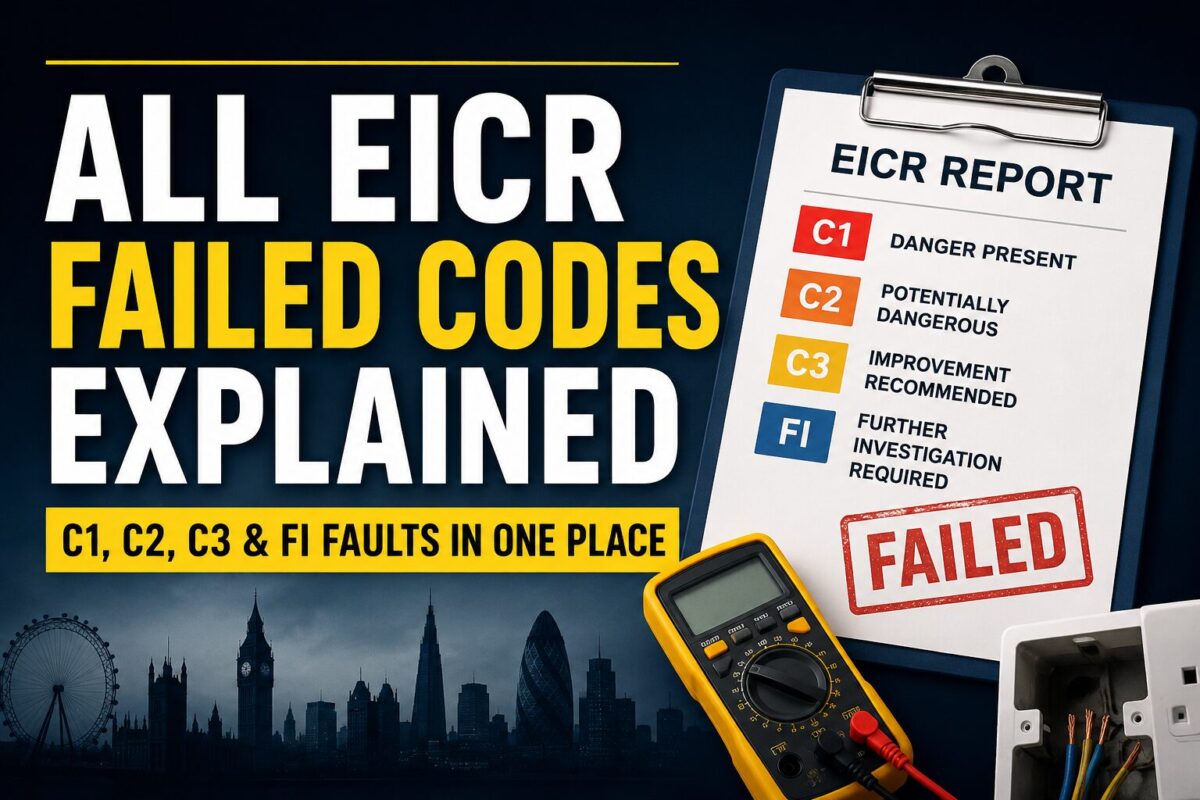
  • C1 – Danger Present

  • C2 – Potentially Dangerous

  • FI – Further Investigation Required

If any C1, C2, or FI code appears on the report, the overall result will be unsatisfactory.


Understanding C1, C2 and FI Codes (Plain English)

C1 – Danger Present

A C1 code means there is an immediate risk of injury.

Typical examples include:

  • Exposed live conductors

  • Severely damaged accessories

  • Burnt or unsafe consumer units

In many cases, the electrician will make the situation safe immediately by isolating the affected circuit.


C2 – Potentially Dangerous

A C2 fault is not immediately dangerous but could become dangerous if left unresolved.

Common C2 issues in London properties include:

  • No RCD protection on socket circuits

  • Inadequate earthing or bonding

  • Deteriorated wiring

  • Outdated consumer units

Most failed EICRs fall into this category.


FI – Further Investigation Required

An FI code means the electrician could not fully confirm safety without further checks.

This may occur when:

  • Wiring is concealed

  • Access is restricted

  • Test results are inconclusive

An FI does not automatically mean the installation is unsafe, but investigation is required to confirm compliance.


The EICR Unsatisfactory 28-Day Rule Explained (England)

For private rented properties in England, the Electrical Safety Standards regulations require landlords to:

  1. Complete any remedial or further investigative work within 28 days, or within a shorter period if specified in the EICR

  2. Obtain written confirmation from a qualified person that the work has been completed

  3. Provide a copy of that confirmation (together with the EICR) to tenants and the local authority if requested

This legal obligation is commonly referred to as the “EICR unsatisfactory 28-day rule.”

Important: This requirement applies to the private rented sector in England. Different rules may apply in Wales or Scotland.


Is the 28-Day Deadline Strict?

Yes. The 28-day period is a legal requirement, unless the report specifies that work must be completed sooner.

If a landlord fails to comply, the local authority has the power to:

  • Serve a remedial notice

  • Arrange the required work themselves

  • Recover the cost from the landlord

  • Impose financial penalties of up to £30,000

In London, enforcement action is far more likely when landlords fail to act or ignore the report.


What Happens If You Don’t Fix an Unsatisfactory EICR?

Failing to address an unsatisfactory EICR can lead to:

  • Council enforcement action

  • Significant financial penalties

  • Insurance complications

  • Legal disputes with tenants

  • Difficulty selling or refinancing the property

In practice, councils usually intervene only when landlords do not take reasonable steps to comply within the required timeframe.


Can Tenants Stay in the Property During Remedial Work?

In most cases, yes.

Unless a fault presents immediate danger (for example, a serious C1 issue), tenants can usually remain in the property while remedial work is carried out. Most EICR remedial works are minor and non-disruptive.


Do You Need a New EICR After Repairs?

Not always.

Once remedial or investigative work is completed:

  • Written confirmation is issued

  • The original EICR is referenced or updated

  • Legal compliance is restored

A full new EICR is only required if substantial changes are made or if the electrician recommends one.


Common Reasons EICRs Fail in London Properties

From real inspections across London, the most common causes of failure include:

  • Lack of RCD protection

  • Inadequate earthing and bonding

  • Outdated consumer units

  • Poor-quality past alterations

  • Damaged accessories or cabling

Many of these issues are quick and cost-effective to fix when addressed promptly.


Real London Case Studies: How Unsatisfactory EICRs Are Resolved

Case Study 1: Victorian Flat – Camden (NW1)

Issue: No RCD protection (C2)
Solution: Consumer unit upgrade
Timeframe: Single visit
Outcome: Compliance restored within 48 hours

Lesson: A failed EICR does not automatically mean a rewire.


Case Study 2: Buy-to-Let Property – Croydon (CR0)

Issue: FI due to inaccessible wiring
Solution: Further investigation
Timeframe: 7 days
Outcome: No remedial work required

Lesson: FI codes often simply require confirmation, not repairs.


Case Study 3: Purpose-Built Flat – Stratford (E15)

Issue: Damaged socket exposing live conductors (C1)
Solution: Same-day repair
Outcome: Immediate safety and compliance

Lesson: Even C1 faults can often be resolved quickly.


Case Study 4: HMO Property – Hackney (E8)

Issue: Multiple C2 faults
Solution: Prioritised remedial work
Timeframe: 10 days
Outcome: Full compliance, no council action

Lesson: Acting early prevents escalation.


How Much Does EICR Remedial Work Cost in London?

Typical remedial costs include:

  • RCD installation: £150–£350

  • Bonding upgrades: £80–£200

  • Consumer unit upgrades: £450–£900

  • Minor repairs: £60–£150

A full breakdown is available here:
👉 https://londoneicrcertificates.co.uk/eicr-certificate-cost/


Step-by-Step: How to Fix an Unsatisfactory EICR Correctly

  1. Review the EICR and understand the fault codes

  2. Arrange remedial or investigative work promptly

  3. Complete the work within 28 days (or sooner if required)

  4. Obtain written confirmation

  5. Retain records for compliance

We handle this entire process end-to-end:
👉 https://londoneicrcertificates.co.uk/remedial-work-for-failed-eicr-certificates/


EICR Requirements by Property Type

Landlords:
👉 https://londoneicrcertificates.co.uk/eicr-certificates-for-landlords-in-london/

Homeowners:
👉 https://londoneicrcertificates.co.uk/eicr-certificates-for-homeowners-in-london/

Commercial Properties:
👉 https://londoneicrcertificates.co.uk/commercial-eicr-certificates-in-london/


Why London Landlords Choose Us

  • NICEIC-approved electricians

  • Fixed, transparent pricing

  • Fast turnaround

  • Same-day reports available

  • Extensive experience with London properties

👉 https://londoneicrcertificates.co.uk/eicr-services/


Book EICR Remedial Work or Inspection Online

If your EICR is unsatisfactory and the 28-day deadline is approaching, acting early almost always saves time and money.

👉 https://londoneicrcertificates.co.uk/eicr-price-calculator/


Final Thoughts

An unsatisfactory EICR is not a crisis. For most landlords, it is a short, manageable compliance process when handled correctly.

Understanding what the report means, knowing your legal obligations, and acting promptly ensures your property remains safe, compliant, and legally lettable.


Need help now?

We’re happy to guide landlords through failed EICRs and help restore compliance quickly and professionally.

❓Frequently Asked Questions About Unsatisfactory EICRs & the 28-Day Rule

1. What does “unsatisfactory” actually mean on an EICR?

An EICR is marked unsatisfactory if the electrician identifies any safety issue that requires action, such as a C1, C2 or FI code. It does not mean the entire electrical system is dangerous, only that specific issues must be addressed to achieve compliance.

2. Do landlords really have only 28 days to fix a failed EICR?

For private rented properties in England, landlords must complete remedial or investigative work within 28 days, or sooner if the EICR specifies a shorter timeframe. Written confirmation of completion is also required.

3. Does the 28-day rule apply to homeowners?

No. The 28-day legal requirement applies to private rented properties in England. Homeowners are not legally bound by this deadline, although fixing safety issues is strongly recommended.

4. What happens if I miss the 28-day deadline?

If a landlord fails to comply, the local authority may take enforcement action. This can include serving a remedial notice, arranging work themselves, recovering costs, and issuing financial penalties of up to £30,000.

5. Do I need a full new EICR after remedial work?

Not always. In most cases, the electrician will issue written confirmation that the remedial or investigative work has been completed, which restores compliance. A full new EICR is only needed if major changes are made or recommended.

6. Can tenants stay in the property if the EICR is unsatisfactory?

In most cases, yes. Unless there is an immediate danger (such as a serious C1 fault), tenants can usually remain in the property while remedial work is carried out.

7. Are C2 faults considered dangerous?

C2 faults are classed as potentially dangerous, meaning they may not pose an immediate risk but could become hazardous if left unresolved. These faults must still be fixed within the required timeframe.

8. What is an FI code and should landlords be worried?

An FI (Further Investigation) code means the electrician could not confirm safety without additional checks. It does not automatically mean the installation is unsafe, but investigation must be completed to confirm compliance.

9. How much does it usually cost to fix an unsatisfactory EICR?

Costs vary depending on the issue. Many common problems, such as RCD protection or bonding upgrades, are relatively affordable. In London, most remedial works cost far less than landlords expect, especially when addressed early.

10. What is the fastest way to deal with a failed EICR?

The fastest approach is to review the report immediately, book remedial work with a qualified electrician, complete the work within the required timeframe, and obtain written confirmation. Acting early almost always prevents stress, fines, and unnecessary costs.

Please Submit Details Below

For your convenience, you can also fill out our online contact form below. Please provide as much detail as possible, and a member of our team will get back to you promptly.
Select Certificate Type:
Tags :
EICR Certificates,EICR Inspection
Share This :

Messy Consumer Unit (DB) in London: Is It a Fail on an EICR? [Examples, Codes & Fixes]

Are you a homeowner, landlord, or business owner in London? Ensuring the safety and compliance of your property’s electrical installations is crucial, and that’s where an Electrical Installation Condition Report (EICR) certificate comes in. But, how do you obtain one? Our step-by-step guide provides all the information you need to follow to get your EICR certificate. From finding a qualified electrician to scheduling the inspection and addressing any issues highlighted in the report, our guide covers everything you need to know. Don’t risk the safety of your property – read our guide and obtain your EICR certificate today!

Messy Consumer Unit (DB) in London: Is It a Fail on an EICR? [Examples, Codes & Fixes]

EICR Certificates,EICR Guide,Electrical Installation,Property Management
Home / Archive by category "Electrical Installation"
Messy electrical consumer unit (DB) inspected during an EICR in a London property

Messy Consumer Unit (DB) in London: Is It a Fail on an EICR?

(2026 London Legal Guide & Booking Advices)

If you’ve recently booked an EICR inspection in London and the electrician mentioned that your consumer unit (also known as a distribution board or DB) looks messy, it can feel stressful. Many landlords, homeowners, and business owners assume that “messy” automatically means a fail.

The truth is more nuanced.

A messy consumer unit does not automatically fail an EICR, but it often raises red flags that lead to deeper checks. In some cases, it results in advisory notes. In others, it exposes safety issues that require urgent remedial work.

In this guide, we’ll explain what a messy consumer unit really means, how it’s assessed during an EICR, what C2 and C3 codes are commonly issued, and how to fix it properly and cost-effectively in London.

If you want to understand the full inspection process first, visit our main guide to EICR Services.


Quick Answer: Is a Messy Consumer Unit a Fail on an EICR?

Short answer: No, not always.

A messy consumer unit only fails an EICR if the untidy condition hides safety-related defects, such as loose connections, exposed live parts, overheating, missing protection, or non-compliant components.

If the consumer unit is untidy but electrically safe, the installation may pass with C3 recommendations. If potential danger is identified, the EICR will fail with a C2 observation and remedial work will be required.

If you need the fastest route to sorting this, you can Book Now Online.


What Is a Consumer Unit (DB)?

A consumer unit is the central control point of your electrical installation. It distributes electricity safely throughout the property and contains:

  • Circuit breakers (MCBs or RCBOs)

  • RCD protection

  • Main isolator switch

  • Surge Protection Device (SPD) in many modern installations

  • Earthing and bonding connections

During an Electrical Installation Condition Report (EICR), the consumer unit is one of the most important areas inspected because faults here can affect the entire system.

If you are a homeowner, you may want to start here: EICR Certificates for Homeowners.


What Does “Messy Consumer Unit” Actually Mean?

A messy consumer unit is not about appearance alone. Electricians assess safety, compliance, and workmanship, not cosmetic neatness.

A consumer unit is typically described as “messy” when it shows one or more of the following:

  • Disorganised or tangled internal wiring

  • Poor cable management

  • Mixed brands of MCBs or RCDs

  • Missing blanking plates

  • Unclear or missing circuit labelling

  • Overcrowded terminals

  • Signs of overheating or arcing

  • Unsupported or poorly routed cables

  • Multiple historic modifications

Sometimes the issue is minor. Other times it’s a warning sign that the installation has been patched over time instead of maintained professionally.


Is a Messy Consumer Unit an Automatic Fail on an EICR?

No, but it often leads to EICR observations because messy boards commonly hide defects that affect safety.

The EICR codes are based on risk:

  • C3 = improvement recommended (usually still passes)

  • C2 = potentially dangerous (fails)

  • C1 = dangerous now (fails and requires immediate action)

  • FI = further investigation needed

To understand the difference between FI and other codes, you can also read our guide on EICR reporting and meaning, and check the answers on our FAQ page.


Messy Consumer Unit EICR Outcomes (At a Glance)

Issue Found Inside Consumer Unit Typical EICR Code Pass or Fail
Poor or missing circuit labels C3 Pass
Untidy but secure wiring C3 Pass
Loose or poorly terminated cables C2 Fail
Exposed live parts C2 Fail
Mixed MCB or RCD brands C2 Fail
Missing blanking plates C2 Fail
No surge protection where required C2 Fail
Signs of overheating or burning C2 Fail

When a Messy Consumer Unit Results in a C3 Code (Pass)

A C3 code means improvement is recommended, but the installation is not immediately dangerous.

Typical C3 items include:

  • Untidy internal wiring that is secure

  • Weak labelling that should be improved

  • Cosmetic disorganisation

  • Older but functional consumer unit layout

C3 recommendations are worth fixing because they reduce risk and help future inspections run smoother.


When a Messy Consumer Unit Triggers a C2 Code (Fail)

A C2 code indicates a potentially dangerous condition.

Messy consumer units frequently lead to C2 observations when they reveal:

  • Loose or overheated connections

  • Exposed live parts due to missing blanks

  • Mixed manufacturer breakers

  • Inadequate RCD protection

  • Absence of surge protection (SPD)

  • Incorrect cable sizing or overcrowding

If a C2 is issued, the EICR fails and the next step is remedial work. We explain the process clearly here: EICR Remedial Work.


Common Hidden Problems Found Behind Messy Consumer Units

What initially looks like poor organisation often hides deeper compliance issues, including:

Mixed protective devices

Different brands of breakers in the same board can raise compatibility concerns and often leads to a fail depending on configuration.

Missing surge protection (SPD)

A messy DB often reveals there is no SPD installed. If you were flagged for this recently, our guide explains it fully: No SPD on my EICR report.

Poor earthing and bonding

Loose or missing bonding is one of the most common London EICR failures. See: EICR failed missing bonding.

Overloaded circuits

Overloading can be hidden behind untidy wiring. See: EICR failed overloaded circuits.


Real Case Studies: Messy Consumer Units Found During EICRs in London

Case Study 1: Rental Flat in Islington (N1)

Issue: Untidy DB with poor labelling
EICR result: Pass with C3 recommendations
Fix: Tidy internal wiring, improve circuit labels
Outcome: Landlord avoided a fail and simplified future inspections
(If you’re in this area, see: EICR Certificate Islington N1.)

Case Study 2: Victorian House in Clapham (SW4)

Issue: Messy DB with mixed devices and missing blanks
EICR result: Fail with C2 observations
Fix: Compatible devices + safety corrections, plus SPD where required
Outcome: Compliance achieved without unnecessary upselling
(Local page: EICR Certificate Clapham SW4.)

Case Study 3: Central London Office

Issue: Modified DB with loose connections and overheating signs
EICR result: Fail with multiple C2 observations
Fix: Consumer unit upgrade and corrective remedial work
Outcome: Business achieved compliance and reduced downtime
(Commercial info: Commercial EICR Certificates in London.)


How Is a Messy Consumer Unit Fixed?

The right solution depends on what the inspection finds.

Option 1: Consumer unit tidy-up (minor works)

Best when there are no safety defects, but the board is poorly organised.

Option 2: Partial upgrade

Needed when protective devices are wrong, missing, or outdated, but a full replacement is not required.

Option 3: Full consumer unit replacement

Recommended where the board is no longer safe or compliant.

If you’re unsure about costs, use our pricing guide: EICR Certificate Cost.


How Much Does It Cost to Fix a Messy Consumer Unit in London?

Typical ranges:

  • Minor tidy-up: £150 to £350

  • Partial upgrade: £350 to £700

  • Full replacement: £600 to £1,200+

The best way to get an accurate price is to book an inspection and receive a clear report plus options.


Does a Messy Consumer Unit Affect Landlords Differently?

Yes. If you’re renting out a property, compliance matters.

Landlords should read: EICR Certificates for Landlords.

If your EICR fails, remedial work must be completed, then the report updated. We walk through the process here: EICR Remedial Work.


What About Homeowners?

Homeowners aren’t legally forced to act on C3 observations, but it’s still smart to address them. A tidy, compliant consumer unit improves:

  • Safety

  • Reliability (less nuisance tripping)

  • Sale and remortgage confidence

Homeowner info: EICR Certificates for Homeowners.

Book an EICR or Remedial Work in London

If your consumer unit may cause issues, sorting it early saves time, stress, and money.

We offer:

  • Fast EICR inspections across London

  • Clear, honest reports

  • In-house remedial work

  • Same-day and urgent bookings

👉 Book Now Online
👉 View Areas We Cover
👉 Learn more about our EICR Services

❓Frequently Asked Questions About Messy Consumer Units and EICR Inspections

1. What counts as a “messy” consumer unit during an EICR?

A consumer unit is considered messy when internal wiring is poorly organised, labelling is unclear, components are mixed, or modifications over time have left the board untidy or difficult to inspect safely.

2. Can a messy consumer unit still pass an EICR?

Yes. If the wiring is untidy but secure and there are no safety defects, the installation may pass with C3 recommendations rather than fail.

3. What EICR code is usually given for a messy consumer unit?

This depends on risk. Minor issues usually receive a C3 code, while problems that could become dangerous, such as loose connections or exposed live parts, are typically coded as C2.

4. Does poor labelling alone cause an EICR failure?

No. Poor or missing circuit labelling normally results in a C3 recommendation, not a failure, unless it contributes to a wider safety concern.

5. Why do electricians take messy consumer units seriously?

Messy consumer units often hide loose connections, overheating, and poor workmanship, which increases the risk of faults and electrical fires if left unresolved.

6. Is a messy consumer unit more likely to fail in rental properties?

Yes. Rental properties are inspected more strictly because landlords have legal responsibilities. Issues found in messy consumer units are more likely to result in a failed EICR for rented homes.

7. Can I tidy a consumer unit before an EICR inspection?

Only a qualified electrician should work inside a consumer unit. DIY attempts can create safety risks and may lead to an immediate EICR failure.

8. Will tidying a messy DB reduce remedial work costs?

In many cases, yes. Addressing minor organisation and labelling issues early can prevent more serious faults from developing and reduce overall repair costs.

9. How long does it take to fix issues found in a messy consumer unit?

Minor tidy-up work can often be completed within an hour, while partial upgrades or replacements may take several hours depending on the severity.

10. Should I book an EICR if my consumer unit looks messy but works fine?

Yes. A professional EICR is the only way to confirm whether the installation is safe and compliant, even if everything appears to be working normally.

Please Submit Details Below

For your convenience, you can also fill out our online contact form below. Please provide as much detail as possible, and a member of our team will get back to you promptly.
Select Certificate Type:
Tags :
EICR Certificates,EICR Inspection
Share This :

Office EICR London: What Landlords and Facilities Teams Need for Offices & Co-Working Spaces

Are you a homeowner, landlord, or business owner in London? Ensuring the safety and compliance of your property’s electrical installations is crucial, and that’s where an Electrical Installation Condition Report (EICR) certificate comes in. But, how do you obtain one? Our step-by-step guide provides all the information you need to follow to get your EICR certificate. From finding a qualified electrician to scheduling the inspection and addressing any issues highlighted in the report, our guide covers everything you need to know. Don’t risk the safety of your property – read our guide and obtain your EICR certificate today!

Office EICR London: What Landlords and Facilities Teams Need for Offices & Co-Working Spaces

EICR Certificates,EICR Guide,Electrical Installation,Property Management
Home / Archive by category "Electrical Installation"
Office EICR London inspection being carried out in a modern co-working space.

Office EICR London: What Landlords and Facilities Teams Need for Offices & Co-Working Spaces

(2026 London Legal Guide & Booking Advices)

If you manage, own, or operate an office building, serviced office, or co-working space, an Office EICR London inspection is not just a formality. It is a core safety responsibility and one of the most important compliance checks for any commercial property.

Offices place far greater demands on electrical systems than residential properties. High occupancy, constant equipment use, frequent layout changes, and shared infrastructure all increase electrical risk. When issues are missed, the consequences can include downtime, failed insurance claims, or serious safety incidents.

This guide explains exactly how office EICRs work, who is responsible, what inspectors check, why offices fail, and how landlords and facilities teams can stay compliant without disrupting daily operations.


What Is an Office EICR and Why It Matters in London

An Electrical Installation Condition Report (EICR) is a detailed inspection of the fixed electrical installation within a property. In office and co-working environments, this includes:

  • Main and sub-distribution boards

  • Fixed wiring and circuits

  • Socket outlets and switches

  • Lighting systems

  • Earthing and bonding

  • Shared landlord infrastructure

In London, many offices operate from older buildings that have been upgraded multiple times. Add modern IT equipment, charging stations, access control, and HVAC systems, and electrical installations are often working far beyond their original design intent.

An office EICR London inspection confirms whether the installation is safe for continued use and highlights risks before they become serious problems.


Who Is Responsible for an Office EICR?

Responsibility depends on how the building is structured, but confusion is common.

Landlord Responsibilities

Landlords are typically responsible for:

  • Incoming electrical supply

  • Main distribution boards

  • Riser cupboards and landlord areas

  • Base-build electrical systems

If you own the building, you are legally responsible for ensuring these systems are safe and compliant.

Facilities Teams and Operators

Facilities managers are often responsible for:

  • Organising EICR inspections

  • Coordinating access and scheduling

  • Managing compliance documentation

  • Arranging remedial works

In co-working and serviced offices, responsibility often extends across the entire space, making regular EICRs essential.

If responsibility is unclear, a professional inspection from a specialist in commercial EICR certificates in London will define boundaries clearly in the report.
👉 https://londoneicrcertificates.co.uk/commercial-eicr-certificates-in-london/


Offices vs Co-Working Spaces: How EICR Inspections Differ

While the report format is the same, the inspection challenges are not.

Shared Distribution and Load Issues

Co-working spaces often use shared boards feeding multiple areas. In London co-working environments, we frequently see EICR issues caused by desk reconfigurations where temporary power solutions slowly become permanent installations.

This can lead to:

  • Overloaded circuits

  • Inadequate protection

  • Poor circuit documentation

Tenant Fit-Outs and Modifications

Office tenants regularly add:

  • Extra sockets

  • Meeting rooms

  • Server areas

If these changes are not properly certified, they are flagged during an EICR.

Downtime Sensitivity

Offices cannot afford extended power outages. A professional EICR testing service in London plans inspections in phases, often out of hours, to minimise disruption.
👉 https://londoneicrcertificates.co.uk/eicr-testing-in-london/


What an Office EICR Inspection Covers

A professional office EICR inspection includes:

  • Visual checks for damage, overheating, and poor workmanship

  • Testing of circuits for continuity, insulation resistance, and polarity

  • Verification of earthing and bonding

  • RCD and protective device testing

  • Identification of fire and shock risks

The purpose is not to fail buildings unnecessarily but to provide a clear, accurate assessment of electrical safety.

For a clear breakdown of report results and codes, see:
👉 https://londoneicrcertificates.co.uk/how-to-read-an-eicr-report-and-ensure-electrical-safety-in-london/


Understanding EICR Codes in Offices

Office EICRs use standard safety codes:

C1 – Danger Present

Immediate risk. Action required straight away.

C2 – Potentially Dangerous

Common in offices and co-working spaces. These faults must be repaired.

C3 – Improvement Recommended

Not unsafe, but below current standards.

FI – Further Investigation Required

Often used where access is restricted or documentation is missing.

If an office EICR includes C2 or FI items, remedial work is usually required.
👉 https://londoneicrcertificates.co.uk/remedial-work-for-failed-eicr-certificates/


Common Reasons Offices Fail an EICR

Across London office inspections, the most frequent issues include:

  • Overloaded circuits from added desks and equipment

  • Missing or inadequate RCD protection

  • Poor earthing in older buildings

  • Uncertified tenant alterations

  • Heat damage inside distribution boards

  • Incorrect or missing circuit labelling

Real Example

In a Shoreditch co-working space, an EICR identified overloaded ring circuits caused by gradual desk expansion. The issue was resolved by redistributing loads and upgrading protection, avoiding a full shutdown and allowing the space to remain operational.


How Often Do Offices Need an EICR?

Best practice guidance recommends:

  • Every 5 years for standard offices

  • Every 3 years for high-usage or co-working spaces

  • At lease changes or handovers

  • After significant electrical alterations

Facilities teams that schedule inspections proactively avoid emergency repairs and compliance pressure.


Office EICR Cost in London: What Affects Pricing?

Office EICR costs depend on:

  • Size of the premises

  • Number of distribution boards

  • Complexity of the installation

  • Age of the wiring

  • Access and out-of-hours requirements

For transparent pricing guidance, see:
👉 https://londoneicrcertificates.co.uk/eicr-certificate-cost/


How to Prepare Your Office for an EICR Inspection

Good preparation reduces disruption and cost.

Before inspection:

  • Ensure access to all electrical rooms

  • Notify staff or tenants in advance

  • Provide previous EICR reports if available

  • Identify critical systems and working hours

Prepared sites are inspected faster and experience fewer delays.


Legal and Insurance Implications for Offices

A valid office EICR:

  • Demonstrates duty of care

  • Supports insurance cover

  • Reduces liability exposure

  • Protects landlords and operators

After incidents, insurers and investigators will request electrical safety documentation. An outdated or missing EICR can cause serious complications.


Why Facilities Teams Choose Specialist Commercial Inspectors

Office electrical systems are not residential systems. Commercial specialists understand:

  • High-load environments

  • Shared responsibilities

  • Business-critical operations

  • Minimal disruption planning

Our team focuses exclusively on professional EICR services in London, including complex office and co-working environments.
👉 https://londoneicrcertificates.co.uk/eicr-services/


Booking an Office EICR in London

If your office or co-working space has never had a formal EICR, or if the last inspection was over five years ago, now is the safest time to act before issues become urgent.

We provide:

  • Commercial-only inspections

  • Flexible scheduling

  • Clear reporting

  • Support with remedial works

You can book directly online here:
👉 https://londoneicrcertificates.co.uk/book-online/

EICR Price Calculator

For common questions, visit our FAQ page:
👉 https://londoneicrcertificates.co.uk/faq/


Final Thoughts

An Office EICR London inspection is not just about compliance. It is about protecting people, businesses, and assets in environments where electrical systems operate under constant demand.

Landlords and facilities teams who take a proactive approach avoid downtime, reduce risk, and demonstrate professional management standards.


❓Office EICR London – Frequently Asked Questions for Offices & Co-Working Spaces

1. Do offices in London legally need an EICR?

Yes. While there is no single law naming “office EICR”, UK health and safety regulations require all electrical systems in commercial premises to be safe and maintained. An EICR is the recognised way to prove compliance and duty of care for offices and co-working spaces.

2. How often should an office or co-working space have an EICR?

Most offices require an EICR every 5 years, but high-usage environments like co-working spaces are often inspected every 3 years. An EICR is also recommended after major electrical changes or at lease handover.

3. Who is responsible for arranging an office EICR: the landlord or the tenant?

It depends on the lease. Landlords are usually responsible for base-build electrics and shared systems, while tenants or operators are responsible for internal fit-outs. In co-working spaces, the operator often carries full responsibility for the electrical installation.

4. Will an office EICR inspection disrupt staff or business operations?

A professional commercial electrician will plan the inspection to minimise disruption. Many office EICRs are carried out in phases or outside working hours, with short and controlled power interruptions where required.

5. What are the most common EICR failures in offices?

Common issues include overloaded circuits, missing RCD protection, poor earthing, uncertified tenant alterations, and heat damage inside distribution boards. These faults usually develop gradually and are often unnoticed until an inspection.

6. What happens if an office EICR comes back unsatisfactory?

If the report includes C1 or C2 faults, remedial work is required to make the installation safe. The electrician will clearly explain what needs fixing, how urgent it is, and whether work can be planned without shutting down the office.

7. Is an EICR required for serviced offices and shared workspaces?

Yes. Serviced offices and co-working spaces typically have higher electrical usage and more frequent layout changes, which makes regular EICR inspections especially important for safety, compliance, and insurance purposes.

8. How long does an office EICR inspection usually take?

This depends on the size and complexity of the office. Small offices may take a few hours, while larger or multi-floor buildings can take a full day or be spread over multiple visits to avoid disruption.

9. How much does an office EICR cost in London?

Office EICR costs vary based on size, number of circuits, distribution boards, and access requirements. Larger offices or co-working spaces with complex installations will cost more than small, single-floor offices.

10. What should facilities teams prepare before an office EICR?

Facilities teams should ensure access to electrical rooms, inform staff in advance, provide previous EICR reports if available, and identify any critical systems. Good preparation helps the inspection run faster and more smoothly.

Please Submit Details Below

For your convenience, you can also fill out our online contact form below. Please provide as much detail as possible, and a member of our team will get back to you promptly.
Select Certificate Type:
Tags :
EICR Certificates,EICR Inspection
Share This :

Is No AFDD a Fail on an EICR? Full Guide for London Landlords & Homeowners

Are you a homeowner, landlord, or business owner in London? Ensuring the safety and compliance of your property’s electrical installations is crucial, and that’s where an Electrical Installation Condition Report (EICR) certificate comes in. But, how do you obtain one? Our step-by-step guide provides all the information you need to follow to get your EICR certificate. From finding a qualified electrician to scheduling the inspection and addressing any issues highlighted in the report, our guide covers everything you need to know. Don’t risk the safety of your property – read our guide and obtain your EICR certificate today!

Is No AFDD a Fail on an EICR? Full Guide for London Landlords & Homeowners

EICR Certificates,EICR Faults & Failures,EICR Guide,Electrical Installation
Home / Archive by category "Electrical Installation"
Electrician inspecting a consumer unit with text overlay “Is No AFDD a Fail on an EICR?” and C3 safety code symbol, representing EICR inspection and AFDD guidance in London.

Is No AFDD a Fail on an EICR? (Full Guide for London Landlords & Homeowners)

Electrical regulations are constantly evolving, and the introduction of Arc Fault Detection Devices (AFDDs) is one of the biggest updates to the BS 7671:2018 (Amendment 2) wiring standards.
Many London landlords and homeowners are now asking the same question:

👉 “Is no AFDD a fail on my EICR report?”

This guide explains exactly what a C3 “No AFDD” observation means, why it’s not a failure, and when upgrading your consumer unit to include AFDD protection makes sense.

⚡ What Is an AFDD and Why It Matters

An AFDD (Arc Fault Detection Device) is an advanced type of protection that detects dangerous arc faults , tiny electrical sparks caused by damaged cables or loose connections that can lead to fires.

AFDDs continuously monitor your electrical circuits and disconnect power automatically if they detect an arc.
They’re especially effective in preventing electrical fires, which account for thousands of incidents across the UK every year.

While AFDDs add an extra layer of safety, they are not yet mandatory for all circuits, which leads us to the key point of confusion during EICR inspections.

🧾 What Does “C3 – No AFDD” Mean on an EICR?

When your Electrical Installation Condition Report (EICR) lists “C3 – No AFDD”, it simply means:

Your installation is safe, but could be improved by adding AFDD protection.

It’s not a failure it’s a recommendation.

Here’s a quick breakdown of the EICR coding system:

Code Meaning Result
C1 Danger Present – Immediate action required FAIL
C2 Potentially Dangerous – Urgent remedial work required FAIL
C3 Improvement Recommended PASS
FI Further Investigation Required FAIL (until checked)

So, if your report includes C3 – No AFDD, your property still passes the EICR and receives a ‘Satisfactory’ outcome.

🔍 When Are AFDDs Required Under BS 7671:2018 (Amendment 2)?

Under the 18th Edition Wiring Regulations (BS 7671:2018+A2:2022), AFDDs are recommended, not mandatory for most standard domestic circuits.

However, they are required in specific high-risk situations such as:

  • HMOs (Houses in Multiple Occupation)
  • Student accommodation
  • Care homes or similar premises
  • High-rise residential buildings (above 18 metres)

If your property falls into one of these categories, your electrician may recommend upgrading to AFDDs during your EICR or future rewiring work.

🧯 Why “No AFDD” Is a C3, Not a Failure

The main reason AFDD absence is coded as C3 rather than C2 or C1 is that:

  • The system is still safe without AFDDs.
  • BS 7671 only recommends AFDDs in most cases, not mandates them.
  • RCDs and MCBs already provide strong protection in modern installations.

An experienced electrician records it as a recommendation for future upgrade, especially during consumer unit replacements.

If your property already has a modern board with RCDs or RCBOs, your electrical safety is considered compliant and safe.

🧰 When to Consider Upgrading to AFDDsScenarios in London Properties

Although not required, adding AFDDs can significantly improve protection against electrical fires.
Here’s when upgrading might be worth it:

  • You’re replacing your consumer unit
  • Your property is a rental (HMO) or multi-occupancy building
  • You’ve had frequent tripping issues or signs of arcing (burn marks, smell of burning, etc.)
  • You want to future-proof your home for upcoming safety standards

Our electricians frequently install consumer units equipped with AFDD + RCBO protection, ensuring full compliance with the latest BS 7671 standards.

🔧 Learn more about our EICR Remedial Work services.

🏙️ Common Misunderstandings About AFDDs and EICR Reports

Many landlords worry that a C3 – No AFDD observation might affect their rental compliance or insurance, but that’s not the case.

Let’s clarify:

  • C3 codes do not cause an EICR to fail.
  • You can legally let or sell the property with a C3 observation.
  • Insurers rarely require AFDDs but may offer reduced fire-risk ratings for upgraded systems.

Your EICR will remain valid and compliant for 5 years (or 1 year after tenant change for rentals).

🧠 How to Read “C3 – No AFDD” in Your Report

A typical observation might look like this:

“No AFDD protection present on socket and lighting circuits – C3 (Improvement Recommended) – Regulation 421.1.7 BS7671:2018+A2:2022.”

This tells you your installation complies with the minimum safety standards, but adding AFDDs would enhance fire protection.

If your EICR also mentions No RCD or No SPD, those may be coded C2 and require urgent attention.

👉 Check out our guide: Is No RCD a Fail on an EICR?

💰 How Much Does It Cost to Add AFDD Protection?

Upgrading to AFDDs is more expensive than standard RCDs, as each device costs between £90–£130 per circuit, compared to around £25–£40 for standard RCBOs.

A full consumer unit upgrade including AFDDs typically costs £750–£1,200, depending on the number of circuits.

To keep costs efficient, many property owners choose partial AFDD upgrades during future rewiring or safety improvements.

💡 Get a clear quote with our EICR Certificate Cost Guide.

🧾 What Should Landlords Do If They Receive a C3 for No AFDD?

If your EICR lists a C3 – No AFDD, you don’t need immediate action but it’s smart to plan ahead.

Here’s a simple checklist:

  1. Keep your EICR report on file for compliance proof.
  2. Ask your electrician for an upgrade quote for AFDDs or a new board.
  3. Review other C2 or C1 faults first (they must be fixed to pass).
  4. Schedule your next EICR renewal before the 5-year mark.

Need help interpreting your report?

🏡 Why Choose London EICR Certificates

At London EICR Certificates, our NICEIC-approved electricians perform hundreds of inspections every month across London.
We help landlords, agents, and homeowners stay compliant with all UK electrical safety laws — from initial inspection to remedial works and final certification.

✅ Same-day digital certificates
✅ Affordable remedial quotes
✅ Fully insured & certified electricians
✅ Covering all London postcodes

🔗 Book your EICR inspection online today at https://londoneicrcertificates.co.uk/book-online/

🧩 Summary: Is No AFDD a Fail on an EICR?

Question Answer
Is no AFDD a fail on an EICR? ❌ No – it’s a C3 (Improvement Recommended)
Does C3 mean unsatisfactory? ✅ No – your EICR still passes
Are AFDDs mandatory in 2025? ⚙️ Only in certain high-risk buildings
Should landlords upgrade? 💡 Recommended when replacing consumer units
Can you rent with a C3? ✅ Yes – fully compliant

The “No AFDD – C3” observation in your EICR is not a failure it’s a recommendation for added protection.
While AFDDs aren’t mandatory yet, they represent the next generation of electrical fire safety and will likely become standard in the future.

If you’re planning electrical upgrades or consumer unit replacements, it’s worth discussing AFDD options with your electrician.

🔧 For expert advice or to book your next EICR inspection, visit our EICR Services page

🧠 Frequently Asked Questions about AFDD and EICR Reports

1. Is “No AFDD” a fail on an EICR report?

No. “No AFDD” is recorded as a C3 – Improvement Recommended, not a failure. Your electrical installation is still safe and compliant, but the electrician suggests adding AFDD protection to improve safety in the future.

2. What does C3 mean on an EICR report?

A C3 code means the system is safe for continued use but could be improved. It doesn’t fail your report. Only C1, C2, or FI codes make an EICR unsatisfactory.

3. Are AFDDs mandatory in the UK?

As of 2025, AFDDs are not mandatory for every property. They’re only required in certain high-risk buildings such as HMOs, student accommodation, care homes, and high-rise residential buildings.

4. Should landlords install AFDDs in London properties?

It’s not required by law, but strongly recommended especially in rental or multi-occupancy properties. Installing AFDDs can help reduce electrical fire risks and future-proof your property against regulation changes.

5. How much does it cost to add AFDD protection?

Installing AFDDs usually costs between £90–£130 per circuit, or £750–£1,200 for a full consumer unit upgrade. The cost depends on the number of circuits and the existing board type.

6. Can I pass an EICR without AFDDs?

Yes, you can still pass. The absence of AFDDs does not cause an EICR failure. It simply receives a C3 note, meaning no immediate action is required.

7. What’s the difference between AFDD, RCD, and RCBO?

RCD protects against electric shock RCBO combines RCD + circuit breaker AFDD detects dangerous arc faults that could cause fires A modern consumer unit with RCDs or RCBOs is still compliant, but adding AFDDs increases fire safety.

8. Will a C3 observation affect my landlord compliance or insurance?

No. A C3 observation does not make your property non-compliant or invalidate your insurance. However, insurers may view AFDD-equipped systems as lower fire risk, potentially improving coverage.

9. Should I upgrade to AFDDs during remedial work?

Yes, if you’re already doing remedial work or upgrading your consumer unit, adding AFDDs makes sense. It’s cost-effective and ensures compliance with the latest BS 7671:2018 (A2:2022) recommendations.

10. How can I book an EICR inspection or remedial upgrade in London?

You can book directly through our website.

Please Submit Details Below

For your convenience, you can also fill out our online contact form below. Please provide as much detail as possible, and a member of our team will get back to you promptly.
Select Certificate Type:
Tags :
EICR Certificates,EICR Inspection
Share This :

Is No RCD a Fail on an EICR? Full Guide for Landlords and Homeowners

Are you a homeowner, landlord, or business owner in London? Ensuring the safety and compliance of your property’s electrical installations is crucial, and that’s where an Electrical Installation Condition Report (EICR) certificate comes in. But, how do you obtain one? Our step-by-step guide provides all the information you need to follow to get your EICR certificate. From finding a qualified electrician to scheduling the inspection and addressing any issues highlighted in the report, our guide covers everything you need to know. Don’t risk the safety of your property – read our guide and obtain your EICR certificate today!

Is No RCD a Fail on an EICR? Full Guide for Landlords and Homeowners

EICR Certificates,Electrical Installation
Home / Archive by category "Electrical Installation"
Electrician safety illustration in blue and yellow theme showing icons for RCD protection, EICR code results, and certified electrician, with text “Is No RCD a Fail on an EICR? 2025 Guide for Landlords and Homeowners.

🧠 Is No RCD a Fail on an EICR? Full 2025 Guide for Landlords and Homeowners

When your property’s Electrical Installation Condition Report (EICR) comes back with the note “No RCD protection,” it can raise serious concerns. But does that automatically mean your property has failed its inspection?

The answer is not always.

In this comprehensive guide, our team at London EICR Certificates explains what an RCD is, when it’s required, and how it affects your EICR results. Whether you’re a landlord, homeowner, or managing agent, understanding RCD compliance is key to keeping your London property safe and legally covered.

⚡ What Is an RCD and Why Does It Matter?

RCD stands for Residual Current Device  a critical piece of electrical safety equipment that disconnects the circuit if it detects an imbalance in current, protecting people from electric shocks and preventing potential electrical fires.

Modern consumer units (fuse boxes) in London homes should include RCD protection for key circuits, especially those serving:

  • Bathrooms and kitchens
  • Outdoor sockets and garden electrics
  • Sockets likely to supply outdoor equipment
  • Portable electrical appliances

Without an RCD, even a small electrical fault can become dangerous. That’s why its presence is checked during every EICR inspection.

🧾 What Do the BS 7671 Wiring Regulations Say About RCDs?

The 18th Edition Wiring Regulations (BS 7671:2018 + A2:2022) set clear rules about where RCD protection must be installed.

Some older installations particularly pre-2008 may still be safe, even without RCDs, but they won’t meet current standards.

During an EICR, your electrician will inspect each circuit and apply observation codes depending on the risk level.

🧩 EICR Observation Codes Explained (C1, C2, C3, FI)

Every EICR report includes codes that show the level of safety concern:

CodeMeaningAction Required
C1Danger presentImmediate action required (FAIL)
C2Potentially dangerousUrgent remedial work needed (FAIL)
C3Improvement recommendedNot a fail, but upgrade advised
FIFurther investigation requiredMore testing needed

💡 So, is “No RCD” a fail?

Not necessarily.

  • No RCD on socket circuits = usually a C3 (recommended upgrade)
  • No RCD on bathroom or outdoor circuits = can be C2 (fail)
  • No RCD and exposed earthing faults = could be C1 (dangerous)

It all depends on the specific risk and use of each circuit.

🏠 Common Scenarios in London Properties

🧱 1. Older Consumer Units

Many London flats and houses still have fuse-based consumer units with no RCD protection.
These often receive a C3, meaning the system is safe to use but not compliant with modern regulations.

🚿 2. Bathroom Circuits Without RCD

If lighting or socket circuits in a bathroom lack RCD protection, it’s a C2 automatic fail. Bathrooms are high-risk environments where the electric shock risk is highest.

🌳 3. Outdoor Sockets or Garden Lighting

Circuits supplying outdoor sockets, EV chargers, or garden lights must have RCDs. Missing one here = C2 fail under BS 7671.

⚙️ 4. Commercial Units

In Commercial EICR Certificates, absence of RCD protection can lead to stricter coding due to higher public risk or business interruption potential.

🔍 How Your EICR Engineer Determines RCD Failures

A certified electrician doesn’t just check for an RCD they test how it performs. During inspection, your engineer will:

  1. Check for the presence of RCD/RCBO protection.
  2. Perform a trip time test to confirm correct operation.
  3. Note if any essential circuits (bathroom, outdoor) lack RCD coverage.
  4. Assign the appropriate observation code (C1, C2, C3).
  5. Recommend remedial upgrades where needed.

You can book certified engineers directly through our EICR Services page.

💰 Cost of Upgrading an RCD or Consumer Unit in London

Upgrading your fuse box to a modern RCD-protected RCBO consumer unit usually costs between £300 – £550, depending on property size and accessibility.

For landlords managing multiple units, bulk EICR + remedial packages can reduce overall costs. Check our EICR Certificate Cost page for transparent pricing.

If your EICR failed due to missing RCDs, we can handle all EICR Remedial Work from RCD installation to consumer unit replacement.

🧰 What Happens After a Failed EICR (Due to No RCD)?

If your property’s EICR fails (C1 or C2), it must be rectified within 28 days under the Electrical Safety Standards in the Private Rented Sector (England) Regulations 2020.

Once remedial work is complete, we’ll issue an updated report confirming the property now meets safety standards.

Landlords can learn more about their obligations here:

🧠 Why Many London Properties Still Lack RCD Protection

Thousands of older homes and rental properties in London were built before RCDs became mandatory. Many landlords assume their systems are still compliant, but under current legislation, electrical safety inspections are now stricter than ever.

Modern RCD protection is not only about compliance, it’s about tenant safety and insurance validity.

🏢 RCDs in Commercial EICRs

In commercial or industrial properties, the absence of RCDs can pose greater risks.
These environments often involve:

  • Heavy machinery or kitchen equipment
  • Outdoor lighting systems
  • Public access areas

A Commercial EICR Certificate ensures your business remains compliant, prevents downtime, and keeps insurance valid.

👉 Learn more on our Commercial EICR page.

⚙️ How to Upgrade to Modern RCD Protection

  • If your report shows “No RCD,” our engineers can:

  • Install RCDs or RCBOs into your current consumer unit
  • Replace old boards entirely
  • Perform remedial work for failed EICRs
  • Issue a new certificate upon completion

All work is carried out by NICEIC-approved electricians, ensuring your property is safe, certified, and compliant.

📊 Example EICR Scenario: London Flat Fails for No RCD

A recent inspection in Battersea showed:

  • 2 socket circuits without RCDs
  • Bathroom light circuit unprotected
  • No RCD main switch

Result: C2 – Fail

Remedy: Installed new RCD-protected RCBO unit for £480, passed re-test same day.
Now compliant under 18th Edition Regulations.

👉 You can read more real-life examples in our Projects section.

🧭 How Often Should You Have an EICR Done?

According to regulations:

  • Landlords: Every 5 years or at change of tenancy
  • Homeowners: Every 10 years
  • Commercial properties: Every 3–5 years, depending on usage

You can find more in-depth advice in our guide

💬 Final Thoughts

“No RCD” doesn’t always mean your EICR has failed — but it’s a clear sign your system needs improvement.

If your report shows missing RCD protection, act early. Upgrading not only ensures compliance but also protects lives and property.

At London EICR Certificates, we provide:

  • Transparent pricing
  • Fast 24–48 hour turnaround
  • NICEIC-certified electricians
  • Full remedial service and certification

Stay compliant. Stay safe.
Book your inspection today, it only takes 60 seconds.

RCD & EICR Compliance Frequently Asked Questions (2025 Guide)

❓1. Is no RCD always a fail on an EICR?

Not always. If your consumer unit has no RCD protection, it doesn’t automatically mean a failed EICR. In most cases, the electrician will issue a C3 observation, which means improvement is recommended but not an immediate fail. However, if circuits supply bathrooms, outdoor sockets, or other high-risk areas, the absence of RCD protection can lead to a C2 fail.

❓2. What is an RCD and why is it important?

An RCD (Residual Current Device) is a life-saving component that quickly disconnects electricity when it detects a fault. It protects against electric shock and fire hazards, especially in wet or outdoor environments. Without an RCD, a single fault could result in serious injury or property damage.

❓3. How can I tell if my consumer unit has RCD protection?

You can usually spot an RCD by checking your fuse box or consumer unit. RCD switches often have a small “Test” or “T” button. If you can’t find one, your system likely lacks RCD protection. Our engineers can confirm this during your EICR inspection.

❓4. What EICR code do you get for no RCD?

The observation code depends on the risk: C3 – Improvement recommended (not fail) for general circuits. C2 – Potentially dangerous (fail) if RCD is missing on bathroom, outdoor, or socket circuits that may be used outside. C1 – Immediate danger (fail) if live parts are exposed.

❓5. Can I rent out my property without RCD protection?

Yes, but only if your EICR report shows no C1 or C2 codes. If missing RCDs lead to a C2 fail, you must complete EICR remedial work within 28 days to stay compliant with the Electrical Safety Standards in the Private Rented Sector (England) Regulations 2020.

❓6. How much does it cost to add RCD protection in London?

Upgrading to RCD or RCBO protection typically costs between £300 and £550, depending on your consumer unit and property size. For commercial buildings or full rewires, costs can be higher. Visit our EICR Certificate Cost page for detailed pricing.

❓7. What’s the difference between an RCD and an RCBO?

An RCD protects multiple circuits at once, while an RCBO combines RCD and circuit breaker functions for individual circuits. Modern installations often use RCBOs for better fault isolation they’re more reliable, safer, and make future inspections simpler.

❓8. Can I fail an EICR for having an old fuse box?

Having an older fuse-based consumer unit doesn’t automatically mean failure. If it’s in good condition and tests safe, it might just receive a C3 code. However, fuse boxes without RCD protection are outdated and should be replaced to meet modern EICR standards.

❓9. Do commercial properties need RCD protection too?

Yes. Commercial properties also require RCDs in circuits where equipment could pose a shock risk or serve outdoor sockets. During a Commercial EICR Certificate inspection, missing RCDs may trigger a C2 fail if staff or the public are exposed to potential danger.

❓10. How do I fix a failed EICR due to no RCD?

If your EICR failed because of missing RCD protection, you’ll need to upgrade your consumer unit or install RCD/RCBO devices. Once completed, a follow-up inspection confirms compliance. Book your inspection with London EICR Certificates to get certified quickly.

Please Submit Details Below

For your convenience, you can also fill out our online contact form below. Please provide as much detail as possible, and a member of our team will get back to you promptly.
Select Certificate Type:
Tags :
EICR Certificates,EICR Inspection,Rental Property Safety
Share This :

EICR Remedial Work Costs in London & What Happens If You Fail an Electrical Inspection

Are you a homeowner, landlord, or business owner in London? Ensuring the safety and compliance of your property’s electrical installations is crucial, and that’s where an Electrical Installation Condition Report (EICR) certificate comes in. But, how do you obtain one? Our step-by-step guide provides all the information you need to follow to get your EICR certificate. From finding a qualified electrician to scheduling the inspection and addressing any issues highlighted in the report, our guide covers everything you need to know. Don’t risk the safety of your property – read our guide and obtain your EICR certificate today!

EICR Remedial Work Costs in London & What Happens If You Fail an Electrical Inspection

EICR Certificates,EICR Guide,Electrical Installation,Electrical Safety
Home / Archive by category "Electrical Installation"
"Illustration showing EICR remedial work costs in London with electrical warning signs, EICR report, and tools on a blue background – LondonEICRCertificates.co.uk theme"

When your property fails an EICR inspection in London, the next words you’ll hear are “remedial work.”
But what exactly are EICR remedial works, how much do they cost, and how fast can you fix the issue to get your property back to satisfactory status?

Whether you’re a landlord, homeowner, or property manager, this comprehensive 2025 guide explains EICR remedial work costs in London, what each failure code means, and the full process to get your electrical safety certificate passed quickly and affordably.

🔹 What Is EICR Remedial Work?

EICR remedial work refers to repairs or upgrades required after your property fails an Electrical Installation Condition Report.
During the EICR inspection, your electrician checks wiring, fuse boards, earthing, sockets, and all fixed electrical components.
If faults or safety issues are found, they’re given EICR codes — and these codes determine whether the installation passes or fails.

⚡ Failed EICR Report? You can book remedial works online at
👉 Remedial Work for Failed EICR Certificates

🔹 EICR Codes Explained (C1, C2, C3, FI)

Understanding your EICR report codes is key to estimating repair costs.

C1 – Danger Present

Immediate risk of injury. Your electrician must make the area safe before leaving.
Examples: live exposed wires, burnt sockets, overheating in fuse box.
🛠 Cost to fix: £50–£200 per item depending on part and labour.

C2 – Potentially Dangerous

The installation is unsafe and must be corrected urgently.
Examples: missing earthing, damaged cable insulation, old fuse board without RCDs.
🛠 Cost to fix: £150–£700 depending on issue.

C3 – Improvement Recommended

Not dangerous, but should be improved to meet modern safety standards.
Examples: minor wear on cables, missing labels, no surge protection.
🛠 Cost to fix: optional – from £30–£150.

FI – Further Investigation

The electrician suspects a problem that needs deeper analysis.
Examples: intermittent tripping, hidden wiring fault, signs of heat damage.
🛠 Cost to investigate: £90–£250 depending on testing time.

🔹 Why an EICR Might Fail

Even newer properties can fail an EICR for several reasons, including:

  1. Outdated consumer unit (fuse board) with no RCD protection.
  2. Loose or burnt connections behind sockets or lights.
  3. No main bonding to gas and water pipes.
  4. Damaged or undersized cables not meeting BS7671 standards.
  5. DIY wiring or non-compliant additions.
  6. Overloaded circuits or old lighting transformers.
  7. Signs of overheating or arcing inside junction boxes.

A failed EICR report isn’t unusual, around 40% of older London homes fail on first inspection, but what you do next matters most.

🔹 Average EICR Remedial Work Costs in London (2025)

Remedial prices vary based on the fault type, property age, and access level.
Below are realistic average London EICR repair costs to help you budget:

Type of Electrical Remedial WorkAverage Cost (excl. VAT)Description
Replace faulty socket or switch£50–£90Includes part + labour
Replace light fitting£45–£75LED upgrades optional
Replace damaged cable£90–£180Based on wall/floor access
Replace consumer unit£450–£700With full RCD protection
Upgrade earthing & bonding£150–£250Required for compliance
Fix ring main fault£150–£300Includes testing
Rewire single circuit£200–£400Small section
Full rewire (1-bed flat)£2,000–£3,000Includes testing & certificate
Full rewire (3-bed house)£3,500–£5,500Including new fuse board
Re-inspection / Re-test£90–£150To obtain pass certificate

💡 Tip: Combine remedial work and re-inspection with the same company to reduce total cost.

🔹 What Happens After a Failed EICR Report?

  1. Receive your report – The electrician lists all faults and codes.
  2. Request a quote – Ask for transparent pricing for each issue.
  3. Book remedial electrical work – Fix all C1, C2, and FI items.
  4. Re-inspection – The engineer retests the fixed circuits.
  5. Satisfactory EICR Certificate issued – You’re now compliant.

⚙️ Schedule remedial work easily:
Book EICR Repairs Online

🔹 How Long Does Remedial Work Take?

  • Minor repairs (sockets, lights): 1–2 hours
  • Fuse board replacement: 4–6 hours
  • Partial rewire: 1–2 days
  • Full rewire: 3–5 days
  • Re-inspection: 1 hour

Most EICR remedial works in London can be completed within 48 hours, ensuring your tenants stay safe and your property passes re-testing quickly.

🔹 EICR Remedial Work for Landlords

Under UK law, landlords must fix C1 and C2 issues within 28 days of a failed inspection.
A follow-up “satisfactory” EICR or written proof of repairs must then be shared with:

  • tenants, and
  • the local housing authority (upon request).
  • Failing to comply can result in civil penalties up to £30,000.

🔹 EICR Remedial Work for Homeowners

For homeowners, remedial work isn’t just about compliance — it’s about safety and long-term savings.
Fixing wiring issues early prevents:

  • circuit damage,
  • electrical fires, and
  • insurance claim rejections.

If you’re planning to sell or rent your home, a Satisfactory EICR Certificate helps buyers, agents, and insurers trust your property’s safety record.

Learn more about homeowner testing:
EICR Certificates for Homeowners in London

🔹 How to Reduce EICR Fail Cost

  1. Book with the same electrician who carried out your inspection.
  2. Request a written breakdown instead of a lump-sum quote.
  3. Upgrade once, not twice – install a modern consumer unit.
  4. Combine repairs with re-inspection to save call-out fees.
  5. Perform regular checks to avoid buildup of faults before the next test.

💰 For full pricing transparency, visit:
EICR Certificate Cost

🔹 EICR Remedial Work for Businesses & Offices

Commercial properties in London often need specialist EICR repairs due to higher electrical load and complex circuits.
Typical issues include:

  • Overloaded socket extensions
  • No RCD protection on distribution boards
  • Damaged emergency lighting circuits
  • Old wiring in suspended ceilings

These are classed as EICR remedial works London businesses must fix quickly to maintain insurance coverage and meet the Electricity at Work Regulations 1989.

🏢 Commercial solutions here:
Commercial EICR Certificates in London

🔹 NICEIC Remedial Work & Certification

Always ensure your EICR remedial works are done by a qualified NICEIC or NAPIT-registered electrician.
This guarantees:

  • compliance with BS7671 standards,
  • valid re-inspection certificates, and
  • safety assurance for insurance or legal use.

🧰 Our NICEIC engineers handle full diagnostics, repairs, and certification:
EICR Services in London

🔹 Urgent & Same-Day EICR Repairs

Sometimes, you can’t wait.
For example:

  • your tenant’s move-in date is tomorrow,
  • you need a satisfactory EICR for insurance, or
  • the property had a C1 immediate danger.

Our team provides urgent EICR remedial work across Greater London including Battersea, Belgravia, Chelsea, and East London with same-day re-testing availability.

🚨 Book emergency help now:
Book EICR Online

🔹 Domestic vs. Commercial EICR Repairs

TypeDomestic (Homes, Flats)Commercial (Shops, Offices)
ScopeWiring, sockets, lights, consumer unitDistribution boards, emergency lighting, machinery circuits
Testing standardBS7671:2018BS7671 + Electricity at Work Regs
Cost range£50–£700 typical£150–£2000+
FrequencyEvery 5–10 yearsEvery 3–5 years

Both types of properties require remedial electrical work London-wide to maintain safety and compliance.

🔹 EICR After Remedial Work – Passing the Certificate

After repairs, your electrician performs a re-inspection.
If all faults are corrected, a “Satisfactory EICR Certificate” is issued, confirming compliance.

What’s Included in the Re-inspection:

  • Visual checks on repaired circuits
  • Continuity and insulation resistance tests
  • RCD trip tests
  • Polarity and bonding verification
  • Updated certificate documentation

📋 Once you pass, store the documents safely for five years and send copies to tenants or agents if required.

🔹 Electrical Safety Certificate Failed – What Now?

If your electrical safety certificate failed, don’t panic.
Failure is a sign your installation needs attention, not demolition.

What You Should Do:

  1. Contact your EICR electrician for a remedial quote.
  2. Fix C1/C2 faults immediately.
  3. Book re-inspection to get your “Satisfactory” certificate.
  4. Keep both reports (failed + passed) for your records.

You don’t need a full rewire unless the system is very old or unsafe.
In most cases, remedial work costs are modest compared to the risks of ignoring them.

🔹 Why Choose London EICR Certificates?

Fast Turnaround – Same-day or next-day repairs and re-tests.
NICEIC-Approved Electricians – Fully qualified for domestic & commercial.
Transparent Pricing – Fixed quotes, no surprises.
Full Compliance Guarantee – Always in line with BS7671 and 2020 landlord regulations.
Coverage Across All London Areas – Central, North, East, South & West.

💬 Ready to fix your failed report?
Visit Remedial Work for Failed EICR Certificates
or Book Online Now for a free same-day estimate.

Failing an EICR isn’t the end of the world it’s the start of making your property safer and legally compliant.
By understanding EICR remedial work costs, knowing what each code means, and acting quickly, you can avoid fines, prevent electrical hazards, and keep your tenants or family protected.

Electrical safety is not a one-time task it’s an investment in peace of mind.

🧾 FAQ: EICR Remedial Work Costs & Failed Electrical Inspections in London

1. What does EICR remedial work mean?

EICR remedial work refers to the repairs or corrections made after a property fails its Electrical Installation Condition Report (EICR). These works fix issues such as damaged wiring, missing earthing, or outdated fuse boards, allowing the property to achieve a “Satisfactory” electrical safety certificate. Remedial work must be carried out by a qualified electrician to comply with UK safety standards.

2. How much does EICR remedial work cost in London?

The average EICR remedial work cost in London ranges between £50 and £700, depending on the issue. Minor faults like socket replacements cost around £50–£90, while consumer unit upgrades can reach £450–£700. Full rewires start from £2,000 for small flats. Costs vary based on property size, fault severity, and accessibility.

3. What happens if my property fails an EICR inspection?

If your EICR fails, you’ll receive a failed EICR report listing all dangerous (C1/C2) or uncertain (FI) faults. You must fix them through remedial electrical work and then book a re-inspection. Once all issues are corrected, a new Satisfactory EICR Certificate is issued to confirm compliance with electrical safety regulations.

4. How long do I have to complete EICR remedial work?

Landlords in the UK must complete EICR remedial work within 28 days of receiving an unsatisfactory report or sooner if the inspector deems it urgent. Proof of repairs and a new EICR must be shared with tenants and, if requested, the local authority. Homeowners are not legally bound but should act promptly for safety.

5. Can I fail an EICR because of old wiring?

Yes. Old or damaged wiring is one of the most common reasons for EICR failure in London. It may trigger C2 or FI codes, requiring replacement or rewiring to meet current BS7671 standards. Rewiring ensures your property remains safe, insurable, and compliant with electrical safety regulations.

6. Who can carry out EICR remedial work in London?

Only a qualified NICEIC or NAPIT-registered electrician should perform EICR remedial works in London. Certified electricians ensure compliance with BS7671 wiring regulations and issue valid documentation upon completion. Hiring a registered contractor also protects landlords from penalties and ensures insurance acceptance.

7. What is the cost to fix a failed EICR certificate?

The cost to fix a failed EICR certificate typically starts at £150 for minor repairs but can exceed £500 for multiple faults. If a consumer unit or main bonding needs replacing, the cost may rise to £700 or more. A full quote should list each item clearly so you know exactly what you’re paying for.

8. How long does EICR remedial work take?

Small remedial jobs like socket replacements or rewiring short circuits take 1–2 hours. Larger tasks such as a full consumer unit replacement can take a full day, while full rewires may take 2–5 days depending on property size. Once complete, a re-inspection can usually be arranged within 24–48 hours.

9. Do I need another EICR after remedial work?

Yes. After remedial work, a re-inspection or EICR re-test is required to confirm all electrical faults have been corrected. Only then will your electrician issue a Satisfactory EICR Certificate. Keep both the failed and passed reports for compliance and insurance purposes.

10. How can I reduce my EICR remedial costs?

You can reduce costs by booking repairs with the same electrician who performed your inspection, requesting a detailed itemised quote, and combining your re-inspection with repairs to avoid extra call-out fees. Upgrading your fuse board to a modern RCD-protected unit can also prevent future failures and save money long term.

Please Submit Details Below

For your convenience, you can also fill out our online contact form below. Please provide as much detail as possible, and a member of our team will get back to you promptly.
Select Certificate Type:
Tags :
EICR Certificates,EICR Inspection,Rental Property Safety
Share This :

Emergency EICR Certificates in London: How to Get Same Day Electrical Safety Reports

Are you a homeowner, landlord, or business owner in London? Ensuring the safety and compliance of your property’s electrical installations is crucial, and that’s where an Electrical Installation Condition Report (EICR) certificate comes in. But, how do you obtain one? Our step-by-step guide provides all the information you need to follow to get your EICR certificate. From finding a qualified electrician to scheduling the inspection and addressing any issues highlighted in the report, our guide covers everything you need to know. Don’t risk the safety of your property – read our guide and obtain your EICR certificate today!

Emergency EICR Certificates in London: How to Get Same Day Electrical Safety Reports

EICR Certificates,Electrical Installation
Home / Archive by category "Electrical Installation"
Emergency EICR certificates in London – same-day and next-day electrical safety reports for landlords, homeowners, and businesses.

✅Why Emergency EICRs Matter in London

Electrical compliance is no longer optional in London it’s a legal requirement. Landlords, homeowners, and businesses must keep their properties safe, and one of the most critical steps is securing a valid Electrical Installation Condition Report (EICR). But what happens when time isn’t on your side?

Maybe your tenants are moving in tomorrow. Maybe you’re finalising a property sale, and the solicitor asks for proof of electrical safety. Or perhaps the council has issued a notice that requires immediate compliance. That’s where emergency EICR London services come in.

In this guide, we’ll show you how to get same-day EICR certificates, why urgent inspections are sometimes unavoidable, what they cost, and how to book fast. By the end, you’ll know exactly how to secure a compliant, certified electrical safety report in just hours not weeks.

When Do You Need an Emergency EICR Certificate in London?

There are many situations where an urgent EICR inspection becomes essential. Some of the most common include:

  • Tenant Move-Ins: New tenants cannot legally move into a rental property without a valid EICR certificate. If your previous report has expired, you’ll need a same-day EICR certificate to avoid delays.
  • Property Sales: Solicitors and buyers often request proof of electrical safety before contracts exchange. An emergency EICR inspection can prevent a sale from falling through.
  • Insurance Compliance: Many insurers require an up-to-date EICR. Without it, your cover may be invalid.
  • Council/HMO Licensing: Local authorities in London require landlords of HMOs to present valid electrical safety reports. If you’re due an inspection, an urgent booking could be the difference between compliance and fines.
  • Remedial Work Follow-Ups: If your property has failed an EICR, urgent remedial work plus a fast EICR re-test may be needed to restore compliance.

👉 Learn more about what happens if your property fails: EICR Remedial Work in London.

Can You Really Get a Same-Day EICR Certificate in London?

Yes but availability is key. Emergency EICR services in London prioritise urgent cases, meaning a certified electrician can often attend your property on the same day or next day.

With London EICR Certificates, you can:

  • Book an urgent EICR inspection today via our online booking form.
  • Receive your report digitally within 24 hours.
  • Arrange same-day remedial work if required.

If engineers are fully booked, we’ll prioritise next day EICR certificate London services to ensure you’re still covered in time.

How Much Does an Emergency EICR Cost in London?

The cost of a standard EICR depends on property size and type. An emergency EICR London service usually adds a premium due to:

  • Out-of-hours availability
  • Priority scheduling
  • Fast turnaround for reports

👉 See our full breakdown here: EICR Certificate Cost in London.

👉 See our EICR Calculator here: EICR Calculator.

While an urgent inspection may cost slightly more, the financial risk of non-compliance fines up to £30,000 is far higher.

Emergency EICR Certificates for Landlords in London

For landlords, time is money. Without a valid EICR, you risk:

  • Void periods because tenants can’t move in
  • Fines up to £30,000 under electrical safety regulations
  • Invalid insurance claims in case of fire or accident

That’s why our urgent landlord EICR London services are designed for speed. Whether you own one property or a full portfolio, our team can deliver same-day certificates across London.

Emergency EICR Certificates for Homeowners in London

It’s not just landlords who face urgent deadlines. Homeowners also need fast EICR inspections for:

  • Property sales where proof of safety is required
  • Mortgage or remortgage approvals
  • Home insurance compliance

Our same-day electrical test London services ensure you’re never left waiting when you need paperwork urgently.

Step-by-Step: How to Book an Emergency EICR in London

Booking your emergency EICR certificate London service is quick and hassle-free:

  1. Check Availability: Use our Book Online form or call directly.
  2. Provide Access Details: We’ll need the property address, contact number, and preferred time slot.
  3. Inspection Carried Out: A certified electrician will complete the EICR test, usually within 1–3 hours.
  4. Receive Your Certificate: Reports are sent digitally, often the same day.

What If Your Property Fails an Emergency EICR?

Failing an urgent inspection doesn’t mean you’re left stranded. We provide:

  • Immediate remedial quotes
  • Priority scheduling for urgent repairs
  • Fast re-testing to issue your certificate

👉 Full details: EICR Remedial Work Services.

Areas We Cover for Emergency EICR Certificates in London

We provide fast EICR inspections across London, including:

  • Emergency EICR certificates in Central London
  • Same day EICR inspection East London
  • Urgent landlord EICR North London
  • Emergency EICR certificate South London
  • London same day electrical safety check in West London

👉 See our full coverage: Areas We Cover.

Why Choose London EICR Certificates for Same-Day Inspections?

  • ✅ NICEIC-approved engineers
  • ✅ Fast digital delivery
  • ✅ Affordable, transparent pricing
  • ✅ Trusted by 2,000+ London clients
  • ✅ Available 7 days a week

👉 Explore all our services: EICR Services.

❓ Emergency EICR Certificates in London – Frequently Asked Questions

📌 Can I really get an emergency EICR certificate in London on the same day?

Yes, in most cases we can arrange a same-day EICR inspection. If not, we’ll prioritise next-day service to ensure compliance without delay.

📌 How fast can you issue a same-day EICR certificate after the inspection?

Certificates are usually delivered digitally within hours, depending on remedial work required.

📌 Do emergency EICR certificates in London cost more than standard ones?

Yes, urgent bookings often include a priority fee, but it’s far cheaper than risking fines or tenancy delays.

📌 Can I book an urgent EICR inspection for my property portfolio?

Absolutely we cover multiple properties across London for landlords and agents.

📌 Do you provide emergency EICR services for commercial properties in London?

Yes, we handle offices, retail shops, restaurants, warehouses, and more with urgent EICR requirements.

📌 What happens if my property fails an emergency EICR inspection?

We provide immediate remedial quotes and can often complete repairs on the same day, followed by a re-test.

📌 Do you cover all areas of London for urgent EICR certificates?

Yes, we provide emergency EICRs in Central, North, South, East, and West London.

📌 What documents do I receive after an urgent EICR inspection?

You’ll receive a digital PDF certificate with full inspection details, test results, and compliance notes.

📌 Who needs an emergency EICR certificate in London?

Landlords, homeowners, property managers, and businesses often need urgent EICRs for sales, lettings, licensing, or insurance.

📌 How do I book an emergency EICR in London today?

You can book instantly via our online booking page

Please Submit Details Below

For your convenience, you can also fill out our online contact form below. Please provide as much detail as possible, and a member of our team will get back to you promptly.
Select Certificate Type:
Tags :
EICR Certificates,EICR Inspection,Rental Property Safety
Share This :