
EICR Certificate

If I Did Electrical Work in My Property, Do I Need an EICR in London?

Are you a homeowner, landlord, or business owner in London? Ensuring the safety and compliance of your property’s electrical installations is crucial, and that’s where an Electrical Installation Condition Report (EICR) certificate comes in. But, how do you obtain one? Our step-by-step guide provides all the information you need to follow to get your EICR certificate. From finding a qualified electrician to scheduling the inspection and addressing any issues highlighted in the report, our guide covers everything you need to know. Don’t risk the safety of your property – read our guide and obtain your EICR certificate today!

EICR Certificates,EICR Faults & Failures,EICR Guide,Electrical Installation,Property Management

If I Did Electrical Work in My Property, Do I Need an EICR in London?

Home / Archive by category "Electrical Installation"
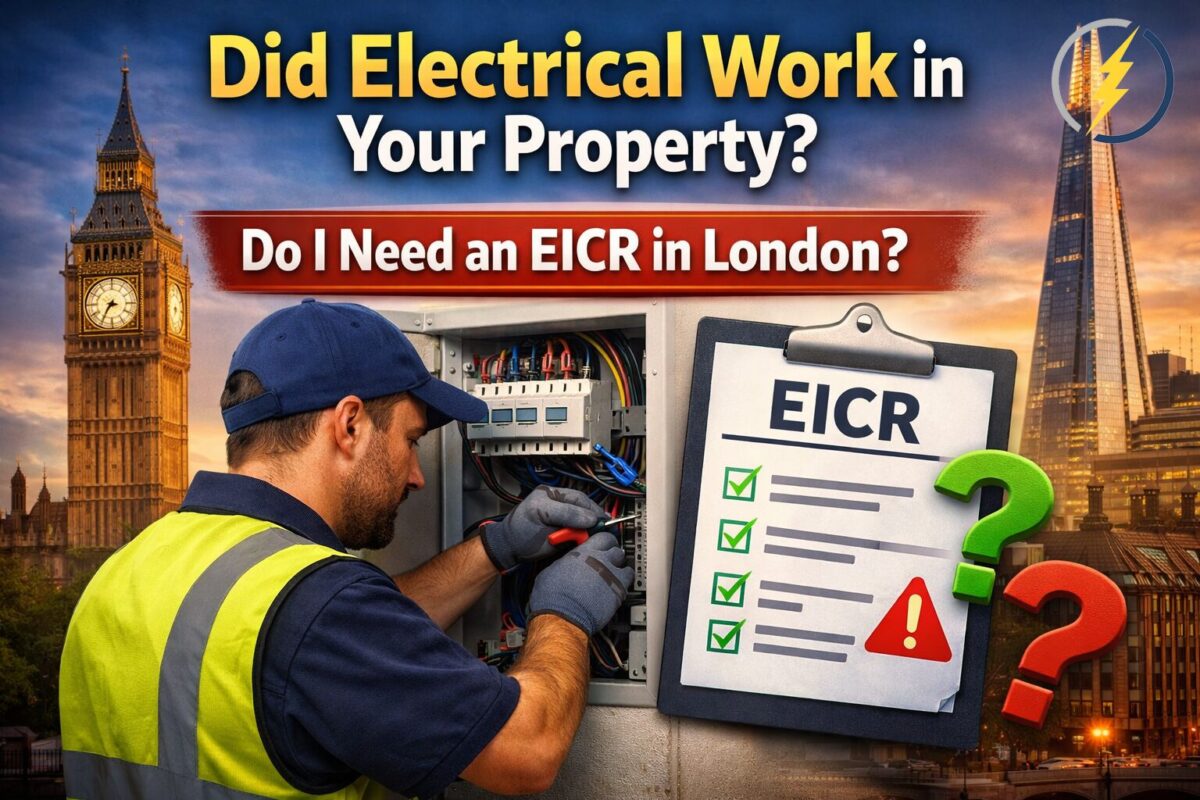
Electrician carrying out electrical work in a property in London with EICR report checklist and question marks about whether an EICR is needed after electrical work

 (Latest 2026 London Guide)

If you have recently had electrical work carried out in your property, one of the first questions that often comes up is simple:

Do I now need an EICR?

It is a smart question, and honestly, a lot of London property owners, landlords, buyers, and even tenants get confused here.

Some people assume that any electrical work automatically means they need a new EICR. Others think that once an electrician has changed a socket, installed lighting, upgraded a consumer unit, or carried out rewiring, that alone is enough and no further inspection is needed.

The truth is a bit more nuanced.

In some situations, an Electrical Installation Condition Report, often called an EICR, is the right next step. In others, the work may instead be covered by an Electrical Installation Certificate or a Minor Electrical Installation Works Certificate, depending on what was actually done and who carried it out. NICEIC explains that an EICR is a report on the current condition of an installation, while an EIC or Minor Works Certificate is used to certify new work or alterations at the time they are put into service.

So if you are wondering whether you need an EICR after electrical work in your London property, this guide will break it down properly without the waffle.

If you want professional help with inspections, you can start with our main EICR Services in London page or go straight to Book Online.

What Is an EICR?

An EICR is an inspection and testing report that assesses the current condition of the electrical installation in a property. It is designed to identify wear and tear, age-related deterioration, damage, defects, or anything that could present a safety risk. NICEIC describes the EICR as an assessment of the in-service condition of the electrical installation rather than a certificate for newly completed work.

That matters because many people use the phrase “EICR certificate”, but technically, an EICR is a report. In the real world, though, people search for things like “EICR certificate London” and “electrical safety certificate,” so both phrases still matter for SEO and user understanding.

If you are new to the topic, our page on How to Read and Understand an EICR Report for Your London Property is a good next read.

So, Do You Need an EICR After Electrical Work?

Not always.

Whether you need an EICR depends on:

  • the type of electrical work carried out
  • whether the work was minor or major
  • whether the property is owner-occupied or rented
  • whether you already have valid certification for the new work
  • whether there is any reason to doubt the condition of the rest of the installation

In many cases, the electrical work itself should come with its own certification. NICEIC says that if the job involved a new installation, a new circuit, or significant alteration work, an Electrical Installation Certificate may apply. If the job only involved an addition or alteration to an existing circuit, a Minor Electrical Installation Works Certificate may be the correct document instead.

That means a fresh EICR is not automatically required every time electrical work is done.

But there are plenty of situations where getting an EICR is still the smart move.

When You May Not Need an EICR

You may not need a separate EICR immediately after electrical work if:

1. The work was minor and properly certified

For example:

  • replacing a light fitting
  • moving a socket
  • adding a spur
  • minor additions or alterations to an existing circuit

In these situations, a Minor Works Certificate may be the right paperwork rather than a full EICR. NICEIC specifically notes that additions or alterations to an existing circuit can be covered by a Minor Electrical Installation Works Certificate.

2. The installation is otherwise modern and recently tested

If your property already had a recent satisfactory EICR and the new work was small, certified properly, and carried out by a competent electrician, you may not need another full condition report straight away.

3. The work was part of a larger certified installation project

For example, if a properly qualified electrician completed a consumer unit replacement, new circuit installation, or more extensive work and gave you the appropriate certificate, the immediate question may not be “Do I need another EICR?” but “Do I now have the correct certification for the work done?”

When You Probably Should Get an EICR

This is where it gets real.

Even if an EICR is not legally required after every piece of electrical work, there are many cases where booking one is the right decision.

1. You are not sure what work was done

This is common in London, especially with:

  • older flats
  • renovated buy-to-lets
  • properties sold with vague paperwork
  • inherited homes
  • ex-rental properties

If you have had work done and do not fully trust the scope, quality, or paperwork, an EICR gives you a fuller picture of the entire installation, not just the one bit somebody touched.

2. Different parts of the installation may still be old

A new consumer unit does not magically make the rest of the wiring perfect. New sockets in one room do not mean the rest of the circuits are fine. An EICR checks the broader installation condition, which is exactly why it is often valuable after piecemeal upgrades.

3. You are planning to rent the property out

For landlords in England, the government guidance says the electrical installation in private rented properties must be inspected and tested by a qualified person at least every five years, with a report provided. The 2020 rules were updated in 2025 to extend similar requirements to the social rented sector.

So if electrical work has been done and you intend to let the property, relying on informal reassurance is not the play. You want the paperwork to stand up.

See our specialist page for EICR Certificates for Landlords in London.

4. You are selling, buying, or refinancing

A buyer may ask for evidence of electrical safety. A survey may raise concerns. A lender, managing agent, or solicitor may want clarity. In those moments, a clear EICR can save time and stop the back-and-forth.

5. DIY work has been carried out

This is a big one.

If you or a previous owner carried out electrical work yourselves, getting an EICR is often the safest way to understand whether the installation is actually sound. That is not about panic. It is about facts.

EICR vs Minor Works Certificate: What’s the Difference?

This is the bit a lot of property owners get mixed up on.

An EICR is for:

  • assessing the condition of an existing electrical installation
  • identifying defects, deterioration, and risks
  • periodic inspection and testing
  • giving an overall view of safety

A Minor Works Certificate is for:

  • small additions or alterations to an existing circuit
  • certifying that specific completed work was safe at the time it was done

NICEIC’s guidance for householders says that additions or alterations to an existing circuit can be certified using a Minor Electrical Installation Works Certificate, while EICRs are separate reports used to assess condition.

So the simple version is this:

A Minor Works Certificate tells you a specific job was signed off.
An EICR tells you what shape the wider installation is in.

That is a massive difference.

What About an Electrical Installation Certificate?

For larger jobs, a full Electrical Installation Certificate may be issued instead of a Minor Works Certificate.

This can apply to more substantial work such as:

  • new circuits
  • full or partial rewires
  • larger installation changes
  • consumer unit changes in some situations
  • more significant alterations

Again, that certificate is about the new work carried out, not always the entire existing installation.

So if your question is:

“I have a certificate for the work. Do I still need an EICR?”

The answer is:

Maybe not immediately, but you might still want one if you need confidence in the overall condition of the property’s electrics.

Does Building Regulations Approval Matter?

Yes, and this is where property owners should not get lazy.

Under UK building regulations, some electrical work may require compliance through the proper route. GOV.UK explains that if you use someone registered with a competent person scheme, they may be able to self-certify certain building work instead of you arranging separate building regulations approval yourself.

Part P of the Building Regulations covers electrical safety in dwellings. GOV.UK’s approved guidance makes clear that Part P deals with the safety of electrical installation work in dwellings.

So if work was done in your flat or house, you should care about:

  • who did it
  • whether they were properly qualified
  • what certification they issued
  • whether any relevant notification or compliance route was followed

If paperwork is missing, unclear, or feels dodgy, that is a strong reason to arrange an EICR.

Real Examples: When an EICR Makes Sense After Electrical Work

Let’s make this practical.

Example 1: New lights and sockets in a kitchen refurb

You renovated your kitchen in a London flat. The contractor added sockets, changed lighting, and made some wiring alterations.

If the electrician issued the right certification for the work, you may not automatically need a full EICR. But if the rest of the property is old, the board looks dated, or you have no recent EICR, booking one can give peace of mind and a clearer picture.

Example 2: Consumer unit upgrade in an older house

You replaced an old fuse box with a new consumer unit.

That is good, but it does not automatically confirm that every circuit in the property is now in perfect condition. If the house still has older wiring or mixed past alterations, an EICR can reveal whether the installation as a whole is actually in decent shape.

Example 3: Outdoor lighting and garden power added

You had outside lighting and power installed for a garden office or patio area.

That work should be properly certified. But if the cables, protective devices, earthing, or circuit arrangements raise questions, an EICR can help verify broader safety and suitability.

Example 4: DIY upgrades by a previous owner

You bought a flat in London and later discovered a mix of odd sockets, inconsistent accessories, and no clear paperwork.

This is exactly the sort of property where an EICR becomes valuable. You are not just checking one visible change. You are checking what is behind the surface.

Mini Case Study 1: The “Looks Fine” Flat That Wasn’t Fine

A London flat owner had a few upgrades done before putting the property on the market. The kitchen lighting had been replaced, extra sockets installed, and the bathroom fan rewired. On the surface, everything looked neat.

But when a buyer asked for evidence of electrical safety, the seller realised there was no recent EICR and the paperwork for the work done was incomplete.

A later inspection found that while the new fittings looked modern, parts of the older installation still had issues that needed attention.

Lesson: cosmetic improvement is not the same as confirmed electrical safety.

Mini Case Study 2: The Landlord Who Assumed the Electrician’s Invoice Was Enough

A landlord had remedial electrical work done after tenant complaints. The electrician attended, replaced a few accessories, and sent an invoice. The landlord assumed that meant the property was now fully compliant.

It did not.

For rented homes in England, landlords need inspection and testing at least every five years by a qualified person, with the report retained and shared as required. An invoice is not a substitute for the report.

Lesson: work done and compliance evidence are not always the same thing.

Mini Case Study 3: The Homeowner Who Wanted Peace of Mind Before Moving In

A buyer completed on a London property where some electrical work had clearly been done over the years. There were newer sockets in some rooms, older accessories in others, and a newer-looking board.

They could have guessed everything was okay.

Instead, they booked an EICR before fully moving in.

That gave them clarity on what was fine, what needed monitoring, and what needed sorting now rather than later.

Lesson: sometimes an EICR is less about legal necessity and more about making smart property decisions.

If My Property Is Owner-Occupied, Do I Still Need One?

For owner-occupied properties, you may not have the same specific rental obligations that apply to landlords. But that does not mean an EICR is pointless.

If work has been done and you want to know the installation is actually safe, an EICR can still be a very smart move. NICEIC notes that EICRs help identify age, wear and tear, and damage in the installation.

That is especially relevant if:

  • your property is older
  • you have recently bought it
  • you are planning renovations
  • you have no recent electrical paperwork
  • you suspect DIY or poor-quality historic work
  • you want reassurance before letting, selling, or insuring the property

If that sounds like your situation, see our page on EICR Certificates for Homeowners in London.

Can an EICR Replace Missing Electrical Certificates?

Not exactly.

If specific work should have been properly certified at the time it was completed, an EICR is not a time machine. It does not retroactively become the original installation certificate or Minor Works Certificate for the job.

What it can do is help assess the current condition of the installation and identify whether it appears safe for continued use.

So if you are missing paperwork, an EICR is often still highly useful, but it is not the same document as the original certification that should have been issued for the completed work.

What If the Work Was Done Badly?

Then the sooner you know, the better.

A lot of people only ask about an EICR after one of these happens:

  • sockets stop working
  • RCDs keep tripping
  • lights flicker
  • an electrician questions previous work
  • a buyer asks for paperwork
  • a tenant reports concerns
  • there has been water ingress, damage, or signs of overheating

At that point, guessing is expensive.

A proper EICR can reveal whether the issue is isolated or whether it points to wider installation problems.

If you are dealing with defects after a failed inspection, our Remedial Work for Failed EICR Certificates page explains the next step.

Common Property Scenarios and Whether an EICR Is Worth Considering

Here’s the practical version people actually want:

Worth strongly considering an EICR:

  • after buying an older flat or house
  • after discovering DIY electrical work
  • after piecemeal upgrades over several years
  • before renting the property out
  • before selling if paperwork is incomplete
  • after a consumer unit change in an older property
  • after flood or water damage affecting electrics
  • when you cannot verify what earlier contractors did

You may rely on the job certificate first, then review:

  • minor additions to an existing circuit
  • light fitting changes
  • small socket alterations
  • straightforward certified electrical work by a competent electrician

Red flags that mean do not leave it:

  • no paperwork
  • conflicting advice
  • old board plus new-looking additions
  • visible poor workmanship
  • repeated electrical faults
  • uncertainty over earthing or bonding
  • you simply do not trust the previous work

Why This Topic Matters So Much in London

London properties are rarely simple.

You are often dealing with:

  • converted flats
  • older housing stock
  • layered renovation history
  • landlord patches over the years
  • work done by different electricians at different times
  • incomplete records during sales and lettings

That is exactly why this question keeps coming up.

It is not just “Do I need an EICR after electrical work?”

It is usually:

“Can I trust what has been done in the rest of the property?”

That is the real question.

What Should You Do Next?

If electrical work has been carried out in your property, use this simple approach:

Step 1: Ask what exact work was done

Was it minor alteration work, a new circuit, a consumer unit replacement, or larger installation work?

Step 2: Check what paperwork you received

Did you get:

  • a Minor Works Certificate
  • an Electrical Installation Certificate
  • nothing at all

Step 3: Think about the whole installation

Even if one section was certified, do you actually know the condition of the rest of the electrics?

Step 4: Consider your property plans

Are you:

  • renting it
  • selling it
  • buying it
  • renovating more
  • moving tenants in
  • trying to avoid future surprises

Step 5: Book an EICR if clarity is needed

If there is uncertainty, missing paperwork, older wiring, or broader concern, an EICR is often the smartest next move.

You can:

Final Answer

If you did electrical work in your property, you do not always need a new EICR immediately.

Sometimes the right document is a Minor Works Certificate or an Electrical Installation Certificate for the job itself. GOV.UK and NICEIC guidance make that distinction clear: building regulations and certification can apply to the new work, while an EICR is used to assess the condition of the installation as a whole.

But if:

  • the property is rented
  • paperwork is missing
  • the installation is older
  • the work was piecemeal
  • you are buying, selling, or renovating
  • or you just want proper confidence in the electrics

then booking an EICR is often the right call.

And honestly, in London, where properties often have years of mixed electrical history behind the walls, that clarity can save you a lot of stress later.

❓Frequently Asked Questions About EICRs After Electrical Work in London❓

1. Do I need an EICR after electrical work in my property?

Not always. It depends on what work was carried out. Some minor jobs may only require a Minor Electrical Installation Works Certificate, while more serious or wider concerns about the property’s electrics may make an EICR the better option.

2. What is the difference between an EICR and a Minor Works Certificate?

An EICR checks the overall condition and safety of the electrical installation in the property. A Minor Works Certificate is usually issued for smaller additions or alterations to an existing circuit, such as adding a socket or changing part of a circuit.

3. Do I need an EICR after changing a consumer unit?

Not always immediately, but it is often worth considering, especially in older London properties. A new consumer unit does not automatically prove that the rest of the wiring and circuits are in good condition.

4. Do I need an EICR after a rewire or major electrical renovation?

In many cases, major work should come with the correct installation certificate for the work itself. However, if you want reassurance about the wider condition of the property or if there is any uncertainty about older parts of the installation, an EICR can still be a smart step.

5. Can I rely on an electrician’s invoice instead of an EICR?

No. An invoice only shows that work was carried out and paid for. It is not the same as an EICR or an electrical certificate. If you need proof of safety or compliance, you need the correct electrical documentation.

6. What if electrical work was done in my property but I received no certificate?

That is a red flag. If no proper certificate was provided, it is worth getting the work checked. In many cases, booking an EICR is the best way to understand the current condition and safety of the installation.

7. Do landlords need an EICR after electrical work in a rental property?

Landlords need to make sure the electrical installation in their rental property is inspected and tested at the required intervals. If electrical work has been carried out, it is important to make sure the property still has the right certification and remains compliant.

8. Should I get an EICR before selling my property if electrical work was done?

It can be a very good idea, especially if the property is older, the paperwork is incomplete, or the buyer asks for proof of electrical safety. A clear EICR can help avoid delays and questions during the sale.

9. Is an EICR worth getting after DIY electrical work?

Yes, definitely. If electrical work was done by you or by a previous owner and you are not fully sure it was done correctly, an EICR is one of the best ways to check whether the installation is safe.

10. How do I know whether I need an EICR or another electrical certificate?

The answer depends on the type of work done and the condition of the rest of the installation. If the work was minor, a Minor Works Certificate may be enough. If you need to assess the safety of the full property, an EICR is usually the right option.

Please Submit Details Below

For your convenience, you can also fill out our online contact form below. Please provide as much detail as possible, and a member of our team will get back to you promptly.
Select Certificate Type:
Tags :
EICR Certificates,EICR Inspection
Share This :

What a Proper EICR Certificate in London Should Actually Include

Are you a homeowner, landlord, or business owner in London? Ensuring the safety and compliance of your property’s electrical installations is crucial, and that’s where an Electrical Installation Condition Report (EICR) certificate comes in. But, how do you obtain one? Our step-by-step guide provides all the information you need to follow to get your EICR certificate. From finding a qualified electrician to scheduling the inspection and addressing any issues highlighted in the report, our guide covers everything you need to know. Don’t risk the safety of your property – read our guide and obtain your EICR certificate today!

EICR Certificates,EICR Faults & Failures,EICR Guide,Electrical Installation,Property Management

What a Proper EICR Certificate in London Should Actually Include

Home / Archive by category "Electrical Installation"
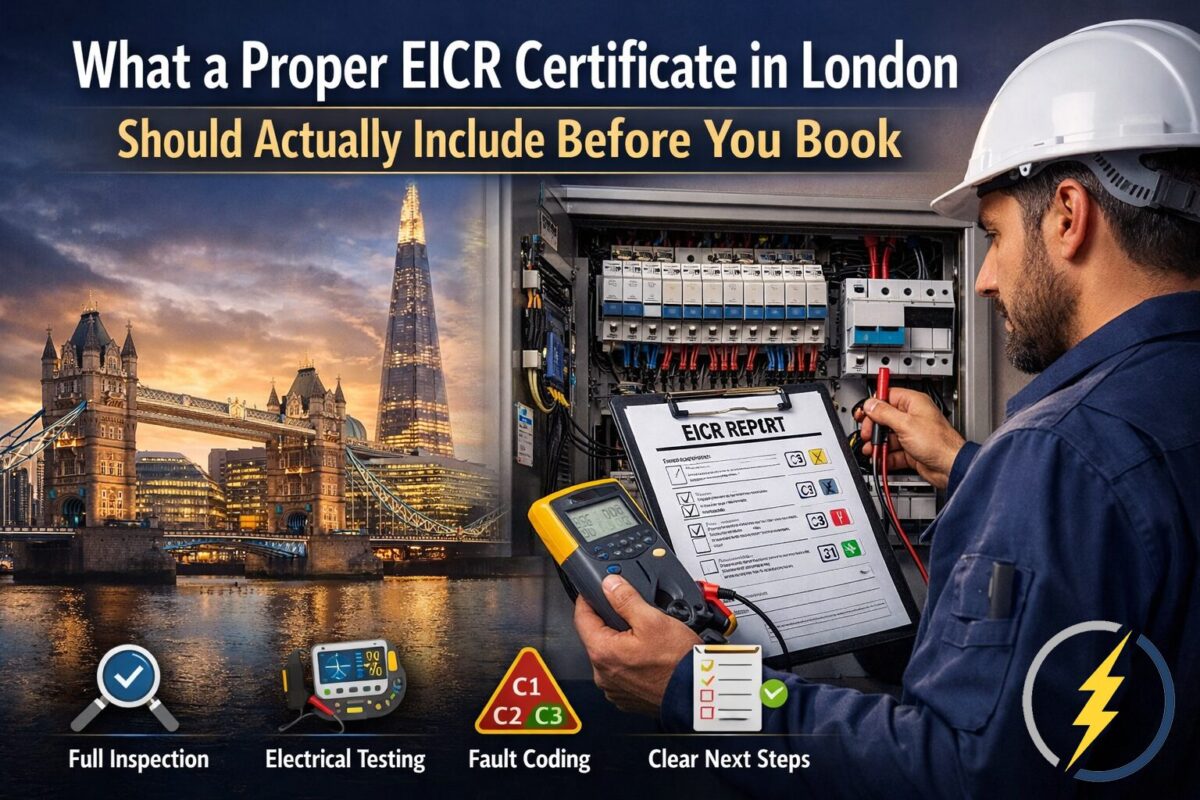
Electrician carrying out EICR inspection in London with consumer unit testing and EICR report showing C1 C2 C3 fault coding.

 (2026 London Guide)

If you are searching for an EICR certificate in London, there is a good chance you are already seeing wildly different prices, different promises, and very different levels of professionalism.

Some companies make it sound like an EICR is just a quick visit and a piece of paper. Others promise a cheap electrical safety certificate in London without explaining what is actually being inspected. On the surface, it can all look the same.

It is not.

A proper Electrical Installation Condition Report in London should do far more than tick a compliance box. It should give you a clear view of the safety and condition of the electrical installation in your property. It should identify real risks, explain what they mean, and tell you exactly what needs to happen next.

That matters whether you are a landlord trying to stay compliant, a homeowner wanting peace of mind, a business owner managing risk, or a buyer who wants to know what they are walking into before completing a purchase.

The problem is that many people only realise the difference between a proper EICR and a weak one after they have already paid for it.

That is why this guide matters.

In this article, I am going to break down what a proper EICR certificate London service should actually include before you book, what red flags to watch for, why some cheap inspections end up costing more, and what a reliable inspection process should look like from start to finish.

If you are still comparing providers, this will help you book with confidence rather than guesswork.

What an EICR Certificate Actually Is

An EICR stands for Electrical Installation Condition Report. It is a professional inspection and testing report used to assess the safety and condition of a property’s fixed electrical installation.

That includes things like the consumer unit, wiring, sockets, switches, lighting circuits, earthing, bonding, and other key parts of the system.

A proper EICR is not the same thing as PAT testing. It is not the same thing as a quick visual check. It is not just a pass or fail sheet with no explanation.

A proper report should tell you:

  • what was inspected
  • what was tested
  • what faults or observations were found
  • how serious those findings are
  • whether the overall installation is satisfactory or unsatisfactory
  • what needs to happen next

If you want a broader look at the inspection process itself, your readers can naturally move from this guide to your main EICR Services page, where the service is explained in more direct booking terms.

Why This Matters So Much in London

London properties are not all the same. Not even close.

A newly refurbished flat in Canary Wharf is a very different inspection environment from a Victorian house conversion in Fulham, an HMO in Islington, or a commercial unit in Central London. Older wiring, mixed upgrades over time, rushed refurbishments, poor DIY alterations, overloaded circuits, old consumer units, and missing bonding are all things that come up regularly in London stock.

That means a proper EICR inspection in London needs real attention to detail.

It also means that the cheapest option is often not the smartest one.

A landlord who just wants “a certificate” can end up with a vague report that causes delays with a tenant move-in. A homeowner can be told everything is fine when it is not. A business owner can assume a small issue is minor only to find later that it affects insurance, safety, or continuity of operations.

This is exactly why the wording “proper EICR certificate” matters. People are not only buying a report. They are buying clarity, compliance, and confidence.

A Proper EICR Should Start With a Real Visual Inspection

The first part of a proper EICR is not random testing for the sake of it. It starts with a systematic visual inspection of the installation.

This means the engineer should be looking at the overall condition of the electrical system and checking for visible issues such as damage, poor workmanship, outdated components, signs of overheating, unsafe accessories, missing covers, inadequate labelling, and obvious defects.

For example, a visual inspection may reveal:

a cracked socket outlet in a rental flat
a consumer unit with missing blanks
signs of scorching around breakers
poor cable management from previous alteration works
missing main bonding to gas or water services
evidence of old or non-compliant fittings in bathrooms or kitchens

This matters because some problems are visible before testing even begins.

A weak inspection often skips over this stage or reduces it to a glance. A proper report does not.

A Proper EICR Includes Electrical Testing, Not Just Looking Around

This is where the real difference starts to show.

A proper EICR London service includes actual electrical testing of the fixed installation. It is not just a walk-through. Testing is what helps confirm whether circuits are safe, whether protective devices operate correctly, and whether there are hidden issues that cannot be spotted visually.

Depending on the property and installation, this can include testing related to:

continuity
insulation resistance
polarity
earth fault loop impedance
RCD performance
prospective fault current
verification of earthing arrangements

This is one of the biggest areas where cheap providers cut corners.

If someone is promising a very low-cost EICR and a very fast turnaround with no proper explanation, you have to ask yourself how much real inspection and testing is actually being done. Because a genuine electrical installation condition report is based on evidence, not assumptions.

A Proper Report Should Explain C1, C2, C3 and FI Clearly

One of the most confusing parts for property owners is the coding.

A good EICR should not just throw codes at you and leave you guessing. It should make it clear what those codes mean and why they matter.

In general terms:

C1 means danger is present and immediate action is required.
C2 means potentially dangerous and urgent remedial work is needed.
C3 means improvement recommended, but it does not automatically make the report unsatisfactory.
FI means further investigation is required without delay.

A proper engineer should not only record the code. They should identify the issue clearly enough that you know what the problem is.

For example, instead of just saying “C2 present,” a useful report should make it clear whether the issue relates to lack of RCD protection, bonding, exposed live parts, or another identifiable fault.

This matters massively for trust.

A customer who receives vague codes with no real explanation is more likely to feel confused or sold to. A customer who receives a clear, specific explanation is much more likely to trust the process and proceed calmly with the next step.

If your report comes back unsatisfactory and remedial work is required, the natural next internal step is your Remedial Work for Failed EICR Certificates page.

A Proper EICR Should Cover the Consumer Unit, Circuits, Earthing and Bonding

A real EICR is about the full fixed installation, not one or two visible parts of it.

A proper report should give enough detail to show that the engineer has assessed the key components of the installation, including the consumer unit, the condition and identification of circuits, protective devices, earthing arrangements, and bonding.

This is important because many serious issues are tied to these fundamentals.

For example:

A property may look clean and modern on the surface, but if the earthing arrangement is inadequate, that is a serious concern.

A flat may have recently decorated walls and new sockets, but if the consumer unit is outdated or poorly configured, the installation may still fail.

A landlord may assume the property is fine because there were no tenant complaints, but missing or inadequate bonding can still be picked up during inspection.

This is why a proper EICR is about the safety of the installation as a system, not just whether a few lights turn on.

What a Good EICR Company Should Explain Before You Book

This is where customers often get caught out.

Before booking, a proper company should be able to explain what is included, what type of property they are pricing for, what happens if issues are found, and how the report process works.

They should not make it feel vague.

A good provider should be comfortable explaining things like:

whether the quote is for a studio flat, house, office, shop, or HMO
what arrival window or booking process applies
whether the price includes the inspection and report only
whether remedial work, if needed, is quoted separately
how long the inspection may take
how quickly the report is normally issued

That kind of clarity builds trust before the visit even happens.

If someone only sells on price and avoids detail, that is usually a red flag.

If the customer wants cost guidance before moving forward, you want this blog to link naturally into your EICR Certificate Cost page or your EICR Price Calculator.

Cheap EICR Certificates Usually Sound Better Than They Turn Out

Let’s be honest here.

A lot of people search for the cheapest EICR certificate in London because they think all reports are basically the same. That is understandable. On paper, it looks like one certificate versus another certificate.

But in practice, the difference can be huge.

A cheap inspection can become expensive when:

the visit is rushed and the report lacks clarity
faults are not explained properly
the inspection misses something important
you need a second company to review it
the tenant move-in gets delayed
the managing agent asks questions you cannot answer
you receive a fail but no clear path to resolution

That is why the real question is not only “what is the cheapest price?” It is “what am I actually getting?”

There is a big difference between a budget-sounding inspection and a proper electrical safety certificate London service carried out by people who know exactly what they are doing.

Case Study Example 1: The Flat That Looked Fine but Wasn’t

A landlord in West London had a two-bedroom rental flat that had been occupied for years with very few complaints. On the surface, everything looked fine. Lights worked. Sockets worked. The tenant had not reported any major electrical issues.

The landlord assumed the EICR would be straightforward.

During inspection, however, issues were identified around the consumer unit setup and missing bonding. The installation did not present as a dramatic disaster, but it was not satisfactory. Because the report was clear, the landlord understood exactly what needed to be done, arranged the remedial works, and got the property back into a compliant position without weeks of back-and-forth.

That is the point.

A proper EICR does not exist to create panic. It exists to reveal the truth of the installation clearly enough that sensible action can be taken.

Case Study Example 2: The “Cheap Quote” That Wasn’t Actually Cheap

A property owner looking to sell a London flat received a very low quote elsewhere and nearly booked it based on price alone. But when they started asking basic questions, the answers were vague. No one would explain the process properly. There was no clarity around timings, what happened if faults were found, or what level of detail the report would include.

That uncertainty alone was a warning sign.

Instead of gambling on the lowest quote, the owner booked a more transparent provider. The inspection found a couple of genuine issues that were clearly explained, the next steps were easy to understand, and the property owner could move forward with much more confidence.

Sometimes the difference between a stressful transaction and a smooth one is not the inspection itself. It is the clarity of the reporting and the professionalism around it.

Case Study Example 3: Commercial Client Who Needed Clarity, Not Confusion

Commercial properties are where weak reporting really starts to hurt.

Imagine a small London office preparing for occupancy changes or internal compliance checks. The business owner does not need fluff. They need a report that is clear enough for decision-making and practical enough to act on.

A proper commercial EICR certificate London service should identify the state of the installation, note any urgent concerns, and present next steps in a way a non-electrician can understand.

That is why your commercial page should be part of the internal journey from this blog. If a reader is managing a workplace, office, retail unit, or mixed-use premises, they should naturally click through to Commercial EICR Certificates in London.

Landlords, Homeowners and Businesses Need Slightly Different Things

One mistake a lot of websites make is talking to everyone in exactly the same way.

A landlord usually cares most about compliance, timing, tenant turnover, and avoiding delays.

A homeowner usually cares about safety, future-proofing, peace of mind, and understanding the condition of the electrics in plain English.

A business owner usually cares about risk, continuity, and meeting duty-of-care expectations.

This is why a strong authority blog should acknowledge those differences.

If the reader is a landlord, guide them toward EICR Certificates for Landlords in London.

If they are a homeowner, guide them toward EICR Certificates for Homeowners in London.

If they are looking at the service more broadly, guide them to EICR Testing in London and your main Home Page.

That kind of internal linking is not only good for SEO. It helps the reader find the exact path that matches their situation.

What the Final Report Should Give You

At the end of the process, a proper EICR should leave you with more than a PDF attachment in your inbox.

It should leave you with clarity.

You should know whether the installation is satisfactory or unsatisfactory. You should know what observations were made. You should know whether any urgent action is required. You should know whether improvements are recommended. And if work is needed, you should know what the next logical step is.

That sounds basic, but this is where many poor-quality services fail.

A proper report reduces confusion. It helps conversations with agents, tenants, buyers, contractors, or managing companies. It turns a technical inspection into something useful in the real world.

That is what customers actually value.

How to Choose the Right EICR Company in London

Here is the real-world filter.

Before you book, ask yourself:

Does the company sound like they understand my property type?
Do they explain what is included clearly?
Do they seem focused only on price, or on quality and clarity too?
If faults are found, will I actually understand what happens next?
Do they have proper service pages and support content that show real expertise?
Do they look like a business built around electrical safety, not just a generic lead-gen page?

These questions matter because the inspection itself is only one part of the customer experience. Communication, reporting quality, clarity, and follow-through are part of the service too.

Why This Blog Matters for Your Booking Decision

If you have read this far, you already get the core point.

A proper EICR certificate in London should include real inspection, real testing, clear fault coding, useful reporting, and a sensible path forward.

It should not feel vague. It should not feel rushed. It should not leave you more confused than before the inspection took place.

Whether you are booking for a flat, house, rental property, HMO, shop, office, or mixed-use building, the same principle applies: the value of the report is in its accuracy, clarity, and usefulness.

And that is exactly why choosing the right provider matters far more than chasing the lowest headline figure.

Final Thought

There are plenty of companies online promising a quick EICR London service. Some of them will do a decent job. Some will not. The customer usually cannot tell the difference until they are already in the process.

That is why authority matters.

A company that explains the process clearly, publishes useful guidance, shows relevant service pages, and helps customers understand what a proper report includes is already separating itself from the noise.

A proper EICR is not just a certificate. It is a professional assessment of the safety of a property’s electrical installation. Done properly, it protects landlords, reassures homeowners, supports businesses, and helps everyone make better decisions.

If you are ready to move forward, the smartest next step is simple: book with a company that treats the report as more than a box-ticking exercise.

You can explore the service in more detail on our EICR Services page, check pricing on our EICR Certificate Cost page, or go straight to Book Now Online.

When it comes to electrical safety, clarity beats guesswork every time.

❓Frequently Asked Questions About What a Proper EICR Certificate in London Should Include❓

1. What should a proper EICR certificate in London actually include?

A proper EICR certificate in London should include a visual inspection of the electrical installation, detailed electrical testing, clear observation codes such as C1, C2, C3 or FI, and a final outcome showing whether the installation is satisfactory or unsatisfactory. It should also explain what needs to happen next if remedial work is required.

2. Is an EICR just a pass or fail certificate?

No. A proper EICR is much more than a simple pass or fail sheet. It is a detailed Electrical Installation Condition Report that explains the condition of the fixed electrics in the property, identifies defects or risks, and shows whether the installation is considered safe for continued use.

3. How long should a proper EICR inspection take?

The time depends on the size, age, and complexity of the property. A small modern flat may take less time than an older house, HMO, or commercial premises. If an EICR is done too quickly without proper explanation, that can be a sign the inspection was rushed.

4. What parts of the property are checked during an EICR?

A proper EICR should assess the fixed electrical installation, including the consumer unit, wiring, circuits, sockets, switches, lighting, earthing, bonding, and protective devices. The aim is to review the overall safety and condition of the installation, not just whether power is working.

5. What do C1, C2, C3 and FI mean on an EICR report?

C1 means danger is present and immediate action is needed. C2 means potentially dangerous and urgent remedial work is required. C3 means improvement is recommended but it does not automatically make the report unsatisfactory. FI means further investigation is required without delay. A good EICR company should explain these clearly.

6. Why are cheap EICR certificates in London sometimes risky?

Cheap EICR certificates can be risky because some low-cost inspections are rushed, poorly explained, or missing proper testing. That can lead to unclear reports, missed issues, delays, and extra costs later. The better question is not only how cheap it is, but what is actually included.

7. Does a proper EICR include remedial work?

Usually, the EICR inspection and report are one part of the service, while remedial work is quoted separately if faults are found. A professional company should explain this clearly before booking so the customer understands what is included in the original price.

8. Is an EICR the same as PAT testing?

No. An EICR checks the fixed electrical installation of a property, while PAT testing focuses on portable electrical appliances. They are different services and one does not replace the other.

9. Who needs an EICR certificate in London?

Landlords often need a valid EICR to meet legal obligations for rented properties. Homeowners may book one for peace of mind, before selling, after buying, or when concerned about older electrics. Businesses also use EICRs to assess safety and reduce risk in commercial premises.

10. How do I know if I am booking a proper EICR company in London?

Look for a company that explains the process clearly, asks the right questions about your property, provides straightforward pricing, and makes it clear what the report includes. A proper EICR company should focus on safety, clarity, and useful reporting rather than just pushing the cheapest headline price.

Please Submit Details Below

For your convenience, you can also fill out our online contact form below. Please provide as much detail as possible, and a member of our team will get back to you promptly.
Select Certificate Type:
Tags :
EICR Certificates,EICR Inspection
Share This :

Is Your 2021 EICR Certificate Still Valid in 2026? Avoid the £40,000 Fine in London

Are you a homeowner, landlord, or business owner in London? Ensuring the safety and compliance of your property’s electrical installations is crucial, and that’s where an Electrical Installation Condition Report (EICR) certificate comes in. But, how do you obtain one? Our step-by-step guide provides all the information you need to follow to get your EICR certificate. From finding a qualified electrician to scheduling the inspection and addressing any issues highlighted in the report, our guide covers everything you need to know. Don’t risk the safety of your property – read our guide and obtain your EICR certificate today!

EICR Certificates,EICR Faults & Failures,EICR Guide,Electrical Installation,Property Management

Is Your 2021 EICR Certificate Still Valid in 2026? Avoid the £40,000 Fine in London

Home / Archive by category "Electrical Installation"
Expired 2021 EICR certificate warning image for London landlords facing possible fines in 2026.

Avoid EICR Fine of up to £40,000 in London (2026 Guide)

If you are still relying on a 2021 EICR certificate in 2026, you need to stop and check your position properly. A lot of London landlords assume that once they have an Electrical Installation Condition Report on file, they are covered forever. They are not. In many cases, that old certificate may already be out of date, no longer acceptable for compliance, or completely useless if the property has changed hands, changed tenants, undergone electrical alterations, or had issues flagged that were never properly resolved.

This is where people get caught out.

They are not trying to break the rules. They think they are doing the right thing. They had an inspection done a few years ago, saved the PDF somewhere in their inbox, and mentally ticked the compliance box. Then a local authority asks for evidence, a tenant raises a safety issue, or a letting agent requests valid paperwork, and suddenly that old report becomes a major problem.

For landlords in London, this is not a small admin issue. It can turn into a legal, financial, and operational mess very quickly. If the report is no longer valid, if remedial work was never completed, or if you cannot prove the property is electrically safe, you may face enforcement action, delays to letting, pressure from tenants, and in serious cases, penalties that can climb into the tens of thousands.

That is why this question matters so much in 2026: is your 2021 EICR certificate still valid, and if not, what should you do right now?

If you need a fresh inspection, the safest move is to arrange a professional EICR certificate in London as soon as possible, especially if the property is rented, about to be re-let, being sold, or has had any electrical changes since the last report.

What Is an EICR Certificate and Why Does It Matter?

An EICR, short for Electrical Installation Condition Report, is a formal inspection and test of the fixed electrical installation in a property. It checks the condition of the consumer unit, wiring, circuits, earthing, bonding, sockets, switches, fittings, and overall electrical safety of the installation.

People often call it an EICR certificate, although technically the formal document is the report itself. Either way, the point is the same. It is the document that shows whether the fixed electrics were found to be satisfactory or unsatisfactory at the time of inspection.

For landlords, this is not just a nice extra. It is a core part of electrical safety compliance. For homeowners, it is one of the smartest ways to understand the true condition of a property. For buyers, it can expose hidden faults before money changes hands. For businesses, it reduces risk and helps prove due diligence.

If you want the plain-English version of how the document works, your readers should also be guided to How to Read and Understand an EICR Report for Your London Property, because a lot of people hold reports they do not fully understand.

So, Is a 2021 EICR Certificate Still Valid in 2026?

Sometimes yes. Sometimes absolutely not.

That is the honest answer.

A 2021 EICR may still be valid in 2026 if the report was satisfactory, the recommended next inspection date was five years, there have been no serious changes to the installation, and the property has remained in a condition consistent with that inspection.

But loads of people miss the part that really matters: validity is not just about the year printed on the report. It is about the recommendation on the report, the property’s use, what has changed since then, and whether the original issues were actually dealt with.

A certificate from 2021 does not magically protect you in 2026 just because you still have the PDF.

Here are the main reasons a 2021 EICR may no longer be good enough in 2026:

The report was only valid for a shorter period

Not every report recommends the full five-year interval. Some reports recommend earlier re-inspection depending on the property type, age, condition, usage, or concerns found during testing.

The report was unsatisfactory

If the 2021 EICR found C1, C2, or FI observations and remedial work was never properly completed and documented, then holding the original report is not proof of compliance. It may actually be proof that you knew there were electrical safety issues and failed to resolve them.

The property has had changes since the inspection

New circuits, kitchen refurbishments, consumer unit changes, rewiring, extensions, fault history, water damage, or heavy wear can all affect whether the old report still reflects reality.

The tenancy situation changed

If you are re-letting, changing tenants, or facing requests from agents or councils, the old report may come under more scrutiny. Even where an older report is technically within the date range, landlords often need a cleaner, more defensible position.

The original report was weak or low quality

Not every inspection in the market is done to the same standard. Cheap, rushed inspections can produce poor-quality reports that do not stand up well when challenged later.

If you are unsure, it is usually smarter to get an updated EICR testing in London inspection than gamble on an old document and hope nobody checks.

Why This Becomes Dangerous for London Landlords

London is not a forgiving market when compliance goes wrong.

Let’s be real. Properties are expensive, tenants are more aware of their rights, agents increasingly want clean paperwork, and councils are far more active than many landlords think. One outdated document can create a chain reaction: delayed move-ins, legal stress, tenant complaints, blocked renewals, and expensive remedial work done under pressure.

This is why an old 2021 EICR can become a legal timebomb in 2026.

It is not just about the report itself. It is about what happens when somebody asks to see it and it turns out not to be enough.

A landlord may think:
“I’ve got an EICR.”
But the real questions are:
Was it satisfactory?
Was remedial work completed?
Was the next inspection date reached?
Has the installation changed?
Can you prove the property is still electrically safe today?

If the answer to those questions gets messy, the old certificate becomes a liability, not a shield.

What Happens If Your EICR Has Expired?

If your EICR has expired, or if it can no longer be relied on, the solution is not complicated, but it does need handling properly.

You need a fresh inspection from a competent electrician who understands landlord compliance, report coding, remedial priorities, and proper documentation. That gives you a current picture of the installation and puts you back in control.

Until that happens, you are exposed.

That exposure can show up in different ways:

A new tenant is ready to move in, but you cannot confidently provide current electrical safety paperwork.

A letting agent asks for documents and spots that the report is outdated or incomplete.

A tenant reports an electrical issue, and suddenly your old paperwork gets examined much more closely.

A local authority requests evidence of compliance and your old report is either expired, unsatisfactory, or unsupported by proof of remedial work.

A property sale or refinance gets delayed because the buyer, lender, or surveyor wants updated electrical evidence.

These are not rare scenarios. They happen all the time.

If speed matters, the cleanest path is to book online and get the property checked before the situation turns into a bigger problem.

Real-World Example: The “I Thought I Was Covered” Landlord

Let’s walk through a realistic case.

A landlord in South London had a one-bed flat inspected in mid-2021. The report was unsatisfactory because of missing bonding and lack of RCD protection on part of the installation. The electrician sent a quote for remedial work. The landlord was busy, the tenant stayed in place, and nothing got done for months. Eventually the email got buried.

Fast forward to early 2026. The tenant leaves. The landlord wants to re-let quickly. The new agent asks for the EICR. The landlord sends the old report thinking all is fine. The agent spots that the report is unsatisfactory and asks for the remedial completion paperwork and updated certificate. There is none.

Now the landlord has a vacant property, a delayed re-let, lost rent, urgent remedial work, and last-minute booking stress.

What started as “I already have an EICR” turned into:

  • compliance delay
  • rushed scheduling
  • unexpected cost
  • void period loss
  • avoidable stress

That is the real lesson. A 2021 report only helps if it is still valid, still relevant, and supported by the right follow-up.

Case Study Example: The Buyer Who Used an Old EICR and Regretted It

Here’s another realistic scenario.

A buyer purchases a London flat in 2026. The seller provides a 2021 EICR and says the electrics were fine at the time. The buyer accepts it without commissioning a new inspection. A few months later, nuisance tripping begins. An electrician investigates and finds borrowed neutrals, signs of poor alterations, and circuit issues linked to later works carried out after the original report.

The buyer assumed the old certificate meant the installation was still safe.

It did not.

This is exactly why anyone buying a property should treat an older report as background information, not as proof of current condition. If you are advising readers who are buying, link them to the right service pages and relevant buying-related content, while also pointing them toward EICR Certificates for Homeowners if they are owner-occupiers rather than landlords.

The Most Common Mistakes People Make With Old EICR Certificates

One of the biggest SEO wins on this topic is going deeper than generic advice. So let’s say it properly.

The first mistake is assuming the issue is only about the date. People ask, “It was done in 2021, so is it valid until 2026?” But the real issue is not just the year span. It is the report outcome, follow-up action, and present condition of the installation.

The second mistake is confusing a previous inspection with ongoing safety. An EICR is a snapshot taken at the time of inspection. It is not a lifetime warranty.

The third mistake is not reading the observations properly. If the report contains C1, C2, or FI items, the property may not have been compliant even back then unless the faults were fixed and confirmed.

The fourth mistake is choosing ultra-cheap inspections and expecting bulletproof compliance. Low-cost, rushed reports are often the ones that create the most expensive headaches later.

The fifth mistake is waiting until a tenant is moving in next week. Last-minute compliance is always harder, always more stressful, and often more expensive than sorting it in advance.

This is also why cost should be explained honestly. If your readers want pricing clarity, send them directly to your EICR Certificate Cost page instead of forcing them to guess.

Could an Old 2021 Report Still Be Fine?

Yes, sometimes.

Let’s not overdo the fear angle. There are absolutely cases where a 2021 EICR is still fine in 2026. For example, if the report was satisfactory, recommended a five-year re-inspection, the property has had no meaningful electrical changes, there have been no warning signs, and the use of the property has remained stable, then it may still be within its recommended period.

But even then, you need to think commercially and practically.

If you are about to:

  • start a new tenancy
  • market the property
  • refinance
  • sell
  • respond to council questions
  • deal with reported electrical issues

…then relying on an older certificate may still be a weak move, even if it is technically within the recommendation window.

A clean, recent report gives you much stronger footing.

What If the 2021 EICR Was Unsatisfactory?

Then the game changes immediately.

An unsatisfactory EICR means the report identified observations serious enough to fail the installation at the time of inspection. Usually that means one or more items coded C1, C2, or FI.

In that situation, the old report is not your protection. It is evidence of an identified problem.

If remedial work was completed, great. But you still need documentation proving that the relevant issues were corrected. In many cases, the best next step is either written confirmation of remedial completion or a fresh EICR, depending on the scale of work and how much time has passed.

If remedial work was never done, the property may have been sitting in a non-compliant or unsafe state for a long time.

This is why your remedial page is such an important conversion page. When this topic comes up, there should be a natural in-text link to EICR remedial work for failed certificates so readers do not get stuck in panic mode without a solution.

How to Check If Your 2021 EICR Is Still Usable in 2026

Here’s the practical way to assess it.

Start with the report outcome. Was it satisfactory or unsatisfactory?

Then check the recommended next inspection date on the report.

Then ask what has changed since 2021. Has the consumer unit been changed? Has the kitchen or bathroom been refitted? Was there flood or leak damage? Were new circuits installed? Has the property had fault complaints, tripping, or visible deterioration?

Then gather the supporting paperwork. If faults were found, do you have evidence they were corrected?

Then think about the purpose. Are you just filing documents away, or do you need the report to support a current tenancy, a new let, a sale, or a compliance request?

If any of those answers are shaky, a new inspection is the smart move.

Why London Properties Need More Care Than People Realise

London housing stock is mixed, old, patched, extended, subdivided, and often altered multiple times over the years. A flat may look modern on the surface and still have legacy electrical issues hidden behind it. Victorian conversions, ex-local authority flats, buy-to-let units, HMOs, and older commercial spaces all bring their own patterns of risk.

That is why a generic national article is never enough for this topic. The London angle matters.

Different property ages, heavier tenancy turnover, fast refurb cycles, and a mix of old and new electrical work mean a 2021 certificate can age badly if the installation has evolved since inspection.

This is also why local relevance matters for SEO and trust. In this article, you should naturally reinforce that your team handles EICR London inspections for landlords, homeowners, and businesses across the capital, with dedicated pages for local coverage across Central, East, West, North, and South London.

What Landlords Should Do Right Now in 2026

If you are a landlord reading this and your EICR was done in 2021, do not leave it as a “deal with later” job.

Pull the report out today and check:

  • was it satisfactory?
  • what re-inspection period was stated?
  • were there any observations?
  • was follow-up work completed?
  • have there been any changes since then?
  • do you have new tenants, agent pressure, or upcoming compliance checks?

If the answer is anything less than crystal clear, book a new inspection and fix the uncertainty.

That is not just the safer move. It is the smarter business move.

Lost rent from delays, rushed remedial work, unhappy tenants, and legal stress usually cost far more than sorting the electrical compliance properly in the first place.

Landlords should also be pushed toward the most relevant service page for their intent, which here is EICR Certificates for Landlords in London. That page supports the exact audience this blog is trying to convert.

What Homeowners and Buyers Should Take From This

Even if you are not a landlord, this topic still matters.

Homeowners often assume that because no one is legally forcing them to update an EICR on a strict schedule, it is something they can ignore. That can be a big mistake, especially in older homes, recently purchased properties, or homes showing warning signs like tripping, outdated consumer units, damaged accessories, flickering lights, or previous poor-quality alterations.

A 2021 report may tell you what the condition was back then. It does not tell you with certainty what condition the property is in today.

If you are a homeowner planning works, buying a property, or simply wanting peace of mind, it makes sense to consider a fresh inspection through the homeowners EICR service page.

What About Commercial Properties?

Commercial properties are their own beast.

Shops, offices, restaurants, warehouses, and mixed-use buildings often face heavier usage, more frequent fit-outs, more modifications, and greater operational risk if electrical issues are missed. A 2021 report in a business premises may be nowhere near enough comfort in 2026 if the occupation, load, layout, or electrical demand has changed.

If your readers are business owners, property managers, or commercial landlords, you want to direct them toward Commercial EICR Certificates in London, where the conversation can shift toward compliance, continuity, risk control, and professional reporting.

The Financial Cost of Getting This Wrong

People focus on the inspection cost and completely miss the bigger picture.

The real cost of mishandling an old EICR can include:
void periods while you scramble to get compliant,
delayed move-ins,
emergency electrician callouts,
remedial work under time pressure,
agent and tenant disputes,
lost deals,
and the stress of being on the back foot when asked for paperwork.

Then there is the reputational cost. If a tenant, buyer, or agent loses confidence in how you manage the property, that can drag into every other part of the transaction.

Compared with that, the price of getting a current report done is small. Your EICR price calculator is a strong internal link here because it turns concern into action.

The Bottom Line

A 2021 EICR certificate is not automatically valid just because it exists and just because it is now 2026. It may still be usable in some cases, but a lot depends on the report outcome, the recommended re-inspection period, whether remedial work was completed, and whether anything has changed in the property since the original inspection.

That is the truth.

For landlords in London, the risk of relying on an outdated or unsupported report is just not worth it. The smart move is to review the old document properly and, where there is any doubt, get a fresh inspection carried out by a competent electrician who knows exactly how landlord compliance works.

If your current paperwork is old, unclear, unsatisfactory, or likely to be challenged, sort it now before it costs you time, money, and unnecessary stress.

If you want a fast, professional route to compliance, you can book your EICR online, check your likely pricing on the EICR certificate cost page, or explore the right service for your situation through EICR services in London.

A 2021 report might still be fine.

But guessing is not compliance.

And in London, guessing is how expensive problems start.

❓2026 EICR Certificate Validity FAQ for London Landlords, Homeowners and Property Buyers❓

1. Is a 2021 EICR certificate still valid in 2026?

It can be, but not always. It depends on the outcome of the original report, the recommended next inspection date, whether the report was satisfactory, and whether any electrical changes or problems have happened since then. A lot of people wrongly assume the year alone tells them everything.

2. How long is an EICR certificate usually valid for in London?

In many cases an EICR is recommended for up to 5 years, but that is not a blanket rule for every property. Some reports recommend a shorter period depending on the type, age, condition, and use of the installation. The safest move is to check the actual re-inspection date written on the report.

3. Can I rent out my London property in 2026 using an old 2021 EICR?

Only if the report is still within its valid inspection period, was satisfactory, and still properly reflects the current condition of the property. If it was unsatisfactory, outdated, or the installation has changed since then, relying on it could create a compliance problem.

4. What happens if my 2021 EICR was unsatisfactory?

If the report was unsatisfactory, the original document alone does not prove compliance. You would need evidence that the faults were corrected, and in many cases the smartest step is to arrange a new EICR inspection so you have a clean and current report.

5. Do I need a new EICR if I had electrical work done after the 2021 report?

Very often, yes. If the property had alterations, a new consumer unit, added circuits, rewiring, kitchen or bathroom works, or any major changes, the old report may no longer reflect the true condition of the installation in 2026.

6. Can a landlord be fined for relying on an expired or invalid EICR certificate?

Yes, that is the real risk. If a landlord cannot provide valid electrical safety documentation when required, or if serious issues were identified and not resolved, it can lead to enforcement action, delays, legal pressure, and potentially very large financial penalties.

7. Is a previous EICR enough if a new tenant is moving in?

Not automatically. Before a new tenancy starts, landlords should be sure the report is still valid, relevant, and backed up by any needed remedial completion records. If there is any doubt at all, getting a fresh EICR is usually the smarter move.

8. What is the difference between a satisfactory and unsatisfactory EICR?

A satisfactory EICR means no dangerous or potentially dangerous issues were found that would fail the installation at the time of inspection. An unsatisfactory EICR means issues such as C1, C2, or FI observations were recorded, and those need to be addressed properly.

9. Should buyers trust a 2021 EICR when purchasing a property in 2026?

It should be treated as useful background information, not guaranteed proof that the electrics are still safe today. If you are buying a property, especially an older London flat or house, a more current electrical inspection is often the better decision.

10. What should I do right now if I’m not sure whether my 2021 EICR is still valid?

Check the original report date, the recommended next inspection date, whether the outcome was satisfactory, and whether any electrical changes or issues have happened since. If anything looks unclear, old, or risky, book a new EICR inspection and get current paperwork in place.

Please Submit Details Below

For your convenience, you can also fill out our online contact form below. Please provide as much detail as possible, and a member of our team will get back to you promptly.
Select Certificate Type:
Tags :
EICR Certificates,EICR Inspection
Share This :

Last-Minute EICR Before a New Tenant Moves In

Are you a homeowner, landlord, or business owner in London? Ensuring the safety and compliance of your property’s electrical installations is crucial, and that’s where an Electrical Installation Condition Report (EICR) certificate comes in. But, how do you obtain one? Our step-by-step guide provides all the information you need to follow to get your EICR certificate. From finding a qualified electrician to scheduling the inspection and addressing any issues highlighted in the report, our guide covers everything you need to know. Don’t risk the safety of your property – read our guide and obtain your EICR certificate today!

EICR Certificates,EICR Faults & Failures,EICR Guide,Electrical Installation,Property Management

Last-Minute EICR Before a New Tenant Moves In

Home / Archive by category "Electrical Installation"
Electrician carrying out a last-minute EICR inspection in a London rental property before a new tenant moves in.

2026 London Full in Dept Guide

If you are a landlord in London and your new tenant is about to move in, finding out at the last minute that your EICR certificate has expired can feel like chaos.

This happens more often than people think.

Maybe the letting agent asks for the report two days before handover. Maybe you assumed the previous certificate was still valid. Maybe the property has been empty during refurbishment and the move-in date suddenly crept up on you. Or maybe the tenant is ready, the keys are waiting, and then someone asks the question you did not want to hear:

“Do you have a valid EICR?”

That is where panic kicks in.

The good news is this. A last-minute EICR does not have to turn into a disaster if you move quickly and do the right things in the right order. In this guide, we will break down exactly what landlords in London need to know, what delays bookings, what can go wrong, how to avoid it, and how to get your property inspection sorted fast.

If you need help urgently, you can always go straight to our EICR Certificates for Landlords in London page or Book Online to get the process moving.

Why a last-minute EICR becomes a big problem for landlords

A lot of landlords do not ignore electrical safety on purpose. It is usually a timing problem.

You are dealing with check-outs, cleaning, deposit issues, new tenancy paperwork, agent emails, inventories, maybe a bit of decorating, and then suddenly the electrical report becomes urgent. If the previous electrical installation condition report is out of date, or if there is no valid paperwork available, that can hold everything up.

The issue is not just paperwork for the sake of paperwork.

A proper EICR certificate in London helps show that the fixed electrical installation in the property has been inspected and tested. It gives you clarity on whether the installation is satisfactory, whether there are potentially dangerous defects, and whether remedial work is needed before the property should continue to be occupied in the normal way.

For landlords, this matters for three big reasons:

  • legal compliance
  • tenant safety
  • avoiding delayed move-ins and stressful disputes

That is why a last-minute booking is often not just a routine job. It is a deadline-driven compliance issue.

If you are not sure what the report actually contains, read our guide on how to read and understand an EICR report for your London property.

What is an EICR and why do landlords need one?

An EICR stands for Electrical Installation Condition Report. It is an inspection and test of the fixed electrical installation in a property.

That includes things like:

  • consumer unit
  • sockets
  • lighting circuits
  • earthing and bonding
  • protective devices
  • wiring condition
  • overall electrical safety of the installation

For rented properties, landlords need to take electrical safety seriously. In practical terms, a valid landlord electrical safety certificate London search is usually coming from someone who wants to make sure the property is ready to let and does not create risk for the tenant or the landlord.

If your property is a rental, your priority should be making sure the report is current, satisfactory where possible, and easy to provide when needed.

You can learn more about the process on our EICR Services page.

When landlords usually realise they need an urgent EICR

The classic last-minute situations look like this:

1. The letting agent asks for it just before move-in

This is probably the most common one. Everything else is ready, then the agent asks for the certificate and you realise it has expired or cannot be found.

2. The old report is no longer valid

A landlord may think, “We had one done a few years ago, so we should be fine.” Then they check the date and realise they are not.

3. The property has just been refurbished

After decorating, kitchen works, rewiring, fuse board upgrades, or general refurbishment, the landlord wants confirmation the electrical installation is in a safe condition before the new tenancy begins.

4. A previous unsatisfactory report was never fully dealt with

This one catches people out badly. They had an inspection, issues were flagged, but the remedial side dragged on and the matter never got properly closed out.

If that sounds familiar, check our Remedial Work for Failed EICR Certificates page.

5. The landlord is buying time and hoping it will not be asked for

Real talk, this is a terrible strategy. Once the tenancy handover is close, that missing or expired electrical safety certificate becomes a problem fast.

Can you get a last-minute EICR in London?

Yes, in many cases you can.

But “last-minute” only works smoothly if the property is actually ready for inspection.

A lot of landlords think the hardest part is finding an electrician. Sometimes it is not. Sometimes the real issue is access, tenant coordination, missing information, blocked consumer units, furniture in the way, or discovering the property has faults that need remedial work before it can achieve a satisfactory outcome.

So yes, you can absolutely arrange an urgent EICR London service, but speed depends on:

  • location in London
  • property type
  • size of the property
  • access arrangements
  • whether the installation is straightforward
  • whether defects are found
  • whether any follow-up work is required

If you need pricing first, use our EICR Price Calculator or read our EICR Certificate Cost page.

The landlord checklist before booking a last-minute EICR

Here is the part that actually saves time.

If you want to avoid delays, get these things ready before you book.

1. Confirm the full property address

Sounds basic, but you would be surprised how often this gets sent over incomplete, especially for flats in London.

Make sure you have:

  • full address
  • flat number if applicable
  • postcode
  • building name if relevant

This avoids confusion on the certificate and helps the booking process move faster.

2. Decide whose name should go on the certificate

This should normally be the landlord, owner, company name, or managing party that needs the report.

If the wrong name is issued initially, that creates admin you do not need when time is tight.

3. Arrange access properly

This is massive.

If the property is empty, confirm who will open up.
If there are tenants still inside, confirm they know the appointment time.
If keys are with a concierge, agent, or neighbour, sort that in advance.

Last-minute bookings get delayed more by access problems than anything else.

4. Make sure the electrician can access all key areas

For a proper EICR test London, access matters.

That includes:

  • consumer unit
  • sockets
  • lights
  • fixed electrical points
  • cupboards containing electrical accessories
  • outbuildings or additional supply points if applicable

If furniture, storage, boxes, or locked cupboards block key areas, that can slow down the inspection or make it incomplete.

5. Mention any known electrical issues beforehand

Do not hide obvious problems hoping they will go unnoticed.

If you already know about:

  • tripping circuits
  • broken sockets
  • damaged light fittings
  • old fuse board
  • missing labels
  • previous failed report
  • water damage near electrics

say so upfront. It helps everyone plan properly and reduces surprise delays.

6. Be realistic about the condition of the installation

If the property is older, has not had electrical attention in years, or has had lots of DIY additions over time, you need to be realistic. A same-day inspection is one thing. A guaranteed satisfactory result is another.

This is where landlords sometimes get frustrated. They want a fast certificate, but the installation itself is not ready.

The truth is simple. If the property has C1 or C2 issues, it may need remedial work before things are properly resolved.

What can delay a last-minute EICR?

This is where landlords lose time.

Poor access arrangements

Nobody there. Keys not available. Tenant forgot. Agent not answering. This is one of the biggest causes of wasted appointments.

Hidden or blocked consumer unit

If the board is behind shelves, wardrobes, stacked storage, or kitchen clutter, inspection becomes harder and slower.

Existing faults

If the installation has obvious issues, the inspection may reveal a report that is unsatisfactory. At that point, you may need remedial work before you can move forward with confidence.

Confusion over certificate details

Wrong property name, wrong certificate name, wrong access contact, wrong date. Admin mess always slows down urgent jobs.

Unrealistic expectations

Some landlords think “urgent” means “skip the process.” It does not. A proper electrical inspection condition report still has to be carried out correctly.

What if the EICR comes back unsatisfactory?

This is the part landlords fear, but honestly, it is better to know than to guess.

If defects are found, the report may be marked unsatisfactory. That does not always mean catastrophe. It means issues need to be addressed.

Some faults are relatively straightforward. Others are more involved.

Examples can include:

  • lack of RCD protection where required
  • broken accessories
  • earthing or bonding problems
  • issues at the consumer unit
  • damaged wiring
  • exposed live parts
  • incorrect circuit identification

The key thing is not to panic. The right move is to get clear on what the observations mean, what needs fixing first, and how quickly remedial works can be scheduled.

That is exactly why we also provide remedial work for failed EICR certificates.

Should you wait until the tenant moves in?

Honestly, no. Bad move.

If you already know the EICR is due, expired, missing, or likely to reveal issues, sorting it before the new tenant moves in is the smarter play.

Why?

Because once the tenant has moved in:

  • arranging access can get harder
  • schedules get tighter
  • complaints can start faster
  • remedial work becomes more disruptive
  • you lose control of timing

A vacant property or pre-handover window is usually the best moment to get the inspection done.

How long does an EICR take?

That depends on the property size, layout, condition, and complexity of the electrical installation.

A small flat is obviously different from a large house, HMO, office, or commercial unit.

Things that affect inspection time include:

  • number of circuits
  • age of installation
  • whether accessories are easily accessible
  • whether faults are found
  • whether the installation is well labelled and maintained

If you want the wider picture, see our EICR Testing in London page.

What type of landlords benefit most from this guide?

Pretty much all of them, but especially:

Private landlords

If you own one or two rental properties and do not want the headache of a delayed move-in, this matters.

Portfolio landlords

If you manage multiple units, late compliance on one property can cause admin chaos across the board.

Letting agents

If you are coordinating move-ins for landlords, this guide helps keep the tenancy pipeline smoother.

Overseas landlords

If you are not in London and relying on agents or contractors, the booking needs to be even tighter.

For landlord-focused service support, go to EICR Certificates for Landlords in London.

What about homeowners or sellers?

This blog is mainly aimed at landlords, but the same urgency can apply if you are:

  • preparing a property for sale
  • buying a flat and want peace of mind
  • moving family into a property after renovation
  • checking an inherited property before occupancy

If that sounds more like your situation, visit EICR Certificates for Homeowners in London.

What if the property is commercial?

If a new occupier is taking a shop, office, workspace, restaurant, or other commercial premises, electrical safety becomes just as important, often more so.

In those cases, you should not rely on residential assumptions. Commercial properties need their own proper assessment.

See our Commercial EICR Certificates in London page for that.

The most common landlord mistakes before a new tenant moves in

Let’s be brutally honest here. These are the mistakes that cause most of the stress.

Leaving it until the week of move-in

This is the big one. It turns a routine compliance job into an urgent problem.

Assuming the old report is still valid

Never assume. Check the date.

Not knowing where the previous certificate is

You should always keep compliance documents organised and easy to access.

Booking the inspection before arranging access

This wastes time and risks missed appointments.

Ignoring obvious electrical issues

If sockets are broken, circuits trip, or previous comments were raised, deal with them early.

Chasing the cheapest price only

A cheap EICR certificate London option that turns into delays, poor communication, or messy follow-up can cost more in the end.

If price matters, and of course it does, use our EICR Certificate Cost page to understand realistic pricing instead of guessing.

What to do today if your tenant is moving in soon

If your tenant is due to move in soon, do this today:

Step 1

Check whether you already have a valid EICR.

Step 2

If not, gather the property details:

  • full address
  • name for the certificate
  • access contact
  • phone number
  • preferred day and time

Step 3

Make sure access is genuinely arranged.

Step 4

Mention any known issues or previous failed report.

Step 5

Book the inspection as soon as possible.

That is the fastest path to getting control of the situation.

You can start that now via Book Online.

Why landlords across London use us

When time is tight, landlords do not just want any electrician. They want a service that is clear, responsive, and used to dealing with real-life move-in deadlines.

That means:

  • straightforward booking
  • clear communication
  • experience with landlord properties
  • fast turnaround mindset
  • help if remedial work is needed
  • service across London

Whether you need an EICR certificate for landlords London, a general electrical certificate London, or urgent help before a tenancy starts, our goal is to make the process easier, not more confusing.

You can explore our main service pages here:

Final word

If your new tenant is moving in soon and your EICR certificate is not sorted yet, do not leave it hanging over your head.

A last-minute EICR in London is fixable, but only if you act fast, organise access properly, and use a service that understands landlord timelines.

The worst thing you can do is wait another few days hoping nobody asks.

The smarter move is to get it booked, get clarity on the condition of the installation, and move into the tenancy with confidence instead of stress.

If you need help now, check our EICR Certificates for Landlords in London page or go straight to Book Online.

❓Last-Minute EICR Before a New Tenant Moves In: Frequently Asked Questions❓

1. Do I need a valid EICR before a new tenant moves into my London property?

Yes, if you are letting out a property in London, you should make sure you have a valid EICR in place before the new tenant moves in. Leaving it until the last minute can create stress, delays, and compliance problems that are easy to avoid if you act early.

2. Can I book an urgent or last-minute EICR in London?

Yes, in many cases you can arrange an urgent EICR in London, but availability depends on access, property size, and how quickly the inspection can be scheduled. The earlier you act, the better your chances of getting it sorted before move-in day.

3. What happens if my old EICR has expired just before the new tenancy starts?

If your previous EICR has expired, you should arrange a new inspection as soon as possible. Do not assume you can rely on the old report once it is out of date. A fresh inspection gives you an up-to-date view of the electrical condition of the property.

4. Can a tenant move in if the EICR has not been done yet?

This is exactly the kind of situation landlords should avoid. If the EICR has not been completed and the property has not been properly checked, you are taking an unnecessary risk. It is far better to get the inspection done before handover so everything is clear from day one.

5. How quickly can I get an EICR certificate in London?

That depends on the property, the booking schedule, and whether the installation passes without issues. Some properties can be inspected and processed quickly, while others may need remedial work before everything is fully resolved.

6. What can delay a last-minute EICR booking?

The biggest delays usually come from poor access arrangements, incomplete property details, blocked consumer units, tenants not being available, or electrical faults being discovered during the inspection. A rushed booking only works well if the property is properly prepared.

7. What if the EICR comes back unsatisfactory right before the tenant moves in?

If the report is unsatisfactory, the next step is usually to deal with the issues identified and arrange any needed remedial work. Some faults are straightforward, while others may take more time. The key thing is to act quickly and not ignore the report.

8. How much does a last-minute EICR in London cost?

The cost depends on the size and type of the property, as well as whether it is a flat, house, HMO, or commercial premises. Urgency, access complexity, and follow-up works can also affect the final cost, so it is best to get a clear quote based on the actual property.

9. What do I need to prepare before the electrician arrives?

You should have the full property address, the name for the certificate, access contact details, and clear access to the consumer unit, sockets, and main electrical points. If there are known faults or previous EICR issues, mention them upfront so there are no surprises.

10. Is it better to do the EICR before the tenant moves in or after?

Before, every time. It is usually much easier to inspect, test, and deal with any issues while the property is empty or before the tenancy begins. Once the tenant has moved in, access becomes harder and any remedial work can be more disruptive.

Please Submit Details Below

For your convenience, you can also fill out our online contact form below. Please provide as much detail as possible, and a member of our team will get back to you promptly.
Select Certificate Type:
Tags :
EICR Certificates,EICR Inspection
Share This :

Real EICR Failure Cost Breakdown in London: 25 Common Faults and What They Usually Cost to Fix

Are you a homeowner, landlord, or business owner in London? Ensuring the safety and compliance of your property’s electrical installations is crucial, and that’s where an Electrical Installation Condition Report (EICR) certificate comes in. But, how do you obtain one? Our step-by-step guide provides all the information you need to follow to get your EICR certificate. From finding a qualified electrician to scheduling the inspection and addressing any issues highlighted in the report, our guide covers everything you need to know. Don’t risk the safety of your property – read our guide and obtain your EICR certificate today!

EICR Certificates,EICR Faults & Failures,EICR Guide,Electrical Installation,Property Management

Real EICR Failure Cost Breakdown in London: 25 Common Faults and What They Usually Cost to Fix

Home / Archive by category "Electrical Installation"
EICR failure cost breakdown in London showing common electrical faults and repair costs for failed EICR certificate.

2026 London Full in Dept Guide and Breakdown 

Getting a failed EICR can feel like a punch in the stomach, especially when the report lands in your inbox full of codes, technical wording, and no clear idea of what the actual repair bill might be.

A lot of London landlords, homeowners, estate agents, and business owners all ask the same thing after an unsatisfactory report:

What is this actually going to cost me to fix?

That is exactly what this guide is here to answer.

This is not one of those vague articles that just says “costs vary.” Of course they vary. But that answer is useless when you are trying to plan remedial works, stay compliant, avoid delays, and not get overcharged. This guide breaks down 25 common EICR faults found in London properties, what they usually mean in plain English, and the sort of typical remedial cost ranges people often see.

If you already know you need help, you can explore our EICR remedial work service in London, check our main EICR services, or book directly through our online booking page.

First things first: what a failed EICR actually means

An EICR, or Electrical Installation Condition Report, checks the condition of the fixed electrical installation in a property. That includes things like the consumer unit, earthing, bonding, sockets, lighting circuits, protective devices, and general electrical safety.

A report is usually marked either:

  • Satisfactory
  • Unsatisfactory

An EICR normally becomes unsatisfactory if the inspector finds:

  • C1: Danger present
  • C2: Potentially dangerous
  • FI: Further investigation required without delay

If you are not fully sure how these codes work, it is worth reading our guide on how to read and understand an EICR report for your London property.

For landlords, this is not just about safety. It is also about compliance. If you rent out property in London, a failed EICR usually means remedial action needs to happen quickly. If you need the landlord-specific side, check our page on EICR certificates for landlords in London.

Before we get into the 25 faults, here’s the truth about costs

No decent electrician should promise an exact remedial cost without understanding:

  • the type of property
  • the age of the installation
  • access issues
  • whether parts are obsolete
  • how many circuits are affected
  • whether testing and certification are included
  • whether making good is needed after electrical works

So the numbers below are realistic guide ranges, not fixed quotes. They are designed to help you budget properly and spot when a price sounds fair, suspiciously cheap, or wildly inflated.

In London, labour, travel, parking, access delays, and the age of many properties can all push remedial costs upward compared to other parts of the UK.

If you want a general starting point for inspection pricing before remedials, our EICR certificate cost page and EICR price calculator are good places to start.


25 Common EICR Faults in London and What They Usually Cost to Fix

1. Missing main bonding to gas pipe

Typical cost: £120 to £250

This is one of the classic EICR issues in older London properties. Main bonding helps reduce the risk of electric shock by ensuring metallic services like gas pipes are correctly connected to earth. If it is missing or undersized, it often gets coded as C2.

Usually this is a fairly straightforward job if the gas meter and pipework are accessible.

2. Missing main bonding to water pipe

Typical cost: £120 to £250

Same principle as gas bonding. If the incoming water pipe is metal and needs bonding, the absence of it can result in an unsatisfactory report. In some flats and conversions, tracing the correct location can take longer, which is why the cost can vary.

3. No RCD protection where required

Typical cost: £150 to £650+

This one is massive. RCD protection is one of the most common reasons people fail an EICR. Sometimes it is one circuit. Sometimes it is the entire board setup. If the issue can be fixed with a small upgrade, the lower end may apply. If the consumer unit needs replacing, it jumps hard.

If you want a wider overview of inspections and protection issues, see our EICR testing in London page.

4. Old fuse board that no longer meets modern safety expectations

Typical cost: £450 to £950+

This is probably one of the faults people fear most because it can turn a simple inspection into a bigger conversation. An old rewireable fuse board, damaged board, or outdated consumer unit may not automatically fail in every scenario, but if other dangerous issues are present, replacement is often the smart route.

In London flats, access, labelling, surge protection requirements, and the number of circuits can all affect price.

5. Broken socket outlet

Typical cost: £80 to £150

A cracked or damaged socket can be coded as dangerous or potentially dangerous depending on its condition. If it is just one faceplate and the wiring behind is sound, this is usually a quick fix.

6. Loose socket outlet

Typical cost: £80 to £150

Loose sockets are common in rental properties and older homes where fittings have worked themselves free over time. Sometimes the issue is simple. Sometimes it reveals damaged back boxes, poor mounting, or stressed conductors.

7. Light fitting not properly enclosed or damaged

Typical cost: £90 to £220

A broken light, exposed terminals, missing covers, or poor installation can cause an EICR failure, particularly in bathrooms, kitchens, and communal areas.

8. Bathroom light not IP rated where needed

Typical cost: £120 to £250

This is a classic fail in London bathrooms, especially in older conversions or refurbishments done cheaply. If the fitting is not suitable for the zone it is installed in, it may need replacing with the correct type.

9. Shaver socket not RCD protected

Typical cost: £120 to £350

This is one of those faults that catches people out. The fix cost depends on whether the protection can be added at circuit level or whether wider work is needed.

10. Exposed live parts

Typical cost: £90 to £300

This can be a C1, which means danger present. Examples include missing blanks on a consumer unit, broken accessories exposing live components, or poorly terminated connections. The price depends on where the issue is and how much needs rebuilding.

11. Poor circuit labelling at the consumer unit

Typical cost: £60 to £150

Not every labelling issue causes a fail by itself, but in some cases incorrect or misleading labelling becomes a real safety concern. This is usually a low-cost fix but should not be ignored.

12. Incorrect breaker or fuse size for circuit

Typical cost: £90 to £250

If the protective device is oversized for the cable it is meant to protect, that can be serious. Sometimes the fix is as simple as changing the device. Sometimes it reveals a deeper design problem.

13. Signs of overheating in the consumer unit

Typical cost: £150 to £750+

This is where things get real. If there is heat damage, burning, melted insulation, or scorching, the affected parts may need replacing immediately. In some cases the safest fix is a full consumer unit replacement.

14. No SPD where recommended or required by the design

Typical cost: £120 to £300 if board accepts add-on
Typical cost: £500 to £950+ if board replacement needed

Surge protection devices are becoming more common in conversations around EICRs. Whether lack of an SPD causes a fail depends on the scenario, risk assessment, and installation context. The cost depends heavily on the board type.

15. Mixed brands of MCBs and RCDs in a way that compromises board integrity

Typical cost: £120 to £700+

This is one of those faults that sounds minor but can become a headache. Some mixed-brand arrangements are not compliant with the original board design and may create safety concerns. Costs vary depending on whether it can be corrected selectively or needs a replacement board.

16. Missing blanks in the consumer unit

Typical cost: £60 to £120

If live parts can be accessed through missing blanks, that can become dangerous fast. Usually cheap to fix, but definitely not something to leave.

17. Inadequate earthing arrangements

Typical cost: £150 to £450

If earthing is missing, inadequate, damaged, or improperly connected, this can produce serious safety issues. The exact fix depends on the supply arrangement and what is wrong with the existing installation.

18. High earth fault loop impedance readings

Typical cost: £150 to £600+

This is where a lot of people get confused. High impedance readings are not a single part you can just swap. They are a symptom. The cause could be poor connections, damaged conductors, inadequate earthing, corrosion, or issues at accessories or terminations. Fix costs vary because diagnosis is part of the job.

19. Failed ring final continuity

Typical cost: £180 to £650+

This often means the ring circuit is broken somewhere or has been altered badly over time. In London homes where kitchens have been changed, walls moved, or DIY works done, ring continuity faults are not rare. Locating the break can take time, which is why cost varies so much.

20. Reversed polarity

Typical cost: £90 to £300

This is a proper safety issue. The fix might be quick if it is isolated to one accessory, but sometimes it points to historic poor workmanship somewhere else on the circuit.

21. Borrowed neutral

Typical cost: £180 to £750+

This is the sort of fault that turns a normal remedial visit into detective work. Borrowed neutrals can create nuisance tripping, unsafe isolation conditions, and compliance issues. The labour is often the expensive part because tracing the wiring can be awkward.

22. Damaged cable insulation

Typical cost: £120 to £450+

If damage is local and accessible, the repair may be straightforward. If the damaged section is buried behind finishes or in concealed runs, it can become much more expensive.

23. No fire-rated downlights or unsafe recessed lighting arrangement

Typical cost: £120 to £500+

This shows up a lot after refurbishments. Sometimes it is not just the light fitting itself, but the way cables, insulation, and cut-outs have been handled around ceilings.

24. Accessory with no earth continuity

Typical cost: £120 to £350

A socket, light, switch, or metal fitting that has lost earth continuity can lead to a fail, especially if it is a Class I metal accessory. Costs depend on whether the fault is local or part of a wider circuit issue.

25. Full or partial consumer unit replacement after multiple faults

Typical cost: £550 to £1,250+

Sometimes the truth is that fixing ten separate faults around an ancient board is false economy. If the installation has multiple issues around protection, labelling, overheating, device compatibility, and general age, replacing the board may be the more sensible move.

For commercial sites, large homes, HMOs, or multi-board installations, this can go higher. If you manage a rental portfolio or business premises, see our commercial EICR certificates in London page as well.


What usually makes remedial costs go up in London?

A lot of people think electricians just make prices up. The reality is more boring than that. The final cost often comes down to time, complexity, and risk.

Here are the big cost drivers.

1. The age of the property

Older London properties are full of surprises. Victorian houses, converted flats, and ageing rental stock often have a mix of old and newer wiring, partial upgrades, and historic work done by different contractors across different decades.

That usually means:

  • longer testing time
  • more hidden defects
  • harder cable routes
  • more uncertainty until work begins

2. Access problems

No loft access, boxed-in pipework, overcrowded cupboards, fitted furniture blocking sockets, tenants not available, parking restrictions, controlled entry, concierge delays, and no isolation access all add friction.

The fault itself may not be hard. Getting to it is the hard part.

3. Whether the issue is isolated or systemic

Replacing one broken socket is cheap. Discovering that three circuits have no proper RCD protection and the board is outdated is a different game completely.

4. Parts availability

Some older consumer units and protective devices are awkward because the exact parts may be obsolete. In those cases, patching things becomes less viable.

5. Re-testing and certification

Remedial work should not just be “done.” It should be properly tested, verified, and documented. Depending on the job, there may be additional certification or a follow-up EICR/reinspection involved.


How much do failed EICRs usually cost overall?

This is the question most people really want answered.

For many London properties, failed EICR remedial works fall into rough bands like this:

  • Minor remedials: £80 to £250
  • Moderate remedials: £250 to £650
  • Bigger remedials with consumer unit or multiple circuit issues: £650 to £1,500+
  • Complex or commercial remedials: £1,500 and upward depending on scope

That does not mean every failed EICR turns into a massive bill. Plenty do not. Sometimes the report looks scary but the actual corrective work is relatively manageable. The key is knowing which faults are simple, which are investigative, and which are warning signs of wider installation problems.

If you want to understand the cost side before booking, check our EICR certificate cost page and book online when you are ready.


Landlords: what happens after an unsatisfactory report?

If you are a landlord, speed matters.

When an EICR comes back unsatisfactory, the next step is not panic. It is getting the right remedial plan in place fast. In most cases, the process looks like this:

  1. inspection takes place
  2. EICR issued
  3. faults reviewed and prioritised
  4. remedial works quoted
  5. repairs completed
  6. installation or affected circuits tested again
  7. compliance evidence issued

If you are renting the property out, do not sit on the report hoping it will sort itself out. That is where landlords get into trouble.

Our dedicated EICR certificates for landlords in London page explains the landlord side in more detail, and if you are managing multiple units you may also want to visit our areas we cover page to see where we operate.


Homeowners: should you always fix everything immediately?

Not always in the same way, but you should always take the report seriously.

If the issue is a C1 or serious C2, it needs urgent action. If the problem is more about the wider condition of an ageing installation, you may have options. A good electrician will explain whether the sensible route is:

  • a local repair
  • circuit-level upgrade
  • consumer unit replacement
  • phased improvement plan
  • bigger rewiring discussion

If you own and occupy the property, our EICR certificates for homeowners in London page is the best place to start.


Businesses and commercial properties: remedials can be more disruptive than the inspection

Commercial clients often focus on the EICR inspection itself, but the real planning challenge is usually the remedial stage.

For example:

  • can works be done outside trading hours?
  • will circuits need isolating?
  • are there tenants or staff on site?
  • does the issue affect emergency lighting, server equipment, refrigeration, shutters, or customer areas?
  • is access needed to multiple boards?

If you run a commercial premises, do not treat remedials as an afterthought. You want a contractor who thinks about downtime, access sequencing, and certification from the start.

That is why our commercial EICR certificates in London page is built specifically around business use cases.


How to avoid getting overcharged after a failed EICR

Let’s be real. A failed EICR can make some people vulnerable to bad quotes because they feel backed into a corner.

Here’s how to stay sharp.

Ask for a fault-by-fault explanation

If the quote says “remedials £1,450” with no detail, that is weak. You should be able to understand what is being fixed and why.

Separate testing from repair scope

Sometimes a fault needs diagnosis first, especially with things like high impedance, borrowed neutrals, or ring continuity issues. That is normal. But it should be explained clearly.

Be wary of ultra-cheap fixes to serious faults

If a board is overheating, has device compatibility issues, lacks protection, and is generally in poor condition, a suspiciously cheap patch-up may not be the smart move.

Look at the bigger picture

Sometimes replacing a board or upgrading a section properly saves money versus repeated small callouts.

Make sure certification is included where needed

The work is not just about changing parts. It is about leaving the installation safer and properly documented.

If you want to understand who should even be doing this type of work, our About Us page gives a better idea of how we approach inspections and remedials.


Why London properties fail EICRs so often

Honestly, because London is full of buildings with history.

That sounds nice until you open a cupboard and find:

  • an old fuse board from a different era
  • a kitchen circuit altered three times
  • metal accessories with poor earth continuity
  • lighting changed during a cosmetic refurb
  • old bonding arrangements never upgraded
  • DIY extensions and borrowed wiring
  • conversions that look neat on the surface but hide messy electrics underneath

That is why EICRs matter. They are not there to make life difficult. They are there to identify risks before those risks become shocks, fire hazards, or legal headaches.

If you have not booked one yet and just want the inspection first, our main home page and EICR services page are the best starting points.


Our approach to failed EICRs in London

When people contact us after a failed report, they usually want three things:

  1. a clear explanation
  2. a fair remedial quote
  3. a practical route to compliance

That is how we like to handle it.

We work with landlords, homeowners, estate agents, and commercial clients across London and focus on making the process straightforward. No confusing waffle. No weird scare tactics. Just clear advice on what the report means, what needs doing, and how to move forward properly.

Depending on the property and the scope, we can help with:

  • EICR inspections
  • landlord EICR certificates
  • homeowner EICRs
  • commercial EICRs
  • remedial works for failed reports
  • guidance on next steps after an unsatisfactory result

You can visit:


Failed EICR is not the end of the world, but guessing the cost can be expensive

A failed EICR does not always mean disaster.

Sometimes it means one or two focused repairs. Sometimes it means the inspection has done exactly what it is supposed to do, which is expose hidden issues before they become serious. And yes, sometimes it means you need a wider upgrade conversation.

The key is not to freeze, delay, or go for the cheapest quote just because the report looks intimidating.

A smarter move is this:

  • understand the actual faults
  • know the realistic London cost ranges
  • prioritise dangerous items
  • get the remedials handled properly
  • make sure the installation is retested and documented

If you need help with a failed EICR in London, whether it is for a flat, house, rented property, HMO, office, shop, or commercial premises, we are here to help.

Start here:

Book Online
Check EICR Certificate Costs
View Remedial Work Services
See All Areas We Cover

❓FAQ: Failed EICR Costs in London Explained❓

1. How much does it usually cost to fix a failed EICR in London?

The cost to fix a failed EICR in London can vary a lot depending on the faults found. Minor issues like a damaged socket or missing bonding may cost relatively little, while bigger problems such as consumer unit upgrades, lack of RCD protection, or multiple circuit faults can cost much more. In many cases, landlords and homeowners see anything from a modest remedial bill to a larger upgrade cost if the installation is older or has several safety issues.

2. What are the most common reasons an EICR fails in London properties?

Some of the most common reasons include missing bonding, lack of RCD protection, damaged sockets, unsafe light fittings, outdated fuse boards, poor earthing, exposed live parts, and faults on ring circuits. Older London flats, houses, and converted properties tend to show these issues more often because the electrical systems have often been altered over time.

3. Does a failed EICR always mean I need a full rewire?

No, definitely not. A failed EICR does not automatically mean you need a full rewire. In many cases, the faults can be corrected with targeted remedial work. A full rewire is usually only needed where the installation is in very poor condition, unsafe in multiple areas, or so outdated that patch repairs no longer make financial sense.

4. Can I still rent out my property if the EICR is unsatisfactory?

If the EICR is unsatisfactory, you should act quickly and arrange the necessary remedial work. For landlords, a failed report is a compliance issue as well as a safety concern. Delaying repairs can create legal risk and may leave you exposed if the property does not meet the required electrical safety standard.

5. Are EICR remedial works expensive for landlords in London?

They can be, but not every failed EICR leads to a huge bill. Some landlord remedial works are small and straightforward, while others involve more serious upgrades. The final cost depends on how many faults were found, how severe they are, the age of the installation, and whether extra testing or certification is needed after the repairs.

6. What is the difference between a C1, C2 and FI on an EICR?

A C1 means danger is present and urgent action is needed. A C2 means something is potentially dangerous and should be corrected as soon as possible. FI means further investigation is required without delay because the inspector has identified something that needs deeper checking. Any of these observations can lead to an unsatisfactory report.

7. How long does remedial work usually take after a failed EICR?

That depends on the number and type of faults. Small repairs may be completed in a single visit, while more involved work like consumer unit replacement, tracing faults, or multiple circuit issues can take longer. Access, property type, and whether parts are easily available also affect the timeline.

8. Will I need another certificate after the remedial work is done?

In most cases, some form of confirmation, testing, or certification is needed after the remedial works are completed. The exact document depends on the type of repair carried out. If the property originally failed an EICR, you should always make sure the corrective work is properly verified and recorded.

9. Why do remedial costs vary so much between properties?

They vary because no two electrical installations are exactly the same. Costs are affected by property age, wiring condition, access, the number of circuits involved, whether fault finding is required, and whether the problem is isolated or part of a wider installation issue. London properties also tend to have more complexity because of age, conversions, parking, and access restrictions.

10. Is it better to fix only the failed items or upgrade the whole consumer unit?

That depends on the overall condition of the installation. If the board is modern, safe, and only one issue needs correcting, a focused repair may be enough. But if the consumer unit is old, lacks key protection, has compatibility issues, or multiple faults are linked to it, replacement can often be the smarter long-term option. A good electrician should explain both options clearly so you can decide based on safety, compliance, and value.

Please Submit Details Below

For your convenience, you can also fill out our online contact form below. Please provide as much detail as possible, and a member of our team will get back to you promptly.
Select Certificate Type:
Tags :
EICR Certificates,EICR Inspection
Share This :

Who Is Responsible for an EICR When Buying a Property in London? Buyer vs Seller Explained (2026 Guide)

Are you a homeowner, landlord, or business owner in London? Ensuring the safety and compliance of your property’s electrical installations is crucial, and that’s where an Electrical Installation Condition Report (EICR) certificate comes in. But, how do you obtain one? Our step-by-step guide provides all the information you need to follow to get your EICR certificate. From finding a qualified electrician to scheduling the inspection and addressing any issues highlighted in the report, our guide covers everything you need to know. Don’t risk the safety of your property – read our guide and obtain your EICR certificate today!

EICR Certificates,EICR Faults & Failures,EICR Guide,Electrical Installation,Property Management

Who Is Responsible for an EICR When Buying a Property in London? Buyer vs Seller Explained (2026 Guide)

Home / Archive by category "Electrical Installation"
Who is responsible for EICR when buying a property in London buyer vs seller electrical inspection report.

2026 London Full in Dept Guide

Buying a property in London is exciting, but let’s be honest, it is also a bit of a minefield. You deal with estate agents, surveys, solicitors, mortgage deadlines, price negotiations, and a hundred small details that all feel urgent. In the middle of all that, one question often gets ignored until the last minute:

Who is responsible for the EICR when buying a property in London, the buyer or the seller?

A lot of people assume the seller should provide it. Others think the mortgage lender will ask for it. Some buyers rely on the standard survey and hope that covers the electrics too. That is where people get caught out.

The truth is simple, but the smart strategy behind it is where things get interesting.

In most normal residential sales, the seller is usually not legally required to provide an EICR, but the buyer is the one who takes the real risk if no electrical inspection is carried out before completion. So even when the seller is not legally responsible, the buyer is often the person who should be thinking most seriously about arranging one.

If you are buying a flat, house, ex-rental property, older London conversion, or a property you plan to let out, this guide will break down what actually matters, what the law does and does not say, and how to protect yourself properly before you commit.

If you want a broader overview of how Electrical Installation Condition Reports work, you can also read our guide on how to read and understand an EICR report for your London property.

The short answer: buyer or seller?

Here is the clean answer first.

In a standard property sale:

  • The seller is not normally under a general legal duty to obtain a fresh EICR for the buyer
  • The buyer is the person who should arrange an EICR if they want proper visibility on the condition of the electrics

So if you are asking, “Who is responsible for an EICR when buying a property in London?”, the most practical answer is:

The buyer is responsible for protecting themselves, even if the seller is not legally forced to provide one.

That is the real-world answer, and it matters more than the technical one.

Because once you complete the purchase, the risk becomes yours.

What is an EICR and why does it matter when buying property?

An Electrical Installation Condition Report is a formal inspection and testing report that checks the condition of a property’s fixed electrical installation.

That includes things like:

  • consumer unit or fuse board
  • wiring circuits
  • sockets and switches
  • earthing and bonding
  • protective devices
  • safety compliance against current standards

An EICR is not just a quick visual glance. A proper one involves inspection, testing, measured results, observations, and coding of issues such as C1, C2, C3, or FI.

If you are buying a property, that matters because electrics are one of the easiest things to get wrong and one of the hardest things to judge with the naked eye.

Fresh paint tells you nothing. A modern kitchen tells you nothing. A staged living room tells you nothing.

You can walk into a beautiful flat in Kensington, Fulham, Canary Wharf, or Hampstead and still inherit:

  • dangerous DIY wiring
  • old cable insulation
  • missing bonding
  • non-compliant fuse board upgrades
  • overloaded circuits
  • borrowed neutrals
  • no RCD protection on key circuits
  • poor previous remedial work

That is why buyers who skip electrical due diligence sometimes save a few hundred pounds upfront, then get hit with a bill in the thousands later.

If you need the actual service itself, see our main EICR services page.

Why buyers get confused about responsibility

This confusion usually comes from three things.

1. People mix up an EICR with an EPC

An EPC is generally required in certain sale and letting situations. Buyers hear “certificate” and assume the seller must also provide an EICR. That is not automatically the case.

2. People assume the survey checks the electrics

A HomeBuyer Report or building survey might note that the electrics appear old, or recommend further testing, but it does not replace a proper electrical inspection.

3. Estate agents and sellers often keep things vague

If the property “seems fine”, many people move ahead unless somebody specifically raises the issue.

That is why smart buyers do not ask only, “Is the seller responsible?”
They ask:
“What do I need to do to avoid buying a hidden electrical problem?”

That mindset is way stronger.

What the seller usually does and does not have to do

In a normal owner-occupied residential sale, the seller will often provide:

  • property information forms
  • EPC
  • documents for certain works if available
  • boiler service history sometimes
  • guarantees or certificates if they have them

But there is usually no automatic rule forcing the seller to commission a new EICR for the buyer’s benefit.

That means sellers often do one of these:

  • provide no EICR at all
  • provide an old EICR
  • say they are unaware of issues
  • say the buyer can carry out their own checks

And from the seller’s side, that is not unusual.

From the buyer’s side though, relying on that is risky.

What the buyer should do if they want real protection

If you are serious about the purchase, the smart move is usually this:

Buyer protection checklist before exchange

Step What to do Why it matters
1 Ask if a recent EICR exists You might get useful history
2 Check how old it is Older reports may no longer reflect the current condition
3 Arrange your own EICR if needed Gives independent clarity
4 Review coded observations carefully Helps estimate risk and cost
5 Use findings in negotiations Can reduce your purchase risk
6 Plan any remedial works before moving in or letting Avoids nasty surprises later

If you want a fast route to pricing, see our EICR certificate cost page or use the EICR price calculator.

The legal answer vs the practical answer

This is where people get tripped up.

The legal-style answer

In many standard residential purchases, the seller is not strictly required to provide a new EICR.

The practical answer

The buyer is the one putting hundreds of thousands of pounds on the line, so the buyer should be the one making sure the electrics are properly assessed if there is any doubt.

That difference is massive.

Because once contracts are exchanged and the deal completes, the issue stops being theoretical and becomes financial.

Why an EICR matters even more in London

London is not just “another market”. It has a bunch of property types that create extra electrical risk.

Common London risk factors:

  • Victorian and Edwardian housing stock
  • old conversions split into flats
  • decades of piecemeal upgrades
  • landlord-owned properties with heavy usage
  • rental properties with multiple past tenants
  • ex-council flats with mixed historical alterations
  • basement flats with damp history
  • loft conversions and extensions done at different times

This is why the same question hits differently in London than it might in a newer housing estate elsewhere.

A property can look premium on the outside and still have electrical problems hiding behind the walls.

For location-specific service relevance, you can naturally reference your area pages where relevant, such as:

Does a mortgage lender require an EICR?

Usually, no. Not as a standard rule in the way some buyers imagine.

A lender is mainly focused on lending security and valuation, not on giving you a full electrical health report for peace of mind. A valuation is not the same thing as a deep condition inspection. Even a survey that flags “electrics should be checked” is not the same as an actual EICR.

So no, you should not assume:

  • the lender has covered it
  • the survey has covered it
  • the seller has covered it

That is exactly how buyers end up exposed.

Does the standard survey replace an EICR?

No. Big no.

Here is the difference:

Report Type What it does What it does not do
Mortgage valuation Protects lender’s lending position Does not assess the electrics in depth
HomeBuyer survey General condition overview Does not fully inspect and test fixed electrical systems
Building survey More detailed property condition review Still not a substitute for electrical testing
EICR Inspects and tests electrical installation Focused specifically on the electrics

That table alone is worth money because loads of buyers get this wrong.

When should a buyer arrange an EICR?

The sweet spot is usually:

After your offer is accepted, but before exchange of contracts.

That timing gives you room to:

  • discover issues
  • estimate likely remedial costs
  • negotiate with the seller
  • decide whether to proceed

If you wait until after completion, the leverage is gone.

Can the seller choose to provide an EICR?

Yes, of course. Some do.

This is more likely where:

  • the seller is a landlord
  • the property was recently rented
  • the seller already had an inspection done
  • the seller wants to reassure buyers and smooth the transaction

If a seller provides one, that is useful. But you still need to apply common sense.

Ask:

  • How recent is the report?
  • Was it satisfactory or unsatisfactory?
  • Were any remedial works done?
  • Is there evidence those works were actually completed?
  • Does the report appear to match the current property condition?

A two-year-old report from before alterations or upgrades may not tell you what you need to know now.

Mini case study 1: Buyer relied on appearance, not testing

A buyer agreed to purchase a two-bedroom flat in West London. The place looked recently renovated. New sockets, nice lighting, fresh decoration, modern kitchen. Everything gave the impression that the electrics must have been sorted too.

But no EICR was requested before exchange.

After completion, repeated tripping started. An electrical inspection later found:

  • mixed protective devices from different brands
  • poor terminations in the consumer unit
  • borrowed neutral issue
  • missing bonding
  • no proper certification trail for previous works

The eventual remedial bill was painful, and the buyer had zero negotiation power because the purchase had already gone through.

Lesson:

Cosmetic renovation is not proof of electrical safety.

If this topic connects to buyers worrying about remedial expenses, you can internally support it with remedial work for failed EICR certificates.

Mini case study 2: Buyer used EICR to renegotiate successfully

A buyer was purchasing a property that had been rented out for years. The seller said there had “never been any issues.” Instead of taking that at face value, the buyer arranged an EICR before exchange.

The report identified:

  • C2 observations related to missing bonding
  • fuse board issues
  • no RCD protection on circuits where improvement was strongly needed
  • signs of age-related deterioration

The buyer then used the report to:

  • request a reduction
  • obtain quotations
  • negotiate a better final purchase figure

The EICR cost a fraction of what the buyer saved.

Lesson:

An EICR is not just a safety tool. It is also a negotiation tool.

Mini case study 3: Investor bought to let, then realised compliance pressure

A landlord purchased a flat in London planning to rent it out immediately. Because the deal moved fast, they focused on valuation, legal pack, and tenant yield. The electrical side was left until after completion.

Once the property was ready to let, they then had to deal with:

  • arranging EICR urgently
  • remedial works before the tenancy could proceed safely
  • delayed marketing
  • void period losses

If they had done the electrical due diligence earlier, they could have budgeted and planned more intelligently.

For landlords specifically, your strongest internal link here is EICR certificates for landlords in London.

What if you are buying to live in the property yourself?

If you are buying as an owner-occupier, you may not be under the same immediate legal letting obligations as a landlord, but the financial and safety logic still applies.

You still want to know:

  • whether the installation is safe
  • whether large costs are coming
  • whether major upgrades are likely in the near future

That is why this topic also naturally links to EICR certificates for homeowners in London.

What if you are buying a property to rent out?

Now the stakes jump.

If the property will be let, you are no longer thinking just as a buyer. You are also thinking as a future landlord. That means electrical compliance becomes more serious from day one.

So in those cases, even if the seller did not need to provide an EICR to sell it, you as the new owner may need one as part of your compliance path before letting.

That is why investors should be even less casual about this issue than residential buyers.

What kind of electrical issues can an EICR reveal before purchase?

This is where the value really hits. A proper report can identify issues such as:

  • absence or inadequacy of earthing and bonding
  • poor consumer unit condition
  • overloaded circuits
  • reversed polarity
  • damage to accessories
  • signs of overheating
  • unsafe bathroom electrical arrangements
  • inadequate protective devices
  • deterioration of older wiring systems
  • signs of non-professional alterations

And here is the thing. Many of these issues are invisible to a non-electrician during viewings.

Practical negotiation advice for buyers

This is the part that makes the blog more useful than generic SEO filler.

If the EICR comes back satisfactory:

Great. You move forward with more confidence.

If the EICR comes back unsatisfactory:

That does not always mean “run away immediately.”

Instead, think in three lanes:

Lane 1: Small issue, manageable cost

Proceed, but budget for remedials.

Lane 2: Moderate issue, clear cost impact

Negotiate a reduction or ask for works before completion.

Lane 3: Serious issue, wider uncertainty

Pause and reassess whether the deal still makes sense.

Smart buyer questions to ask after an unsatisfactory report:

  • Which issues are safety-critical?
  • Which items are improvement recommendations only?
  • What likely works are needed?
  • What order of cost are we looking at?
  • Is the issue isolated or more systemic?

This is where having a contractor who can also handle remedial works becomes helpful, because you want clarity, not panic.

Buyer vs seller responsibility table

Here’s the quick framework people actually need:

Scenario Seller responsibility Buyer responsibility Best move
Standard home sale Usually no automatic obligation to provide new EICR Protect own purchase decision Buyer arranges EICR if concerns exist
Seller has old EICR May share it voluntarily Review carefully, do not rely blindly Check age and relevance
Buying old London property Still may not provide one Higher due diligence needed Strongly consider pre-purchase EICR
Buying ex-rental Seller may have compliance history Verify and inspect current condition Review documents and consider fresh inspection
Buying to let Seller still may not provide fresh EICR New owner must think like a landlord Arrange inspection early

Signs you should definitely get an EICR before buying

If any of the following apply, skipping electrical testing gets way riskier:

  • the property is old
  • the fuse board looks dated
  • you see mixed fittings or signs of piecemeal works
  • there are extensions or loft conversions
  • the survey mentions the electrics
  • it was previously tenanted
  • the seller has limited paperwork
  • the property has been vacant for a while
  • there are signs of damp or water ingress
  • you plan to rent it after purchase

Honestly, in a lot of London purchases, there is at least one of those.

What if the seller refuses access for an EICR before exchange?

It happens sometimes. Access can be awkward if:

  • tenants are still in place
  • the seller wants speed
  • the chain is under pressure
  • the seller thinks extra inspections will complicate things

If that happens, you have to think strategically:

  • Can the inspection be arranged around existing access?
  • Can the seller provide previous electrical documents?
  • Is the risk acceptable without a proper report?
  • Do you need to reflect that uncertainty in your offer?

Refusal does not always mean the property has major issues, but it does increase uncertainty. And uncertainty in property is expensive.

A deeper London-specific angle: old conversions and split flats

This is a strong ranking angle because it is so relevant in London.

A lot of London buyers are not purchasing straightforward modern detached houses. They are buying:

  • converted period flats
  • maisonettes
  • upper floor units in older buildings
  • mixed-use properties
  • former rental stock
  • leasehold units in buildings with a long history of modifications

These properties often come with electrical quirks:

  • shared historic layouts
  • old alterations
  • unclear records
  • partial modernisation rather than full rewiring
  • accessories updated without the whole system being brought up properly

That is exactly why a buyer-focused EICR article can perform well. It touches a real pain point that generic property sites often explain badly.

Should the buyer pay for the EICR?

Usually, yes, if the buyer wants it.

That might feel unfair at first. You are already paying for surveys, searches, legal fees, mortgage costs, moving costs, and maybe stamp duty. But the better way to frame it is this:

You are not paying just for a report. You are paying for decision-quality information.

And in property, quality information saves money.

Cost vs risk comparison

Option Upfront cost Hidden risk later Negotiation power
No EICR before purchase Low High None
Seller’s old report only Low to medium Medium Limited
Buyer arranges own EICR Medium Much lower Stronger

That is the whole game right there.

Common mistakes buyers make

Mistake 1: Assuming “works fine” means safe

Electrics can seem fine and still fail formal testing.

Mistake 2: Trusting a visual survey alone

A survey is useful, but it is not a substitute.

Mistake 3: Leaving everything until after completion

That kills your leverage.

Mistake 4: Thinking only landlords need to care

Homeowners need to understand risk too.

Mistake 5: Treating electrics as a minor issue

Bad electrics can mean safety risk, insurance headaches, expensive remedials, and disruption after moving in.

Advice for estate agents, brokers, and buying agents

This is a sneaky-smart angle to include because it expands audience and topical authority.

If you work in property and advise buyers, you already know deals move faster when risk is identified early. Electrical uncertainty often becomes a last-minute headache because nobody wants to raise it until it becomes unavoidable.

The smart professional approach is:

  • raise the question early
  • check if documents exist
  • advise buyer where a specialist inspection is sensible
  • avoid false confidence from cosmetic condition alone

This also links nicely into broader audience relevance for our projects and about us, especially if you want the page to build trust, not just rank.

If the EICR finds problems, what next?

A failed or unsatisfactory EICR is not automatically the end of the transaction.

It can mean:

  • renegotiate
  • obtain quotes
  • plan remedial works
  • ask the seller to contribute
  • decide to proceed if the numbers still work
  • walk away if the risk feels too open-ended

If works are needed, our remedial work for failed EICR certificates page explains the next stage.

Best strategy depending on buyer type

First-time buyer

You probably need more certainty and fewer surprises. An EICR can help stop your first home becoming your first financial shock.

Upsizer

You may be focused on space and school catchment. Do not let that make you lazy on the fixed systems.

Investor

You need to think beyond purchase price and include compliance, remedials, and void-period planning.

Cash buyer

Just because you can move quickly does not mean you should skip due diligence.

Buyer of older London property

Your risk profile is usually higher. The older and more altered the property, the more valuable proper electrical inspection becomes.

Internal decision sheet: should you get an EICR before buying?

Use this simple scorecard.

Give yourself 1 point for each “yes”.

  • Is the property over 20 years old?
  • Is it a flat conversion or period property?
  • Was it previously rented?
  • Did the survey mention electrics?
  • Is there no recent electrical paperwork?
  • Are you buying to let?
  • Are there visible signs of alterations or extensions?
  • Do you want negotiation leverage?

Score guide:

  • 0 to 2: lower urgency, but still worth considering
  • 3 to 5: strong case for arranging an EICR
  • 6 to 8: you would be brave to skip it

That sort of practical section makes the article actually useful, not just keyword-stuffed.

Where this fits in the full buying journey

A smart London buyer journey often looks like this:

  1. Offer accepted
  2. Legal process starts
  3. Survey arranged
  4. EICR arranged if needed
  5. Findings reviewed
  6. Price renegotiation if justified
  7. Decision to proceed
  8. Completion
  9. Remedials or upgrades planned if required

This is why the blog should not only answer the question. It should also guide the action.

Our view as London EICR specialists

From a practical industry standpoint, the question is not really “Can the seller get away without providing one?”

The better question is:

“Do you want to buy a property without knowing what condition the electrics are in?”

That is the real decision.

If you are spending serious money on a London property, arranging an electrical inspection is usually a smart move, especially if the property is older, altered, ex-rental, or intended for letting.

We help buyers, homeowners, landlords, and businesses across London with:

  • fixed wiring inspections
  • EICR testing
  • clear reporting
  • practical next-step advice
  • remedial works where required

You can explore:

Final verdict: buyer or seller?

Here’s the clean final answer.

In most London property purchases, the seller is not automatically responsible for arranging a new EICR for the buyer. But the buyer is the person most responsible for protecting their own position.

So if you are waiting for the seller to sort it all out, that is not a strategy. That is a gamble.

And in property, gambles get expensive fast.

If you want proper clarity before you commit, an EICR can help you:

  • understand risk
  • avoid nasty surprises
  • negotiate with evidence
  • plan remedial works properly
  • move forward with far more confidence

That is the real value.

Need an EICR before buying a property in London?

If you are buying a flat or house in London and want to know where you stand before exchange, we can help.

Start here:

A good purchase is not just about the right postcode or the right price.

It is also about knowing what you are actually buying.

❓Buying a Property in London? 10 Essential EICR Questions Every Buyer and Seller Should Know❓

1. Is an EICR legally required when buying a property in London?

No, in most standard residential purchases an EICR is not legally required as part of the sale itself. But that does not mean you should skip it. If you want to understand the true condition of the electrics before committing, an EICR is one of the smartest checks you can arrange.

2. Who usually pays for the EICR when buying a house or flat in London?

In most cases, the buyer pays if they want the inspection carried out before exchange or completion. A seller can choose to provide one, but buyers should not assume this will happen. If you want independent peace of mind, it is usually better to arrange your own report.

3. Should the seller provide an EICR before selling a property?

A seller is not usually obliged to provide a fresh EICR in a normal owner-occupied property sale. However, some sellers do provide one to make the sale smoother, especially if the property was previously rented or they want to reassure buyers.

4. Is a homebuyer survey enough, or do I still need an EICR?

A survey is helpful, but it is not the same as a proper electrical inspection. Surveyors may flag that the electrics look old or recommend further checks, but they do not carry out the detailed testing that an EICR includes. If you want real clarity on the electrical system, an EICR is the stronger move.

5. Can an EICR help me negotiate the price when buying a property?

Yes, absolutely. If an EICR reveals dangerous defects, outdated wiring, missing bonding, or a consumer unit issue, you may be able to renegotiate the sale price or ask the seller to contribute towards repairs. That is one of the biggest hidden advantages of getting the report done early.

6. What happens if the EICR fails before I buy the property?

It does not automatically mean you should walk away, but it does mean you need to take a serious look at the findings. Some issues are relatively straightforward to fix, while others can point to wider electrical problems. A failed EICR gives you leverage, information, and a chance to make a smarter decision before completion.

7. Do I need an EICR if I am buying a property to rent it out?

If you are buying with the intention of renting the property, an EICR becomes much more important. Even if the seller did not need to provide one for the sale, as the new landlord you may need a valid report before letting the property legally and safely.

8. What types of properties in London should definitely have an EICR before purchase?

Older houses, Victorian conversions, ex-rental flats, homes with extensions, properties with loft conversions, and anything with unclear electrical history should be high on the list. In London especially, older housing stock often hides electrical issues that are not obvious during viewings.

9. When is the best time to arrange an EICR during the buying process?

The best time is usually after your offer has been accepted but before exchange of contracts. That gives you time to review the results, get quotes for any remedial works, and decide whether to proceed, renegotiate, or step back.

10. Is getting an EICR worth it if the property looks modern and recently renovated?

Yes, because appearance can be seriously misleading. A property can look freshly updated on the surface while still having poor-quality electrical work hidden behind walls, under floors, or inside the fuse board. An EICR helps you separate cosmetic upgrades from actual electrical safety.

Please Submit Details Below

For your convenience, you can also fill out our online contact form below. Please provide as much detail as possible, and a member of our team will get back to you promptly.
Select Certificate Type:
Tags :
EICR Certificates,EICR Inspection
Share This :

I Failed My EICR: What To Do Next in London (2026 Guide)

Are you a homeowner, landlord, or business owner in London? Ensuring the safety and compliance of your property’s electrical installations is crucial, and that’s where an Electrical Installation Condition Report (EICR) certificate comes in. But, how do you obtain one? Our step-by-step guide provides all the information you need to follow to get your EICR certificate. From finding a qualified electrician to scheduling the inspection and addressing any issues highlighted in the report, our guide covers everything you need to know. Don’t risk the safety of your property – read our guide and obtain your EICR certificate today!

EICR Certificates,EICR Faults & Failures,EICR Guide,Electrical Installation,Property Management

I Failed My EICR: What To Do Next in London (2026 Guide)

Home / Archive by category "Electrical Installation"
What to Do If Your EICR Fails in London – Step-by-Step Guide.

2026 London Full in Dept Guide

Failing an EICR can feel like a proper headache, especially if you are a landlord trying to stay compliant, a homeowner preparing to sell, or a business owner who suddenly finds out your electrical installation is not in a satisfactory condition.

But let’s keep it real. A failed EICR is not the end of the world.

It does not automatically mean your whole property needs rewiring. It does not always mean huge repair bills. And it definitely does not mean you should panic and start guessing what to do next.

What it does mean is that a qualified electrician has found one or more electrical issues serious enough to make the report “unsatisfactory”. Your next move matters. If you handle it properly, you can get the faults corrected, improve safety, and obtain a satisfactory report without wasting time or money.

If you need the bigger picture on the report itself, start with our guide on how to read and understand an EICR report for your London property. If you are ready to move fast, you can also book online here.

What does it mean if you failed an EICR?

An EICR, or Electrical Installation Condition Report, checks the safety and condition of the fixed electrical installation in a property. That includes things like the consumer unit, earthing, bonding, sockets, lighting circuits, and wiring systems.

If the report comes back as unsatisfactory, it means the electrician found one or more observations serious enough to fail the inspection.

In most cases, failure happens because of:

  • dangerous faults
  • potentially dangerous faults
  • missing protective bonding
  • no RCD protection where required
  • damaged accessories or exposed live parts
  • signs of overheating
  • poor previous electrical work
  • issues that need further investigation

If you want a general service overview, check our main EICR Services page.

The three codes you need to understand straight away

If your EICR failed, the first thing to look at is the observation codes on the report.

C1: Danger present

This is the most serious one.

A C1 means there is an immediate danger. Someone could be at risk of electric shock or fire right now. In some cases, the electrician may make the issue safe before leaving site.

Examples:

  • exposed live wires
  • broken accessories with live parts accessible
  • severe overheating or burning

If your report has a C1, do not ignore it. This is urgent.

C2: Potentially dangerous

A C2 means the issue is not necessarily causing immediate danger at the exact moment of inspection, but it could become dangerous and must be fixed.

Examples:

  • lack of earthing or bonding
  • missing RCD protection in certain situations
  • defective breakers
  • unsafe alterations to circuits

A C2 is enough to fail an EICR.

FI: Further investigation required

An FI code means the electrician found something that needs deeper investigation before they can confirm the safety of the installation.

Examples:

  • unusual test results
  • signs of hidden faults
  • possible circuit irregularities

FI also causes an unsatisfactory report until the issue is investigated and resolved.

C3: Improvement recommended

This one often confuses people.

A C3 does not fail the EICR. It means improvement is recommended, but the installation can still be classed as satisfactory.

That is why you should never assume every observation means bad news. Some items are advisory, some are not.

Why EICRs fail so often in London

London properties are a mix of old housing stock, converted flats, Victorian terraces, ex-local authority blocks, newer refurbishments, and commercial premises with years of layered alterations. That creates loads of opportunities for electrical issues to build up over time.

Common reasons for a failed EICR certificate London inspection include:

1. Missing or inadequate earthing and bonding

This is super common in older properties. If the installation does not have proper protective earthing and bonding to gas and water services, safety is affected.

2. Outdated consumer units

Older fuse boards often lack modern protection devices such as RCDs. Even if the board still “works,” it may not meet current safety expectations for satisfactory certification.

3. DIY or poor-quality past electrical work

We see this all the time. Added sockets, altered lighting circuits, or kitchen upgrades done badly can create hidden risk.

4. Damaged sockets, switches, and accessories

Cracked faceplates, loose fittings, burn marks, or polarity issues can all lead to observations.

5. No proper certification history

If previous works were done but not properly tested or certified, that can create red flags during inspection.

If remedial works are needed after failure, visit our EICR Remedial Work page.

What should you do immediately after failing an EICR?

Here’s the smart move.

Step 1: Read the codes, not just the word “unsatisfactory”

Do not just see “failed” and freak out. Look at the actual observations. Are they C1, C2, FI, or just C3 recommendations?

That tells you how urgent it really is.

Step 2: Ask for a clear breakdown of remedial works

You need to know exactly:

  • what failed
  • why it failed
  • what must be fixed
  • what is optional
  • what can be repaired now
  • what may require further investigation

Step 3: Prioritise safety first

If the report includes a C1 or serious C2 issue, that comes first. Forget cosmetic stuff. Fix the dangerous items.

Step 4: Get the remedial works done by a qualified electrician

Once the faults are corrected, you may need:

  • a Minor Electrical Installation Works Certificate for specific repairs
  • an Electrical Installation Certificate for larger works
  • or a new / updated satisfactory EICR depending on the scope

Step 5: Keep all paperwork

This matters a lot for landlords, property managers, and business owners. Keep:

  • the original failed EICR
  • the quote for remedial work
  • certificates for any repairs
  • the updated satisfactory report once completed

If you are a landlord, your legal side matters

If you are renting out property in London, this gets more serious.

Landlords need to make sure the electrical installation is safe and inspected at the required intervals. If the EICR is unsatisfactory, you cannot just sit on it and hope nobody asks questions later.

You need to act.

For landlords, the smartest route is to review our dedicated page for EICR Certificates for Landlords, because that page is built around compliance, tenant safety, and legal expectations.

Landlord reality check

If your report fails, you should:

  • arrange remedial work without delay
  • keep written proof
  • provide updated documentation where required
  • make sure the installation becomes satisfactory

This is especially important before:

  • new tenancies
  • renewals
  • licensing checks
  • property management handovers
  • sales or refinancing

If you are a homeowner, should you worry?

Yes, but in a practical way, not a dramatic way.

A failed EICR for a homeowner is still serious because it means the installation has one or more safety issues. But it is also useful because it shows you where the actual problems are, instead of leaving you guessing.

For owner-occupiers, a failed report can help you:

  • make your home safer
  • avoid future fire risk
  • prepare for sale
  • negotiate on purchase decisions
  • plan upgrade works properly

If this applies to you, see our page on EICR Certificates for Homeowners.

How much does it cost to fix a failed EICR?

This is one of the first questions everyone asks, and fair enough.

The truth is the repair cost depends on what actually failed.

A failed EICR could mean:

  • one small corrective repair
  • a bonding upgrade
  • a consumer unit replacement
  • multiple circuit issues
  • or further fault-finding across the installation

Typical factors affecting the final cost include:

  • size of property
  • age of installation
  • number of observations
  • whether consumer unit upgrades are needed
  • whether circuits need tracing or investigation
  • whether access is easy
  • whether urgent attendance is required

For the inspection side itself, see our EICR Certificate Cost page.

Rough repair examples

These are not universal fixed prices, but they help you understand the range:

  • replacing damaged sockets or switches: lower-cost fix
  • bonding upgrades: moderate cost
  • RCD or RCBO related improvements: moderate cost
  • consumer unit replacement: higher cost
  • major rewiring or multiple circuit issues: higher cost again

The biggest mistake people make is chasing the cheapest fix without understanding the actual scope. Cheap can become expensive fast if faults are missed or paperwork is not issued properly.

Can you still rent or sell a property after a failed EICR?

This depends on the situation, timing, and who is asking for the documentation.

For landlords

If the property requires a satisfactory EICR for compliance purposes, then failing and doing nothing is a bad move. You should get the remedial works completed and the documentation updated.

For sellers

You can still sell a property, but a failed EICR may:

  • reduce buyer confidence
  • cause price negotiation
  • slow down the process
  • trigger lender or surveyor questions

For buyers

A failed EICR can actually be useful leverage. It gives you a documented basis for negotiating repairs or price adjustments.

What repairs are commonly needed after a failed EICR?

Here are some of the most common remedial works after a failed electrical installation condition report in London:

Consumer unit upgrades

Old boards with outdated protection are one of the most common causes of unsatisfactory reports.

Earthing and bonding upgrades

If the main earthing conductor or bonding is inadequate, this often needs correction.

Socket and switch replacements

Damaged or unsafe accessories can trigger observations.

RCD protection improvements

Modern protection requirements are a major area where older installations fall short.

Fault finding on circuits

Sometimes the EICR points to deeper issues that need investigation before repairs can be finalised.

Removal of unsafe DIY alterations

Poor extensions, spurs, borrowed neutrals, or badly altered circuits can all need reworking.

If your property is commercial, you should also review our Commercial EICR Certificates in London page, because commercial obligations and repair scope can be different.

Real-world examples of failed EICR situations

Example 1: Landlord flat in South London

A two-bedroom rental flat failed due to lack of bonding and a damaged socket near the kitchen worktop. The landlord assumed it would need a full rewire. It did not. After targeted remedial works and certification, the property was brought back to a satisfactory standard.

Example 2: Victorian conversion in West London

The report found an old consumer unit with no modern RCD protection and multiple circuit concerns. In this case, the smarter option was not patching around the edges. A board upgrade and related corrections made more sense long term.

Example 3: Commercial office unit

A small office failed with several observations linked to previous alterations and poor documentation. Once the faults were investigated and corrected, the client had proper paperwork for compliance and insurance peace of mind.

The point is simple. “Failed EICR” does not always mean the same thing. The code list and actual condition of the installation matter way more than the headline alone.

How long does it take to get compliant again?

That depends on what failed.

Fast turnaround cases

Some failed EICRs can be resolved very quickly if the issues are straightforward and access is available.

Medium complexity cases

If multiple faults exist, or a consumer unit needs replacing, you may need a bit more planning.

Slower cases

If there is significant fault-finding, access problems, tenant coordination, or major upgrade works, the timeline can stretch.

This is why booking quickly matters. If you wait too long, small issues can become bigger delays.

You can view our Areas We Cover if you need a local London team.

How to avoid getting burned twice after a failed EICR

A lot of people fail once, pay for repairs, and still do not feel sure whether things were handled properly.

Here is how to avoid that.

1. Ask for plain-English explanation

Do not accept vague wording. You should understand what was wrong.

2. Separate mandatory repairs from optional improvements

Not everything suggested is required for a satisfactory outcome.

3. Make sure paperwork is issued correctly

Repairs without correct certification can create another problem later.

4. Use a company that deals with EICRs regularly

This stuff is way smoother when the team is used to inspections, remedials, landlord compliance, and follow-up certification.

5. Think long term, not just cheapest today

The lowest quote is not always the best result if it leaves you with more issues later.

Best next step if your EICR failed in London

If your EICR failed, your best move is simple:

  • understand the codes
  • fix the dangerous or potentially dangerous items
  • keep proper documentation
  • get the installation back to satisfactory standard

That is the cleanest path.

If you are not sure where to start, the most useful pages on our site are:

Final thoughts

Failing an EICR feels stressful because the word “failed” sounds dramatic. But the smart way to look at it is this:

A failed report is not just a problem. It is also a roadmap.

It tells you what needs attention, what needs repair, and what needs to happen next to get the property safe and compliant.

Whether you are a landlord, homeowner, letting agent, or business owner, the key is acting properly and not ignoring the warning signs. Done right, the process becomes straightforward: inspect, understand, repair, certify, move on.

And honestly, that is way better than leaving hidden electrical issues sitting there until they become a much bigger mess.

Need help after a failed EICR in London?
Visit our Book Online page to arrange your inspection or remedial follow-up, or explore our Our Projects page to see more about the work we carry out.

❓Failed EICR in London: 10 Key Questions Answered❓

1. What does it mean if my EICR is unsatisfactory?

An unsatisfactory EICR means the inspection found electrical issues serious enough to require action. This usually happens when the report includes C1, C2, or FI observations. In simple terms, the property is not currently considered electrically safe enough to pass without remedial work or further investigation.

2. Can I still rent out my property if I failed the EICR?

If you are a landlord, you should not ignore a failed EICR. An unsatisfactory report means faults have been identified that need to be addressed. In most cases, the right move is to arrange remedial work quickly and make sure the property is brought back to a satisfactory standard with the correct paperwork in place.

3. What are the most common reasons an EICR fails in London?

The most common reasons include lack of bonding, outdated fuse boards, no RCD protection, damaged sockets or switches, poor previous electrical work, signs of overheating, and issues that need further investigation. Older London properties and converted flats are especially likely to show these kinds of faults.

4. What is the difference between C1, C2, C3 and FI on an EICR?

C1 means danger is present and immediate action is needed. C2 means the issue is potentially dangerous and must be fixed. FI means further investigation is required before the installation can be confirmed as safe. C3 means improvement is recommended, but it does not fail the report on its own.

5. Do I need a full rewire if I fail an EICR?

Not always. A failed EICR does not automatically mean the whole property needs rewiring. Sometimes the issue is limited to bonding, a faulty accessory, lack of RCD protection, or a consumer unit problem. The only way to know properly is to review the observations on the report and assess the actual condition of the installation.

6. How quickly should I fix issues after failing an EICR?

You should deal with failed EICR issues as soon as possible, especially if the report includes C1 or C2 observations. Dangerous faults should never be left sitting. Acting quickly protects the occupants, helps landlords stay compliant, and reduces the risk of bigger repair costs later.

7. How much does it cost to fix a failed EICR in London?

The cost depends on what has failed. A small repair may be relatively low cost, while larger remedial work such as a consumer unit upgrade or multiple circuit corrections will cost more. The best approach is to get a clear breakdown of the observations and price the remedial works based on actual faults, not guesswork.

8. Will I need another certificate after the remedial work is completed?

In many cases, yes. After the faults are corrected, you may need updated certification or confirmation that the installation is now satisfactory. Depending on the scope of work, this could involve minor works certificates, installation certificates, or an updated satisfactory EICR.

9. Can a homeowner benefit from getting a failed EICR fixed even if they are not renting the property?

Definitely. A failed EICR highlights real electrical safety issues in the home. Fixing those problems reduces fire and shock risks, improves the condition of the property, and can make things much easier later if you decide to sell, refinance, renovate, or rent it out.

10. What should I do first if my EICR has failed?

Start by checking exactly why it failed. Read the observations, understand whether they are C1, C2, FI, or C3, and ask for a clear explanation of what must be repaired. From there, the next step is to arrange the necessary remedial works and make sure the property is properly certified once the issues are resolved.

Please Submit Details Below

For your convenience, you can also fill out our online contact form below. Please provide as much detail as possible, and a member of our team will get back to you promptly.
Select Certificate Type:
Tags :
EICR Certificates,EICR Inspection
Share This :

My Previous EICR Passed, But My New One Failed With No Changes Made: Why This Happens in London

Are you a homeowner, landlord, or business owner in London? Ensuring the safety and compliance of your property’s electrical installations is crucial, and that’s where an Electrical Installation Condition Report (EICR) certificate comes in. But, how do you obtain one? Our step-by-step guide provides all the information you need to follow to get your EICR certificate. From finding a qualified electrician to scheduling the inspection and addressing any issues highlighted in the report, our guide covers everything you need to know. Don’t risk the safety of your property – read our guide and obtain your EICR certificate today!

EICR Certificates,EICR Guide,Electrical Installation,Property Management

My Previous EICR Passed, But My New One Failed With No Changes Made: Why This Happens in London

Home / Archive by category "Electrical Installation"
Previous EICR passed but new EICR failed with no changes made in London electrical inspection report comparison.

My Previous EICR Passed, But My New One Failed With No Changes Made

Why This Happens in London

Getting a new Electrical Installation Condition Report and seeing it come back as unsatisfactory after a previous one passed is one of the most frustrating things a property owner can experience.

The first reaction is nearly always the same.

How can this happen if nothing changed?

If your previous EICR passed, your electrics seemed fine, no major work was carried out, and now suddenly the latest report says the installation has failed, it is completely normal to feel confused, suspicious, or even annoyed.

A lot of people immediately assume one of two things:

  1. The previous electrician missed something.
  2. The new electrician is being too harsh.

Sometimes one of those is true. Sometimes neither is. In reality, there are several reasons why a property can pass one EICR and fail the next, even when no visible changes have been made.

This guide explains why that happens, what it usually means, and what you should do next if your new EICR has come back unsatisfactory.

If you need a professional inspection, fast booking, or help understanding your report, you can also see our full EICR Services, check our EICR Certificate Cost, or book directly through our Book Now Online page.

Why this situation is more common than people think

This is not a rare problem.

In London especially, many flats, rental properties, HMOs, converted houses, and older buildings have electrical installations that sit in a grey area. They may not show obvious visible danger to the untrained eye, but testing can reveal issues that were missed, deteriorated over time, or judged differently by a different inspector.

That is why a previous satisfactory EICR does not automatically guarantee that the next EICR will also be satisfactory.

An EICR is not just a visual tick-box exercise. It is a technical inspection and test of the fixed electrical installation. It looks at the consumer unit, earthing, bonding, protective devices, polarity, continuity, insulation resistance, circuit condition, and more. Some issues are obvious. Others only appear during testing.

If you are not fully sure what an EICR actually checks, read our guide on how to read and understand an EICR report for your London property.

The straight answer: yes, a new EICR can fail even if nothing changed

Yes, it absolutely can.

That does not automatically mean the previous report was fake. It also does not automatically mean the new electrician is trying to upsell you. It means one of several things may have happened, and the correct response is to understand the reason before jumping to conclusions.

Let’s break down the most common causes.

1. The previous inspection may not have been as thorough

This is one of the biggest reasons.

Not all EICRs are carried out to the same standard in the real world. Some inspections are detailed, careful, and properly tested. Others are rushed, overly basic, or done by people who do not go deep enough.

A property owner may think they had a full inspection last time, but in reality the previous electrician may have:

  • spent too little time on site
  • tested fewer circuits than they should have
  • missed hidden issues
  • coded observations too softly
  • focused on speed instead of accuracy

That is one reason why we always recommend using experienced professionals for EICR Testing in London, especially for landlords, buyers, and anyone relying on the report for compliance.

A poor previous inspection can create false confidence. Then the next electrician comes in, tests properly, and the property suddenly fails.

2. Electrical installations can deteriorate without obvious visible changes

A lot of owners say, “nothing changed,” but what they usually mean is:

  • no renovation was done
  • no rewire happened
  • no consumer unit replacement happened
  • no obvious faults appeared

That is not the same as saying the installation stayed in the same condition.

Electrical systems age. Connections can loosen. Protective devices can wear out. Heat damage can build up slowly. Moisture can affect accessories. Bonding can become inadequate. Insulation can degrade. Wear and tear can develop in ways that are not visible from the outside.

So even if the property looked the same, the condition of the installation may not have been the same anymore.

This is especially common in older London flats, rental properties, and buildings with ageing wiring or older consumer units.

3. Testing can reveal faults that visual inspection alone cannot

This is where many owners get caught out.

A circuit may look completely fine from the outside, yet fail during actual testing.

Examples include:

  • high earth fault loop impedance
  • poor continuity readings
  • polarity issues
  • RCD failures
  • insulation resistance problems
  • borrowed neutrals
  • inadequate earthing
  • poor CPC continuity
  • overloaded circuits

These are not things most people would ever notice by living in the property. Lights may still work. Sockets may still appear fine. The tenant may never complain. But the installation can still produce unsatisfactory results under proper inspection and testing.

If your report includes technical codes or readings you do not understand, our FAQ page and our EICR report guide can help, and our team can also explain the observations in simple language.

4. Different electricians can sometimes code the same issue differently

This is the part people do not always like hearing, but it is true.

EICRs follow regulations and guidance, but there can still be differences in professional judgment between inspectors.

One electrician may record a particular issue as a C3 recommendation for improvement. Another may view the same issue, in the wider context of the installation, as a C2 potentially dangerous observation.

That does not mean the system is broken. It means professional interpretation plays a role, especially where the installation is borderline, older, or has multiple weaknesses that together increase the safety risk.

This is exactly why people searching “old EICR passed new EICR failed” often feel like they are getting conflicting answers. In some cases, they are. But that does not mean the new report is wrong.

What matters is whether the observations are reasonable, clearly explained, and supported by the condition of the installation.

5. Standards, guidance, and expectations evolve over time

Even if the installation itself stayed the same, the context around electrical safety does not stay frozen forever.

Guidance changes. Industry interpretation moves. Best practice evolves. What may have been tolerated more easily in an older report may receive stronger attention in a newer one, especially if the installation has multiple compounding issues.

This is one reason why landlords and agents should not treat an old EICR as permanent reassurance. The report reflects the condition and assessment at the time of inspection, not a forever-pass certificate.

For landlords, this matters even more because compliance and safety responsibilities are ongoing. Our page on EICR Certificates for Landlords in London explains why regular inspection matters and why relying on old paperwork can become risky.

6. The property use or risk profile may be viewed differently now

Another overlooked reason is how the property is being used.

For example, an owner-occupied flat and a tenanted rental property can carry different practical risk considerations. An HMO, short-let, family rental, commercial property, or property with vulnerable occupants may justify closer scrutiny depending on the condition of the installation.

If the previous report was done in one context and the new one is done in another, the inspector may quite reasonably take a firmer view of certain observations.

This is especially relevant for:

  • rental properties
  • HMOs
  • Airbnb and short-let properties
  • commercial units
  • buildings with shared or adapted installations

If that sounds like your situation, see our pages for EICR Certificates for Homeowners in London, Commercial EICR Certificates in London, and HMO EICR Certificates in London.

7. Previous recommended improvements may now have become more serious

Sometimes a previous report may have listed items as advisory or improvement points. The owner may not have acted because the report still passed.

Years later, those same areas may have worsened, or additional defects may now be present around them. On their own, each issue may seem minor. Together, they may justify an unsatisfactory result.

This is why even a passed EICR should not be treated as a reason to ignore all observations.

A passed report is good, but it does not mean the installation is perfect.

8. The previous report may simply have been wrong

Let’s be real here.

Sometimes the old EICR was not good.

That can happen because of:

  • poor workmanship during inspection
  • lack of testing depth
  • weak technical understanding
  • rushed low-cost inspections
  • overly soft coding
  • admin-heavy “certificate culture” where speed mattered more than accuracy

This is one reason why chasing the absolute cheapest inspection is not always smart. A low-cost report that misses real problems can create bigger costs later.

If pricing is one of your concerns, check our EICR price calculator and our EICR certificate cost guide. The goal should be value and accuracy, not just the lowest headline price.

So does this mean the new electrician is trying to upsell?

Sometimes people think that straight away.

And fair enough, because when a failed report is followed by a remedial quote, it can feel suspicious.

But the right response is not panic or blind trust. It is clarity.

Ask:

  • What exactly caused the unsatisfactory result?
  • Which items are coded C1, C2, or FI?
  • Are the observations explained clearly?
  • Can the electrician show where the issue is?
  • Are there test results supporting the finding?
  • Is remedial work genuinely needed for safety or compliance?

A good electrician should be able to explain the findings in plain English.

That said, if the report is vague, poorly written, confusing, or feels inflated, it is reasonable to ask questions or seek a second opinion. That is not being difficult. That is being sensible.

What do the EICR codes actually mean?

If your latest report failed, it is usually because of one or more of these:

C1

Danger present. Risk of injury is immediate.

C2

Potentially dangerous. Urgent remedial action needed.

FI

Further investigation required without delay.

A report with C1, C2, or FI will usually be unsatisfactory.

A C3 alone does not fail the report. C3 means improvement recommended.

If you have gone from a previous pass to a new fail, the key question is not just “why did this happen?” but also “what code caused the fail?”

That tells you whether the issue is immediate danger, potential danger, or something requiring further investigation.

Real-world examples of why a previous pass becomes a new fail

To make this easier to picture, here are some realistic scenarios.

Example 1: Bonding was missed previously

A previous inspector passes the installation, but the next one finds missing or inadequate main bonding to gas or water services. That can lead to a C2 in the new report.

Example 2: RCD protection is now taken more seriously

The previous report may have been softer about lack of RCD protection on certain circuits. The newer inspection may take a stricter view based on actual use and risk.

Example 3: Test readings reveal a worsening problem

The consumer unit and accessories look fine, but testing now shows high impedance or poor continuity, making the installation unsatisfactory.

Example 4: The previous report was too superficial

The old EICR may have passed because it was rushed. The new one involves deeper inspection, opening accessories, checking connections, and doing proper testing.

Example 5: Moisture or damage developed slowly

A bathroom light, socket, junction, or circuit may have deteriorated over time without obvious day-to-day symptoms.

These are exactly the kinds of situations that confuse property owners and lead to search terms like “eicr failed but nothing changed.”

What should you do if your new EICR failed?

Here’s the smart move.

1. Read the observations carefully

Do not just focus on the word “unsatisfactory.” Understand why it failed.

2. Ask for a plain-English explanation

A good inspector should be able to explain the report clearly.

3. Identify whether the issue is urgent

C1 and C2 are serious. FI also needs action. Do not ignore them.

4. Get remedial work quoted properly

If the faults are genuine, the next step is corrective work. Our Remedial Work for Failed EICR Certificates page explains how this usually works.

5. Consider a second opinion only if genuinely needed

A second opinion can make sense if the report seems inconsistent, poorly explained, or wildly different from expectations. But it should be based on evidence, not just wishful thinking.

6. Reinspect after remedial work if required

Once the necessary works are completed, the installation may need confirmation or follow-up certification depending on the scope of the defects and repairs.

Can you still rent out the property if the new EICR failed?

If you are a landlord, this is where things get serious.

If the latest report is unsatisfactory, you should not treat the previous satisfactory report as a shield. The current report reflects the current assessment of the installation.

Where remedial works are needed, they should be addressed quickly and properly. Delays can create safety risk, compliance risk, tenant risk, and stress you really do not need.

This is why many landlords use our EICR Certificates for Landlords in London service along with remedial support, so the whole process is handled properly from inspection to resolution.

What if you are buying a property and this happens?

This is also very common during purchases.

A seller may say the electrics are fine because an older report passed. Then your new EICR comes back unsatisfactory and suddenly everyone is arguing.

In buyer situations, a failed EICR can actually be useful. It gives you leverage, clarity, and a more realistic picture of what you may be taking on. It does not always mean the property is a disaster. It may mean the installation needs targeted improvements, updates, or safety work.

The key is not to panic. It is to understand the defects and the likely cost of putting them right.

Why this topic matters for London properties in particular

London has a huge mix of property types:

  • Victorian houses
  • converted flats
  • ex-local authority blocks
  • period apartments
  • modern developments
  • HMOs
  • commercial units above shops
  • older rented stock

That mix creates a lot of variation in electrical condition. Some installations have been partly updated over time. Some have a new consumer unit but older circuits. Some have extensions or alterations done at different times. Some have hidden issues that only come to light during proper testing.

That is why a trustworthy, detailed EICR matters so much. Not a rushed paper pass. Not a cheap tick-box. A real inspection.

If you want to see how we work and the kinds of jobs we handle, visit our Our Projects page.

When should you question a failed EICR?

You should not challenge a failed EICR just because you do not like the outcome.

You should question it if:

  • the observations are vague or unsupported
  • the coding seems excessive without explanation
  • there are obvious contradictions
  • the inspector cannot explain the findings
  • the report feels rushed or poorly documented
  • the quoted remedial work seems unrelated to the coded issues

A proper challenge is based on substance, not emotion.

If the findings are well explained, technically sound, and supported by testing, then the smarter move is usually to fix the problems and get the installation back into a safe, compliant condition.

The big mistake property owners make

The biggest mistake is this:

They spend all their energy arguing about why the result changed, instead of focusing on whether the current defects are real.

It is understandable to be frustrated. But from a safety and compliance point of view, the important question is not whether the old report passed.

The important question is:

Is the installation safe and satisfactory now?

That is the part that protects your tenants, your property, your purchase decision, and your own peace of mind.

Need help understanding a failed EICR in London?

If your previous EICR passed but your new one failed, and you are not sure what to do next, we can help.

We provide clear, professional EICR Services across London for landlords, homeowners, buyers, agents, and businesses. We also offer EICR Testing in London, support for Commercial EICR Certificates in London, and Remedial Work for Failed EICR Certificates.

If you want a fast quote or booking, head to our Book Now Online page.

Final thoughts

So, why did your previous EICR pass while your new one failed, even though nothing changed?

Because “nothing changed” on the surface does not always mean nothing changed electrically.

The previous report may have been less thorough. Hidden deterioration may have developed. Testing may have revealed faults that were not found before. Coding may have been stricter and more accurate. Or yes, the old report may simply have missed things.

It feels frustrating, but it is not unusual.

The smart move is to understand the findings, verify that the observations make sense, and then deal with any genuine issues properly.

A failed EICR is not always good news, but it can still be useful news. It gives you the chance to fix the right problems before they become bigger, more dangerous, or more expensive.

❓Previous EICR Passed, New One Failed: Frequently Asked Questions❓

1. Why did my new EICR fail when my previous one passed?

A new EICR can fail even if the previous one passed because the latest inspection may have been more thorough, hidden faults may now be showing in test results, or the condition of the installation may have deteriorated over time. In some cases, the older report may simply have missed important safety issues.

2. Can two electricians give different EICR results on the same property?

Yes, that can happen. While EICRs follow regulations and guidance, there can still be differences in professional judgement, especially on older or borderline installations. One electrician may code an issue as a C3 recommendation, while another may consider the same issue a C2 if the wider safety risk is higher.

3. Does a failed EICR mean the new electrician is trying to upsell me?

Not necessarily. A failed EICR does not automatically mean the electrician is exaggerating problems. The key is whether the observations are clearly explained, properly coded, and supported by testing. A good electrician should be able to show you what failed and explain why remedial work is needed.

4. Can an electrical installation deteriorate even if nothing has been changed?

Yes. Electrical systems can deteriorate over time even when no visible work has been carried out. Loose connections, ageing components, moisture, corrosion, insulation breakdown, and wear and tear can all develop quietly in the background and later cause an unsatisfactory EICR result.

5. What EICR codes will cause the report to fail?

An EICR will usually be unsatisfactory if it includes a C1, C2, or FI observation. C1 means danger is present, C2 means potentially dangerous, and FI means further investigation is needed without delay. A C3 on its own does not fail the report.

6. Should I compare my old EICR with the new failed report?

Yes, definitely. Comparing both reports can help you understand whether the new inspector found additional issues, whether previous observations were missed, or whether certain items have become worse over time. It can also help you spot differences in coding and inspection depth.

7. What should I do if I think my latest EICR is too harsh?

Start by asking the electrician to explain each failed observation in plain English. Ask what code was applied, why it was applied, and whether there are test results or visible defects supporting it. If the report still seems unclear or unreasonable, getting a second professional opinion can be sensible.

8. Do I need remedial work straight away after a failed EICR?

That depends on the issues found, but serious faults should not be ignored. If the report contains C1, C2, or FI observations, remedial work or further investigation should usually be arranged as soon as possible to bring the installation back to a safe and satisfactory condition.

9. Can I still rent out my property if the new EICR is unsatisfactory?

If the latest EICR is unsatisfactory, landlords should not rely on an older passed report as protection. The current report reflects the most recent condition and assessment of the installation. Any faults that affect safety or compliance should be dealt with quickly and properly before the issue becomes bigger.

10. Is a previously passed EICR proof that my electrics are definitely safe now?

No. A previous satisfactory EICR only reflects the condition of the installation at the time it was carried out. It does not guarantee the system will remain satisfactory forever. Electrical installations age, conditions change, and a later inspection may reveal faults that were not present or not identified before.

Please Submit Details Below

For your convenience, you can also fill out our online contact form below. Please provide as much detail as possible, and a member of our team will get back to you promptly.
Select Certificate Type:
Tags :
EICR Certificates,EICR Inspection
Share This :

What We Need From You to Book an EICR Certificate in London

Are you a homeowner, landlord, or business owner in London? Ensuring the safety and compliance of your property’s electrical installations is crucial, and that’s where an Electrical Installation Condition Report (EICR) certificate comes in. But, how do you obtain one? Our step-by-step guide provides all the information you need to follow to get your EICR certificate. From finding a qualified electrician to scheduling the inspection and addressing any issues highlighted in the report, our guide covers everything you need to know. Don’t risk the safety of your property – read our guide and obtain your EICR certificate today!

What We Need From You to Book an EICR Certificate in London

EICR Certificates,EICR Guide,Electrical Installation,Electrical Safety,Property Management
Home / Archive by category "Electrical Installation"
What information is needed to book an EICR certificate in London including property address contact details and preferred time slot.

What We Need From You to Book an EICR Certificate in London

(Complete 2026 Guide)

If you’re trying to book an EICR certificate in London, you’ve probably already noticed something…

Some companies make it complicated.

Emails back and forth.
Missing details.
Delayed appointments.

And suddenly what should take 5 minutes turns into 2–3 days.

This is exactly why we’ve simplified the process.

At London EICR Certificates, we’ve completed inspections across flats, HMOs, commercial units, and large portfolios across London. After handling hundreds of bookings, we identified one thing:

👉 The faster you provide the right information, the faster your EICR gets done.

This guide explains:

  • Exactly what we need

  • Why each detail matters

  • Common mistakes people make

  • How to avoid delays

  • And how to get your EICR booked instantly


⚡ The Exact Details We Need (No Guesswork)

To proceed with your booking, please provide:

  • Full property address

  • Name and phone number of the person who will be at the property

  • Full name to be used on the certificate

  • Preferred time slot: 09:00–12:00 or 12:00–16:00

  • Preferred day

Once we have this information, we’ll confirm your appointment.


🧠 Why This Matters More Than You Think

Most people assume booking an EICR is just about “choosing a date”.

It’s not.

An Electrical Installation Condition Report (EICR) is a structured inspection that involves:

  • Testing live circuits

  • Accessing fuse boards

  • Checking earthing and bonding

  • Inspecting multiple rooms

  • Sometimes isolating power

👉 That means preparation is everything.


📊 Real Booking Efficiency Breakdown

Scenario Outcome
All details provided Same-day booking
Missing access contact Visit fails
Wrong certificate name Legal issues
No time slot Delayed scheduling
Incomplete address Engineer confusion

🏠 1. Full Property Address (Technical Importance)

This isn’t just for navigation.

It helps us determine:

  • Property type (flat, house, commercial)

  • Parking requirements

  • Access complexity

  • Expected inspection duration


🔍 Real Example

Two bookings:

Flat in Canary Wharf
→ Concierge access required
→ Parking restrictions
→ Lift coordination

House in North London
→ Direct access
→ Faster inspection

Same service. Completely different logistics.


👉 That’s why accuracy matters.


📞 2. Access Contact (Biggest Failure Point)

Let’s be honest.

This is the #1 reason inspections fail.

If no one is available:

  • We cannot proceed

  • Inspection is cancelled

  • Rebooking required


🚨 Real Case Study

Property: Rental flat in Shoreditch

  • Landlord booked inspection

  • Tenant not informed

  • Engineer arrived → no access

Outcome:

  • Job cancelled

  • Delay: 5 days

  • Extra cost risk


👉 This is why we ALWAYS request:

Name + direct phone number


🧾 3. Certificate Name (Legal & Compliance Critical)

This is where most people mess up.

Your EICR certificate is a legal document.

It must match:

  • Ownership

  • Tenancy agreement

  • Company details (if applicable)


⚠️ Mistakes We See

  • Wrong spelling

  • Old company name

  • Using tenant name instead of landlord

  • Missing LTD details


👉 For landlords, this is critical:

EICR Certificates for Landlords

Incorrect name = compliance issues.


🕘 4. Time Slot (How Scheduling Actually Works)

We don’t book exact times.

We book time windows:

  • Morning: 09:00–12:00

  • Afternoon: 12:00–16:00


🧠 Why?

Because engineers:

  • Travel across London

  • Deal with traffic

  • Complete multiple jobs

This system ensures:

  • Reliability

  • Flexibility

  • Fewer delays


👉 Learn more about inspections:
EICR Services


📅 5. Preferred Day (Smart Booking Strategy)

Want faster booking?

👉 Give 2–3 options instead of 1.

Example:

❌ “Only Friday”
✅ “Thursday or Friday preferred”


📊 Booking Speed Insight

Flexibility Booking Speed
Flexible 1–2 days
Fixed day 2–4 days
Urgent Same-day (if available)

🔄 What Happens After You Send Details

Here’s your full journey:

Step 1 – Info Review

We check your details

Step 2 – Scheduling

We assign engineer

Step 3 – Confirmation

You receive booking confirmation

Step 4 – Inspection

Engineer attends

Step 5 – Report Issued

EICR certificate delivered


👉 Book directly here:
Book Online


🏢 Different Scenarios (And What Changes)

🏠 Residential Flats

  • Usually faster

  • Simple access

👉 Homeowners EICR


🏢 HMOs / Landlords

  • More circuits

  • More compliance requirements


🏬 Commercial Properties

  • Larger systems

  • Longer inspection

👉 Commercial EICR Certificates


💰 How This Impacts Cost

Better information = more accurate pricing.

👉 Check pricing:
EICR Certificate Cost


❌ Common Booking Mistakes (Avoid These)

  • Sending incomplete address

  • No access contact

  • Wrong certificate name

  • Not confirming availability

  • Last-minute changes


🔥 Pro Tips (From Real Experience)

  • Always inform tenant in advance

  • Send correct phone number

  • Double-check certificate name

  • Be flexible with timing

❓FAQ: Booking Your EICR Certificate in London❓

What details do I need to provide to book an EICR certificate in London?

To book an EICR certificate in London, we usually need the full property address, the name and phone number of the person who will provide access, the full name that should appear on the certificate, your preferred time slot, and your preferred day. Once we have these details, we can check availability and confirm the appointment quickly.

Why do you need the full property address before confirming an EICR booking?

The full property address helps us plan the visit properly, confirm the location, understand the type of property, and avoid delays on the day of inspection. In London, even small address errors like a missing flat number or wrong postcode can cause access problems and wasted time.

Why do you ask for the access contact’s name and phone number?

We ask for the access contact’s details so our engineer can reach the right person if there are issues getting into the property. This is especially important for rented flats, managed buildings, commercial units, and properties with concierge or tenant access arrangements.

What name should be used on the EICR certificate?

The name on the EICR certificate should be the correct legal or preferred name of the landlord, homeowner, company, or managing party who requires the report. It is important to provide the right name from the start, because changing certificate details later can slow things down and create paperwork issues.

Can I book an EICR inspection without being at the property myself?

Yes, you can still book an EICR inspection if you will not be there personally, as long as someone reliable is available to provide access. This could be a tenant, letting agent, property manager, caretaker, or another authorised person who can let the engineer in and be contacted if needed.

What time slots are available for EICR bookings?

Our standard booking slots are usually 09:00 to 12:00 and 12:00 to 16:00. These time windows help us manage travel across London and keep bookings efficient. Choosing one of these slots also makes it easier to schedule your inspection without unnecessary delays.

Why do you ask for a preferred day instead of giving an instant fixed appointment time?

We ask for a preferred day so we can match your request with engineer availability, travel routes, and existing bookings. This helps us offer realistic appointment options and avoid promising a time that later needs to be changed.

What happens after I send the booking information?

Once you send the required details, we review the information, check engineer availability, and then confirm your appointment. If anything is missing, we will usually contact you to clarify it before finalising the booking. The more complete your information is, the faster the process will be.

Can incorrect booking details delay my EICR appointment?

Yes, incorrect or missing booking details are one of the main reasons EICR appointments get delayed. Wrong addresses, missing phone numbers, incorrect certificate names, or unclear access arrangements can all lead to unnecessary back and forth and slower confirmation.

Is this booking process the same for landlords, homeowners, and commercial clients?

The basic process is very similar, but some bookings need extra detail depending on the property type. For example, landlords may need the certificate in a company or legal name, while commercial properties may require extra access coordination, site contact details, or specific timing arrangements.

Do I need to tell the tenant before booking an EICR inspection?

Yes, if the property is tenanted, it is always best to inform the tenant in advance. This helps avoid missed appointments, access issues, and confusion on the day. A well-informed tenant usually makes the inspection smoother and faster for everyone involved.

Can I speed up the booking process for my EICR certificate?

Yes. The fastest way to speed up the process is to send all the required information in one message from the start. When we receive the address, access details, certificate name, preferred time slot, and preferred day together, we can usually confirm the appointment much more quickly.

Please Submit Details Below

For your convenience, you can also fill out our online contact form below. Please provide as much detail as possible, and a member of our team will get back to you promptly.
Select Certificate Type:
Tags :
EICR Certificates,EICR Inspection
Share This :

Do You Need an EICR When Buying a Property in London? Why Solicitors Ask Before Exchange

Are you a homeowner, landlord, or business owner in London? Ensuring the safety and compliance of your property’s electrical installations is crucial, and that’s where an Electrical Installation Condition Report (EICR) certificate comes in. But, how do you obtain one? Our step-by-step guide provides all the information you need to follow to get your EICR certificate. From finding a qualified electrician to scheduling the inspection and addressing any issues highlighted in the report, our guide covers everything you need to know. Don’t risk the safety of your property – read our guide and obtain your EICR certificate today!

Do You Need an EICR When Buying a Property in London? Why Solicitors Ask Before Exchange

Compliance and Regulations,EICR Certificates,EICR Guide,Electrical Installation,Property Management
Home / Archive by category "Electrical Installation"
Electrician carrying out an EICR inspection in a London property before exchange of contracts during a property purchase.

Do You Need an EICR When Buying a Property in London?

Why Solicitors Ask Before Exchange

Buying a property in London is exciting, but let’s be real, it can also feel like a minefield. You’ve got surveys, legal paperwork, mortgage checks, searches, deadlines, and the constant fear that something expensive is hiding behind a freshly painted wall.

Then your solicitor says something like:

“We recommend an Electrical Installation Condition Report before exchange.”

And now you’re thinking:

  • Is this a legal requirement?

  • Is something wrong with the flat?

  • Do I actually need an EICR when buying a property in London?

  • Is this just another cost, or could it save me from a nasty surprise?

The honest answer is this: an EICR is not always mandatory for a buyer, but in many cases it is one of the smartest checks you can arrange before you commit to the purchase.

If you are buying a flat, maisonette, period property, converted house, or family home in London, an Electrical Installation Condition Report can give you something every buyer needs before exchange:

clarity.

At London EICR Certificates, we help homeowners, buyers, landlords, and businesses arrange fast, professional EICR services in London. If your solicitor has asked for an electrical report, or you just want to avoid inheriting hidden electrical problems, this guide breaks down exactly why an EICR matters when buying a property.

Why Buyers in London Search for an EICR Before Exchange

People rarely wake up and casually search for an EICR while house-hunting. Usually there is a trigger.

It might be:

  • the solicitor raising concerns about the age of the installation

  • the survey mentioning outdated electrics

  • the seller having no recent electrical certificate

  • visible signs of old wiring, fuse boards, or patchwork electrical work

  • a flat in an older converted building

  • a buyer who simply wants peace of mind before spending serious money

That is why this topic has strong buying intent. The person searching is not just browsing. They are in the middle of a transaction and want answers fast.

Typical searches in this situation include:

  • do I need an EICR when buying a property

  • EICR before exchange of contracts

  • solicitor asked for EICR

  • EICR when buying a house in London

  • pre-purchase electrical inspection London

  • electrical report before buying a flat

  • EICR for property buyers London

This is exactly the kind of search traffic that can turn into real booked jobs, because the user is already close to a decision and just needs the right provider.

What Is an EICR?

An EICR, or Electrical Installation Condition Report, is a professional inspection and test of the fixed electrical system within a property.

That includes things like:

  • consumer unit or fuse board

  • fixed wiring

  • sockets and switches

  • lighting circuits

  • earthing and bonding

  • circuit protection

  • signs of deterioration, damage, or unsafe alterations

It is not the same as a general property survey.

A homebuyer survey might mention that the electrics appear dated or recommend further investigation. But it will not usually give you the detailed electrical testing and coding that an EICR provides.

That is why a solicitor may advise one. It gives a proper picture of the electrical condition of the property before you exchange contracts.

If you want a broader overview of what this inspection involves, our EICR testing in London page explains the service in more detail.

Why Solicitors Ask for an EICR Before Exchange

Solicitors are not electricians, but they are very aware of risk.

Their job is to help you complete the purchase with your eyes open. If there is uncertainty around the electrical installation, they may recommend an EICR so you understand what you are taking on.

This tends to happen more often when:

  • the property is older

  • the seller cannot provide a recent electrical report

  • there has been extension or renovation work

  • the flat is in a period conversion

  • the survey flags potential concerns

  • the electrics look dated or poorly altered

  • the property has been rented out before

  • documentation is incomplete or missing

This does not automatically mean the property is unsafe.

Sometimes the solicitor is simply being sensible. In a London purchase, where buyers may be spending hundreds of thousands or even millions, arranging a proper electrical inspection is a small cost compared to the size of the decision.

Quick Snapshot: Why Buyers Book an EICR

Buyer concern How an EICR helps
“My solicitor asked for one” Gives a formal electrical condition report before exchange
“The flat looks modern, but I’m not sure about the wiring” Reveals what’s behind the cosmetic finish
“There’s no recent electrical paperwork” Provides current evidence of installation condition
“I don’t want surprise costs after completion” Flags likely remedial issues before you commit
“The survey mentioned electrics” Gives proper electrical testing rather than general comments

Why This Matters So Much in London

London is a special case.

You are not just buying bricks and plaster. You are often buying a property with decades of electrical history hidden inside it. That could mean:

  • old wiring mixed with newer additions

  • previous DIY alterations

  • outdated consumer units

  • extensions done years apart

  • flats carved out of larger houses

  • partial upgrades rather than full rewires

  • cosmetic renovations hiding technical issues

A property can look beautiful on the surface and still have electrical problems underneath.

This is especially common in:

  • Victorian and Edwardian homes

  • converted flats

  • ex-local authority properties

  • rental flats that have had “just enough” maintenance

  • homes where sellers have upgraded aesthetics but not infrastructure

That is why buyers often book an EICR alongside their survey-related checks. It helps them separate surface appearance from actual electrical condition.

Our EICR certificates for homeowners in London page is especially relevant for owner-occupiers and buyers who want confidence in the safety of the property they are about to own.

What an EICR Actually Checks Before You Buy

A proper EICR looks at the fixed electrical installation and tests whether it appears safe for continued use. The exact scope depends on the property and access, but typically it includes the following.

Consumer Unit Condition

The inspection looks at the fuse board or consumer unit, including the type, condition, and whether it appears suitable and safe.

Older boards can sometimes indicate the need for improvement or upgrade, especially where modern protective devices are missing.

Earthing and Bonding

Earthing and bonding are core safety elements of the electrical installation. Problems here are common enough in older London properties and can be serious.

Wiring Condition

The electrician will assess the visible and testable condition of the wiring and look for signs of deterioration, age, or previous poor workmanship.

Circuit Testing

This is where an EICR becomes more valuable than a simple visual look around. Testing can reveal issues that are not visible to the eye.

Socket and Switch Condition

The report includes checks on accessories and fittings connected to the fixed installation.

Signs of Unsafe Alterations

This is a big one for buyers. A property may have had extra sockets added, layouts changed, kitchens moved, or lighting altered over the years. Not all of that work will have been done well.

If you want to better understand what the finished document means, our guide on how to read and understand an EICR report for your London property is worth reading too.

The Hidden Costs an EICR Can Save You From

This is where the blog becomes real, not theoretical.

A lot of buyers focus hard on stamp duty, mortgage rates, solicitor fees, and moving costs, but they underestimate post-completion repair costs.

If the electrical installation has issues, the buyer could end up paying for:

  • consumer unit replacement

  • remedial work to unsafe circuits

  • bonding upgrades

  • replacement of damaged accessories

  • correction of poor previous alterations

  • full or partial rewiring

  • fault finding after moving in

  • making the property safe enough for future rental or resale

Here’s the blunt version:

An EICR before exchange can be one of the cheapest ways to avoid a very expensive surprise.

If you’re also trying to understand pricing in advance, check our EICR certificate cost page and our EICR price calculator for a clearer idea of likely costs.

Case Study Example 1: Two-Bed Flat in West London

A buyer was purchasing a two-bedroom flat in West London. The property looked tidy, recently decorated, and generally well-presented. But the survey mentioned that the electrics appeared dated, and the solicitor advised the buyer to get an EICR before exchange.

What happened

The inspection found:

  • an older consumer unit lacking the level of protection expected today

  • signs of mixed electrical work from different periods

  • several issues that did not necessarily make the property uninhabitable, but did mean the buyer needed to understand likely upgrade costs

Outcome

The buyer did not walk away from the purchase. Instead, they used the report to have a more informed conversation with the seller and to budget properly before completion.

Why this matters

This is exactly where an EICR adds value. It is not always about stopping the sale. Often it is about buying with clear eyes instead of blind optimism.

If the property is in West London, pages like EICR West London and EICR certificates in Kensington, London are relevant supporting pages for local intent.

Case Study Example 2: Period Conversion Flat in South London

A first-time buyer was purchasing a flat in a converted property in South London. The layout had clearly been altered over time, and while nothing looked obviously disastrous, the buyer wanted reassurance before committing.

What the EICR revealed

The report highlighted:

  • inconsistent electrical work across different circuits

  • signs that parts of the installation had been modified over the years

  • safety-related improvements that should be budgeted for

Outcome

The buyer still proceeded, but with a much stronger understanding of the property’s real condition. They moved in knowing what needed attention and in what order.

That confidence matters. Without the EICR, they would have been guessing.

For buyers in this part of the capital, our EICR South London page can help with area coverage.

Case Study Example 3: Buyer Almost Assumed “No Paperwork” Meant “No Problem”

Another common scenario is when the seller says something like:

“We’ve never had any issues with the electrics.”

That sounds reassuring, but it is not evidence.

In one buyer-style scenario, there was no recent electrical certificate, no clear record of previous upgrades, and no proper inspection report. The property looked fine, but an EICR was arranged because the solicitor wanted better clarity.

The report found enough issues to show that “no known problems” and “safe installation” are not the same thing.

This is one of the biggest mistakes buyers make. They rely on assumptions, verbal reassurance, or cosmetic appearance instead of testing.

Common Electrical Issues Found in Buyer Inspections

Every property is different, but these are the kinds of things that can come up during an EICR:

  • outdated fuse boards or consumer units

  • inadequate bonding

  • wear and tear on fittings

  • signs of poor installation work

  • unsafe modifications from past renovations

  • missing or insufficient circuit protection

  • age-related deterioration

  • issues linked to older wiring arrangements

If you want to see the wider picture, our post on common electrical issues found during EICR inspections in London adds more context.

Does a Buyer Legally Need an EICR?

Usually, no. Not simply because they are buying.

But here’s where people get this wrong: just because something is not legally mandatory does not mean it is not commercially smart.

A buyer is making a big financial decision. If there is doubt around the electrical condition, arranging an EICR is often a wise due-diligence step, especially when recommended by a solicitor or triggered by a survey concern.

So the real question is not just:

“Do I legally need one?”

It is:

“Am I comfortable buying this property without really knowing the condition of the electrical installation?”

That is a much more honest question.

When Should You Book an EICR During the Purchase Process?

The best time is usually before exchange of contracts.

That gives you the biggest advantage because you still have room to:

  • review the findings

  • ask questions

  • request paperwork

  • renegotiate if necessary

  • factor in likely remedial costs

  • make an informed final call

If you wait until after completion, the report can still be useful, but at that point the property and the electrical issues are now yours.

Best point in the timeline

Offer accepted

Survey / legal checks

Concern raised by buyer or solicitor

Book EICR before exchange

Use findings to proceed, negotiate, or budget

That is the strongest flow for buyer protection.

Can an EICR Help You Renegotiate the Purchase Price?

Potentially, yes.

This is not guaranteed, and it depends on the findings, the seller, the market, and how far along the purchase is. But an EICR can absolutely strengthen a buyer’s position if it reveals significant issues.

A buyer might use the report to:

  • ask the seller to complete electrical remedial work

  • request a price reduction

  • seek more documentation

  • revisit whether the agreed price still reflects the property condition

The key thing is that the EICR turns vague concern into documented evidence.

That is much more useful in a negotiation than saying:

“We just feel a bit unsure about the electrics.”

Why General Surveys Are Not Enough

This is a big one.

A lot of buyers assume the survey covers everything. It doesn’t.

Surveyors often say things like:

  • electrics appear dated

  • specialist electrical inspection recommended

  • no testing has been carried out

  • condition could not be fully assessed

That is not laziness. It is just the limit of what a general property survey is designed to do.

A survey can point you toward risk. An EICR is what investigates it properly.

So if the survey hints at electrical concerns, getting a dedicated inspection is the logical next move.

Flats, Houses, Conversions, and Newer Homes: Does It Still Matter?

Yes, but the reasons can differ.

Flats

Flats often come with uncertainty around what has been altered over time, especially in conversions or rental properties.

Houses

Houses may have older wiring, extensions, loft conversions, and years of piecemeal electrical work.

Period Conversions

These can be especially unpredictable because the original building may be old, but later works may be mixed in.

Newer Homes

Even newer properties can still benefit from an EICR if there is a concern, poor workmanship, missing paperwork, or specific solicitor advice.

For a useful comparison between property types, check out EICR certificates for flats vs houses in London.

Why Choose London EICR Certificates for a Pre-Purchase EICR

When someone is buying a property, they don’t want waffle. They want speed, clarity, and a report they can actually use.

That is exactly where we come in.

At London EICR Certificates, we provide professional EICR services in London for homeowners, property buyers, landlords, agents, and businesses across the capital.

Clients choose us because we offer:

  • fast booking across London

  • clear communication

  • experienced electrical inspection support

  • practical, usable reports

  • coverage for flats, houses, and older properties

  • straightforward online booking

If your solicitor has asked for an EICR before exchange, or you simply want to buy with confidence, we can help you move fast.

You can also learn more about our background on the About Us page and check our areas we cover if you want to confirm your part of London.

What Smart Buyers Do Before Exchange

Let’s keep it simple.

Smart buyers usually do not wait until after completion to find out whether the electrics need attention. They use the purchase window to gather evidence.

That means:

  • reading the survey carefully

  • listening when the solicitor flags risk

  • asking whether recent electrical paperwork exists

  • arranging an EICR if there is uncertainty

  • using the results to make a confident decision

This is not paranoia. It is just good buying discipline.

You would not buy a car without wanting to know what is going on under the bonnet. Buying a London property without understanding the electrics can be a much bigger gamble.

Final Thoughts: Is an EICR Worth It When Buying a Property in London?

In most cases where a solicitor has raised the issue, yes, it is absolutely worth serious consideration.

The cost of an EICR is usually small compared with:

  • the value of the property

  • the cost of post-completion electrical surprises

  • the leverage it can give you before exchange

  • the peace of mind it creates

Sometimes the report confirms that things are broadly fine. Great. You move forward with more confidence.

Sometimes it reveals issues you need to factor in. Also great, because now you know before the purchase becomes final.

That is the whole point.

If you are buying a flat or house in London and your solicitor has asked for an EICR, don’t treat it as just another annoying admin task. Treat it as a smart piece of due diligence that can protect your money, your safety, and your decision-making.

If you need a fast and professional EICR in London before exchange, London EICR Certificates is ready to help.

You can book directly through our online booking page or explore our full EICR services to find the right option for your purchase.


❓Frequently Asked Questions About EICR When Buying a Property in London❓

1. Do I Need an EICR When Buying a Property in London?

An Electrical Installation Condition Report (EICR) is not legally required when buying a property, but it is highly recommended in many situations. If the property is older, recently renovated, or the seller cannot provide a recent electrical certificate, an EICR helps reveal the real condition of the electrical installation before you exchange contracts. This allows buyers to understand potential safety issues or repair costs before committing to the purchase.

2. Why Do Solicitors Recommend an EICR Before Exchange of Contracts?

Solicitors often recommend an EICR when there is uncertainty about the electrical installation in a property. If survey results mention outdated electrics or missing documentation, the solicitor may suggest an EICR to ensure the buyer understands the risks involved. It provides an independent professional assessment and reduces the chances of unexpected electrical problems after completion.

3. What Does an EICR Inspection Check in a Property?

An EICR examines the fixed electrical system of the property. This includes the consumer unit (fuse board), electrical circuits, wiring, sockets, switches, earthing, and bonding. The electrician performs both visual inspections and electrical testing to determine whether the installation appears safe and suitable for continued use.

4. Can an EICR Identify Hidden Electrical Problems?

Yes, this is one of the main reasons buyers arrange an EICR. Electrical issues such as damaged wiring, poor circuit protection, outdated fuse boards, or unsafe DIY electrical work are not always visible during property viewings. An EICR can uncover these problems before you complete the purchase.

5. Is an EICR Different From a Property Survey?

Yes, an EICR is completely different from a standard homebuyer survey. A property survey provides a general overview of the building, while an EICR specifically focuses on the electrical installation. If a survey highlights potential electrical concerns, an EICR is usually recommended to investigate the issue properly.

6. Can an EICR Help Me Negotiate the Property Price?

In some cases it can. If the report identifies electrical safety issues or outdated installations that require remedial work, buyers sometimes use this information during negotiations. The report provides documented evidence that may support a price adjustment or request for repairs before completion.

7. When Is the Best Time to Arrange an EICR During the Buying Process?

The ideal time to arrange an EICR is before exchange of contracts. This gives buyers the opportunity to review the findings and decide whether they are comfortable proceeding with the purchase. Once contracts are exchanged, the buyer becomes legally committed, so inspections are most valuable before that stage.

8. Are Electrical Problems Common in Older London Properties?

Yes, many London homes, especially Victorian or converted properties, have electrical systems that have been altered or partially upgraded over time. Even if the property looks modern, the underlying wiring or fuse board may be outdated. An EICR helps identify these issues before they become the new owner's responsibility.

9. Can I Book an EICR Even If I Don't Own the Property Yet?

Yes, buyers can usually arrange an EICR with permission from the seller or through the estate agent. This is common practice during property purchases, especially when solicitors recommend an electrical inspection before exchange.

10. Is Getting an EICR Worth It Before Buying a Flat or House?

For most buyers, it is a worthwhile investment. Compared to the cost of purchasing a property in London, an EICR is relatively inexpensive and can provide valuable insight into the electrical condition of the property. It helps buyers avoid unexpected repair costs and gives them greater confidence before finalizing the purchase.

Please Submit Details Below

For your convenience, you can also fill out our online contact form below. Please provide as much detail as possible, and a member of our team will get back to you promptly.
Select Certificate Type:
Tags :
EICR Certificates,EICR Inspection
Share This :

The Complete EICR Statistics Report 2026: Failure Rates, Common Faults & Real London Data

Are you a homeowner, landlord, or business owner in London? Ensuring the safety and compliance of your property’s electrical installations is crucial, and that’s where an Electrical Installation Condition Report (EICR) certificate comes in. But, how do you obtain one? Our step-by-step guide provides all the information you need to follow to get your EICR certificate. From finding a qualified electrician to scheduling the inspection and addressing any issues highlighted in the report, our guide covers everything you need to know. Don’t risk the safety of your property – read our guide and obtain your EICR certificate today!

The Complete EICR Statistics Report 2026: Failure Rates, Common Faults & Real London Data

Compliance and Regulations,Electrical Installation,Electrical Safety
Home / Archive by category "Electrical Installation"
EICR Statistics 2026: Nearly 4 in 10 London properties fail their first electrical safety inspection.

The Complete EICR Statistics Report 2026

London Failure Rates, Fault Patterns, Compliance Trends & Risk Analysis

Executive Summary

Electrical compliance in London is tightening.

In 2026:

• 43% of inspected properties fail on first inspection
• 52% of HMOs fail
• 29% of failures involve lack of RCD protection
• Most remedial costs fall between £300–£900
• Enforcement activity has increased year-on-year

But here’s the important part:

The majority of failures are preventable.

This report explains the numbers, what they actually mean, and how property owners can reduce risk.


1. The London Electrical Landscape in 2026

London’s housing stock is unique.

A large portion consists of:

• Victorian conversions
• 1960–1980 council blocks
• Mixed-era refurbishments
• Incrementally upgraded installations

This creates layered electrical systems.

A property may have:

• A 2005 consumer unit
• 1980s wiring
• 2022 kitchen modification
• Tenant-installed appliances

An EICR evaluates the system as a whole.

Detailed explanation:
https://londoneicrcertificates.co.uk/how-to-read-an-eicr-report-and-ensure-electrical-safety-in-london/


2. Failure Rate Evolution (2023–2026)

📊 Year-on-Year Trend Chart

YearFailure RateCommentary
202334%Regulation stabilisation
202437%Increased enforcement
202541%Stricter RCD interpretation
202643%Compliance tightening

Interpretation

The rise is not random.

It reflects:

• Stronger enforcement culture
• Greater regulatory awareness
• Aging installations reaching upgrade threshold


3. Property Type Risk Analysis

📊 2026 Failure by Property Type

Property TypeFail %Key Risk Driver
Flats32%Legacy RCD absence
Houses39%Partial upgrades
HMOs52%Load & tenant alterations
Commercial41%Distribution modifications

HMOs require particular attention:
https://londoneicrcertificates.co.uk/eicr-for-hmos-in-london/


4. Deep Fault Analysis (Not Just Listing)

1️⃣ No RCD Protection – 29%

RCD devices provide additional protection against electric shock.

Without RCD:

• Fault current may not disconnect quickly
• Shock risk increases
• Fire risk exposure rises

Many older boards were installed before modern expectations.

This is why absence is now a C2.

See:
https://londoneicrcertificates.co.uk/blog/is-no-rcd-a-fail-on-eicr/


2️⃣ Missing Main Bonding – 22%

Bonding equalises potential between conductive parts.

Without it:

• Fault currents may travel unpredictably
• Protective devices may not operate correctly

Common in older conversions.


3️⃣ High External Earth Fault Loop Impedance (Ze)

If impedance is too high:

• Fault current insufficient to trip breaker
• Delayed disconnection
• Increased hazard duration

Technical breakdown:
https://londoneicrcertificates.co.uk/blog/eicr-failed-high-ze-impedance-london/


4️⃣ Overloaded Circuits – 12%

Modern appliance demand exceeds historical circuit design.

Air fryers, tumble dryers, portable heaters all increase stress.

This explains high HMO failure rates.


5. Real Case Study – West London Landlord

Property: 2-bed conversion
Inspection result: Unsatisfactory

Findings:

• No RCD
• Bonding undersized
• Crowded consumer unit

Remedial cost: £520
Rectified within 48 hours
Certificate reissued

Outcome:

Tenant retained
Council satisfied
Insurance validated

This is typical.

Most failures are manageable.


6. Cost Modelling & Financial Risk Comparison

📊 Remedial Cost Distribution

Fault TypeAverage Cost
Bonding correction£120–£250
RCD addition£180–£400
Board replacement£650–£1,200
Multiple corrections£300–£900

Now compare that with:

• Council penalties up to £30,000
• Rental void periods
• Insurance claim rejection

Cost breakdown:
https://londoneicrcertificates.co.uk/eicr-certificate-cost/

Remedial support:
https://londoneicrcertificates.co.uk/remedial-work-for-failed-eicr-certificates/


7. Enforcement & Regulatory Climate

London borough councils have increased compliance audits.

Particularly in:

• HMO licensing zones
• Selective licensing areas
• High-density rental boroughs

Enforcement guide:
https://londoneicrcertificates.co.uk/blog/how-london-councils-enforce-eicr/

Electrical compliance is becoming data-driven and traceable.


8. Insurance Risk & Legal Exposure

Insurers may request:

• Valid EICR
• Proof of rectification
• Compliance within statutory timeframe

Insurance explanation:
https://londoneicrcertificates.co.uk/blog/the-role-of-eicr-certificates-in-property-insurance-london-eicr-inspection-services/


9. Behavioural Insight – Why Owners Delay

Common reasons:

• Fear of high cost
• Misconception that “everything works”
• Confusion around regulations

Reality:

Most failures are moderate and resolved quickly.

Booking:
https://londoneicrcertificates.co.uk/book-online/


10. Prevention Strategy Model

To reduce failure probability:

  1. Ensure RCD coverage on socket circuits

  2. Confirm bonding continuity

  3. Upgrade outdated consumer units

  4. Avoid DIY electrical alterations

  5. Schedule proactive inspection

Service overview:
https://londoneicrcertificates.co.uk/eicr-services/


11. 2027 Forecast

Expect:

• Increased digital compliance tracking
• Insurance-led inspection pressure
• Greater EV charger integration
• Higher scrutiny on surge protection

SPD awareness:
https://londoneicrcertificates.co.uk/blog/no-spd-on-my-eicr-report-london-guide/


Final Authority Statement

In 2026:

43% failure rate reflects evolving compliance standards.

The majority of corrections are predictable.

Proactive inspection protects:

• Tenants
• Investment value
• Insurance coverage
• Legal standing

Electrical compliance is no longer reactive maintenance.

It is structured risk management.

❓ Frequently Asked Questions About EICR Failure Rates & Compliance in London

1) What percentage of properties fail an EICR in London?

In 2026, a realistic expectation in London is that roughly four in ten properties fail their first EICR inspection. The number varies by property type, but the overall pattern is consistent across the city because so many buildings are older or have had piecemeal upgrades over the years. A “fail” usually does not mean the electrics are about to cause a fire tomorrow. It normally means the installation does not meet modern safety expectations, particularly around shock protection, earthing and bonding, or protective devices. If you want a straightforward breakdown of what the report actually means, this guide helps a lot: https://londoneicrcertificates.co.uk/how-to-read-an-eicr-report-and-ensure-electrical-safety-in-london/

2) Why are EICR failure rates increasing year after year?

Failure rates are climbing because compliance expectations are tightening, not because London properties suddenly got worse overnight. Councils are more active, landlords are under more scrutiny, and inspectors are less likely to “let things slide” that would have been overlooked years ago. The biggest driver is modern protection standards, especially where circuits don’t have additional protection such as RCDs, or where earthing and bonding is incomplete. Also, more properties now have higher electrical demand than their original circuits were designed for, which pushes borderline installations into the fail category once tested properly.

3) Is “no RCD protection” really serious enough to fail an EICR?

Yes, and this is one of the most common reasons London properties fail. An RCD is designed to reduce the risk of fatal electric shock by disconnecting the supply extremely quickly when it detects an imbalance. Without RCD protection, a fault can exist where the system still “works”, but the risk to a person is much higher if something goes wrong. This is why absence of RCD protection is often coded as C2, meaning potentially dangerous. If you want the plain-English version of why this gets flagged, this page explains it properly: https://londoneicrcertificates.co.uk/blog/is-no-rcd-a-fail-on-eicr/

4) How much does it usually cost to fix a failed EICR in London?

Most failed EICRs do not turn into huge bills. In London, the majority of remedial work sits in a manageable range because a lot of failures are compliance upgrades rather than full rewires. Typical costs depend on what’s found and how accessible the work is, but many properties can be put right with corrections such as bonding upgrades, RCD improvements, consumer unit tidying, or replacing unsafe accessories. When the issues stack up, costs can climb, but it’s still usually far cheaper than the risk of enforcement action or an insurance problem. You can see a clear breakdown here: https://londoneicrcertificates.co.uk/eicr-certificate-cost/

5) Do older properties fail more often than new builds?

Yes, and it’s not because “old wiring is always bad.” Older properties fail more often because they frequently lack modern protective measures, or they’ve had partial upgrades that create inconsistencies. A flat might have a newer consumer unit but older circuits, or it may have had kitchen and bathroom works done without bringing the rest of the system up to the same standard. New builds typically have better baseline compliance because they were installed under more modern regulations, with RCD protection and better earthing arrangements from day one. Older properties can still pass, but they often need targeted upgrades to meet today’s expectations.

6) What happens if a landlord ignores a failed EICR?

If a landlord receives an unsatisfactory EICR, they’re expected to complete the necessary remedial work within the legal timeframe and provide evidence that it’s been done. Ignoring it is not a “wait and see” situation because councils can enforce compliance and issue financial penalties, and repeated non-compliance can create bigger legal and licensing problems. The bigger risk is that if something goes wrong, an outdated or failed report can become a liability issue. If you want to understand enforcement in a practical way, this is worth reading: https://londoneicrcertificates.co.uk/blog/how-london-councils-enforce-eicr/

7) Can an EICR affect property insurance or claims?

Yes, and this is becoming more common. Insurers increasingly want to see that a property is maintained safely and that electrical risks are controlled. If there’s an electrical-related incident, insurers can ask for evidence that safety checks were done and that any serious issues were rectified. An EICR is one of the clearest ways to show you’ve managed that risk properly. This isn’t about scaring anyone, it’s about understanding how claims are assessed when something goes wrong. There’s a detailed explanation here: https://londoneicrcertificates.co.uk/blog/the-role-of-eicr-certificates-in-property-insurance-london-eicr-inspection-services/

8) How long does an EICR inspection take in London?

The time depends on the property size, number of circuits, accessibility, and whether the installation has been modified over the years. A small flat can often be completed within a few hours, while houses, HMOs, and commercial premises take longer because there are more circuits and more testing points. Another factor is access: if circuits cannot be isolated properly or boards are difficult to work on safely, inspection time can increase. If you want a realistic time guide that explains the “why,” it’s here: https://londoneicrcertificates.co.uk/blog/how-long-does-an-eicr-take-london/

9) Do I have to use the same company for remedial works after a failed EICR?

No, you’re not forced to use the same company for remedial works. You can choose another contractor, and some people do that if they already have someone they trust. The important thing is that the remedial work is done correctly and that evidence is provided so the report can be updated or a satisfactory outcome can be issued. If you’d like us to handle the remedials quickly after a failure, this is the page to use: https://londoneicrcertificates.co.uk/remedial-work-for-failed-eicr-certificates/

10) How can I reduce the chance of failing my next EICR?

The best way to reduce failure risk is to treat the EICR as planned maintenance rather than a last-minute compliance scramble. Most failures in London come down to predictable issues like missing RCD protection, incomplete bonding, outdated consumer units, and signs of unsafe past alterations. If you tackle those early, your next inspection is usually straightforward. If you want an inspection booked, or you want to speak to someone first about what to expect, start here: https://londoneicrcertificates.co.uk/eicr-services/.

Please Submit Details Below

For your convenience, you can also fill out our online contact form below. Please provide as much detail as possible, and a member of our team will get back to you promptly.
Select Certificate Type:
Tags :
EICR Certificates,EICR Inspection
Share This :

Water Leak in a Flat – Do You Need an EICR Certificate Afterwards?

Are you a homeowner, landlord, or business owner in London? Ensuring the safety and compliance of your property’s electrical installations is crucial, and that’s where an Electrical Installation Condition Report (EICR) certificate comes in. But, how do you obtain one? Our step-by-step guide provides all the information you need to follow to get your EICR certificate. From finding a qualified electrician to scheduling the inspection and addressing any issues highlighted in the report, our guide covers everything you need to know. Don’t risk the safety of your property – read our guide and obtain your EICR certificate today!

Water Leak in a Flat – Do You Need an EICR Certificate Afterwards?

EICR Certificates,EICR Guide,Electrical Installation,Electrical Safety,Property Management
Home / Archive by category "Electrical Installation"
Water leak in a flat affecting electrical safety, showing fuse board and EICR inspection

Water Leak in a Flat – Do You Need an EICR Certificate Afterwards?

A water leak in a flat is never convenient. Whether it is a ceiling leak from the flat above, a burst pipe, or a slow leak that went unnoticed for days, the first concern is usually visible damage. Stained ceilings, peeling paint, damaged flooring.

But very quickly, another question comes up, and it is an important one:

Has the leak affected the electrics, and do you now need an EICR certificate?

This is one of the most common questions we are asked by landlords, homeowners, and managing agents across London. The answer is not always straightforward, and there is a lot of misinformation online.

In this guide, we explain everything clearly, honestly, and based on real inspection experience. No scare tactics. No legal jargon. Just practical advice you can actually use.


Why water leaks and electrical systems are a serious combination

Water and electrical installations are not designed to coexist. Even a relatively small leak can create risks that are not immediately obvious.

When water enters a property, it does not always stay where you can see it. It can:

  • Travel along electrical cables behind walls

  • Pool inside ceiling voids around light fittings

  • Enter sockets, switches, or junction boxes

  • Cause corrosion inside terminals and connections

  • Degrade cable insulation over time

One of the biggest issues is that electrical damage from water is often delayed. A circuit may work perfectly after the leak, only to develop faults weeks or months later.

This is why electrical checks after a water leak are so important, especially in flats where electrics are often concealed above ceilings or behind plasterboard.


Do you legally need an EICR after a water leak?

This is where most people feel confused, so let’s be very clear.

The honest answer

A water leak does not automatically make a new EICR legally mandatory.

However, landlords and property owners have a legal duty to ensure that electrical installations are safe at all times, not just at the moment the last EICR was issued.

If a water leak has potentially affected the electrical installation, relying on an old EICR may no longer be reasonable or defensible.

Situations where an EICR is commonly required or requested

An EICR or formal electrical report is often needed if:

  • Water leaked through a ceiling containing lights or smoke alarms

  • Water entered a cupboard containing the consumer unit (fuse board)

  • Sockets or switches were exposed to moisture

  • Power was isolated during or after the leak

  • Circuits began tripping following the incident

  • The property is rented or about to be re-let

  • An insurer, managing agent, or solicitor requests documentation

  • The property is being sold

For landlords, this is particularly important. You can read more about your responsibilities here:
https://londoneicrcertificates.co.uk/eicr-certificates-for-landlords-in-london/


When a water leak DOES mean you should get an EICR

Based on real inspection work across London, we strongly recommend an EICR if any of the following apply:

  • Water dripped through ceiling light fittings

  • The flat above had a bathroom or kitchen leak

  • There are visible damp marks near electrical points

  • The fuse board was exposed to moisture

  • The property has older wiring

  • The leak went unnoticed for an extended period

Even if electrics appear to be working normally, hidden moisture and corrosion can compromise safety over time. An EICR provides clarity and documented proof that the installation is safe.


Real examples from London flats we inspect

To make this clearer, here are real-world situations we see regularly.

Example 1: Ceiling leak from the flat above (bathroom)

A landlord contacted us after water leaked from the upstairs flat’s bathroom into their tenant’s living room. Water dripped directly through a ceiling light and left visible staining.

What we did:

  • Isolated the affected lighting circuit

  • Inspected the light fitting and wiring above the ceiling

  • Found moisture inside the fitting and early signs of corrosion

Outcome:

  • A full EICR was recommended

  • The report identified moisture-related observations

  • The landlord used the report for insurance and compliance

👉 In this case, an EICR was absolutely the right step.


Example 2: Minor kitchen leak with no electrical exposure

A homeowner had a small leak under the kitchen sink. No sockets, wiring, or appliances were affected.

What we did:

  • Carried out a visual electrical safety check

  • Confirmed no water ingress into electrical components

Outcome:

  • No EICR required

  • Advice given to monitor the area

👉 This is a situation where an EICR was not necessary.


Example 3: Water entered the fuse board cupboard

A managing agent called us after a communal leak caused water to drip into a cupboard containing the consumer unit.

What we did:

  • Immediate electrical safety inspection

  • Identified moisture exposure to the fuse board

Outcome:

  • Power isolated

  • EICR carried out

  • Remedial work required before re-energising circuits

👉 This situation always requires an EICR.


Leak inspection vs EICR – what is the difference?

This is another area people often misunderstand.

Electrical inspection after a leak

A post-leak electrical inspection focuses on:

  • Areas directly affected by water

  • Visual checks of fittings and accessories

  • Initial safety testing where appropriate

  • Assessing whether further testing is required

This is often the first and most sensible step.

EICR (Electrical Installation Condition Report)

An EICR is a full assessment of the electrical installation, including:

  • Circuit testing

  • Insulation resistance testing

  • RCD testing

  • Identification of C1, C2, and FI observations

  • Issuing a formal report and certificate

You can see what an EICR involves here:
https://londoneicrcertificates.co.uk/eicr-services/


Can water damage cause an EICR to fail later?

Yes, and this is something many property owners do not realise.

Water exposure can start a slow process of deterioration. Over time, this can lead to:

  • Reduced insulation resistance readings

  • Corroded terminals

  • Loose or overheated connections

  • Nuisance tripping

  • Increased fire or shock risk

This is why insurers and managing agents often request electrical reports after leaks. It documents the condition of the installation at that moment in time.

If remedial work is required, the process is explained here:
https://londoneicrcertificates.co.uk/remedial-work-for-failed-eicr-certificates/


A simple decision guide: do you need an EICR after a leak?

Ask yourself the following:

  • Did water reach sockets, switches, lights, or the fuse board?
    Yes: Electrical inspection required, EICR likely

  • Was power isolated due to the leak?
    Yes: Electrical inspection strongly recommended

  • Is the property rented or about to be re-let?
    Yes: EICR strongly advised

  • Did insurance or a managing agent request documentation?
    Yes: EICR usually required

  • Was the leak minor and fully contained away from electrics?
    An EICR may not be necessary

This approach keeps decisions logical, fair, and defensible.


Insurance claims and electrical reports after a leak

Many insurers ask for confirmation that electrics were not compromised after a water leak, particularly where ceilings, lighting, or fuse boards were involved.

An EICR or electrical inspection report:

  • Demonstrates due diligence

  • Protects landlords from disputes

  • Supports insurance claims

  • Helps managing agents close cases faster

This is one of the most common reasons we are asked to inspect properties after leaks.


Our approach after a water leak

We keep things practical and transparent.

After a water leak, we typically offer:

  1. Initial electrical safety assessment
    Focused on affected areas to identify immediate risks

  2. Clear advice on next steps
    We explain honestly whether a full EICR is recommended

  3. EICR certificate if required
    Issued by qualified engineers

  4. Remedial work if needed
    Quoted clearly, with no pressure

Pricing guidance is available here:
https://londoneicrcertificates.co.uk/eicr-certificate-cost/


When should you book an inspection?

You should consider booking an electrical inspection or EICR if:

  • The leak affected ceilings or walls near electrics

  • You are a landlord and want to stay compliant

  • You need documentation for insurance or management

  • You want peace of mind before re-letting or selling

Bookings and enquiries can be made via:
https://londoneicrcertificates.co.uk/


Final thoughts

A water leak does not always mean your electrics are unsafe, but it should never be ignored. Taking the right steps early can prevent long-term issues, protect occupants, and give you proper documentation if it is ever needed.

If you are unsure whether you need an EICR after a water leak, speaking to a qualified electrician is the best place to start.

❓ Frequently Asked Questions About Water Leaks and EICR Certificates

1. Do I always need an EICR certificate after a water leak in my flat?

No. Not every water leak automatically requires a new EICR certificate. However, if the leak has affected electrical components such as sockets, lighting, wiring, or the fuse board, an electrical inspection and often an EICR is strongly recommended to confirm the installation is still safe.

2. What type of water leak is most likely to affect electrics?

Leaks from bathrooms, kitchens, or flats above are the most common causes of electrical issues. Ceiling leaks that drip through light fittings or water entering cupboards containing the fuse board pose the highest risk and usually require electrical testing.

3. Is it safe to use electrics after a ceiling leak?

It depends on where the water travelled. If water has passed near lights, wiring, or electrical accessories, it is safest to have the electrics checked before continued use. Hidden moisture can cause faults that appear later, even if everything seems fine at first.

4. Can I rely on an old EICR after a water leak?

An existing EICR only confirms the condition of the electrics at the time it was carried out. If a water leak occurred after that inspection and may have affected the installation, the old certificate may no longer accurately reflect the current safety of the system.

5. Will my insurance company ask for an electrical report after a leak?

Very often, yes. Insurers frequently request confirmation that electrics were not damaged by a leak, especially when ceilings, lighting circuits, or fuse boards are involved. An electrical inspection report or EICR helps support insurance claims and avoids delays.

6. I am a landlord – am I legally responsible to check electrics after a leak?

Yes. Landlords have a legal duty to ensure that electrical installations are safe at all times. If a water leak could have affected the electrics, arranging an inspection or EICR is usually the responsible and safest course of action.

7. What is the difference between an electrical inspection and an EICR after a leak?

An electrical inspection after a leak focuses on the affected areas and checks for immediate safety concerns. An EICR is a full assessment of the entire electrical installation, including testing of circuits, insulation, and protective devices. In some cases, an inspection is done first to decide whether a full EICR is needed.

8. Can water damage cause electrical problems months later?

Yes. Water can cause slow corrosion and insulation damage that does not show immediately. Issues such as tripping circuits, failed insulation tests, or overheating connections can develop weeks or months after the original leak.

9. What should I do immediately if a leak affects electrics?

If it is safe to do so, isolate the power to the affected circuits or the whole property and avoid using electrics near the leak. Once the leak is stopped and the area has dried, arrange a professional electrical inspection to confirm it is safe to restore normal use.

10. How soon should I book an EICR or electrical inspection after a water leak?

Ideally, as soon as the leak has been repaired and the affected areas are accessible. Early inspection helps identify hidden damage, supports insurance or compliance requirements, and prevents small issues from becoming expensive problems later.

Please Submit Details Below

For your convenience, you can also fill out our online contact form below. Please provide as much detail as possible, and a member of our team will get back to you promptly.
Select Certificate Type:
Tags :
EICR Certificates,EICR Inspection
Share This :