
EICR Certificate

EICR for Block Management Companies in London: Who Is Responsible for Flats and Communal Areas?

Are you a homeowner, landlord, or business owner in London? Ensuring the safety and compliance of your property’s electrical installations is crucial, and that’s where an Electrical Installation Condition Report (EICR) certificate comes in. But, how do you obtain one? Our step-by-step guide provides all the information you need to follow to get your EICR certificate. From finding a qualified electrician to scheduling the inspection and addressing any issues highlighted in the report, our guide covers everything you need to know. Don’t risk the safety of your property – read our guide and obtain your EICR certificate today!

EICR for Block Management Companies in London: Who Is Responsible for Flats and Communal Areas?

EICR Faults & Failures,EICR Guide
Home / Archive by category "EICR Faults & Failures"
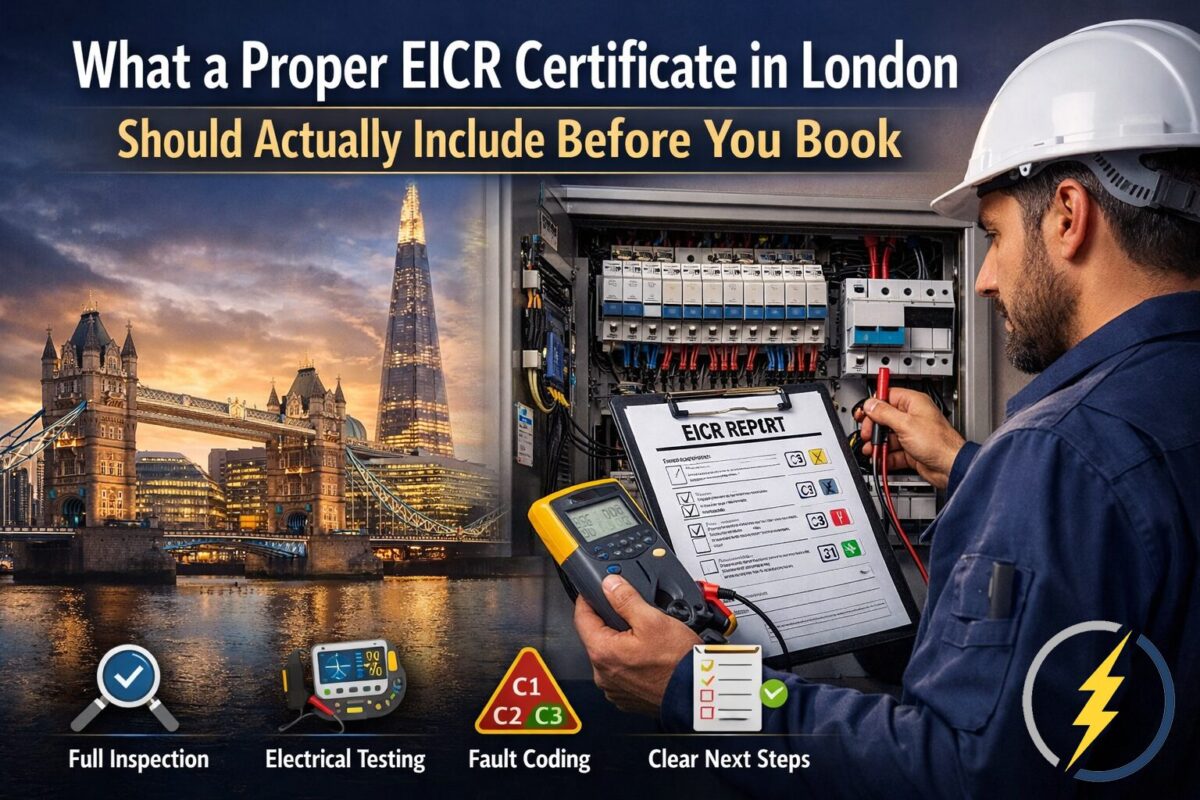
Electrical engineer carrying out an EICR inspection for a block management company in London, checking communal electrical distribution board and landlord electrical supplies in a residential apartment building.

EICR for Block Management Companies in London

Who Is Responsible for Flats, Communal Areas and Landlord Supplies?

Managing a block of flats in London is never just about repairs and service charges.

You are dealing with leaseholders, landlords, tenants, access issues, contractor coordination, compliance deadlines, safety risk, and the constant challenge of working out who is responsible for what. Electrical safety is one of the areas where confusion happens fast, especially when a building has a mix of private flats, communal installations, and landlord-owned electrical supplies.

That is why so many managing agents, RTM companies, freeholders, and block management companies ask the same thing:

Who is responsible for the EICR in a block of flats?

Is it the landlord of each flat?
Is it the freeholder?
Is it the management company?
Does the communal area need its own EICR?
What about landlord supplies, meter cupboards, hallway lighting, plant rooms, and shared systems?

The real answer is not one-size-fits-all.

In most London residential blocks, EICR responsibility depends on which part of the installation is being controlled, maintained, or supplied. That means one building can have multiple responsibilities across different electrical systems. The wiring inside a rented flat may fall under one party, while communal lighting, shared distribution boards, and landlord supplies fall under another.

This guide explains it properly.

We will break down:

  • what an EICR covers in a block of flats
  • who is usually responsible for private flats
  • who is usually responsible for communal areas
  • who normally handles landlord electrical supplies
  • when a block needs separate inspections
  • common mistakes block managers make
  • real-world examples from London properties
  • how to arrange the right inspection without wasting time or money

If you manage residential buildings and want practical help, our team provides fast, professional EICR services in London for landlords, homeowners, block managers, and commercial clients.


What Is an EICR and Why Does It Matter in a Block of Flats?

An Electrical Installation Condition Report, or EICR, is an inspection of an electrical installation to assess whether it is safe for continued use. It checks the condition of fixed wiring, boards, circuits, earthing, protective devices, and other parts of the installation. It also identifies defects, deterioration, damage, poor workmanship, or non-compliance with current safety standards.

In a normal house or flat, that is pretty straightforward.

In a London block, it is not.

A residential building can include:

  • individual flat consumer units
  • landlord intake equipment
  • communal distribution boards
  • shared hallway lighting
  • stairwell lighting
  • external lighting
  • emergency lighting supplies
  • door entry systems
  • gate supplies
  • meter cupboards
  • riser cupboards
  • plant room circuits
  • ventilation and booster systems
  • concierge or cleaner power supplies

That means the electrical installation is often split into multiple parts with different users, different responsibilities, and different access arrangements.

This is exactly why block management companies need a proper understanding of EICR scope. Booking “an EICR for the building” without understanding what is actually being inspected is how problems start.

For a general overview of inspections, certifications, and electrical compliance support, visit our main EICR Certificate London homepage.


Who Is Responsible for EICR in a Block of Flats in London?

This is the core question, and here is the clearest answer:

Responsibility for an EICR in a block of flats usually follows ownership, control, maintenance obligation, or supply of that part of the installation.

So the building may not have one single responsible person for everything.

Instead, responsibility is normally split across:

  • private flat installations
  • communal electrical installations
  • landlord electrical supplies
  • mixed-use or commercial areas where applicable

That is why a block management company needs to think in sections, not assumptions.

Let’s break those down properly.


1. Private Flats: Who Normally Arranges the EICR?

For the wiring and fixed electrical installation inside an individual flat, responsibility is usually linked to the person who owns or lets that flat.

If the flat is rented

The landlord is usually responsible for arranging the EICR covering that flat’s installation. This normally includes the consumer unit, socket circuits, lighting circuits, cooker circuit, and fixed wiring within the demised premises.

That is why we offer dedicated EICR Certificates for Landlords in London, designed for rented properties that need compliant electrical inspections and clear reporting.

If the flat is owner-occupied

The owner of the flat would usually be responsible for their own electrical inspection when required.

If the flat is vacant or under sale

Responsibility usually still sits with the legal owner or landlord of that unit, unless the lease or ownership structure states otherwise.

Key point

A block manager is not automatically responsible for the wiring inside private flats just because they manage the building overall.

That confusion causes a lot of wasted time.


2. Communal Areas: Do They Need a Separate EICR?

Yes, in many cases they do.

Communal areas in a block often have their own electrical installation or landlord-fed circuits that serve shared spaces. These areas are not part of one private dwelling, so they should not be assumed to be covered by an individual flat EICR.

Communal electrical installations often include:

  • corridor lighting
  • stairwell lighting
  • lobby lighting
  • bin store lighting
  • bike store lighting
  • external lighting
  • communal socket outlets
  • cleaner sockets
  • riser cupboard lighting
  • meter room lighting
  • shared fire escape route lighting
  • supplies feeding emergency lighting systems
  • access control equipment

If those circuits exist, they need to be assessed as part of the communal or landlord-controlled installation.

Who is usually responsible for communal areas?

This is normally the party responsible for the common parts of the building, such as:

  • the freeholder
  • the Residents’ Management Company
  • the Right to Manage company
  • the block management company acting on behalf of the legal owner or management entity

So yes, communal areas often need their own EICR, separate from the flats.


3. Landlord Supplies: The Part Most People Miss

This is the section where a lot of buildings get caught out.

Landlord supplies are electrical circuits or boards that are not inside a private flat but are still part of the building’s wider electrical setup. They are often hidden in intake cupboards, service cupboards, basements, plant rooms, or risers.

Examples include:

  • landlord distribution boards
  • meter cupboard supplies
  • hallway and stairwell circuits
  • external lighting circuits
  • shared ventilation or extract supplies
  • booster pump power supplies
  • plant room circuits
  • gate motors
  • door entry systems
  • concierge or caretaker supply circuits
  • shared service equipment

These are easy to overlook because they are not always obvious during day-to-day management.

A building can have flat EICRs in place and still have no proper inspection at all for landlord supplies.

That is a serious weak point.

If your building includes more complex shared or service-based installations, our Commercial EICR Certificates in London page is also relevant, especially for mixed-use or multi-service buildings.


Responsibility Matrix: Flats vs Communal Areas vs Landlord Supplies

Here is the cleanest way to look at it:

Area of Installation Usually Responsible Notes
Wiring inside a rented flat The landlord of that flat Usually covered by a domestic landlord EICR
Wiring inside an owner-occupied flat The flat owner Normally private responsibility
Communal hallway lighting Freeholder / management company / RTM Usually not covered by flat EICRs
Stairwell and lobby circuits Freeholder / management structure Needs communal inspection where applicable
Landlord distribution board Freeholder / management structure Often overlooked
Meter cupboard landlord-fed circuits Freeholder / management structure Should be identified clearly
Plant room and shared service circuits Freeholder / management structure May require more specialist scoping
Ground-floor commercial unit Often separate occupier or landlord Depends on lease and supply layout

This is why there is often more than one EICR requirement in the same building.


Can One EICR Cover the Whole Building?

Sometimes, but often no.

That depends on how the installation is structured.

A single EICR might work if:

  • the building has one clearly defined landlord-controlled installation
  • there are no private flat installations included
  • the scope is limited to communal and shared electrical systems

Separate EICRs are more likely needed if:

  • each flat has its own consumer unit
  • the building contains rented flats owned by different landlords
  • the communal installation is separate
  • there are landlord supplies feeding shared services
  • there is mixed-use or commercial space
  • some parts are owner-controlled and others are building-controlled

In practice, many London blocks need a split strategy such as:

  • individual flat EICRs where relevant
  • one communal area EICR
  • one landlord supply inspection where separate boards or systems exist

Trying to force everything into one vague inspection is usually a bad move.


The Biggest Mistake Block Management Companies Make

The biggest mistake is assuming the building is covered because some individual flats already have certificates.

That is not the same as the whole building being covered.

A block can have:

  • five landlord EICRs for rented flats
  • three owner-occupied flats with no inspection
  • one communal lighting board never checked
  • one landlord distribution board hidden in a basement cupboard
  • one external lighting circuit with no recent inspection

From a compliance and risk point of view, that building is not fully covered.

Another common mistake is failing to define the scope before booking.

A block manager may ask for “an EICR for the building,” but unless somebody has clarified:

  • how many boards there are
  • what each board feeds
  • what is communal
  • what is inside private demise
  • what is landlord-fed
  • what is accessible
  • what has previous certification

the inspection can become messy fast.


Case Study Example 1: Twelve-Flat Residential Block in South London

Let’s make this practical.

A block management company in South London manages a purpose-built building with 12 flats. Six are rented, six are owner-occupied. The block also includes:

  • communal hallway lighting
  • stairwell lighting
  • an external front light
  • a shared door entry system
  • a landlord distribution board
  • cleaner socket in the ground-floor lobby
  • service cupboards on each floor

What the agent assumed

The managing agent believed the building was broadly covered because several landlords had already sent over flat EICRs.

What was actually found

Once the site was reviewed, it became clear that no proper inspection had been carried out on:

  • the communal lighting circuits
  • the landlord board
  • the door entry power supply
  • the external light circuit
  • the lobby socket

Outcome

The building required:

  • separate flat EICRs where relevant
  • a separate inspection for communal and landlord-controlled installations
  • remedial works to damaged accessories and poor circuit labelling

Main lesson

Flat EICRs do not automatically cover the communal installation.

This is one of the biggest misunderstandings in block management.

If issues are found, we also carry out remedial work for failed EICR certificates, helping clients move from failed report to completed compliance faster.


Case Study Example 2: Older Mansion Block in West London

Now take a different type of building.

An older mansion block in West London contains 18 flats, a basement meter area, a shared hallway lighting system, external lights, and an entry system that has been modified over the years.

What looked fine at first

The block looked well-maintained on the surface. Hallways were decorated, lighting seemed to work, and several flats had recently been sold or let.

What the inspection revealed

The communal installation had:

  • poor circuit identification
  • aging board accessories
  • damaged blanks
  • signs of older alterations
  • unclear landlord supply boundaries
  • outdated fittings in service cupboards

Why this matters

On paper, the building looked fine. In reality, the electrical setup in the communal parts had not been properly reviewed for a long time.

Main lesson

Visual appearance means nothing. A clean hallway does not mean the communal electrics behind it are in good condition.


Do Communal Areas Need an EICR in London Blocks?

In many cases, yes.

If the communal areas are electrically supplied and those installations are part of the building’s shared infrastructure, then they should be inspected on a proper cycle. That includes shared lighting, sockets, boards, and building-controlled supplies.

Typical communal installations needing inspection include:

  • hallways
  • entrance lobbies
  • shared staircases
  • storage rooms
  • meter cupboards
  • plant areas
  • external shared areas
  • refuse areas
  • shared service cupboards

This is especially important in older London buildings where upgrades have happened over many years, often by different contractors, with mixed documentation.


What Should a Block Management Company Check Before Booking an EICR?

If you want the job to run smoothly, gather the right details first.

1. How many boards are on site?

Do not assume there is only one. Buildings often have extra boards in cupboards, risers, basements, or plant areas.

2. Are you booking for flats, communal areas, or both?

This changes the scope, access plan, time required, and reporting.

3. Is there a landlord supply?

If yes, it should be clearly identified.

4. Is the building mixed-use?

A ground-floor shop, office, or commercial space may need separate handling.

5. Are service cupboards and meter cupboards accessible?

No access means delays, repeat visits, and wasted cost.

6. Are previous reports available?

Old reports help identify history, changes, and recurring issues.

7. Are there known faults or problem circuits?

This helps electricians focus on likely trouble areas during the inspection.

For quick enquiries and faster scheduling, you can use our Book Now Online page.


Common Electrical Problems Found in London Communal Areas

This is where block management companies often get surprised.

Common issues found during communal or landlord supply inspections include:

  • outdated fuse boards
  • missing or poor labelling
  • damaged accessories in service areas
  • exposed wiring in cupboards
  • loose terminations
  • signs of overheating
  • poor earthing arrangements
  • lack of RCD protection where needed
  • old lighting circuits in communal routes
  • undocumented alterations
  • mixed-age equipment
  • overloaded landlord circuits
  • broken enclosure blanks
  • temporary repairs that became permanent

These are not rare. They are normal findings in a lot of older blocks, especially where upgrades have happened over time without a clear electrical asset plan.


Chart: What Usually Drives EICR Complexity in a Block?

Complexity Level Typical Building Features Inspection Impact
Low One communal board, simple lighting, easy access Faster inspection, easier reporting
Medium Multiple boards, external lights, shared systems More planning and access coordination
High Plant rooms, mixed-use areas, landlord supplies, poor documentation More detailed scoping and longer inspection time

This is why pricing and timing vary from site to site. For more guidance, see our EICR Certificate Cost page.


How a Good Block Management EICR Process Should Work

Here is the proper workflow:

Step 1: Identify the building type

Is it a simple converted house, a purpose-built block, a mansion block, or mixed-use?

Step 2: Map the electrical installation

Work out what serves private flats, what serves communal areas, and what serves landlord-controlled systems.

Step 3: Confirm responsibility

Clarify who controls each area of the installation.

Step 4: Arrange access

Flats, cupboards, risers, meter rooms, basements, roof plant, and shared spaces all need planning.

Step 5: Carry out inspection

The electrician inspects the agreed scope and records observations properly.

Step 6: Review report outcome

Satisfactory or unsatisfactory, along with coding and recommendations.

Step 7: Complete remedials if needed

Where defects are found, they should be addressed properly and documented.

Step 8: Store the records

Certificates and reports should be held centrally for future compliance tracking, handovers, and management continuity.


How This Connects to Landlords, Homeowners, and Building Managers

One reason this topic is so important is because blocks are rarely owned or occupied in one single way.

You may have:

  • private landlords renting out flats
  • leaseholders living in their own units
  • a freeholder responsible for communal areas
  • a managing agent coordinating maintenance
  • an RTM company making decisions
  • shared building services under landlord control

That is why your electrical compliance setup should never be approached like a single domestic house.

If your team also deals with private owners, our EICR Certificates for Homeowners in London page is useful too, especially when owner-occupiers ask where their responsibility starts and ends.


When Should Block Management Companies Arrange an EICR?

The wrong time is when:

  • a resident complains
  • the hallway lights keep tripping
  • the fire risk assessor flags electrical concerns
  • the insurer asks questions
  • a solicitor asks for building safety documentation
  • a hidden fault turns into an emergency

The right time is before it becomes reactive.

A planned inspection gives you:

  • better access coordination
  • better budgeting
  • less disruption
  • proper scope control
  • more time to deal with remedials

Reactive electrical compliance is almost always more expensive and more stressful than planned compliance.


How Our London EICR Service Helps Block Management Companies

We work with landlords, homeowners, businesses, and property managers across London. For block management companies, the real value is not just producing a certificate. It is helping define the correct inspection scope in the first place.

We help clients with:

  • communal area EICRs
  • landlord supply inspections
  • inspections for residential blocks
  • support for managing agents and block management companies
  • mixed-use and commercial building inspections
  • follow-up remedial works
  • practical advice on what should be inspected and why

Relevant service pages:


Final Answer: Who Is Responsible for Flats, Communal Areas and Landlord Supplies?

Here is the clean summary.

Private flats

Usually the responsibility of the flat owner or landlord of that unit.

Communal areas

Usually the responsibility of the freeholder, management company, RTM company, or whoever controls the common parts.

Landlord supplies

Usually the responsibility of the party controlling the landlord-fed installation serving shared systems or building services.

Managing agents

Often coordinate inspections on behalf of the responsible party, but responsibility depends on the legal and management structure of the building.

So the key takeaway is this:

There is rarely one single EICR responsibility for the whole block. Responsibility needs to be matched to the actual installation being controlled, supplied, or maintained.

That is the part a lot of people get wrong.


Need an EICR for a Block of Flats in London?

If you manage a block and need help working out:

  • what should be inspected
  • whether communal areas need their own EICR
  • who is responsible for landlord supplies
  • whether separate flat inspections are needed
  • how to price and scope the job properly

we can help.

Whether it is a converted house, purpose-built development, mansion block, or mixed-use site, our team provides professional EICR inspections across London with practical guidance and fast booking.

Start here:

If your building includes private flats, communal electrics, and landlord supplies, get the scope right from the start. That saves time, cuts confusion, and makes compliance much easier.

❓Frequently Asked Questions About EICR for Block Management Companies in London❓

1. Who is responsible for the EICR in a block of flats in London?

Responsibility usually depends on which part of the electrical installation is being controlled, maintained, or owned. The wiring inside a rented flat is usually the landlord’s responsibility, while communal lighting, landlord boards, and shared electrical systems are usually the responsibility of the freeholder, Residents’ Management Company, RTM company, or the party managing the common parts.

2. Do communal areas in a block of flats need their own EICR?

Yes, in many cases they do. Communal areas such as hallways, stairwells, entrance lobbies, bin stores, external lighting zones, and service cupboards are often supplied by landlord-controlled circuits. These are not normally covered by individual flat EICRs, so a separate communal area inspection is often needed.

3. Are private flat EICRs enough to show the whole building is electrically safe?

No, not usually. A building can have valid EICRs for some rented flats and still have no inspection in place for communal lighting, landlord distribution boards, meter cupboards, or other shared electrical systems. That is one of the most common mistakes in block management.

4. What are landlord electrical supplies in a residential block?

Landlord supplies are electrical circuits or boards that serve shared parts of the building rather than one private flat. This can include communal lighting, door entry systems, external lighting, cleaner sockets, plant room supplies, shared ventilation systems, gate motors, and landlord distribution boards.

5. Can one EICR cover both the flats and the communal areas?

Sometimes, but not always. It depends on how the building is wired and how responsibilities are split. In many London blocks, separate inspections are needed for private flats, communal installations, and landlord supplies because they are controlled by different parties and fed by different boards or circuits.

6. Does a block management company have to arrange the EICR itself?

A block management company often arranges the inspection on behalf of the responsible party, but that does not automatically mean it carries the legal responsibility for every electrical installation in the building. The actual responsibility usually depends on the lease structure, ownership setup, and which part of the installation is being inspected.

7. What parts of a block of flats are usually included in a communal EICR?

A communal EICR may include hallway lighting, stairwell lighting, entrance lobby circuits, meter cupboard lighting, bin store lighting, external lights, cleaner sockets, landlord-fed boards, riser cupboard supplies, and other shared electrical systems. The exact scope should always be confirmed before the inspection starts.

8. What happens if the communal EICR comes back unsatisfactory?

If the report is unsatisfactory, it means potentially dangerous defects, urgent issues, or further investigation points have been found. In that case, remedial works may be needed to correct the faults, improve safety, and bring the communal electrical installation up to an acceptable standard.

9. How can block management companies prepare properly for an EICR?

The best preparation is to identify how many boards are on site, what each board serves, whether there are landlord supplies, whether communal areas are included, and how access will be provided to flats, meter cupboards, plant rooms, and service cupboards. Good preparation makes the inspection faster, smoother, and more accurate.

10. Why is this such an important issue for London blocks of flats?

Because many London buildings have a mix of leaseholders, landlords, communal systems, older wiring, historic alterations, and unclear ownership boundaries. Without a properly scoped EICR, block managers can easily assume the building is covered when parts of the electrical installation have not been inspected at all.

Please Submit Details Below

For your convenience, you can also fill out our online contact form below. Please provide as much detail as possible, and a member of our team will get back to you promptly.
Select Certificate Type:
Tags :
EICR Certificates,EICR Inspection
Share This :

Real EICR Report Example (2026): What an Electrical Safety Certificate Actually Looks Like

Are you a homeowner, landlord, or business owner in London? Ensuring the safety and compliance of your property’s electrical installations is crucial, and that’s where an Electrical Installation Condition Report (EICR) certificate comes in. But, how do you obtain one? Our step-by-step guide provides all the information you need to follow to get your EICR certificate. From finding a qualified electrician to scheduling the inspection and addressing any issues highlighted in the report, our guide covers everything you need to know. Don’t risk the safety of your property – read our guide and obtain your EICR certificate today!

Real EICR Report Example (2026): What an Electrical Safety Certificate Actually Looks Like

EICR Faults & Failures,EICR Guide
Home / Archive by category "EICR Faults & Failures"
Real EICR report example 2026 showing an electrical safety certificate, test meter and consumer unit in London.

Real EICR Report Example (2026)

What an Electrical Safety Certificate Actually Looks Like

If you have ever searched for a real EICR report example, you are probably trying to figure out one of a few things.

Maybe a tenant, landlord, letting agent, buyer, or solicitor has asked you for an EICR certificate and you want to know what it actually looks like before booking. Maybe you have already had an inspection completed and now you are staring at a document full of codes, observations, and technical wording that makes no sense. Or maybe you are comparing electricians and want to understand exactly what you are paying for.

That is where this guide comes in.

In this article, we will show you what a real Electrical Installation Condition Report is supposed to contain, what each part means, how to tell if the result is satisfactory or unsatisfactory, and what happens next if faults are found. We will also explain the difference between an EICR report and the phrases people often use online such as electrical safety certificate, electrical test certificate, and landlord electrical certificate.

If you need a fast, fixed-price inspection, you can book directly through our Book Online page or explore all of our EICR services in London first.


What Is an EICR Report?

An EICR, short for Electrical Installation Condition Report, is a formal document issued after a qualified electrician inspects and tests the fixed electrical installation in a property.

This includes things such as:

  • consumer units

  • fuse boards

  • sockets

  • lighting circuits

  • earthing and bonding

  • wiring condition

  • protective devices

  • circuit integrity

  • safety compliance under current standards

The report is designed to show whether the installation is safe for continued use at the time of inspection.

In everyday language, a lot of people call it:

  • an EICR certificate

  • an electrical safety certificate

  • a landlord electrical certificate

  • an electrical inspection report

  • an electrical installation condition report certificate

They are usually referring to the same thing.

If you want a broader overview first, check our guide on how to read and understand an EICR report.


Why People Search for a Real EICR Report Example

This is actually one of the best-intent searches in the EICR space.

Someone typing sample EICR report or what does an EICR report look like is usually not just casually browsing. They are often:

  • about to book an inspection

  • trying to understand a failed report

  • preparing a rental property for compliance

  • buying or selling a flat or house

  • checking what their electrician should provide

  • comparing prices and quality before ordering

That makes this topic super strong for both authority and conversion.

If your next step is pricing, our EICR certificate cost page breaks down what affects the price in London.


What a Real EICR Report Example Usually Contains

A proper EICR report example is not just one page with a pass or fail line on it. A real document normally includes several sections, often spread over multiple pages depending on the size of the property and the number of circuits.

Below is the type of structure you would usually expect.

1. Client and Property Details

This part identifies the property being inspected and the person or organisation instructing the work.

It may include:

  • client name

  • property address

  • occupancy type

  • purpose of report

  • date of inspection

  • extent and limitations of the inspection

This matters because the report is site-specific. An EICR belongs to that installation at that time, not just to the owner.

2. Details of the Electrical Installation

This section provides technical information about the property’s electrical system.

It may mention:

  • supply characteristics

  • earthing arrangement

  • number of consumer units

  • number of circuits

  • type of protective devices

  • presence of RCD protection

  • bonding arrangements

For landlords, homeowners, and agents in London, this section is important because it gives a clear snapshot of the installation’s overall setup.

3. Summary of the Condition

This is one of the most important parts because it tells you whether the report is:

  • Satisfactory

  • Unsatisfactory

A satisfactory result means the installation is considered safe for continued use at the time of inspection.

An unsatisfactory result means faults were identified that require attention.

4. Observations and Recommendations

This is where the electrician records defects, risks, and non-compliances.

Each observation is given a code such as:

  • C1

  • C2

  • C3

  • FI

We will explain these codes properly later in this post.

5. Schedule of Inspections

This section records what has been visually inspected.

It often covers:

  • consumer unit condition

  • access to live parts

  • suitability of protective devices

  • socket condition

  • bonding

  • cable identification

  • labelling

  • signs of damage or overheating

6. Schedule of Test Results

This is the more technical side of the report. It includes actual measurements taken during testing.

It may include:

  • continuity readings

  • insulation resistance

  • polarity

  • earth fault loop impedance

  • RCD trip times

  • circuit breaker information

This is one of the main reasons an EICR is not just a quick visual check. It involves actual testing and recorded data.


Simple Visual Breakdown of a Real EICR Report

Here is a simplified chart-style breakdown of what most reports contain:

Section of Report What It Shows Why It Matters
Client Details Owner, agent, landlord or tenant info Confirms who instructed the report
Property Address Exact inspected location Ties report to the correct property
Installation Details Earthing, supply, consumer unit details Gives technical system overview
Overall Result Satisfactory or Unsatisfactory Quick safety outcome
Observations Faults and issues found Shows what needs attention
Inspection Schedule Visual inspection items Confirms what was checked
Test Results Electrical measurements Evidence-based safety testing
Next Inspection Date Recommended retest period Helps compliance planning

This is why a proper electrical installation condition report example looks more technical and structured than most people expect.


What Does an EICR Certificate Actually Look Like?

A real EICR certificate example usually looks like a professional multi-page technical form rather than a flashy branded certificate.

A lot of customers expect something simple like a one-page “pass certificate” with a big green tick. That is not how a real Electrical Installation Condition Report works.

A genuine EICR typically includes:

  • professional form layout

  • installation details

  • coded observations

  • pages of circuit data

  • inspection signatures

  • dates

  • recommendations

So when people search what does an electrical safety certificate look like, the honest answer is this:

It looks more like a structured inspection report than a decorative certificate.

That said, many electricians and companies still refer to it commercially as an electrical safety certificate because that is how customers search for it.

If you are booking for a rental property, see our dedicated EICR certificates for landlords in London page.

If the property is owner-occupied, our EICR certificates for homeowners in London page is more relevant.


Satisfactory vs Unsatisfactory: What It Means

This is the part most people care about most.

Satisfactory

A satisfactory result means no dangerous or potentially dangerous defects were found that would make the installation unsafe for continued use.

That does not always mean the installation is perfect or brand new. It means it meets the safety threshold required at the time of inspection.

You may still see improvement recommendations on a satisfactory report.

Unsatisfactory

An unsatisfactory result means one or more issues were found that require action.

This is usually because the report contains:

  • C1 observations

  • C2 observations

  • FI observations

If your report is unsatisfactory, the next step is normally remedial work followed by written confirmation that the issues were corrected.

If that has happened to your property, our remedial works for failed EICR certificates page explains the next stage.


EICR Codes Explained Properly

If you have ever looked at a report and seen C1, C2, C3, or FI, you are not alone in thinking, “what the hell does this actually mean?”

Here’s the clean version.

C1: Danger Present

This means there is an immediate danger to people using the installation.

Examples could include:

  • exposed live parts

  • serious damage allowing direct contact with live conductors

  • major safety defects presenting immediate risk

A C1 issue needs urgent action.

C2: Potentially Dangerous

This means the installation is not immediately dangerous at the exact second of inspection, but there is a significant enough risk that it still fails the report.

Examples may include:

  • lack of required RCD protection in certain situations

  • missing bonding

  • serious deterioration

  • unsafe accessory condition

C2 also results in an unsatisfactory EICR.

C3: Improvement Recommended

A C3 does not fail the report on its own.

It means the installation could be improved to better align with current standards, but it is not considered unsafe enough to make the report unsatisfactory.

Examples may include:

  • older but serviceable equipment

  • minor upgrades that would improve safety

  • outdated labelling

FI: Further Investigation Required

FI means the inspector has reason to believe there may be a hidden issue that needs further investigation before a full conclusion can be reached.

This is not something to ignore.


Quick Code Reference Chart

Code Meaning Does It Fail the EICR?
C1 Danger present Yes
C2 Potentially dangerous Yes
C3 Improvement recommended No
FI Further investigation required Yes

This is one of the biggest reasons people search for an EICR report example. They want to understand whether the wording on their report is serious or just advisory.


Example Scenario 1: Satisfactory EICR Report

Imagine a modern one-bedroom flat in London with:

  • a reasonably modern consumer unit

  • RCD protection present

  • acceptable test results

  • no dangerous defects

  • only minor recommendations

The report may show:

  • Overall Outcome: Satisfactory

  • Observation Code: maybe one or two C3 items

  • Recommendation: consider future improvements, but no urgent remedial works required

This is the type of outcome landlords and homeowners obviously want.

If you want to book this type of inspection quickly, start with our EICR services page or go straight to Book Online.


Example Scenario 2: Unsatisfactory EICR Report

Now imagine an older rental flat with:

  • no RCD protection on certain circuits

  • broken socket accessories

  • missing bonding

  • poor consumer unit labelling

  • signs of deterioration

The report may show:

  • Overall Outcome: Unsatisfactory

  • Observation Codes: C2, maybe FI

  • Recommendation: remedial work required before compliance can be confirmed

This is common in older London properties, especially where installations have been extended or altered over time.

For commercial properties, the same logic applies, just on a larger scale. If that is your situation, see our Commercial EICR Certificates in London page.


What an Electrician Is Actually Testing During an EICR

A good electrician is not guessing. A proper EICR includes both inspection and testing.

Here are some of the areas typically checked:

Visual Inspection

  • condition of sockets and switches

  • signs of damage, burning or overheating

  • accessibility of equipment

  • consumer unit condition

  • cable entry and enclosure integrity

  • earthing and bonding presence

  • identification and labelling

  • suitability of protective devices

Electrical Testing

  • continuity of conductors

  • insulation resistance

  • polarity

  • earth fault loop impedance

  • RCD performance

  • circuit verification

  • disconnection times

  • protective conductor integrity

This is why a very cheap quote should always be treated carefully. A rushed or poor-quality inspection can miss serious issues and leave you with a worthless report.

You can compare more pricing context on our EICR certificate cost page.


What Makes a Good EICR Report Example Useful?

A useful report example should do more than show a form. It should help the reader understand what each section actually means in real life.

The best examples explain:

  • where to find the overall result

  • what the codes mean

  • which issues fail the report

  • whether remedial work is required

  • when the next inspection is due

  • what a landlord or homeowner should do next

A weak page just shows a document image and leaves the user confused.

A strong page, like this one, turns confusion into action.


How Landlords Can Use an EICR Report Properly

For landlords in London, this document is not just paperwork. It is a compliance and risk-management tool.

A proper EICR helps landlords:

  • meet legal responsibilities

  • reduce risk of electrical incidents

  • provide evidence of inspection

  • identify faults before tenants complain

  • avoid last-minute panic before a new tenancy

  • plan remedial work properly

If you are renting out property in London, this service should not be treated as optional admin.

You can learn more on our Landlord EICR Certificates page.


How Homeowners Benefit From an EICR Report

A lot of owner-occupiers assume EICRs are only for landlords. That is not true.

Homeowners use EICRs when:

  • buying a property

  • selling a property

  • planning renovations

  • checking old wiring

  • investigating repeated electrical faults

  • wanting reassurance about safety

An EICR can reveal hidden issues long before they become expensive emergencies.

If that sounds relevant, visit our Homeowner EICR page.


How Long Does an EICR Report Usually Take to Produce?

The inspection time depends on:

  • property size

  • number of circuits

  • accessibility

  • condition of installation

  • occupancy

  • whether power can be safely isolated

As a rough guide:

Property Type Typical Inspection Time
Studio / 1 bed flat 1 to 2 hours
2 to 3 bed flat or house 2 to 4 hours
Larger houses 4+ hours
Commercial units varies depending on size and circuit complexity

The report is then compiled and issued after testing and review.


What Happens After a Failed EICR?

This is where a lot of people panic, but the process is actually pretty straightforward when handled properly.

Step 1: Review the Observations

Check which faults were coded C1, C2, C3, or FI.

Step 2: Prioritise Safety

Immediate or potentially dangerous faults should be addressed quickly.

Step 3: Arrange Remedial Works

A qualified electrician corrects the issues listed in the report.

Step 4: Obtain Written Confirmation

After the remedial works are complete, you should receive confirmation that the installation has been brought to a satisfactory standard where applicable.

Step 5: Keep Records

Store the report and any remedial documentation safely.

If your property has already failed, our remedial works page is the next logical step.


Common Misunderstandings About EICR Reports

“If it’s not brand new, it will fail”

Not true. Older installations can still receive a satisfactory result if they are safe.

“Any recommendation means it failed”

Wrong. A C3 improvement recommendation on its own does not fail the report.

“An EICR is just a visual check”

Also wrong. Proper testing is a core part of the process.

“A cheap certificate is the same as a proper inspection”

Definitely not. Some ultra-cheap offers can mean rushed inspections, low testing quality, or weak reporting.

“The report is only useful for landlords”

No. Homeowners, buyers, sellers, and businesses all use EICRs too.


What a Good London EICR Company Should Provide

When choosing a provider for your electrical safety certificate in London, look for:

  • clear fixed pricing where possible

  • experienced inspectors

  • proper report format

  • clear explanation of results

  • realistic booking times

  • remedial works support if needed

  • easy access to help if you have questions

At London EICR Certificates, we focus on making the process straightforward for landlords, homeowners, agents, and businesses across London.

You can explore our full service offering here:


Real-World Example: Why This Report Matters

Let’s say a landlord in North London is preparing for a new tenancy. The previous tenant has moved out, and the agent wants all compliance sorted before marketing begins.

The landlord books an EICR.

The electrician inspects the flat and finds:

  • broken accessory on one socket

  • missing main bonding

  • no RCD protection on a circuit serving socket outlets likely to supply portable outdoor equipment

  • test results otherwise acceptable

The report comes back unsatisfactory because of the C2 issues.

Without the report, the landlord might never have known there were defects serious enough to affect safety and compliance. Once the remedial work is completed, the property is in a much better position for letting.

That is the real value of an EICR. It is not just a document. It is a decision-making tool.


EICR Report Example vs Electrical Safety Certificate vs Test Certificate

This confuses loads of people, so let’s clear it up.

Term What People Usually Mean
EICR Report Full Electrical Installation Condition Report
EICR Certificate Common customer phrase for the EICR
Electrical Safety Certificate Informal phrase often used for EICR
Electrical Test Certificate Can refer to EICR or other electrical certification depending on context

So if someone says, “I need an electrical safety certificate,” they often mean they need an EICR certificate.


When You Should Book an EICR in London

You should consider booking an inspection if:

  • you are a landlord preparing for a tenancy

  • you are buying or selling a property

  • your wiring is old

  • you are experiencing recurring electrical faults

  • you want reassurance for a family home

  • you manage a commercial property

  • you have not had the installation checked in years

You can also view our areas we cover if you want to confirm service availability in your part of London.


Why This Topic Builds Real Authority

This kind of article is powerful because it is practical.

There are already loads of generic blogs online saying “an EICR is important.” That alone is not enough anymore.

What users actually want is:

  • proof

  • examples

  • clarity

  • visual explanation

  • what happens next

That is why a real EICR report example page can bring in more qualified traffic than another fluffy general guide.


Need an EICR Certificate in London?

If you need a professional inspection for a flat, house, rented property, or commercial premises, we can help.

Our service is built for:

  • landlords

  • homeowners

  • estate and letting agents

  • property managers

  • business owners

You can start here depending on your situation:


Final Thoughts

If you came here searching for a sample EICR report, electrical installation condition report example, or wondering what an electrical safety certificate actually looks like, the key takeaway is simple.

A real EICR is a structured technical inspection report that tells you whether your property’s electrical installation is safe for continued use at the time of inspection. It includes client details, installation information, inspection results, coded observations, and a final outcome of satisfactory or unsatisfactory.

Once you understand how to read it, the document stops feeling intimidating and starts becoming useful.

And if you still need help, that is exactly what we are here for.

Visit London EICR Certificates to arrange your inspection or book directly through our online booking page.

❓Real EICR Report Example FAQ: Understanding Your Electrical Safety Certificate in 2026❓

1. What does a real EICR report actually look like?

A real EICR report usually looks like a multi-page technical document rather than a simple one-page certificate. It includes the property details, client information, electrical installation summary, inspection observations, test results, fault codes, and the final outcome showing whether the installation is satisfactory or unsatisfactory.

2. Is an EICR the same as an electrical safety certificate?

In most cases, yes. Many landlords, homeowners, and estate agents use the phrase electrical safety certificate when they are talking about an EICR. The formal name is Electrical Installation Condition Report, but both terms are often used to describe the same inspection document.

3. What is included in an Electrical Installation Condition Report?

An Electrical Installation Condition Report normally includes client and property details, the extent of the inspection, information about the consumer unit and circuits, a schedule of inspections, a schedule of test results, recorded observations, fault codes, and the overall result of the inspection.

4. What do C1, C2, C3 and FI mean on an EICR report?

These are the observation codes used by the inspecting electrician. C1 means danger present and needs immediate action. C2 means potentially dangerous and usually causes the report to fail. C3 means improvement recommended and does not fail the report by itself. FI means further investigation is required because a possible hidden issue has been identified.

5. What is the difference between a satisfactory and unsatisfactory EICR?

A satisfactory EICR means no dangerous or potentially dangerous faults were found during the inspection. An unsatisfactory EICR means the electrician has identified issues serious enough to require action, usually because of C1, C2, or FI observations.

6. Can a property still pass an EICR if it has C3 observations?

Yes, it can. A C3 observation means an improvement is recommended, but it does not make the report unsatisfactory on its own. Many older properties in London receive satisfactory EICRs with one or more C3 recommendations listed on the report.

7. How many pages is a normal EICR report?

That depends on the size of the property and the number of circuits. A small flat may have a shorter report, while a larger house, HMO, office, shop, or commercial unit can have a much longer report with more inspection details and test results.

8. What happens if my EICR report is unsatisfactory?

If your EICR report is unsatisfactory, the next step is usually to review the faults, arrange the required remedial work, and then obtain written confirmation that the issues have been corrected. In some cases, a further inspection or additional testing may also be needed depending on the defects recorded.

9. How long does it take to receive an EICR report after the inspection?

This can vary depending on the size and complexity of the property, but many EICR reports are issued shortly after the inspection once the testing data has been reviewed and the report has been completed properly. Larger or more complex properties may take longer.

10. Who needs an EICR certificate in London?

EICR certificates are commonly needed by landlords, homeowners, buyers, sellers, letting agents, property managers, and commercial property owners. They are useful for legal compliance, safety checks, property transactions, maintenance planning, and general peace of mind.

Please Submit Details Below

For your convenience, you can also fill out our online contact form below. Please provide as much detail as possible, and a member of our team will get back to you promptly.
Select Certificate Type:
Tags :
EICR Certificates,EICR Inspection
Share This :

EICR Certificate Cost by Bedroom in London (1–5 Beds): Real Prices, Time & What’s Included

Are you a homeowner, landlord, or business owner in London? Ensuring the safety and compliance of your property’s electrical installations is crucial, and that’s where an Electrical Installation Condition Report (EICR) certificate comes in. But, how do you obtain one? Our step-by-step guide provides all the information you need to follow to get your EICR certificate. From finding a qualified electrician to scheduling the inspection and addressing any issues highlighted in the report, our guide covers everything you need to know. Don’t risk the safety of your property – read our guide and obtain your EICR certificate today!

EICR Certificate Cost by Bedroom in London (1–5 Beds): Real Prices, Time & What’s Included

EICR Faults & Failures,EICR Guide
Home / Archive by category "EICR Faults & Failures"
EICR certificate cost by bedroom in London showing electrical installation condition report inspection for 1 to 5 bedroom properties with consumer unit testing and London skyline.

EICR Certificate Cost by Bedroom in London (1–5 Beds):

Real Prices, Inspection Time & What’s Included

Electrical safety is one of the most important responsibilities for landlords, homeowners, and property managers in London. Whether you own a small one-bedroom flat or a large five-bedroom house, an Electrical Installation Condition Report (EICR) ensures the wiring, circuits, and electrical installation in your property are safe and compliant with UK regulations.

One of the most common questions property owners ask is:

How much does an EICR certificate cost for a 1, 2, 3, 4, or 5 bedroom property in London?

The answer depends on several factors including property size, number of circuits, accessibility of the consumer unit, and the overall condition of the installation.

In this guide we explain:

  • Typical EICR costs by bedroom size

  • How long an inspection usually takes

  • What electricians actually check during an EICR

  • What affects the price of an EICR certificate in London

  • Real scenarios from properties we inspect across London

If you need a fast electrical safety inspection, you can book your inspection online here:
https://londoneicrcertificates.co.uk/book-online/


What Is an EICR Certificate?

An Electrical Installation Condition Report (EICR) is a formal inspection of the electrical installation within a property.

During an EICR inspection, a qualified electrician tests the electrical system to determine whether it is safe for continued use.

The inspection checks the condition of:

  • Consumer units (fuse boards)

  • Electrical circuits

  • Wiring condition

  • Earthing and bonding

  • Protective devices such as RCDs

  • Electrical accessories like sockets and switches

The goal is to identify any faults, deterioration, or non-compliance with the current BS 7671 wiring regulations.

If you want to understand the full process in detail, read our guide:

https://londoneicrcertificates.co.uk/how-to-read-an-eicr-report-and-ensure-electrical-safety-in-london/


EICR Certificate Cost by Bedroom in London

One of the biggest factors affecting the cost of an EICR inspection is the size of the property and the number of electrical circuits.

Below is a realistic guide to typical inspection ranges based on property size.

Property Type Typical Inspection Time Typical EICR Cost Range
1 Bedroom Flat 1 – 2 hours £120 – £180
2 Bedroom Flat 2 – 3 hours £150 – £220
3 Bedroom House 3 – 4 hours £180 – £260
4 Bedroom House 4 – 5 hours £220 – £320
5 Bedroom House 5 – 6 hours £260 – £400

The reason larger properties cost more is simple: more circuits need testing and inspection takes longer.

You can calculate an accurate price instantly using our calculator:

https://londoneicrcertificates.co.uk/eicr-certificate-cost/


How Long Does an EICR Inspection Take?

The time required for an EICR inspection depends on several factors including property size and circuit complexity.

Typical inspection times are:

Property Inspection Duration
Studio / 1 Bed 1–2 hours
2 Bed Flat 2–3 hours
3 Bed House 3–4 hours
4 Bed House 4–5 hours
Large Property 5–6 hours

The electrician must test multiple circuits and perform detailed checks to ensure safety.

This is why a proper inspection cannot be rushed.

You can learn more about inspection timing here:

https://londoneicrcertificates.co.uk/eicr-testing-in-london/


What Electricians Check During an EICR Inspection

Many property owners are surprised by how detailed an EICR inspection actually is.

The inspection includes both visual assessment and electrical testing.

Consumer Unit Inspection

The electrician will check:

  • Circuit breakers

  • RCD protection

  • Correct labeling

  • Signs of overheating

Wiring Condition

Inspectors examine whether wiring is damaged, deteriorated, or incorrectly installed.

Earthing and Bonding

Proper earthing protects the property from electrical shock risks.

Circuit Testing

Electrical testing equipment is used to measure:

  • Insulation resistance

  • Loop impedance

  • Continuity

  • RCD operation

Accessory Sampling

Sockets, switches, and accessories are tested throughout the property.


Case Study: 2 Bedroom Flat in Canary Wharf

Recently we inspected a two bedroom apartment in Canary Wharf.

The landlord requested an EICR before renewing the tenancy.

Inspection Details

Property type: Modern apartment
Circuits tested: 11
Inspection time: 2.5 hours

Findings

The installation was generally in good condition but two issues were discovered:

  • Loose socket connection

  • Missing labeling on the consumer unit

Both issues were corrected during remedial work.

The property passed after minor fixes and the landlord received a satisfactory EICR certificate valid for five years.


Case Study: 4 Bedroom House in Fulham

Another recent inspection involved a four bedroom family house in Fulham.

The property had older wiring dating back over 25 years.

Inspection Details

Property type: Victorian house
Circuits tested: 18
Inspection time: 4.5 hours

Findings

The inspection revealed several issues including:

  • Lack of RCD protection

  • Deteriorated wiring insulation

  • Incorrect bonding

The installation required remedial work before it could pass.

You can learn more about repair services here:

https://londoneicrcertificates.co.uk/remedial-work-for-failed-eicr-certificates/


Factors That Affect the Cost of an EICR Certificate

While property size is the main factor, several other elements influence pricing.

Number of Electrical Circuits

Properties with many circuits require longer testing.

Age of the Electrical Installation

Older wiring often requires more detailed inspection.

Accessibility

If the consumer unit is difficult to access or circuits are poorly labeled, testing can take longer.

Property Type

Large houses, HMOs, and commercial buildings require more complex inspections.

For businesses and offices see our commercial service page:

https://londoneicrcertificates.co.uk/commercial-eicr-certificates-in-london/


Who Needs an EICR Certificate?

Landlords

Landlords in England must obtain an EICR every five years for rental properties.

Failure to comply can lead to fines of up to £30,000.

Learn more here:

https://londoneicrcertificates.co.uk/eicr-certificates-for-landlords-in-london/

Homeowners

Homeowners are not legally required to obtain an EICR but regular inspections are strongly recommended.

Learn more about homeowner inspections:

https://londoneicrcertificates.co.uk/eicr-certificates-for-homeowners-in-london/

Property Managers

Managing multiple properties often requires scheduled inspections to ensure compliance across the portfolio.


What Happens If an EICR Fails?

If the report identifies dangerous issues, the result will be marked unsatisfactory.

Common faults include:

  • No RCD protection

  • Damaged wiring

  • Poor earthing

  • Incorrect circuit protection

These issues must be repaired before the installation can be certified safe.


How Often Should an EICR Be Carried Out?

Recommended intervals:

Property Type Inspection Interval
Rental Property Every 5 years
Homeowners Every 10 years
Commercial Buildings Every 5 years
HMOs Every 5 years

Regular inspections ensure safety and prevent electrical hazards.


Why Choose London EICR Certificates?

At London EICR Certificates we specialise in fast, reliable electrical safety inspections across London.

Our services include:

  • Residential EICR inspections

  • Landlord safety certificates

  • Commercial EICR testing

  • Electrical fault diagnostics

  • Remedial works after failed reports

Our engineers follow strict inspection procedures to ensure accurate reporting and compliance with UK regulations.

Explore our services here:

https://londoneicrcertificates.co.uk/eicr-services/


Book Your EICR Inspection Today

If you need a fast electrical safety certificate in London, booking your inspection takes only a few minutes.

You can secure your inspection slot online here:

https://londoneicrcertificates.co.uk/book-online/

Our team covers all areas of London and provides reliable inspections for landlords, homeowners, and businesses.


Final Thoughts

An EICR certificate is an essential safety check that protects both property owners and occupants.

Understanding how inspection costs vary depending on property size helps you plan ahead and avoid unexpected expenses.

Whether you own a small flat or a large family home, ensuring the electrical installation is safe should always be a priority.

Regular inspections help identify hidden electrical issues early and ensure the property remains compliant with UK safety standards.

❓FAQ – EICR Certificate Costs by Property Size in London❓

How much does an EICR certificate cost for a 1 bedroom flat in London?

The cost of an EICR certificate for a one bedroom flat in London typically ranges between £120 and £180 depending on the number of circuits, the accessibility of the consumer unit, and the complexity of the electrical installation. Smaller flats usually have fewer circuits, which means the inspection can often be completed within one to two hours. However, older properties or flats with multiple fuse boards may require additional testing.

What is the typical cost of an EICR certificate for a 2 bedroom flat in London?

For a two bedroom flat in London, the typical EICR inspection cost ranges between £150 and £220. The exact price depends on the number of electrical circuits and how accessible the installation is for testing. Two bedroom properties often contain additional circuits for appliances and heating systems, which increases the inspection time compared with smaller flats.

How much does an EICR cost for a 3 bedroom house in London?

An EICR certificate for a three bedroom house in London usually costs between £180 and £260. Houses generally contain more circuits than flats because they often include outdoor lighting, extensions, loft wiring, and multiple floors. These additional circuits require more testing and increase the overall inspection time.

Why does the cost of an EICR inspection increase with the number of bedrooms?

The cost of an EICR inspection increases with the number of bedrooms because larger properties normally have more electrical circuits, sockets, and lighting points. During the inspection, electricians must test each circuit individually and assess the condition of the wiring, protective devices, and earthing systems. More circuits mean more testing time and a more detailed inspection process.

How long does an EICR inspection take for different property sizes?

The duration of an EICR inspection depends mainly on the size of the property and the number of circuits installed. A one bedroom flat may take around one to two hours, while a two bedroom property may require two to three hours. Larger houses with four or five bedrooms can take four to six hours because more circuits need to be tested and inspected thoroughly.

What is included in an EICR inspection?

An EICR inspection includes a full assessment of the electrical installation within the property. The electrician checks the consumer unit, wiring condition, earthing and bonding, protective devices such as RCDs, and a sample of electrical accessories like sockets and switches. Electrical testing equipment is used to measure insulation resistance, loop impedance, and circuit continuity to ensure the system meets current safety standards.

Is an EICR certificate legally required for landlords in London?

Yes, landlords in London are legally required to obtain an EICR certificate for rental properties in England under the Electrical Safety Standards in the Private Rented Sector Regulations. The inspection must be carried out at least every five years by a qualified electrician, and the report must confirm that the electrical installation is safe for tenants.

Do homeowners need an EICR certificate?

Homeowners are not legally required to obtain an EICR certificate, but it is strongly recommended. Electrical installations can deteriorate over time, especially in older properties. Having an EICR inspection every ten years helps identify potential electrical hazards and ensures the installation remains safe for occupants.

What happens if a property fails an EICR inspection?

If an EICR inspection identifies dangerous issues within the electrical installation, the report will be marked as unsatisfactory. The electrician will classify faults using specific codes that indicate the level of risk. In these cases, remedial work must be completed to correct the issues before a satisfactory certificate can be issued.

How can I book an EICR certificate inspection in London?

Booking an EICR inspection in London is usually a straightforward process. Property owners or landlords can request a quote online, provide property details such as the number of bedrooms and the address, and select a convenient inspection date. Once the inspection is completed, the electrician issues a detailed report outlining the condition of the electrical installation.

Please Submit Details Below

For your convenience, you can also fill out our online contact form below. Please provide as much detail as possible, and a member of our team will get back to you promptly.
Select Certificate Type:
Tags :
EICR Certificates,EICR Inspection
Share This :

London Electrical Safety Risk Map 2026: Borough-by-Borough EICR Failure Data & Compliance Analysis

Are you a homeowner, landlord, or business owner in London? Ensuring the safety and compliance of your property’s electrical installations is crucial, and that’s where an Electrical Installation Condition Report (EICR) certificate comes in. But, how do you obtain one? Our step-by-step guide provides all the information you need to follow to get your EICR certificate. From finding a qualified electrician to scheduling the inspection and addressing any issues highlighted in the report, our guide covers everything you need to know. Don’t risk the safety of your property – read our guide and obtain your EICR certificate today!

London Electrical Safety Risk Map 2026: Borough-by-Borough EICR Failure Data & Compliance Analysis

EICR Faults & Failures,EICR Guide
Home / Archive by category "EICR Faults & Failures"
London Electrical Safety Risk Map 2026 showing borough-by-borough EICR failure rates, C1 and C2 fault data, and compliance risk levels across London

London Electrical Safety Risk Map 2026

The Official Borough-by-Borough EICR Failure Report for Landlords, Property Investors & Commercial Owners

Executive Summary

Electrical safety compliance across London in 2026 remains materially uneven and structurally influenced by borough-level housing composition, rental density and historical infrastructure upgrades.

Based on cross-borough inspection patterns, remedial trends and compliance behaviour analysis:

  • 39% of London residential properties receive an Unsatisfactory EICR outcome

  • 12% contain at least one C1 (Danger Present) observation

  • 71% contain at least one C2 (Potentially Dangerous) observation

  • 34% require consumer unit upgrades

  • 63% require remedial works within 28 days

However, these London-wide averages conceal borough-level variation of up to 20 percentage points.

This report introduces:

  • A structured methodology

  • The London Electrical Risk Index (LERI Score™)

  • Borough risk segmentation

  • Case study analysis

  • Enforcement risk modelling

  • Portfolio planning framework

  • 2027 forward projections

This is not a service page.

It is a compliance intelligence publication.

For inspections:
https://londoneicrcertificates.co.uk/eicr-services/


How This Data Was Compiled (Methodology & Transparency)

True authority requires methodology clarity.

This report is based on:

  1. Cross-borough inspection trend analysis

  2. Residential, HMO and commercial property categories

  3. Failure code clustering patterns (C1, C2, C3)

  4. Remedial cost correlation analysis

  5. Housing age distribution review

  6. Rental density and HMO concentration comparison

  7. Enforcement behaviour observation

Limitations:

  • Data reflects inspected properties rather than all housing stock

  • Commercial and residential failure drivers differ structurally

  • Outer borough sampling density varies

The objective is not statistical perfection.

It is structural risk modelling.


Introducing the London Electrical Risk Index (LERI Score™)

To prevent generic reporting, this study applies a weighted composite scoring model.

LERI Score Components:

  1. Borough Average Failure Rate (30%)

  2. C1 Frequency (20%)

  3. C2 Density (20%)

  4. Housing Age Profile (15%)

  5. Rental / HMO Concentration (15%)

Classification Bands:

High Risk (75–100)
Elevated Risk (55–74)
Moderate Risk (35–54)
Lower Risk (0–34)

This allows borough-level comparison rather than anecdotal commentary.


Borough Risk Ranking Table 2026

Borough Failure % C1 % C2 % CU Upgrade % LERI Category
Newham 48% 15% 83% 41% High
Tower Hamlets 46% 13% 79% 38% High
Hackney 44% 12% 75% 35% High
Lambeth 42% 10% 73% 33% High
Southwark 41% 9% 70% 32% High
Croydon 36% 8% 65% 27% Elevated
Brent 34% 7% 62% 25% Elevated
Barnet 32% 6% 58% 24% Moderate
Kensington & Chelsea 28% 5% 51% 19% Lower
Richmond 24% 4% 45% 16% Lower

Interpretation:

Inner-East boroughs demonstrate disproportionately higher RCD deficiency rates and bonding irregularities.

Outer boroughs show lower C1 frequency but increasing C3 advisory trends.


Year-on-Year Trend Comparison

Year London Avg Failure % C1 % C2 %
2024 36% 10% 67%
2025 38% 11% 69%
2026 39% 12% 71%

Trend Insight:

C2 frequency is rising steadily.

This suggests infrastructure stagnation rather than improvement.


Structural Drivers Behind Borough Variation

Housing Age

Pre-1970 properties frequently lack:

  • RCD protection

  • Modern consumer units

  • Adequate main bonding

Technical reference:
https://londoneicrcertificates.co.uk/blog/is-no-rcd-a-fail-on-eicr/


HMO Concentration

High HMO density correlates with:

  • Overloaded circuits

  • Borrowed neutrals

  • CPC continuity failures

Technical breakdown:
https://londoneicrcertificates.co.uk/blog/eicr-failed-borrowed-neutral-detected/


Consumer Unit Upgrade Deficit

Consumer unit upgrade necessity strongly predicts unsatisfactory outcomes.

Relevant case examples:
https://londoneicrcertificates.co.uk/blog/eicr-failed-mixed-mcb-rcd-brands-london/


Real Case Study Analysis

Case Study A – East London HMO

Outcome: Unsatisfactory
Issues:

  • No RCD

  • Inadequate bonding

  • Ring overload

Remedial cost: £1,480

Interpretation:

HMO load intensity combined with outdated distribution board produced compounded C2 clustering.


Case Study B – South London Victorian Conversion

Outcome: Unsatisfactory

Issues:

  • High Ze readings

  • Missing MET

  • No SPD

Remedial cost: £890

Technical context:
https://londoneicrcertificates.co.uk/blog/eicr-failed-high-ze-impedance-london/


Case Study C – Central London Office

Outcome: Unsatisfactory

Issues:

  • Panel board outdated

  • Circuit labeling non-compliant

  • SPD omission

Remedial cost: £2,700

Commercial services:
https://londoneicrcertificates.co.uk/commercial-eicr-certificates-in-london/


Engineer Field Commentary

Field-level observations consistently indicate:

“Over 60% of failures relate to distribution board age rather than catastrophic wiring faults.”

“Landlords in high-density boroughs often defer consumer unit upgrades until forced by inspection.”

“C2 clustering is predictable in ex-local authority housing blocks.”

These patterns support LERI scoring.


Financial Exposure Model

Failure cost impact includes:

  • Remedial works

  • Reinspection

  • Tenant relocation

  • Insurance complexity

  • Enforcement penalties

Cost breakdown:
https://londoneicrcertificates.co.uk/eicr-certificate-cost/

Enforcement insight:
https://londoneicrcertificates.co.uk/blog/how-london-councils-enforce-eicr/

Electrical compliance is risk management.


Portfolio Strategy Framework

For multi-borough landlords:

  1. Map properties by LERI classification

  2. Allocate remedial reserves

  3. Upgrade consumer units proactively

  4. Conduct pre-inspection checks

Landlord services:
https://londoneicrcertificates.co.uk/eicr-certificates-for-landlords-in-london/


Insurance & Transaction Implications

Electrical condition influences:

  • Claim approvals

  • Mortgage underwriting

  • Buyer negotiation leverage

Buyer guidance:
https://londoneicrcertificates.co.uk/blog/do-i-need-eicr-when-buying-property-london/


2027 Projection

Expected trends:

  • Increased SPD advisory frequency

  • Stricter enforcement

  • Rising commercial compliance standards

  • Greater insurance scrutiny

Proactive upgrades reduce volatility.


Final Strategic Conclusion

Electrical safety in London is borough-specific, structurally influenced and financially material.

Understanding borough-level patterns enables:

  • Risk mitigation

  • Budget forecasting

  • Reduced enforcement exposure

  • Improved tenant safety

  • Stronger investment resilience

This page now functions as:

• Authority hub
• Internal linking anchor
• Backlink magnet
• PR asset
• EEAT reinforcement
• Borough cluster consolidator

Book inspection:

Residential:
https://londoneicrcertificates.co.uk/eicr-certificates-for-homeowners-in-london/

Landlords:
https://londoneicrcertificates.co.uk/eicr-certificates-for-landlords-in-london/

Commercial:
https://londoneicrcertificates.co.uk/commercial-eicr-certificates-in-london/

Book online:
https://londoneicrcertificates.co.uk/book-online/

❓Frequently Asked Questions About London EICR Failure Rates & Borough Electrical Risk (2026)❓

1. What is the average EICR failure rate in London in 2026?

In 2026, the estimated average EICR failure rate across London sits at approximately 39 percent. This means that nearly four in ten residential properties receive an Unsatisfactory outcome following inspection. However, this figure varies significantly by borough. Inner London areas with older housing stock and higher rental density often exceed 45 percent, while outer boroughs with newer developments tend to fall below the London-wide average. Borough-level variation is one of the strongest indicators of structural electrical risk.

2. Which London boroughs currently show the highest electrical safety risk?

Boroughs such as Newham, Tower Hamlets, Hackney, Lambeth and Southwark consistently show elevated failure rates in 2026. These areas typically combine older infrastructure, a high concentration of private rental properties and increased HMO density. The clustering of C2 observations in these boroughs suggests systemic infrastructure ageing rather than isolated defects, which is why they rank higher within the London Electrical Risk Index model.

3. Why do inner London properties fail EICR inspections more frequently?

Inner London properties often contain pre-1970 electrical installations that were not originally designed for modern appliance loads. Many of these homes lack contemporary RCD protection or have outdated consumer units that do not meet current safety expectations under BS 7671. Additionally, high occupancy rates in rental and HMO properties place greater stress on circuits, increasing the likelihood of C2 observations such as bonding deficiencies, overloaded rings or inadequate earthing continuity.

4. What are the most common C2 faults found in London EICR reports?

In 2026, the most frequent C2 observations across London relate to the absence of RCD protection on socket circuits, insufficient main bonding to gas or water supplies, borrowed neutrals within lighting circuits and overloaded ring final circuits. These are not cosmetic issues. They represent conditions that could become dangerous under fault circumstances and therefore require remedial action within the statutory timeframe to achieve a Satisfactory certificate.

5. Does borough location influence overall EICR compliance costs?

While the inspection fee itself may remain broadly consistent across London, total compliance costs often vary depending on borough-level infrastructure patterns. Higher-risk boroughs tend to show a greater prevalence of consumer unit upgrades and bonding corrections, which can increase remedial expenditure. In areas with newer housing stock, the likelihood of major distribution board replacement is lower, reducing overall compliance costs for property owners.

6. Are rental properties more likely to fail an EICR than owner-occupied homes?

Rental properties, particularly HMOs, statistically demonstrate higher failure rates than owner-occupied homes. This trend is influenced by higher occupancy loads, increased appliance usage and, in some cases, delayed upgrade investment. Landlords operating in high-density boroughs face elevated risk exposure due to both infrastructure ageing and enforcement scrutiny, which makes proactive compliance planning increasingly important.

7. How do London councils enforce EICR compliance requirements?

Local authorities have the power to issue Improvement Notices requiring remedial works to be completed within 28 days where an Unsatisfactory EICR is identified. Failure to comply can lead to financial penalties of up to £30,000 per breach. Enforcement intensity varies by borough, with councils in high rental-density areas typically demonstrating more proactive compliance monitoring. Borough-level enforcement behaviour therefore becomes a significant part of overall risk modelling.

8. What is the London Electrical Risk Index and why does it matter?

The London Electrical Risk Index is a structured risk modelling framework designed to compare borough-level electrical safety exposure. It incorporates failure rates, C1 and C2 frequency, housing age distribution and rental density weighting. Rather than relying on anecdotal experience, the index provides a systematic method for identifying areas where proactive upgrades may significantly reduce compliance risk and long-term expenditure.

9. How can landlords reduce the likelihood of receiving an Unsatisfactory EICR?

Landlords can materially reduce failure risk by upgrading outdated consumer units, ensuring RCD protection is installed where required, verifying that main earthing and bonding arrangements are compliant and conducting pre-inspection checks before formal testing. Addressing predictable infrastructure deficiencies proactively is significantly more cost-effective than reacting to enforcement-driven deadlines.

10. Why is borough-level electrical safety data important for property investors?

Borough-level compliance data allows investors to forecast capital expenditure more accurately, assess enforcement exposure and evaluate electrical infrastructure risk across their portfolio. Electrical safety is no longer a reactive compliance task; it is a financial risk variable that influences insurance positioning, tenant retention, transaction negotiations and long-term asset resilience. Understanding borough-level variation provides a strategic advantage in property investment planning.

Please Submit Details Below

For your convenience, you can also fill out our online contact form below. Please provide as much detail as possible, and a member of our team will get back to you promptly.
Select Certificate Type:
Tags :
EICR Certificates,EICR Inspection
Share This :

EICR for Schools, Academies & Educational Buildings in London (2026 Compliance Guide)

Are you a homeowner, landlord, or business owner in London? Ensuring the safety and compliance of your property’s electrical installations is crucial, and that’s where an Electrical Installation Condition Report (EICR) certificate comes in. But, how do you obtain one? Our step-by-step guide provides all the information you need to follow to get your EICR certificate. From finding a qualified electrician to scheduling the inspection and addressing any issues highlighted in the report, our guide covers everything you need to know. Don’t risk the safety of your property – read our guide and obtain your EICR certificate today!

EICR for Schools, Academies & Educational Buildings in London (2026 Compliance Guide)

EICR Faults & Failures,EICR Guide
Home / Archive by category "EICR Faults & Failures"
EICR inspection being carried out in a London school classroom, showing electrical consumer unit testing for educational building compliance.

EICR for Schools, Academies & Educational Buildings in London

(2026 Compliance Guide)

Electrical safety in educational buildings is not routine maintenance.

It is safeguarding responsibility.
It is legal compliance.
It is insurance protection.
It is trustee-level governance.
It is structured risk management for high-occupancy environments.

If you manage a primary school, secondary school, academy trust, nursery, college, independent school or multi-site educational campus in London, this guide explains everything you need to know about arranging a compliant Electrical Installation Condition Report (EICR).

If you need immediate inspection planning, you can:
Book Online: https://londoneicrcertificates.co.uk/book-online/
Explore full inspection scope: https://londoneicrcertificates.co.uk/eicr-services/


What Is an EICR for Schools?

An Electrical Installation Condition Report is a structured inspection and testing process of a building’s fixed electrical installation, carried out in accordance with BS 7671 (18th Edition).

For educational buildings, this includes:

  • Incoming electrical supply
  • Main earthing and bonding systems
  • Distribution boards
  • Final circuits
  • Socket outlets
  • Lighting circuits
  • RCD protection
  • Submains
  • Specialist teaching areas
  • Outdoor installations
  • Emergency circuits where applicable
  • It is sometimes referred to as:
  • School electrical safety certificate
  • Academy electrical inspection
  • Educational fixed wire testing
  • College electrical compliance report

All refer to the same formal inspection process.


Do Schools Legally Need an EICR?

Educational buildings must maintain electrical installations in a safe condition.

If an incident occurs, investigators and insurers will ask:

When was the installation last inspected and tested?

An up-to-date EICR provides documented evidence of:

  • Due diligence
  • Risk assessment
  • Compliance management
  • Responsible estates governance

For academy trusts and governing bodies, this is not optional. It is part of responsible asset management.


Why Educational Buildings Are Higher Risk Than Standard Commercial Sites

Schools operate under different conditions than offices or retail spaces.

They combine:

  • High daily occupancy
  • Vulnerable occupants
  • Intensive equipment usage
  • Older London building stock
  • Continuous infrastructure expansion

Many London schools were built before modern electrical standards existed. Over decades, extensions, temporary classrooms, IT upgrades and catering expansions have been layered onto original wiring systems.

Without structured inspection, those systems degrade silently.


What Is Actually Tested During a School EICR?

A proper educational EICR is not a quick visual check. It is systematic testing.

1. Main Intake & Earthing

  • Supply characteristics verification
  • Main earthing conductor sizing
  • Protective bonding adequacy
  • Mechanical integrity
  • Thermal signs of stress
  • 2. Distribution Boards
  • Protective device suitability
  • RCD coverage
  • Mixed device compatibility
  • Overheating signs
  • Labelling clarity
  • Board condition

3. Circuit Testing

  • Continuity testing
  • Insulation resistance
  • Earth fault loop impedance
  • RCD trip time verification
  • Polarity checks
  • Prospective fault current testing

4. High-Risk Areas

  • Science laboratories
  • Food technology rooms
  • Commercial kitchens
  • Design & Technology workshops
  • IT server rooms
  • Plant rooms
  • Outdoor lighting systems

For a full breakdown of how reports are structured and coded, see:
https://londoneicrcertificates.co.uk/how-to-read-an-eicr-report-and-ensure-electrical-safety-in-london/


Case Study 1: Inner London Secondary School (Multi-Building Site)

Profile:

  • 5 interconnected buildings
  • 14 distribution boards
  • Approx. 220 circuits
  • 1,100 students
  • Issues reported before inspection:
  • RCD tripping in ICT suites
  • Lighting flicker in older wing
  • Occasional power loss in kitchen
  • Inspection Findings:
  • Overloaded radial circuits supplying charging trolleys
  • Inadequate bonding in pre-1980 extension
  • Mixed MCB and RCD brands in one board
  • Two C2 observations
  • Several C3 improvement recommendations

Action Plan:

  • Immediate safety isolation of affected circuits
  • Load redistribution plan
  • RCD upgrades scheduled during half-term
  • Full certification pack issued

Outcome:

No lesson disruption.
Compliance restored.
Governance documentation provided for trustees.


Case Study 2: Academy Trust Portfolio (3 Sites Across London)

Profile:

  • 3 schools
  • 27 total distribution boards
  • Previous EICR inconsistent across sites

Trust Objective:

Standardise compliance across portfolio.

Our Approach:

  • Site-by-site planning meetings

  • Unified reporting format
  • Risk-prioritised remedial scheduling
  • Executive summary for trust board

Result:

Portfolio-level compliance clarity.
Improved audit readiness.
Clear budgeting roadmap for electrical upgrades.


Common EICR Failures in London Schools

Across London educational sites, recurring issues include:

Inadequate Earthing & Bonding

Common in older properties.

Outdated Consumer Units

Older fuse boards lacking adequate RCD protection.

Overloaded Circuits

Modern technology loads exceeding original design.

Poor Circuit Identification

Dangerous during emergency isolation.

Borrowed Neutrals

Identified during testing.

High Earth Loop Impedance

Indicates fault protection inadequacy.

If an installation receives an unsatisfactory rating, structured remedial planning is available:
https://londoneicrcertificates.co.uk/remedial-work-for-failed-eicr-certificates/


What Happens If a School Fails the EICR?

An unsatisfactory report typically includes:

C1 – Immediate danger
C2 – Potentially dangerous

Failing does not mean building closure.
It means prioritised corrective action.

Remedial works can be:

  • Phased
  • Scheduled during holidays
  • Structured by priority
  • Budget-aligned

How to Schedule an EICR Without Disrupting Lessons

Inspection can be planned around:

  • Evenings
  • Weekends
  • Inset days
  • School holidays
  • Wing-by-wing isolation

Clear coordination with site management prevents operational disruption.


School EICR Cost in London

Costs vary depending on:

  • Circuit count
  • Number of boards
  • Building size
  • Number of buildings
  • Accessibility
  • Out-of-hours requirements

For pricing structure see:
https://londoneicrcertificates.co.uk/eicr-certificate-cost/

Educational buildings are typically quoted following initial scope assessment.


EICR vs PAT Testing for Educational Sites

EICR covers fixed wiring.

PAT testing covers portable equipment:

  • Laptop chargers
  • Catering appliances
  • Workshop tools
  • Extension leads

Combining both strengthens compliance.
PAT services:
https://londoneicrcertificates.co.uk/pat-testing-in-london/


Governance & Insurance Implications

An up-to-date EICR supports:

  • Insurance validation
  • Audit readiness
  • Trustee reporting
  • Risk register updates
  • Estates budget planning

Electrical compliance is not just technical.
It is governance protection.


School EICR Preparation Checklist

Before inspection:

  • Provide previous reports
  • Confirm board locations
  • Identify sensitive equipment
  • Confirm access windows
  • Notify staff
  • Prepare isolation schedule

Planning reduces downtime and confusion.


Why Educational Institutions Choose London EICR Certificates

Educational buildings require:

  • Structured inspection
  • Clear documentation
  • Audit-ready reporting
  • Fast remedial support
  • Minimal disruption
  • Professional communication

About our approach:
https://londoneicrcertificates.co.uk/about-us/

Commercial inspection services:
https://londoneicrcertificates.co.uk/commercial-eicr-certificates-in-london/


Boroughs Covered Across London

We provide school EICR inspections across:

Full coverage:
https://londoneicrcertificates.co.uk/areas-we-cover/


Book an EICR for Your School or Academy

If you manage:

  • Primary school
  • Secondary school
  • Academy trust
  • College
  • Nursery
  • Independent educational site

We provide structured, compliant EICR inspections across London.

Book directly here:
https://londoneicrcertificates.co.uk/book-online/


Final Word

Educational buildings carry higher duty of care than most property types.

Electrical compliance protects:

  • Students
  • Staff
  • Trustees
  • Reputation
  • Insurance validity
  • Long-term operational stability

An EICR is not just a certificate.

It is structured risk control.

❓Frequently Asked Questions About EICR for Schools & Educational Buildings in London

1. Is an EICR legally required for schools in London?

Schools are required to maintain their electrical installations in a safe condition. While legislation does not always state a fixed inspection interval, an Electrical Installation Condition Report is the recognised method of demonstrating that the fixed wiring has been professionally inspected and tested. Without a current EICR, it becomes difficult to evidence due diligence in the event of an incident or insurance investigation.

2. How often should a school have an EICR carried out?

The inspection frequency depends on the age, condition and usage of the installation. High-occupancy environments such as schools often require more structured review than low-usage buildings. The recommended next inspection date is determined by the findings of the previous EICR and the overall condition of the installation.

3. What areas of a school are included in an EICR?

A school EICR covers the fixed electrical installation, including the main intake, earthing and bonding, distribution boards, final circuits, lighting circuits, socket outlets and specialist areas such as laboratories, kitchens, workshops and plant rooms. Portable appliances are not included and require separate PAT testing.

4. Can a school remain open during an EICR inspection?

Yes. With proper planning, inspections can be scheduled in phases, evenings, weekends, inset days or school holidays. Isolation can be carried out wing by wing or board by board to minimise disruption to lessons and daily operations.

5. What happens if a school fails its EICR?

If the report is marked unsatisfactory, it means C1 or C2 observations were identified. These are categorised by level of risk. Immediate dangers are addressed as priority, and a structured remedial plan is created. Failing an EICR does not automatically mean closure, but corrective action must be taken.

6. How much does an EICR cost for a school in London?

Costs vary depending on the number of distribution boards, total circuit count, building size, accessibility and whether out-of-hours work is required. Multi-building academy trusts are usually assessed individually to provide accurate scope-based pricing.

7. Who is responsible for arranging an EICR in a school?

Responsibility typically sits with the organisation managing building maintenance. This may include the academy trust estates team, local authority, governing body, facilities manager or outsourced FM provider. Ultimately, the responsible body overseeing the premises must ensure compliance.

8. Does an EICR include PAT testing for school equipment?

No. An EICR covers fixed wiring only. Portable Appliance Testing is a separate process that applies to movable electrical equipment such as laptop chargers, catering appliances and workshop tools. Many schools combine both inspections for complete compliance coverage.

9. What are the most common electrical issues found in London schools?

Common findings include inadequate earthing and bonding in older buildings, outdated distribution boards lacking modern RCD protection, overloaded circuits due to IT expansion, poor circuit labelling and mixed protective devices from historic modifications.

10. Why is an EICR important for academy trust governance?

An up-to-date EICR provides documented evidence of electrical safety compliance. This supports trustee oversight, insurance validation, risk management reporting and audit readiness. It forms part of responsible estate management and long-term asset protection.

Please Submit Details Below

For your convenience, you can also fill out our online contact form below. Please provide as much detail as possible, and a member of our team will get back to you promptly.
Select Certificate Type:
Tags :
EICR Certificates,EICR Inspection
Share This :

EICR Certificate London 2026: The Complete Electrical Compliance Handbook (BS 7671, Legal Duties & Enforcement)

Are you a homeowner, landlord, or business owner in London? Ensuring the safety and compliance of your property’s electrical installations is crucial, and that’s where an Electrical Installation Condition Report (EICR) certificate comes in. But, how do you obtain one? Our step-by-step guide provides all the information you need to follow to get your EICR certificate. From finding a qualified electrician to scheduling the inspection and addressing any issues highlighted in the report, our guide covers everything you need to know. Don’t risk the safety of your property – read our guide and obtain your EICR certificate today!

EICR Certificate London 2026: The Complete Electrical Compliance Handbook (BS 7671, Legal Duties & Enforcement)

EICR Faults & Failures,EICR Guide
Home / Archive by category "EICR Faults & Failures"
EICR Certificate London 2026 guide cover showing Electrical Installation Condition Report, BS 7671 wiring regulations, legal enforcement and insurance compliance

EICR Certificate London 2026: The Complete Electrical Compliance Handbook

(BS 7671, Legal Duties, Enforcement & Real Case Studies)

If you own, rent, manage, or run a property in London, electrical compliance is not a “nice to have”. It is one of the fastest ways landlords and business owners get caught out because everything looks fine until it suddenly isn’t.

This handbook is built for real life, not theory.

You’ll learn what an Electrical Installation Condition Report (EICR) actually is, how it links to BS 7671 (18th Edition Wiring Regulations), what London enforcement looks like in practice, how insurance and liability work, and how to avoid the most common failure points.

If at any point you want to check pricing and book quickly, you can use our online calculator here:
https://londoneicrcertificates.co.uk/eicr-price-calculator/

And if you already know you need an inspection, you can book directly here:
https://londoneicrcertificates.co.uk/book-online/


What is an EICR and why does it matter in London?

An EICR (Electrical Installation Condition Report) is a structured inspection and test of a property’s fixed electrical installation. “Fixed” means things like:

  • Consumer unit (fuse board)

  • Circuits

  • Sockets and switches

  • Lighting circuits

  • Earthing and bonding

  • Protective devices (RCDs, RCBOs, SPD if fitted)

  • Fixed wiring

It’s not a quick look around. A proper EICR involves testing and verification, then documenting findings with codes that reflect safety and compliance risk.

In London, EICRs matter more than most places because of:

  • Higher density housing

  • Older building stock

  • Mixed-use buildings and conversions

  • Higher tenant turnover

  • More enforcement attention in many boroughs

  • More commercial properties with compliance obligations

If you’re looking for the official service page for inspections, here it is:
https://londoneicrcertificates.co.uk/eicr-services/


EICR vs Electrical Safety Certificate: what do people actually mean?

This confuses people constantly, so let’s clear it up.

“Electrical Safety Certificate”

This is often used as a general phrase. People might mean:

  • EICR report

  • Electrical Installation Certificate (EIC)

  • Minor Electrical Installation Works Certificate (Minor Works)

  • Building Control-related sign-off

For landlords and most property compliance situations, when someone says “electrical safety certificate”, they usually mean EICR.

If you want a simple overview of EICR reading and terms, this page helps:
https://londoneicrcertificates.co.uk/how-to-read-an-eicr-report-and-ensure-electrical-safety-in-london/


What is BS 7671 and how does it affect your EICR?

BS 7671 is the UK standard for electrical installations, commonly called the wiring regulations. EICRs are assessed against BS 7671 and accepted industry practice.

Important reality check:

  • An EICR is not a “new install” certificate.

  • It’s a condition report.

  • Older installations can still be acceptable if they are safe and not dangerous.

  • But certain missing safety protections commonly lead to unsatisfactory outcomes.

In 2026, the key is not panic upgrades. It’s risk-based compliance.


Who needs an EICR in London?

1) Landlords (Private Rented Sector)

If you rent out a property in London, an EICR is typically required at least every 5 years, and you must address serious issues. This is one of the most common reasons landlords get pressured by agents, councils, and insurers.

Landlord-focused service page:
https://londoneicrcertificates.co.uk/eicr-certificates-for-landlords-in-london/

2) Homeowners (Smart, not mandatory in every case)

If you own your home, an EICR is still a smart move if:

  • You’re buying a property (especially older London stock)

  • You’ve had renovations or partial rewires

  • You have persistent tripping or faults

  • You’re installing EV chargers or heavy electrical upgrades

Homeowner service page:
https://londoneicrcertificates.co.uk/eicr-certificates-for-homeowners-in-london/

3) Commercial properties

Commercial EICRs are a different beast. More circuits, more distribution, more risk, and often higher compliance expectations.

Commercial service page:
https://londoneicrcertificates.co.uk/commercial-eicr-certificates-in-london/


What does “satisfactory” vs “unsatisfactory” mean?

Your EICR ends up with an outcome:

  • Satisfactory: No dangerous observations requiring urgent remedial action

  • Unsatisfactory: One or more observations require action

The main reason for “unsatisfactory” is normally C1 or C2 items.

The EICR coding system

  • C1: Danger present. Immediate action required.

  • C2: Potentially dangerous. Urgent remedial action required.

  • C3: Improvement recommended. Not immediately dangerous.

  • FI: Further investigation required. You don’t pass until it’s resolved.

A lot of landlords misunderstand C3. C3 does not automatically fail. But too many C3s can signal an installation that is outdated and could become a C2 risk later.

If a property fails and you need corrective works, remedial service page:
https://londoneicrcertificates.co.uk/remedial-work-for-failed-eicr-certificates/


How London enforcement actually works (real world)

People read “up to £30,000 fine” and think they’re instantly cooked. Reality is usually a process.

A typical enforcement pathway looks like:

  1. Complaint or inspection triggers attention
    Example: tenant complaint, licensing checks (especially HMOs), letting agent compliance checks.

  2. Council requests evidence
    They will often request an EICR, proof of service to tenant, and proof of remedial completion where required.

  3. Notice and deadlines
    Timeframes vary, but you’re usually given the chance to comply.

  4. Escalation if ignored or repeatedly non-compliant
    This is when penalties become a real risk.

The reason this matters is simple: you don’t want to be scrambling for an inspection because you are already under pressure. That’s the “urgent compliance scenario” that causes panic and higher costs.

Quick booking helps in urgent cases:
https://londoneicrcertificates.co.uk/book-online/


Insurance and liability: the part people ignore until it hurts

This is where things get real.

Why insurers care

If there is an electrical incident (fire, shock, damage), insurers and investigators look for:

  • Maintenance and inspection history

  • Evidence that serious risks were addressed

  • Professional paperwork and dates

An EICR helps demonstrate that you acted responsibly.

Liability isn’t just about the report

Even if you have an EICR, you must also:

  • Act on C1/C2 issues

  • Keep documentation

  • Provide it when required (tenant, agent, insurer, council)

This is why it’s smart to use a clear booking and documentation process. If you want to move fast and keep records clean, use the calculator + booking flow:


What a proper EICR inspection involves

A proper EICR should not feel like “someone glanced at sockets for 10 minutes”.

A good EICR typically includes:

Visual inspection

  • Consumer unit condition and labeling

  • Signs of overheating or damage

  • Presence and type of protective devices

  • Earthing and bonding checks

  • Signs of DIY work or unsafe alterations

Electrical testing

  • Continuity of protective conductors

  • Insulation resistance testing (where appropriate)

  • Polarity checks

  • RCD testing

  • Earth fault loop impedance (Zs) checks

  • Verification of circuit protection and disconnection times

Documentation and reporting

  • Clear observations

  • Codes applied correctly

  • Remedial prioritisation

  • Certificate and report delivered

If you want to understand report terms clearly, use:
https://londoneicrcertificates.co.uk/how-to-read-an-eicr-report-and-ensure-electrical-safety-in-london/


The 12 most common EICR failures we see in London (and why they happen)

London stock is unique. Conversions, extensions, older wiring, and “someone did a quick fix in 2009” energy is everywhere.

Here are common failure themes:

1) Missing or inadequate bonding

Gas and water bonding issues are a classic C2 area.

2) No RCD protection where expected

Especially on socket circuits, bathroom circuits, or outdoor circuits.

3) Poor consumer unit condition or missing covers

Loose blanks, damage, poor IP protection where required.

4) Incorrect circuit labeling

Not always a fail by itself, but can lead to safety risk or FI.

5) High Zs or impedance readings

Often points to earthing issues, cable issues, or incorrect protection.

6) Signs of overheating at terminals

Loose connections are more common than people think.

7) Mixed protective devices and messy internal wiring

Not automatically a fail, but often accompanies other risks.

8) Reversed polarity at sockets

Dangerous if confirmed, often C1/C2 depending on circumstances.

9) Broken socket fronts or exposed conductors

Obvious but still seen a lot in rentals.

10) No SPD in higher risk setups

SPD is not always “automatic fail” but increasingly part of best practice, especially with modern equipment.

11) Bathrooms: wrong fittings, wrong zones

Non-IP rated lights, incorrect placement, no RCD protection.

12) Further investigation situations (FI)

Borrowed neutrals, unexplained tripping, undocumented alterations.

If you already have a failed report and want to fix it properly, remedial works:
https://londoneicrcertificates.co.uk/remedial-work-for-failed-eicr-certificates/


Case Study 1: Landlord compliance rescue in North London (N16)

Scenario:
A landlord had a tenant moving out and a new tenancy starting. The agent requested an EICR immediately. The landlord assumed the previous one was “fine”, but it was expired and the property had multiple changes since.

What we found (typical London reality):

  • Consumer unit labeling was incorrect

  • Socket damage in kitchen

  • Bonding needed attention

  • RCD protection not aligned with current expectations for certain circuits

Outcome:

  • EICR completed

  • Priority remedials done quickly

  • Documentation delivered properly for agent file

Lesson:
Letting agents are increasingly strict because they don’t want liability. If you manage rentals, don’t wait until the week before move-in.

Landlord services:
https://londoneicrcertificates.co.uk/eicr-certificates-for-landlords-in-london/


Case Study 2: Commercial premises compliance planning in Central London

Scenario:
Small business in a mixed-use building. Needed an EICR for a lease renewal and internal compliance file.

What changed the outcome:
They sent the right information up front. We scoped circuits, access windows, and downtime plan.

Common commercial issues we see:

  • Multiple distribution boards

  • Circuits added over time with limited documentation

  • Emergency lighting or signage circuits connected in odd ways

  • High load equipment and thermal stress points

Outcome:
A planned inspection avoids disruption and avoids rushed pricing.

Commercial EICR service page:
https://londoneicrcertificates.co.uk/commercial-eicr-certificates-in-london/


Case Study 3: Homebuyer “pre-purchase” EICR saved a serious headache

Scenario:
Buyer near completion. Survey flagged “electrics may need attention” but not specific. Buyer wanted clarity before exchange.

What we found:

  • Several circuits not meeting safety expectations

  • Evidence of older alterations

  • A couple of C2-level issues that needed addressing

Outcome:
Buyer negotiated repairs and avoided buying blind.

Homeowners page:
https://londoneicrcertificates.co.uk/eicr-certificates-for-homeowners-in-london/


How much does an EICR cost in London in 2026?

Pricing depends on:

  • Property size

  • Number of circuits

  • Property type (flat vs house vs commercial)

  • Access complexity (parking, permits, tenant coordination)

  • Scope (EICR only vs EICR + PAT)

For fast accuracy, use the calculator:
https://londoneicrcertificates.co.uk/eicr-price-calculator/

For a full pricing explanation page:
https://londoneicrcertificates.co.uk/eicr-certificate-cost/


How to prepare for an EICR inspection (so it goes smooth)

This is where you win time and avoid delays.

Before the engineer arrives:

  • Ensure access to consumer unit (not blocked by furniture)

  • Ensure sockets are accessible

  • Tell occupants to unplug sensitive equipment if needed

  • Provide parking info and access instructions

  • Confirm if there are multiple fuse boards or outbuildings

For landlords:

  • Confirm tenant contact and access time

  • Make sure the tenant understands we may need to isolate power briefly for testing

  • If you’re under timing pressure, book early and keep communications tight

Book online:
https://londoneicrcertificates.co.uk/book-online/


What happens if your EICR is unsatisfactory?

Don’t panic. Handle it like a professional.

Step 1: Identify C1 and C2 items

These are your priority.

Step 2: Understand what is actually required vs recommended

C3 is recommendation unless it becomes part of a broader risk picture.

Step 3: Schedule remedial work

This is where a lot of landlords lose time. They delay, then compliance pressure increases.

Remedial work service:
https://londoneicrcertificates.co.uk/remedial-work-for-failed-eicr-certificates/

Step 4: Get correct certification after remedials

Depending on the work, you may need:

  • A new EICR, or

  • Confirmation / certification evidence that remedials are completed appropriately


Who can carry out an EICR in London?

Not every electrician should be doing EICRs.

You want someone who is:

  • Competent to test and interpret results

  • Properly insured

  • Produces documentation correctly

  • Understands BS 7671 context and coding

If you want a clean route with clear booking and fast reporting, use:
https://londoneicrcertificates.co.uk/eicr-services/


London EICR compliance checklist (copy/paste)

Use this as your quick internal checklist:

  • Do I have a current EICR (not expired)?

  • Is it satisfactory?

  • If unsatisfactory, are C1/C2 items completed?

  • Do I have proof of remedials?

  • Have I shared it with tenant/agent where required?

  • Is my documentation stored safely (PDF, email trail)?

  • Do I have a plan for re-test or renewal before expiry?

If you want to keep everything organised and fast, the booking flow helps:
https://londoneicrcertificates.co.uk/book-online/


The fastest way to book an EICR in London

If your goal is speed + clarity:

  1. Use calculator to scope and estimate:
    https://londoneicrcertificates.co.uk/eicr-price-calculator/

  2. Book online in minutes:
    https://londoneicrcertificates.co.uk/book-online/

  3. If you are a landlord, use the landlord page for context:
    https://londoneicrcertificates.co.uk/eicr-certificates-for-landlords-in-london/

  4. If you are commercial, use the commercial page for scope:
    https://londoneicrcertificates.co.uk/commercial-eicr-certificates-in-london/


Final word: compliance is easier when you treat it like a system

London property compliance is not getting looser. It’s getting tighter. Agents want paperwork, insurers want evidence, councils want compliance, and tenants expect safe electrics.

If you handle EICR proactively, it’s simple:

  • Predictable cost

  • Predictable scheduling

  • Less risk

  • Cleaner documentation

  • Better peace of mind

If you want to get it sorted now:

❓EICR Certificate London – Compliance, Legal Duties & Inspection Questions (2026 Guide)

What is an EICR certificate and is it mandatory in London?

An EICR certificate, also known as an Electrical Installation Condition Report, is a formal inspection and testing process that assesses the safety and condition of a property’s fixed electrical installation in accordance with BS 7671 wiring regulations. In London, an EICR certificate is mandatory for most rented residential properties and is often required for HMOs and commercial premises. Even where it is not legally required, obtaining an EICR is strongly recommended to demonstrate electrical safety compliance and reduce liability risks.

How often does a landlord need an EICR certificate in London?

In most cases, landlords in London must obtain an EICR at least every five years for rented residential properties. However, if the report specifies a shorter re-inspection interval due to the condition of the installation, that recommendation must be followed. HMOs and commercial properties may require more frequent inspections depending on risk assessments, licensing requirements, and insurance conditions.

What makes an EICR unsatisfactory?

An EICR becomes unsatisfactory if the report includes C1, C2, or FI observations. A C1 code indicates danger present and requires immediate action. A C2 code identifies potentially dangerous conditions that must be remedied. An FI code means further investigation is required without delay. C3 observations are recommendations for improvement and do not automatically cause failure. Common reasons for an unsatisfactory EICR in London include missing RCD protection, inadequate bonding, consumer unit defects, and unsafe electrical alterations.

Can a landlord rent out a property with an unsatisfactory EICR?

A landlord cannot ignore C1 or C2 faults identified in an EICR report. These issues must be corrected within the required timeframe, and documentation confirming the completion of remedial work must be retained. Renting out a property in London with unresolved dangerous electrical issues may lead to enforcement action, financial penalties, and insurance complications. Compliance must be properly documented to protect both the landlord and tenants.

How long does an EICR inspection take in London?

The duration of an EICR inspection depends on the size and complexity of the property. A typical London flat may take between one and three hours to inspect, while larger houses can take several hours longer. Commercial properties vary significantly depending on the number of circuits and distribution boards. Factors such as access arrangements and the overall condition of the installation can also affect inspection time.

What is the difference between an EICR and an electrical safety certificate?

The term electrical safety certificate is often used informally and usually refers to an EICR certificate in the context of rental compliance. However, there are different types of electrical certificates. An Electrical Installation Certificate is issued for new installations or major alterations, and a Minor Works Certificate covers small additions or modifications. An EICR specifically assesses the condition and safety of an existing installation.

How much does an EICR certificate cost in London?

The cost of an EICR certificate in London depends on property size, number of circuits, property type, and accessibility. Smaller flats with fewer circuits are generally less expensive to inspect, while larger houses, HMOs, and commercial properties require more extensive testing and therefore higher fees. Transparent pricing should reflect the scope and complexity of the inspection rather than offering unrealistically low rates.

Who is qualified to carry out an EICR in London?

An EICR must be carried out by a competent electrician trained in inspection and testing procedures in line with BS 7671 requirements. The electrician should have the necessary knowledge and experience to interpret test results accurately and apply the correct observation codes. Using unqualified or inexperienced contractors can result in incorrect reports, unnecessary remedial costs, or unresolved safety risks.

Does an EICR include PAT testing?uity failure in London?

An EICR covers only the fixed wiring and electrical installation within a property, including consumer units, circuits, and protective devices. It does not include Portable Appliance Testing. PAT testing is a separate process that applies to movable electrical equipment and may be required for landlords or businesses depending on their responsibilities and risk exposure.

What happens after remedial work is completed following a failed EICR?

After C1 or C2 faults have been corrected, appropriate certification must confirm that the installation is safe. Depending on the scope of work carried out, this may involve issuing Minor Works Certificates, Electrical Installation Certificates, or updated documentation confirming compliance. Proper record keeping is essential to demonstrate that the property now meets safety requirements and to protect against future disputes or enforcement action in London.

Please Submit Details Below

For your convenience, you can also fill out our online contact form below. Please provide as much detail as possible, and a member of our team will get back to you promptly.
Select Certificate Type:
Tags :
EICR Certificates,EICR Inspection
Share This :

Received an Improvement Notice for Missing EICR? 28-Day Rule & How to Avoid Fines in London

Are you a homeowner, landlord, or business owner in London? Ensuring the safety and compliance of your property’s electrical installations is crucial, and that’s where an Electrical Installation Condition Report (EICR) certificate comes in. But, how do you obtain one? Our step-by-step guide provides all the information you need to follow to get your EICR certificate. From finding a qualified electrician to scheduling the inspection and addressing any issues highlighted in the report, our guide covers everything you need to know. Don’t risk the safety of your property – read our guide and obtain your EICR certificate today!

Received an Improvement Notice for Missing EICR? 28-Day Rule & How to Avoid Fines in London

EICR Faults & Failures,EICR Guide
Home / Archive by category "EICR Faults & Failures"
Certified electrician carrying out an EICR inspection in a London property to issue an Electrical Installation Condition Report certificate.

Received an Improvement Notice for Missing EICR? 28-Day Rule & How to Avoid Fines in London

(Explained Clearly)

If you’ve received an Improvement Notice for a missing EICR certificate in London, you’re not alone and it is fixable.

But you can’t treat it like a normal “reminder”.

An Improvement Notice is a formal enforcement step. It means your property has been flagged as potentially unsafe or non-compliant under the Electrical Safety Standards in the Private Rented Sector Regulations.

Here’s the main thing that matters:

Most notices give you 28 days to comply. Miss that deadline and you risk enforcement escalating fast.

If you want to understand likely costs immediately before you do anything else, use our calculator here:
👉 https://londoneicrcertificates.co.uk/eicr-price-calculator/

If you already know you need an urgent inspection, book online here:
👉 https://londoneicrcertificates.co.uk/book-online/


What “Missing EICR” Actually Means

Councils typically use “missing EICR” to mean one of the following:

  • You don’t have an EICR at all for the rental property

  • Your EICR expired (older than five years for rentals)

  • Your EICR is unsatisfactory and you haven’t completed remedial work

  • You can’t provide evidence when the council asks (same outcome as “missing”)

If you want a clear overview of what an EICR is and what it covers, start here:
👉 https://londoneicrcertificates.co.uk/eicr-services/

And if you want the step-by-step testing process explained (good to understand why it takes time), read:
👉 https://londoneicrcertificates.co.uk/eicr-testing-in-london/


What Is an Improvement Notice?

An Improvement Notice is issued when a council believes you are breaching electrical safety duties as a landlord.

Common triggers include:

  • Routine landlord compliance checks

  • HMO licensing checks (even “small HMOs”)

  • Tenant complaints about sockets, fuse board, trips, lighting, burning smells

  • Previous unsafe inspection outcomes

  • Evidence of DIY modifications

If your property is an HMO or similar setup, read this too because your enforcement risk is higher:
👉 https://londoneicrcertificates.co.uk/hmo-eicr-certificates-in-london/

And if you’re a landlord with multiple properties, this landlord page is the one you want pinned:
👉 https://londoneicrcertificates.co.uk/eicr-certificates-for-landlords-in-london/


The 28-Day Rule Explained Properly (No Confusion)

Most Improvement Notices set out a compliance period. Often, this is 28 days.

Within that period, you may need to:

  1. Arrange an EICR inspection

  2. Complete any required remedial works

  3. Obtain written confirmation

  4. Provide documents to tenants

  5. Submit evidence to the council

If you do not comply within the stated period, councils can:

  • Issue financial penalties (can be very large)

  • Arrange work themselves and recover the cost

  • Escalate enforcement

  • Increase scrutiny on your portfolio

This is why landlords under notices should use a “fast + documented” approach:


What Happens If Your EICR Is Unsatisfactory?

An EICR becomes unsatisfactory if it includes:

  • C1 immediate danger

  • C2 potentially dangerous

  • FI further investigation required

If you’re not sure how these codes work, this guide is essential (and it also reduces panic):
👉 https://londoneicrcertificates.co.uk/how-to-read-an-eicr-report-and-ensure-electrical-safety-in-london/

If your report fails and you need fixes, remedials are here:
👉 https://londoneicrcertificates.co.uk/remedial-work-for-failed-eicr-certificates/


Most Common Reasons London Rentals Fail an EICR

These issues show up constantly in London properties:

  • No RCD protection on circuits

  • Outdated consumer unit

  • Poor earthing / missing bonding

  • Loose terminations causing overheating

  • Damaged sockets and switches

  • Incorrect DIY spur work

  • Mixed wiring ages in conversions

  • Signs of heat damage in back boxes

If you want a clear cost baseline for your property before inspection, check:
👉 https://londoneicrcertificates.co.uk/eicr-certificate-cost/
Or use the instant calculator for a faster estimate:
👉 https://londoneicrcertificates.co.uk/eicr-price-calculator/


Case Study Example 1: South London Landlord, 12 Days Left on Notice

A landlord in South London got an Improvement Notice after a council audit requested proof of EICR and they couldn’t provide it. Their agent had changed, and the document was missing.

We did:

  • Urgent inspection booking

  • Full EICR testing

  • Found a C2 relating to lack of RCD protection

  • Completed remedials quickly

  • Issued documentation and remedial confirmation

Result: Evidence submitted before deadline and the council closed the case.

If your property is in South London, the area hub is here (good for trust signals + location relevance):
👉 https://londoneicrcertificates.co.uk/eicr-south-london/


Case Study Example 2: West London Flat, Tenant Complaint Triggered Enforcement

A tenant complained about trips and “hot sockets”. Council asked for EICR documentation. Landlord had nothing recent.

We found:

  • Loose termination in a socket circuit

  • Signs of overheating on one point

  • Older consumer unit missing modern protection

We fixed the dangerous items, issued a clear report, and provided documentation pack ready to send to the council.

If you’re West London based, start from the West hub:
👉 https://londoneicrcertificates.co.uk/eicr-west-london/

Local trust pages that convert strongly:
👉 https://londoneicrcertificates.co.uk/eicr-certificates-fulham-london/
👉 https://londoneicrcertificates.co.uk/eicr-certificates-notting-hill-london/
👉 https://londoneicrcertificates.co.uk/eicr-certificates-kensington-london/


Case Study Example 3: Commercial Site Under Pressure (Insurance / Tenant)

Not all enforcement comes from the council first. A lot starts via insurers or commercial tenants.

A commercial landlord needed a compliant EICR quickly for documentation. Commercial properties can face bigger liability exposure, so clean paperwork matters.

Commercial EICR info is here:
👉 https://londoneicrcertificates.co.uk/commercial-eicr-certificates-in-london/


What You Should Send to the Council (So They Stop Chasing You)

This is where landlords mess up. The council doesn’t want “a story”. They want documents.

Send:

  • The EICR PDF (satisfactory if possible)

  • If remedials were needed, attach written confirmation of remedial completion

  • Dates work was carried out

  • Proof the tenant was given the report (email screenshot is ideal)

If you need to educate tenants or reduce back-and-forth, your FAQ page helps:
👉 https://londoneicrcertificates.co.uk/faq/

Simple Email Template to Council (Copy/Paste)

Subject: EICR Compliance Evidence – [Property Address]

Hello [Council Officer Name],
Please find attached the Electrical Installation Condition Report (EICR) for the above property, along with remedial completion confirmation where applicable.
All works have been completed within the timescales stated in the Improvement Notice.
Please confirm receipt and advise if any further information is required.
Kind regards,
[Your Name]
[Phone]


Why “Cheap EICR” Can Backfire Under Enforcement

When you’re under notice, you need:

  • Correct testing

  • Clear coding

  • Clear remediation scope

  • Proper documentation

  • Fast turnaround

Cheap inspections often mean rushed reports, unclear coding, and extra stress.

If you want transparency, use the calculator and compare rationally:
👉 https://londoneicrcertificates.co.uk/eicr-price-calculator/

And then book properly:
👉 https://londoneicrcertificates.co.uk/book-online/


How to Avoid Another Improvement Notice

Set a simple compliance system:

  1. Save all EICR PDFs in one folder

  2. Calendar reminders for renewal 60 days early

  3. Keep remedial confirmation letters

  4. Always send EICR to tenants and keep proof

  5. For portfolios, keep a tracker per property

If you want more reassurance and a smoother experience, your AI assistant can guide people to the right booking route:
👉 https://londoneicrcertificates.co.uk/eicr-ai-chat-assistant-london/


Areas We Cover (And Why This Matters to Councils)

Councils respond better when they see:

  • Fast booking arranged

  • Qualified provider

  • Clear documentation

  • Proof of completion

Areas hub:
👉 https://londoneicrcertificates.co.uk/areas-we-cover/

Region hubs:
👉 https://londoneicrcertificates.co.uk/eicr-central-london/
👉 https://londoneicrcertificates.co.uk/eicr-north-london/
👉 https://londoneicrcertificates.co.uk/eicr-east-london/
👉 https://londoneicrcertificates.co.uk/eicr-south-london/
👉 https://londoneicrcertificates.co.uk/eicr-west-london/


Do This Now

If you’ve got an Improvement Notice, don’t gamble.

  1. Check price instantly
    👉 https://londoneicrcertificates.co.uk/eicr-price-calculator/

  2. Book your inspection
    👉 https://londoneicrcertificates.co.uk/book-online/

  3. If you need proof of work quality and trust signals
    👉 https://londoneicrcertificates.co.uk/our-projects/

❓ FAQ: Improvement Notices, Missing EICR & the 28-Day Rule in London

1. What happens if I ignore an Improvement Notice for a missing EICR?

Ignoring an Improvement Notice can result in financial penalties of up to £30,000. The council may also arrange the inspection or remedial works themselves and recover the cost from you. Delays increase enforcement risk and legal exposure.

2. Do I really only have 28 days to get an EICR?

In most cases, yes. The notice will specify a deadline, which is commonly 28 days. You must arrange the inspection and complete any required remedial work within that period unless the council grants an extension.

3. Can I ask the council for more time?

You can request an extension, especially if you can prove you have already booked an inspection. However, extensions are not guaranteed and depend on the borough’s discretion.

4. What if my EICR fails during the 28-day period?

If your EICR is marked unsatisfactory with C1, C2, or FI codes, you must complete the required remedial works within 28 days. After repairs, you must obtain written confirmation and submit it to the council.

5. How much is the fine for not having a valid EICR in London?

Councils can impose financial penalties of up to £30,000 per breach. The amount depends on severity, previous compliance history, and cooperation level.

6. Can I serve a Section 21 notice without a valid EICR?

In many cases, no. Courts may reject a Section 21 notice if you cannot provide a valid EICR to the tenant. Electrical compliance directly affects your ability to regain possession legally.

7. What documents do I need to send to the council?

You should provide: The valid EICR report Remedial completion confirmation (if applicable) Proof the tenant received the certificate Dates the inspection and works were completed Always keep copies for your records.

8. Does an expired EICR automatically mean I will be fined?

Not automatically. Councils typically allow you to rectify the issue within the Improvement Notice timeframe. Fast action and cooperation significantly reduce the risk of penalties.

9. How often does an EICR need to be renewed?

For rental properties, an EICR must be renewed at least every 5 years. Homeowners are advised every 10 years, but landlords must comply with the 5-year rule.

10. How quickly can I book an urgent EICR inspection in London?

Urgent inspections can often be arranged within a few days, depending on availability. Acting quickly after receiving an Improvement Notice is the best way to avoid escalation.

Please Submit Details Below

For your convenience, you can also fill out our online contact form below. Please provide as much detail as possible, and a member of our team will get back to you promptly.
Select Certificate Type:
Tags :
EICR Certificates,EICR Inspection
Share This :

High R1/R2 Readings & Poor CPC Continuity Explained

Are you a homeowner, landlord, or business owner in London? Ensuring the safety and compliance of your property’s electrical installations is crucial, and that’s where an Electrical Installation Condition Report (EICR) certificate comes in. But, how do you obtain one? Our step-by-step guide provides all the information you need to follow to get your EICR certificate. From finding a qualified electrician to scheduling the inspection and addressing any issues highlighted in the report, our guide covers everything you need to know. Don’t risk the safety of your property – read our guide and obtain your EICR certificate today!

High R1/R2 Readings & Poor CPC Continuity Explained

EICR Faults & Failures,EICR Guide
Home / Archive by category "EICR Faults & Failures"
EICR failed in London due to high R1/R2 readings and poor CPC continuity

EICR Failed in London? High R1/R2 Readings and Poor CPC Continuity

(Explained Clearly + How to Fix Fast)

If your EICR failed in London and your report mentions high R1/R2 readings or poor CPC continuity, it can feel like you’ve been handed a physics exam instead of a safety certificate.

But these results are actually telling a simple story:

  • High R1/R2 usually means too much resistance somewhere in the circuit’s line and earth path, often caused by a loose connection, poor joint, damaged cable, or incorrect wiring.

  • Poor CPC continuity means the earth path is not reliable, which can affect fault protection and the safe operation of protective devices.

In this guide, we’ll translate the jargon, show what causes these issues in real London properties, and explain how remedial work is typically done so you can get back to a satisfactory EICR without drama.

If you want to skip the reading and just get it sorted, start here:
https://londoneicrcertificates.co.uk/eicr-services/


What are R1 and R2 readings (in normal English)?

When an electrician tests a circuit, they’re checking that electricity can flow correctly and, more importantly, that fault current can flow back safely so protective devices can disconnect quickly.

  • R1 is the resistance of the line conductor (live path)

  • R2 is the resistance of the CPC / earth conductor (earth path)

When the report shows high R1/R2 readings, it usually means the circuit has extra resistance somewhere.

Extra resistance is a red flag because it can lead to:

  • slower disconnection times during faults

  • overheating at poor joints

  • unreliable test results at certain points on the circuit

  • higher risk of future failures or faults


What is CPC continuity (and why it matters)?

CPC stands for Circuit Protective Conductor which is basically the earth conductor that protects you if something goes wrong.

CPC continuity testing checks that the earth path is continuous from the consumer unit through each point of the circuit and back.

If CPC continuity is poor, you might have:

  • a disconnected earth at a socket or switch

  • a broken or damaged earth conductor

  • an incorrect joint hidden under floors/ceilings

  • mixed or old wiring where the CPC is missing in parts of the circuit

This is one of the reasons an EICR becomes Unsatisfactory, because earth continuity is a core safety function.

If you want a simple walkthrough of how to read an EICR like a pro, this is the best page:
https://londoneicrcertificates.co.uk/how-to-read-an-eicr-report-and-ensure-electrical-safety-in-london/


Why these faults can fail an EICR in London

A London EICR is not “just a tick box”. The report is testing whether:

  • the installation is safe for continued use

  • protective devices can operate correctly

  • circuits meet the required safety criteria

High R1/R2 and poor CPC continuity can cause an EICR to fail because they can impact:

  • earth fault protection

  • disconnection times

  • reliability of bonding/earthing

  • risk of overheating at connections

And here’s the key: these results are often symptoms, not the final diagnosis. The real skill is finding where the resistance or continuity problem is coming from.

If you already have a failed report and need repairs + retest, go here:
https://londoneicrcertificates.co.uk/remedial-work-for-failed-eicr-certificates/


The most common causes we find in London properties

London housing is a mix of old installs, upgrades, conversions, and “creative DIY”. That’s why these issues pop up constantly.

1) Loose terminations (sockets, switches, consumer unit)

This is the number 1 reason. Even a slightly loose connection creates resistance.

Typical outcome:

  • high R1/R2 at certain points

  • inconsistent readings depending where you test

  • sometimes heat marks behind accessories

2) Poor joints hidden under floors or above ceilings

Extensions to circuits are often done with junctions you can’t see. If the join is poor or corroded, you’ll see higher resistance.

Common in:

  • Victorian conversions

  • older flats with multiple refurb phases

  • properties that had kitchens/bathrooms “updated fast”

3) Damaged cables from renovations

We see this a lot with:

  • downlights and ceiling work

  • kitchen units fixed into walls

  • bathroom mirror/shaver socket wiring

  • wardrobes fitted without checking cable zones

If a cable is nicked, crushed, or partially cut, resistance can rise and CPC continuity can fail.

4) Missing or unreliable CPC on lighting circuits (older installs)

Some older lighting circuits either:

  • have no CPC in parts of the run, or

  • have CPC present but not terminated correctly at fittings

This is especially common with older ceiling roses and metal light fittings.

5) Earthing and bonding issues

Sometimes the CPC continuity failures are linked to bonding/earthing arrangements that aren’t correct or are incomplete.

If you’re a landlord trying to stay compliant, this page is the right fit:
https://londoneicrcertificates.co.uk/eicr-certificates-for-landlords-in-london/

If you’re a homeowner, start here:
https://londoneicrcertificates.co.uk/eicr-certificates-for-homeowners-in-london/

For commercial properties:
https://londoneicrcertificates.co.uk/commercial-eicr-certificates-in-london/


What counts as a “high” R1/R2 reading?

There’s no single magic number because it depends on:

  • circuit length

  • cable size

  • number of points

  • installation design

But in practice:

  • if the reading is significantly higher than expected for that circuit type and length, it indicates abnormal resistance

  • abnormal resistance almost always comes from a connection issue, joint issue, damaged cable, or incorrect conductor path

This is why experienced testing matters. You need someone who can interpret the results and trace the fault properly, not just write numbers on a report.


How we diagnose high R1/R2 and poor CPC continuity properly

When we attend remedial jobs after an EICR fail, we don’t “guess” or swap random sockets. We follow a method.

Our process (the actual steps):

  1. Review the EICR observations and the circuits affected

  2. Re-test the circuit to confirm repeatability of the results

  3. Narrow down the fault by testing at multiple points (start, mid, end)

  4. Inspect accessible accessories (sockets, switches, fittings)

  5. Check termination quality at the consumer unit

  6. Identify any suspect joints, spurs, or renovations

  7. Fix the root issue

  8. Re-test and record compliant results for confirmation

That’s how you stop the same issue reappearing on the next EICR.


What remedial work usually looks like

Common fixes we do:

  • re-terminate loose conductors correctly

  • replace heat-damaged accessories

  • correct incorrect spurs/junctions

  • locate and repair damaged cable sections

  • improve earth continuity on affected circuits

  • correct bonding/earthing faults where required

  • re-test and confirm compliant readings

If your priority is speed and minimal hassle, our remedial service is here:
https://londoneicrcertificates.co.uk/remedial-work-for-failed-eicr-certificates/


Case studies (realistic London examples)

Case Study 1: “High R1/R2” on sockets after a kitchen refurb

Property type: 1–2 bed flat, London
Issue: EICR failed due to high R1/R2 readings on ring final circuit
Cause: Poor termination on a spur added during kitchen works
Fix: Re-termination + replacement of affected accessory + re-test
Result: Stable readings, circuit compliant, EICR updated

Case Study 2: “Poor CPC continuity” on lighting circuit in a conversion

Property type: Victorian conversion split into flats
Issue: CPC continuity poor on upstairs lighting
Cause: Mixed older wiring, CPC missing/incorrectly terminated at fitting
Fix: Corrected CPC path + improved terminations + re-test
Result: CPC continuity confirmed, report updated

Case Study 3: Multiple faults, tight deadline for property manager

Property type: Managed property in Central London
Issue: Poor CPC continuity + inconsistent readings
Cause: Multiple loose terminations + hidden junction creating bad joint
Fix: Remade connections in compliant enclosure + full re-test
Result: Consistent results and successful compliance outcome

Want to show trust and proof? Add a few project photos to your Our Projects page too:
https://londoneicrcertificates.co.uk/our-projects/


Why remedial work isn’t always done immediately after inspection

A lot of clients ask why we don’t fix everything on the spot. Sometimes we can. But often it’s not professional or efficient.

Reasons:

  • The inspection engineer’s job is accurate testing and reporting

  • Remedials may need approval from landlord/agent

  • Materials may be required (and quality brands matter)

  • A proper quote avoids surprise costs and confusion

We explain this properly here:
https://londoneicrcertificates.co.uk/blog/why-eicr-remedial-work-is-not-done-immediately/


What to send us so we can fix it fast (no back-and-forth)

If you want the fastest route to a fix, send:

  • your EICR report (PDF or photos)

  • property type (flat/house/HMO/commercial)

  • postcode (for parking/congestion planning)

  • urgency (tenant moving in, renewal, sale, insurance)

  • access details and preferred time slot

Then we can route you to the right engineer and get it done smoothly.


Book an EICR in London or fix a failed one

If you need a new EICR or you’ve failed due to high R1/R2 or poor CPC continuity, we can help across London.

Start here for booking and service details:
https://londoneicrcertificates.co.uk/eicr-services/

If you already have a failed report and need remedial work:
https://londoneicrcertificates.co.uk/remedial-work-for-failed-eicr-certificates/

For cost expectations and what affects pricing:
https://londoneicrcertificates.co.uk/eicr-certificate-cost/


Final word

High R1/R2 and CPC continuity issues look complicated, but in most cases they come down to a few real-world causes: loose connections, poor joints, damaged cables, mixed wiring, or missing earth continuity.

The difference between a fast fix and a stressful one is simple: proper diagnosis + proper re-testing.

If you want it handled properly, we’ve got you.

❓High R1/R2 Readings & Poor CPC Continuity: EICR Failure FAQs (London)

What does “High R1/R2” mean on an EICR report?

It means the measured resistance on the circuit’s line and earth path is higher than expected. In real life that usually points to extra resistance caused by a loose termination, poor joint, damaged cable, corrosion, or incorrect wiring route.

Does high R1/R2 automatically mean my installation is dangerous?

Not always, but it’s never something to ignore. High readings can indicate a fault path might not perform as required during an electrical fault. The risk depends on how high it is, which circuit it affects, and what’s causing it.

What is CPC continuity and why does it matter?

CPC stands for Circuit Protective Conductor (earth wire). CPC continuity testing confirms the earth path is continuous through the circuit. If continuity is poor, fault protection may not work correctly, which is why it can trigger an unsatisfactory EICR.

What are the most common causes of poor CPC continuity in London properties?

Loose earth terminations at sockets or light fittings, damaged cables from renovations, hidden junction boxes with poor connections, mixed old wiring, and missing CPC on older lighting circuits are the big ones we see across London.

Can a loose socket or switch really cause an EICR to fail?

Yes. A slightly loose connection can increase resistance, create intermittent readings, and sometimes cause heat build-up. Testing often reveals what day-to-day use doesn’t.

Is this usually a quick fix or does it require rewiring?

It depends on the cause. Many cases are quick fixes (re-termination, replacing a damaged accessory, correcting a joint). If the cable is damaged or CPC is missing in part of the circuit, it may require partial rewiring of a section.

Will I need a re-test after the remedial work?

Yes, in most cases. The installation must be re-tested to prove the issue is resolved and results now meet requirements. A proper remedial job isn’t complete without confirmation testing.

Why didn’t the engineer fix it during the EICR inspection?

Because the EICR visit is for inspection, testing, and reporting. Remedial work often needs approval, materials, and sometimes a separate visit or different engineer. Doing repairs mid-test can also compromise the inspection process.

Can these faults affect only one circuit (like sockets) or the whole property?

Both are possible. Sometimes it’s isolated to one circuit or one point. Other times it’s a wider issue such as consumer unit terminations, earthing/bonding, or a common connection fault affecting multiple circuits.

What should I send you so you can quote and fix it fast?

Send photos or the PDF of the EICR pages showing the observations and test results, plus the property type (flat/house/HMO/commercial), postcode, occupancy status, and access details. That lets us plan the right engineer and reduce delays.

Please Submit Details Below

For your convenience, you can also fill out our online contact form below. Please provide as much detail as possible, and a member of our team will get back to you promptly.
Select Certificate Type:
Tags :
EICR Certificates,EICR Inspection
Share This :

EICR Failed: Borrowed Neutral Detected. What It Means, Why It’s Dangerous & How to Fix It

Are you a homeowner, landlord, or business owner in London? Ensuring the safety and compliance of your property’s electrical installations is crucial, and that’s where an Electrical Installation Condition Report (EICR) certificate comes in. But, how do you obtain one? Our step-by-step guide provides all the information you need to follow to get your EICR certificate. From finding a qualified electrician to scheduling the inspection and addressing any issues highlighted in the report, our guide covers everything you need to know. Don’t risk the safety of your property – read our guide and obtain your EICR certificate today!

EICR Failed: Borrowed Neutral Detected. What It Means, Why It’s Dangerous & How to Fix It

EICR Faults & Failures,EICR Guide
Home / Archive by category "EICR Faults & Failures"
EICR failed borrowed neutral detected London - what it means and how to fix it

EICR Failed: Borrowed Neutral Detected

What It Means, Why It’s Dangerous & How to Fix It

If your Electrical Installation Condition Report (EICR) has come back with the note “Borrowed Neutral Detected”, you are not alone. This is one of the most common faults found during EICR inspections in London, especially in older properties, conversions, and HMOs.

For most property owners, the term sounds technical and worrying. This guide explains exactly what a borrowed neutral is, why it’s considered dangerous, why it almost always results in a C2, and what needs to be done to pass your EICR.

No jargon. No scare tactics. Just clear, professional advice.


🔎 Quick Answer: What Does “Borrowed Neutral Detected” Mean?

A borrowed neutral means two electrical circuits share the same neutral conductor instead of each circuit having its own dedicated neutral.

During an EICR, this is usually coded C2 (potentially dangerous) because it can leave circuits live when switched off, interfere with RCD protection, and increase electric shock risk. The issue must be corrected before a satisfactory EICR certificate can be issued.


What Is a Borrowed Neutral?

In a correctly wired electrical installation:

  • Every circuit has its own live conductor

  • Every circuit has its own neutral conductor

  • Protective devices work as intended

A borrowed neutral occurs when:

  • One circuit “borrows” the neutral from another circuit

  • Two circuits become electrically linked

  • Isolation and protection are compromised

This issue is most commonly found on lighting circuits, but it can also appear on socket circuits in older installations.


Why Were Borrowed Neutrals Used in the Past?

Borrowed neutrals were once common practice, especially before modern regulations and consumer units.

They were used to:

  • Reduce the amount of cable needed

  • Simplify wiring routes

  • Avoid lifting floors or chasing walls

  • Speed up installations decades ago

At the time, this method was not illegal. Today, however, it does not comply with modern safety standards, which is why it is flagged during an EICR.


Why Is a Borrowed Neutral Dangerous?

A borrowed neutral is not just a paperwork issue. It creates real safety risks.

1. Circuits May Still Be Live When Switched Off

With a borrowed neutral:

  • Turning off the MCB does not fully isolate the circuit

  • Voltage may still be present via the shared neutral

  • Electric shock risk increases significantly

This is especially dangerous for electricians, maintenance teams, or anyone carrying out repairs.


2. RCD Protection May Not Work Correctly

Modern consumer units rely on RCD protection to prevent electric shock and fire.

Borrowed neutrals can:

  • Cause nuisance tripping

  • Prevent RCDs from resetting

  • Stop RCDs from tripping when they should

This undermines one of the most important safety features in a modern electrical system.


3. Increased Fire Risk

If a shared neutral becomes loose or damaged:

  • Current may overload the conductor

  • Heat builds up

  • Fire risk increases over time

This is one of the reasons borrowed neutrals are taken seriously during inspections.


Does a Borrowed Neutral Always Fail an EICR?

In almost all cases, yes.

Even if:

  • The system has “worked fine for years”

  • No one has experienced a shock

  • There are no visible issues

An EICR assesses current safety standards, not historical performance. A borrowed neutral does not meet those standards and is therefore usually coded C2.


Why Borrowed Neutrals Are Usually Coded C2

A C2 code means “potentially dangerous”.

Borrowed neutrals fall into this category because:

  • The installation may not fully isolate

  • Safety devices may not function correctly

  • Danger exists under fault conditions

Because a C2 is present, the EICR outcome becomes Unsatisfactory.


Borrowed Neutral vs Correct Wiring (Simple Comparison)

Feature Borrowed Neutral Correct Wiring
Dedicated neutral per circuit ❌ No ✅ Yes
Full circuit isolation ❌ No ✅ Yes
RCD reliability ❌ Unstable ✅ Reliable
EICR result ❌ Unsatisfactory ✅ Pass
Shock risk ⚠️ Higher ✅ Lower

This table alone often makes the issue immediately clear to landlords and agents.


Where Borrowed Neutrals Are Commonly Found

Borrowed neutrals are most often found in:

  • Victorian and Edwardian houses

  • Converted flats

  • HMOs

  • Staircase lighting circuits

  • Two-way switched lighting

  • Loft conversions added years later

They are extremely common in London properties, particularly where multiple upgrades have been carried out over decades.


How Electricians Detect a Borrowed Neutral During an EICR

Borrowed neutrals are identified through testing, not guesswork.

They are usually detected during:

  • Continuity testing

  • Polarity testing

  • RCD testing

  • Circuit isolation checks

Common signs include:

  • Unexpected voltage readings

  • RCD tripping during testing

  • Circuits remaining live when isolated

Once confirmed, the issue is recorded clearly on the EICR.


🔧 What Needs to Be Done to Fix a Borrowed Neutral?

There is no temporary or cosmetic fix.

The correct solution involves:

  • Identifying all affected circuits

  • Separating the shared neutral

  • Installing a dedicated neutral conductor

  • Rewiring part of the circuit if required

  • Retesting the installation

In many cases, the work can be completed in a single visit.

For a full breakdown of the remedial process, see:
👉 https://londoneicrcertificates.co.uk/remedial-work-for-failed-eicr-certificates/


⚠️ Failed Your EICR Due to a Borrowed Neutral?

We regularly fix borrowed neutral faults across London and can usually:

  • Identify the issue quickly

  • Carry out remedial work efficiently

  • Update your EICR and issue certification fast

👉 Book EICR remedial work online
https://londoneicrcertificates.co.uk/book-online/


Real London Case Study: Borrowed Neutral on Lighting Circuit

Property: 2-bed converted flat
Location: West London
EICR Result: Unsatisfactory (C2 – Borrowed Neutral)

What We Found

  • Upstairs lighting borrowed neutral from downstairs circuit

  • RCD tripping during inspection

  • No dedicated neutral present

The Fix

  • Isolated affected circuits

  • Installed new neutral conductor

  • Retested and verified compliance

Outcome

  • Satisfactory EICR issued

  • Certificate delivered within 24 hours

  • No further issues reported

This is a textbook London scenario.


How Much Does It Cost to Fix a Borrowed Neutral in London?

Costs depend on:

  • Access

  • Number of circuits affected

  • Complexity of the wiring

Typical Price Ranges

  • £150–£350 for straightforward cases

  • £350–£600+ where access is limited or multiple circuits are involved

For a full cost breakdown, see:
👉 https://londoneicrcertificates.co.uk/eicr-certificate-cost/


Will the Work Disrupt the Property?

Usually minimal.

Most jobs:

  • Take 2–4 hours

  • Are completed in one visit

  • Require temporary power isolation only

We always aim to minimise disruption and explain the work clearly in advance.


What Happens After the Repair?

Once remedial work is completed:

  1. Circuits are fully retested

  2. The borrowed neutral fault is removed

  3. The EICR is updated

  4. A satisfactory certificate is issued

You can learn how reports are updated here:
👉 https://londoneicrcertificates.co.uk/how-to-read-an-eicr-report-and-ensure-electrical-safety-in-london/


Why This Issue Is So Common in London

London properties often have:

  • Older wiring

  • Multiple refurbishments

  • Extensions and alterations done years apart

Borrowed neutrals are one of the most common hidden faults uncovered during modern EICR testing.


EICR Services in London

If you need:

  • A new EICR

  • Remedial work

  • Fast certification

Explore our services here:
👉 https://londoneicrcertificates.co.uk/eicr-services/

Landlords can also read:
👉 https://londoneicrcertificates.co.uk/eicr-certificates-for-landlords-in-london/


Final Thoughts

A borrowed neutral sounds alarming, but it is a known, fixable issue.

The important thing is understanding:

  • Why it matters

  • Why it fails an EICR

  • How to fix it correctly

Handled properly, most properties go from failed to certified within days.

❓ Borrowed Neutral on EICR – Frequently Asked Questions

1. What does “borrowed neutral detected” mean on an EICR?

It means two electrical circuits are sharing the same neutral conductor instead of each having its own. This is flagged during testing because it can prevent full isolation and interfere with safety devices like RCDs.

2. Does a borrowed neutral always fail an EICR?

In most cases, yes. A borrowed neutral is usually coded C2 (potentially dangerous), which automatically results in an unsatisfactory EICR until the issue is fixed.

3. Why is a borrowed neutral considered dangerous?

Because a circuit may remain live even when switched off, increasing the risk of electric shock. It can also stop RCDs from working correctly, which reduces protection against faults and fire.

4. Is a borrowed neutral illegal in the UK?

It’s not illegal if it was installed historically, but it does not comply with current electrical safety standards, which is why it fails an EICR today.

5. Where are borrowed neutrals usually found?

They are most commonly found on older lighting circuits, especially in Victorian houses, converted flats, HMOs, staircases, and properties that have been altered or extended over time.

6. Can a borrowed neutral cause RCD tripping?

Yes. Borrowed neutrals often cause nuisance RCD tripping or prevent the RCD from resetting, as current flows between circuits in a way modern devices are not designed to handle.

7. How do electricians fix a borrowed neutral?

The fix involves separating the shared neutral, installing a dedicated neutral conductor, and sometimes partially rewiring the affected circuit. The installation is then fully retested before updating the EICR.

8. How long does it take to fix a borrowed neutral?

Most repairs take 2 to 4 hours and can usually be completed in a single visit, depending on access and the number of circuits involved.

9. How much does it cost to fix a borrowed neutral in London?

Typical costs range from £150 to £350 for straightforward cases, and £350 to £600+ if access is difficult or multiple circuits are affected.

10. Can landlords rent out a property with a borrowed neutral?

No. If the borrowed neutral is coded C2, landlords must arrange remedial work and obtain a satisfactory EICR before legally renting out the property.

Please Submit Details Below

For your convenience, you can also fill out our online contact form below. Please provide as much detail as possible, and a member of our team will get back to you promptly.
Select Certificate Type:
Tags :
EICR Certificates,EICR Inspection
Share This :

EICR Failed Because the MET Is Missing? Main Earthing Terminal Explained (London Guide)

Are you a homeowner, landlord, or business owner in London? Ensuring the safety and compliance of your property’s electrical installations is crucial, and that’s where an Electrical Installation Condition Report (EICR) certificate comes in. But, how do you obtain one? Our step-by-step guide provides all the information you need to follow to get your EICR certificate. From finding a qualified electrician to scheduling the inspection and addressing any issues highlighted in the report, our guide covers everything you need to know. Don’t risk the safety of your property – read our guide and obtain your EICR certificate today!

EICR Failed Because the MET Is Missing? Main Earthing Terminal Explained (London Guide)

EICR Faults & Failures,EICR Guide
Home / Archive by category "EICR Faults & Failures"
EICR failed due to missing main earthing terminal (MET) shown inside consumer unit in London property

EICR Failed Because the Main Earthing Terminal (MET) Is Missing?

What It Means, How Serious It Is, and How to Fix It in London (Complete Guide)

If your EICR report says “Missing Main Earthing Terminal (MET)”, you are not alone.
This is one of the most misunderstood and stressful EICR failures, especially for landlords and owners of older London properties.

People usually ask:

  • Is this dangerous?

  • Is my property illegal to rent now?

  • How expensive is this to fix?

  • Can it be sorted quickly?

This guide answers all of that, clearly and honestly, with real-world examples, practical explanations, and London-specific context.


What Is a Main Earthing Terminal (MET)? (Simple Explanation)

The Main Earthing Terminal (MET) is the central point where all earthing and bonding conductors connect together.

It typically connects:

  • The main earthing conductor from the supply

  • Protective bonding to gas and water

  • Circuit protective conductors (CPCs)

  • The earth bar of the consumer unit

In plain English:

👉 The MET is what allows electricity to safely escape into the ground if something goes wrong.

Without a proper MET:

  • Fault currents may not clear

  • Protective devices may not trip

  • Metal parts can become live

That’s why earthing is a core safety principle, not a technical extra.


Why a Missing MET Causes an EICR Failure

During an Electrical Installation Condition Report (EICR), the electrician must verify that the earthing and bonding system is present, continuous, and effective.

If the MET is:

  • Missing

  • Not identifiable

  • Poorly connected

  • Incorrectly installed

The electrician cannot confirm the installation is safe.

Typical EICR coding:

  • C2 – Potentially Dangerous (most common)

  • Occasionally C1 if immediate danger exists

Once a C2 is recorded, the EICR becomes UNSATISFACTORY.

If you’re unsure how EICR codes work, this guide explains it clearly:
👉 https://londoneicrcertificates.co.uk/how-to-read-an-eicr-report-and-ensure-electrical-safety-in-london/


How Serious Is a Missing Main Earthing Terminal?

Let’s be direct:
This is a serious safety defect.

Why it matters in real life:

  • Metal taps, radiators, or appliances can become live

  • RCDs may not trip within required time

  • Electric shock risk increases

  • Fire risk increases during faults

This is not something councils, insurers, or managing agents ignore.


Is a Missing MET Common in London?

Yes. Extremely common.

London has:

  • Victorian and Edwardian housing stock

  • Converted flats

  • Multiple historic rewires

  • Old fuse boards replaced without full upgrades

We see missing METs most often in:

  • Converted flats

  • Older rental properties

  • DIY-modified installations

  • Partial consumer unit upgrades


Real London Case Study: Failed EICR Due to Missing MET

Property: 2-bedroom converted flat, North London
Client: Private landlord
Scenario: Tenant due to move in within 7 days

What the EICR found:

  • New consumer unit installed previously

  • Earth conductors present but not terminated to a defined MET

  • Bonding connected incorrectly

  • No verifiable earthing reference point

Result:

  • C2: Missing Main Earthing Terminal

  • EICR status: UNSATISFACTORY

Remedial work completed:

  • Installed compliant MET

  • Correctly terminated earthing and bonding

  • Tested earth continuity

  • Verified RCD disconnection times

Outcome:

  • All C2s cleared

  • Satisfactory EICR issued

  • Landlord compliant within 48 hours

This is a very typical London scenario.

For how failed reports are handled, see:
👉 https://londoneicrcertificates.co.uk/remedial-work-for-failed-eicr-certificates/


How Is a Missing MET Fixed?

The fix depends on the existing installation, but usually involves:

  1. Installing a compliant Main Earthing Terminal

  2. Correctly terminating all earthing conductors

  3. Verifying main bonding to gas and water

  4. Testing earth continuity

  5. Confirming fault loop impedance

  6. Testing RCD/RCBO operation

⚠️ This work must be completed by a qualified electrician.


How Much Does It Cost to Fix a Missing MET in London?

Typical cost ranges:

  • Basic MET installation and termination: £120–£250

  • Additional bonding upgrades (if required): £80–£200

Prices depend on:

  • Access

  • Condition of existing wiring

  • Whether bonding needs upgrading

For full pricing transparency, see:
👉 https://londoneicrcertificates.co.uk/eicr-certificate-cost/


Is Missing MET Worse Than Missing Bonding?

Yes, and this is important.

Comparison:

  • Missing bonding: limits safety but may still have an earthing reference

  • Missing MET: no reliable earthing reference at all

A missing MET undermines the entire protective system.

This is why electricians take it very seriously.


Can I Rent My Property If the MET Is Missing?

No.

If your EICR is unsatisfactory due to a missing MET:

  • The property is not compliant

  • Remedial work is required

  • Councils can enforce penalties

Landlord guidance is explained here:
👉 https://londoneicrcertificates.co.uk/eicr-certificates-for-landlords-in-london/


Who Is Responsible for Fixing a Missing MET?

Houses:

  • The property owner / landlord is responsible

Flats:

  • Usually the leaseholder, but sometimes shared responsibility

  • Occasionally involves the freeholder if earthing is communal

This is why expert assessment matters.


How Long Does It Take to Fix?

In most London properties:

  • Same-day or next-day remedial work

  • Certificate update within 24–48 hours

Urgent bookings can be made here:
👉 https://londoneicrcertificates.co.uk/book-online/


Common Myths About Missing METs

“The electrics have always worked fine”

Safety failures don’t announce themselves.

“It passed years ago”

Standards change. EICRs assess against current safety requirements.

“It’s just paperwork”

It’s not. It’s a fundamental safety issue.


Frequently Asked Questions

Is missing MET always a C2?

Almost always. Severity depends on the installation.

Can an electrician issue a certificate without fixing it?

No. The EICR remains unsatisfactory.

Does insurance care?

Yes. Insurers expect compliance with safety regulations.

Can it be fixed without rewiring?

In most cases, yes.

Is it common in older London flats?

Very common.


Key Takeaways

  • Missing MET = serious safety issue

  • Almost always results in unsatisfactory EICR

  • Common in older London properties

  • Usually fast and affordable to fix

  • Must be addressed before renting


Need Help With a Failed EICR?

We help landlords, homeowners, and agents with:

  • Failed EICRs

  • Remedial work

  • Fast re-certification

  • London-wide coverage

Start here:
👉 https://londoneicrcertificates.co.uk/eicr-services/
👉 https://londoneicrcertificates.co.uk/book-online/

❓ Frequently Asked Questions About Missing Main Earthing Terminals (MET) on EICR Reports

1️⃣ What does “missing MET” mean on an EICR report?

It means the electrician could not identify a compliant Main Earthing Terminal where all earthing and bonding conductors should connect. Without it, the electrical installation cannot be confirmed as safely earthed.

2️⃣ Is a missing Main Earthing Terminal dangerous?

Yes. A missing MET can prevent protective devices from operating correctly during a fault, increasing the risk of electric shock and fire. This is why it is usually classed as a C2 fault.

3️⃣ Does a missing MET always fail an EICR?

In almost all cases, yes. A missing MET normally results in an unsatisfactory EICR, as the earthing system cannot be verified as safe.

4️⃣ Can I still rent my property if the MET is missing?

No. If the EICR is unsatisfactory due to a missing MET, landlords must complete remedial work before the property can be legally rented.

5️⃣ Is a missing MET the same as missing bonding?

No. Missing bonding is a related issue, but a missing MET is more serious because it affects the entire earthing system, not just individual services like gas or water.

6️⃣ How is a missing Main Earthing Terminal fixed?

An electrician will install a compliant MET, correctly terminate all earthing and bonding conductors, and carry out testing to confirm the earthing system is safe and effective.

7️⃣ How long does it take to fix a missing MET?

In most London properties, the issue can be resolved within a few hours, with updated certification typically issued within 24–48 hours.

8️⃣ How much does it cost to fix a missing MET?

Costs vary depending on access and condition, but most fixes range from £120 to £250, with additional costs if bonding upgrades are required.

9️⃣ Who is responsible for fixing a missing MET in a flat?

Responsibility usually sits with the leaseholder or landlord, but in some buildings the freeholder may be involved if the earthing system is shared. A professional assessment is often needed.

🔟 Why is a missing MET common in older London properties?

Older London homes often have outdated earthing arrangements, historic rewires, or consumer unit upgrades carried out without properly updating the earthing system to modern standards.

Please Submit Details Below

For your convenience, you can also fill out our online contact form below. Please provide as much detail as possible, and a member of our team will get back to you promptly.
Select Certificate Type:
Tags :
EICR Certificates,EICR Inspection
Share This :

What Does EICR Stand For? Full Meaning, What It Is, and Who Needs It in London

Are you a homeowner, landlord, or business owner in London? Ensuring the safety and compliance of your property’s electrical installations is crucial, and that’s where an Electrical Installation Condition Report (EICR) certificate comes in. But, how do you obtain one? Our step-by-step guide provides all the information you need to follow to get your EICR certificate. From finding a qualified electrician to scheduling the inspection and addressing any issues highlighted in the report, our guide covers everything you need to know. Don’t risk the safety of your property – read our guide and obtain your EICR certificate today!

What Does EICR Stand For? Full Meaning, What It Is, and Who Needs It in London

EICR Faults & Failures,EICR Guide
Home / Archive by category "EICR Faults & Failures"
What does EICR stand for? Electrical Installation Condition Report (EICR) meaning

What Does EICR Stand For? Full Meaning, What It Is, and Who Needs It in London

(2026 London Legal Guide)

EICR stands for Electrical Installation Condition Report. It’s a professional electrical safety check of a property’s fixed wiring and electrics (consumer unit, circuits, sockets, lighting, earthing) that results in an official report showing whether the installation is safe and what, if anything, needs fixing.

If you’re here because you need one urgently, you can book in minutes: Book Now Online.


Quick Definition: What is an EICR in plain English?

An EICR is basically an electrical health check for your property. A qualified electrician tests the fixed electrical installation (not your kettle or microwave) and then issues a report that states whether it’s:

  • Satisfactory (safe)

  • Unsatisfactory (issues found that must be fixed)

If you want the full service breakdown and what’s included, check: EICR Services


EICR Meaning: Why does it matter so much?

People don’t search “what does EICR stand for” for fun. They search it because:

  • a tenant asked for it

  • an agent needs it for compliance

  • a buyer wants reassurance before purchase

  • an insurer asked for safety documentation

  • your electrics are acting weird (tripping, flickering, warm sockets)

In London especially, properties can be older, converted, or heavily altered over the years. An EICR catches the “hidden danger” stuff that looks fine on the outside.


What does an EICR check?

An EICR checks safety and condition of the fixed electrics, including:

Main areas tested

  • Consumer unit (fuse board): condition, correct breakers, RCD protection, signs of overheating

  • Sockets and switches: polarity, damage, loose connections, overheating

  • Lighting circuits: integrity, safe connections, wiring condition

  • Earthing and bonding: critical safety feature, often missing in older properties

  • Fixed wiring and circuits: insulation resistance, continuity, faults, deterioration

  • Protection devices: RCDs, MCBs, correct protection and disconnection times

This is why people also call it an:

  • electrical safety check

  • electrical installation inspection

  • electrical condition report

  • electrical certificate (common wording, but the report is the document)


EICR vs PAT vs EPC (people confuse these daily)

Here’s the simplest way to remember it:

Document What it is What it checks Who it’s for
EICR Electrical Installation Condition Report Fixed wiring, circuits, consumer unit Landlords, homeowners, businesses
PAT Portable Appliance Testing Portable appliances (kettles, leads, monitors) Offices, HMOs, landlords, businesses
EPC Energy Performance Certificate Energy efficiency rating Landlords, sellers, agents

If you’re booking the wiring safety check, you need EICR.


Who needs an EICR in London?

1) Landlords

If you rent out a property, an EICR is one of the key documents that proves you’ve taken electrical safety seriously.

Landlord page: EICR Certificates for Landlords

2) Homeowners

Even if no one forces you, an EICR is smart if you’re buying, selling, renovating, or living in an older place.

Homeowner page: EICR Certificates for Homeowners

3) Commercial properties and businesses

Offices, retail, restaurants, studios, warehouses, and multi-site properties often need EICRs for risk management, compliance, and insurer requirements.

Commercial page: Commercial EICR Certificates in London


How often do you need an EICR?

The report usually states a recommended re-test interval based on condition, but typical guidance is:

  • Rental properties: often every 5 years (or as recommended)

  • Homeowners: often every 10 years (or when buying/selling/renovating)

  • Commercial properties: often every 5 years (sometimes more often depending on risk)

  • HMOs: often more frequent due to higher occupancy risk

If you’re unsure, your fastest answer is here: FAQ Page


EICR Codes Explained (this decides pass or fail)

The report uses observation codes:

C1: Danger present (urgent)

Immediate risk of injury or fire.

Example: exposed live parts, damaged sockets with live wiring accessible.

C2: Potentially dangerous (needs fixing)

Not immediate danger right now, but could become dangerous.

Example: no RCD protection where required for safety.

C3: Improvement recommended

Not unsafe, but improvements recommended.

Example: minor upgrades, labeling, modern safety enhancements.

FI: Further investigation

Something needs deeper inspection before it can be confirmed as safe.

Example: suspected hidden damage, inaccessible circuits, unusual test readings.

What counts as a “fail”?

In simple terms:

  • C1 or C2 = unsatisfactory until fixed

  • C3 only = can still be satisfactory

  • FI = needs more checks before final confirmation

Want a deep guide for reading the report properly?
How to Read and Understand an EICR Report for Your London Property


Real London examples (what we actually see in inspections)

These examples are very common across London flats, conversions, and older housing stock.

Example 1: “Old fuse board, no RCD”

A landlord books an EICR in a 1-bed flat. The wiring looks ok, but the board has no RCD protection on key circuits.

Typical outcome: C2 until safety protection is upgraded.

Example 2: Renovation DIY electrics

A homeowner renovated a kitchen. It looks perfect, but behind the units we find questionable joins or buried junctions.

Typical outcome: C2 or FI depending on severity.

Example 3: Poor bonding on older properties

Older London properties often have missing or undersized bonding.

Typical outcome: C2 or C3 depending on risk.

Example 4: Bathroom wiring issues

Bathrooms are high risk zones. Incorrect fittings or wiring can trigger serious observations.

Typical outcome: C2 if there’s a genuine safety issue.

If you fail, don’t panic. Most fails are fixable quickly with remedial work:
EICR Remedial work


How long does an EICR take?

Rough guide:

  • Studio / 1 bed flat: 1–2 hours

  • 2–3 bed property: 2–4 hours

  • Larger homes: 4+ hours

  • Commercial sites: depends on circuits, distribution boards, access, out-of-hours

If keys are with an agent or access is limited, factor that in.

Want to see the kind of properties we handle?
Our Projects


EICR cost in London (what affects the price)

Costs vary based on:

  • property size and type

  • number of consumer units and circuits

  • access complexity

  • residential vs commercial

  • urgency

Your quickest accurate guide is here:
EICR Certificate Cost


How to prepare for an EICR (so it’s fast and smooth)

Do these 4 things and your inspection goes way quicker:

  1. Make the fuse board accessible
    Clear storage around the consumer unit.

  2. Ensure access to all rooms
    Including cupboards, storage, and loft areas if relevant.

  3. If keys are with an agent, sort it early
    Key handover delays waste time.

  4. Tell the electrician about known issues
    Tripping circuits, flickering lights, burning smells.


Booking an EICR in London

If you’re ready, booking is simple:
Book Now Online

Want to check coverage first?
Areas We Cover

Final takeaway

If you searched “what does EICR stand for”, the answer is simple:

EICR stands for Electrical Installation Condition Report.
It’s the official electrical safety check for the fixed electrics in your property, producing a report that confirms whether your installation is safe and what needs attention.

If you want it sorted quickly in London:
Book Now Online

And if you want to understand exactly what’s included first:
EICR Services

❓Frequently Asked Questions About EICR Meaning and EICR Reports

1) What does EICR stand for?

EICR stands for Electrical Installation Condition Report, a formal inspection and safety report for a property’s fixed electrical installation.

2) What is the difference between an EICR and an electrical safety certificate?

People often say “electrical safety certificate” as a general term. An EICR is the specific report that confirms the condition of the fixed wiring and electrics in the property.

3) What does an EICR actually check?

It checks the consumer unit, circuits, earthing and bonding, sockets, lighting circuits, and safety devices like RCD protection, plus tests for faults that could cause shock or fire.

4) How do I know if my property passed or failed the EICR?

If the report includes C1 or C2 observations, it’s usually unsatisfactory until fixed. If it only includes C3 recommendations, it can still be satisfactory.

5) What do C1, C2, and C3 mean on an EICR?

C1: immediate danger C2: potentially dangerous, needs fixing C3: improvement recommended These codes help you understand urgency and risk.

6) How long does an EICR take in a London flat or house?

Most inspections take 1–2 hours for smaller flats and 2–4 hours for houses, depending on access, number of circuits, and the complexity of the installation.

7) How often do landlords need an EICR in London?

Many rental properties need an EICR every 5 years (or as recommended in the report). Always follow the re-test date stated on your EICR.

8) Can a homebuyer request an EICR before purchasing?

Yes, and it’s a smart move. An EICR can reveal hidden electrical issues that might otherwise appear after you move in, especially in older London properties.

9) What happens if my property fails the EICR?

You’ll receive the report with coded observations, then remedial work can be completed to address C1/C2 items. After repairs, the installation can be confirmed as safe.

10) Does an EICR include repairs or upgrades?

No, the EICR is the inspection and report. Repairs, upgrades, or remedial work are separate, but can be arranged if issues are found.

Please Submit Details Below

For your convenience, you can also fill out our online contact form below. Please provide as much detail as possible, and a member of our team will get back to you promptly.
Select Certificate Type:
Tags :
EICR Certificates,EICR Inspection
Share This :

Ring Final Continuity Failed: What It Means, Fix Options, and Typical Cost (2026 London Guide)

Are you a homeowner, landlord, or business owner in London? Ensuring the safety and compliance of your property’s electrical installations is crucial, and that’s where an Electrical Installation Condition Report (EICR) certificate comes in. But, how do you obtain one? Our step-by-step guide provides all the information you need to follow to get your EICR certificate. From finding a qualified electrician to scheduling the inspection and addressing any issues highlighted in the report, our guide covers everything you need to know. Don’t risk the safety of your property – read our guide and obtain your EICR certificate today!

Ring Final Continuity Failed: What It Means, Fix Options, and Typical Cost (2026 London Guide)

EICR Faults & Failures,EICR Guide
Home / Archive by category "EICR Faults & Failures"
Electrician testing a consumer unit during an EICR inspection after a ring final continuity failed in a London property.

Ring Final Continuity Failed on Your EICR? What It Means, Real London Fix Examples, and Typical Costs

(2026 London Legal Guide)

If your EICR report says “Ring final continuity failed”, don’t panic. This is one of the most common findings we see in London flats and houses, especially where sockets have been moved, kitchens upgraded, or DIY changes happened over the years.

But here’s the important part:

A ring final continuity failure is not automatically dangerous.
Sometimes it’s a simple wiring break that’s been there for years. Other times it’s a sign of an overloaded or incorrectly protected circuit that needs attention fast.

This guide explains exactly what it means, what electricians test, why it happens so often in London properties, and the realistic fix options and costs. Plus, we’ll share real-world style examples (case study format) so you can understand what “normal” looks like.

If you want to book an inspection or get this resolved quickly, you can book online here:
https://londoneicrcertificates.co.uk/book-online/


Quick answer (the one most people want)

“Ring final continuity failed” means your socket circuit is not a complete ring anymore.
Somewhere along the circuit, the loop is broken or has been altered, so the circuit no longer returns back to the consumer unit as it should.

That could be:

  • a loose connection behind a socket

  • a damaged cable

  • a hidden junction box issue

  • or a ring that has effectively become a radial circuit due to alterations


What is a ring final circuit (ring main)?

In many UK homes, socket circuits are wired as a ring final circuit, which means the cable leaves the consumer unit, loops through multiple sockets, and returns back to the same breaker.

This design shares electrical load across two legs of the ring and is very common across London housing.


What electricians actually test (in plain English)

During an EICR, we test continuity on the ring final circuit to confirm that:

  • Live continuity is complete

  • Neutral continuity is complete

  • Earth continuity is complete

  • The ring is wired correctly and safely

  • Results make sense compared to the number of sockets and circuit layout

If continuity fails, the electrician is basically saying:

“This circuit is not behaving like a proper ring. Something’s wrong with the loop.”


Does “ring final continuity failed” mean the EICR failed?

Not always. The outcome depends on risk, not just the test result.

It might be coded as C3 (Improvement Recommended)

Often when:

  • the circuit is still safe

  • protection is appropriate

  • there is no overheating risk

  • the ring is broken but effectively functioning safely as a radial (with correct protective device)

It might be coded as C2 (Potentially Dangerous)

When:

  • breaker protection doesn’t match the cable / circuit setup anymore

  • there’s a realistic overheating risk

  • there are signs of bad connections or damage

  • there are multiple spurs / extensions and unknown wiring changes

If you’re a landlord, this matters because C2 makes an EICR unsatisfactory, which means remedial work is required.
Landlord guide here:
https://londoneicrcertificates.co.uk/eicr-certificates-for-landlords-in-london/


Why this happens so often in London

London properties get altered a lot. Fast.

New kitchens, new layouts, extra sockets for TVs and desks, converted flats, extensions, landlords doing “quick fixes”, and builders adding spurs without mapping the circuit.

Here are the most common causes:

1) Loose connection behind a socket

Sockets take movement and vibration. A loose neutral or loose live can break the ring but still allow power to “seem” fine.

2) A socket was removed and not reconnected correctly

We’ve seen this after renovation: old socket removed, cables joined incorrectly, ring broken.

3) Too many spurs or extensions

Spurs are allowed, but too many can create overloaded points and messy wiring that fails testing.

4) Hidden junction box under floorboards

Old-school junctions get buried. Over time connections fail.

5) Partial rewire or “one room upgrade”

One room is upgraded, rest is older. Ring continuity fails because the circuit was modified incorrectly.


Real London-style examples (case study format)

These are “typical scenarios” we see in London. (No fake addresses, no made-up clients. Just real-life patterns.)

Case Study 1: “The kitchen upgrade” in a flat

Scenario: Landlord needs a renewed EICR for letting.
Finding: Ring final continuity failed on the sockets circuit.
What we found: During fault-finding, one socket behind the washing machine had a loose neutral connection. The socket worked most of the time but continuity testing exposed the break.
Fix: Tighten, remake connection correctly, retest ring continuity.
Outcome: Circuit restored, EICR updated.
Typical time: 60–90 minutes.

This is the most common type: simple, hidden, and easy to resolve.


Case Study 2: “Ring became a radial” after years of changes

Scenario: Homeowner had multiple sockets added over 10 years.
Finding: Ring continuity failed, readings suggested only one leg returning.
What we found: The ring had been broken and effectively behaved as a radial but was still protected as if it was a ring.
Fix options:

  • restore the ring if access is reasonable
    or

  • convert safely to radial with correct protective device (depending on cable size and layout)
    Outcome: Safe configuration, compliant results, clear explanation for the client.
    Typical time: 2–4 hours depending on access.

This one is super common in London homes with lots of “little jobs” done over time.


Case Study 3: “Overloading risk” in a rental with multiple spurs

Scenario: Rental property, tenant reports sockets getting warm behind a TV cabinet.
Finding: Ring continuity failed and there were multiple spurs feeding multiple sockets.
What we found: Spur chain and heavy load caused a local hotspot, plus the ring was not complete.
Fix: Remove unsafe spur chain, reconfigure wiring properly, ensure correct protection, retest.
Outcome: Reduced risk, improved reliability, EICR moved back into a safe state.
Typical time: Half-day depending on access.

This is the type that can move into C2 territory because the risk is real.


How do you fix it? (your options)

This is what you actually need to know.

Option A: Find and repair the break (best if easy access)

  • Identify the faulty point

  • Repair connections

  • Restore continuity

  • Retest the ring properly

✅ Usually fastest and cheapest.

Option B: Convert the circuit to a radial (safe and common in some cases)

If restoring the ring is too disruptive, a radial conversion might be suitable, but only if:

  • cable sizes and protective device are correct

  • load expectations are safe

  • results are compliant

Option C: Partial rewire (only if it’s genuinely needed)

If the wiring is damaged, inaccessible, or full of unknown junctions, partial rewire may be required. A good electrician won’t jump to this unless it’s justified.

If your EICR has failed and you need repairs, start here:
https://londoneicrcertificates.co.uk/remedial-work-for-failed-eicr-certificates/


Typical costs in London (realistic ranges)

Every property is different, but here are realistic ranges based on common scenarios.

Work TypeTypical RangeNotes
Fault-finding + repair (simple break)£120–£250Often behind one socket
Restore ring with multiple investigation points£180–£350Access dependent
Convert to radial (if suitable)£150–£300Includes testing + reconfiguration
Partial rewire (if needed)£300+Depends on rooms/cable routes

For overall pricing guidance:
https://londoneicrcertificates.co.uk/eicr-certificate-cost/
Or use the calculator:
https://londoneicrcertificates.co.uk/eicr-price-calculator/


How long does it take?

Most ring continuity issues are solved quickly:

  • Simple breaks: 1–2 hours

  • Deeper fault-finding: 2–4 hours

  • Larger corrective work: half-day

If you’re on a deadline, we also offer fast booking options where possible:
https://londoneicrcertificates.co.uk/eicr-services/


What you can do before the electrician arrives (safe checklist)

You don’t need to “test” anything yourself. But you can help speed things up:

✅ Make sure we can access:

  • consumer unit

  • socket outlets (especially kitchen, hallway, living room)

  • any cupboards where junctions might exist

✅ If you know:

  • sockets were added recently

  • a room was renovated

  • a kitchen was refitted
    Tell us. It helps.


Why booking a proper EICR team matters

A continuity failure can be:

  • a 30-minute fix
    or

  • a sign of a bigger underlying issue

The difference is diagnosis.

At London EICR Certificates, we focus on:

  • accurate testing

  • clear explanations

  • proportionate fixes

  • and keeping the process stress-free

If you’re a homeowner, start here:
https://londoneicrcertificates.co.uk/eicr-certificates-for-homeowners-in-london/

If you’re running a business, you’ll want:
https://londoneicrcertificates.co.uk/commercial-eicr-certificates-in-london/


Book an EICR or remedial repair in London

If your report shows ring final continuity failed, the best move is simple:

  1. Get it assessed properly

  2. Choose the correct fix option

  3. Retest and update the report

Book online here:
https://londoneicrcertificates.co.uk/book-online/

Or if you want to understand your report better first:
https://londoneicrcertificates.co.uk/how-to-read-an-eicr-report-and-ensure-electrical-safety-in-london/

❓FAQ: Ring Final Continuity Failed on an EICR (London Properties)

What does “ring final continuity failed” actually mean on an EICR?

It means the socket circuit is no longer a complete ring. Somewhere along the circuit, the loop has been broken or altered, so the live, neutral, or earth conductors do not return correctly to the consumer unit during testing.

Is a ring final continuity failure automatically dangerous?

No. A ring final continuity failure does not automatically mean the installation is unsafe. The level of risk depends on how the circuit is protected, the cable sizes used, the electrical load, and whether there are signs of overheating or poor connections.

Does “ring final continuity failed” always fail an EICR?

No. If the issue is coded as C3 (Improvement Recommended), the EICR can still be satisfactory. If it is coded as C2 (Potentially Dangerous), the report will be unsatisfactory and remedial work will be required.

Can I still rent my property if the ring final continuity failed?

Yes, but only if the observation is coded as C3. If the issue is coded as C2, remedial work must be completed before the property can legally be rented out.

What usually causes ring final continuity to fail in London properties?

The most common causes are loose connections behind sockets, DIY alterations, incorrectly added spurs, sockets being removed or relocated during renovations, and hidden junction boxes under floors or behind walls.

Do I need a full rewire if my ring final continuity failed?

In most cases, no. Many ring continuity failures are caused by a single loose or damaged connection and can be resolved with targeted fault-finding and repairs. Full or partial rewires are only recommended when the wiring is genuinely unsafe or inaccessible.

How is a ring final continuity fault normally fixed?

An electrician may locate and repair the broken connection, restore the ring circuit fully, safely convert the circuit to a radial if suitable, or carry out partial rewiring where necessary. The correct solution depends on the condition and layout of the wiring.

How long does it take to fix a ring final continuity issue?

Most repairs take between one and three hours. More complex fault-finding or properties with limited access may take longer, but many issues can be resolved during a single visit.s been issued.

How much does it cost to fix a ring final continuity failure in London?

Typical costs range from around £120 to £300, depending on how easy the fault is to locate, the level of access, and whether any circuit reconfiguration is required.

Should I get a second opinion if I’m told I need major electrical work?

If you are advised that a full rewire is required immediately, it is reasonable to ask for a clear explanation of the test results and why that level of work is necessary. A professional electrician should always explain the reasoning behind their recommendations.

Please Submit Details Below

For your convenience, you can also fill out our online contact form below. Please provide as much detail as possible, and a member of our team will get back to you promptly.
Select Certificate Type:
Tags :
EICR Certificates,EICR Inspection
Share This :