
EICR Certificate
26 April 2026
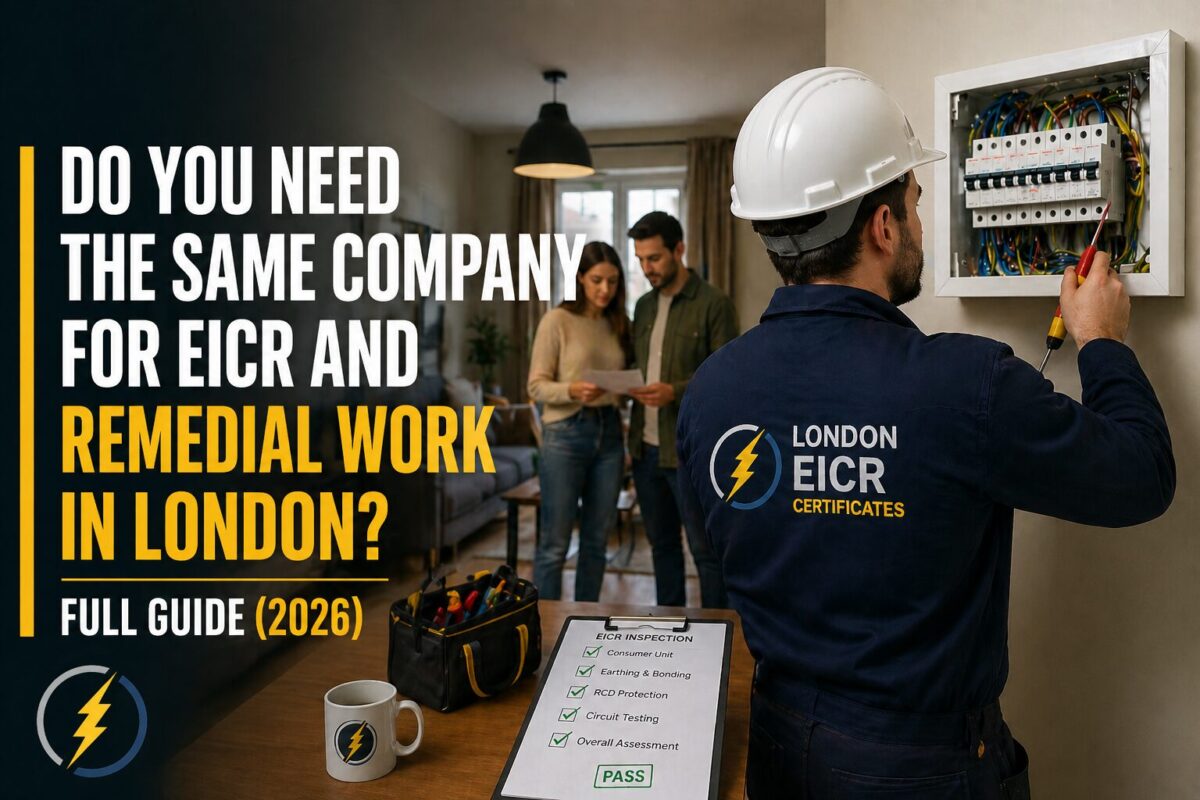
Do You Need the Same Company for EICR and Remedial Work in London? Full Guide (2026)
Where Most EICR Problems Actually Begin
For most landlords and property owners in London, the EICR inspection itself is not the stressful part.
The real confusion begins after the report lands in your inbox.
You open the document expecting a simple pass or fail, but instead you’re faced with technical observations, classification codes, and a list of issues that now need to be addressed. At that point, the situation quickly shifts from a routine compliance task into a decision that affects cost, timing, and even your ability to rent or sell the property.
One of the first and most important questions that comes up is this:
Do you need to use the same company that carried out the EICR to complete the remedial work?
It’s a fair question, and one that doesn’t have a one-line answer. While there is no legal requirement forcing you to stay with the same contractor, the practical implications of that decision can be significant.
This guide breaks it down properly, based on how things actually work in London, not just theory.
Quick Answer: Are You Required to Use the Same Company?
No, you are not legally required to use the same company.
You are completely free to:
- choose a different electrician
- get multiple quotes
- request a second opinion
However, this flexibility comes with trade-offs.
The decision you make here will directly impact:
- how quickly your property becomes compliant
- whether you pass the re-test first time
- how much you end up paying overall
What a Failed EICR Actually Means (And Why It Matters)
To understand the decision properly, you need to understand what an EICR represents.
An Electrical Installation Condition Report is not just a checklist. It is a structured assessment carried out under BS 7671 regulations, combining:
- physical inspection
- circuit testing
- measured readings
- professional judgement
When a report is marked as “unsatisfactory”, it means the installation contains issues classified as:
- C1 – Immediate danger (requires urgent action)
- C2 – Potentially dangerous (must be fixed to pass)
- FI – Further investigation required
Even a single C2 results in a fail.
Common issues we see across London properties include:
- lack of RCD protection on circuits
- outdated or overloaded consumer units
- missing or inadequate bonding
- damaged sockets or switches
- signs of previous poor-quality electrical work
If you want to understand these codes in more detail, refer to:
https://londoneicrcertificates.co.uk/how-to-read-an-eicr-report-and-ensure-electrical-safety-in-london/
Why Remedial Work Is Not Just “Fixing Things”
This is where many landlords misunderstand the process.
Remedial work is not simply about repairing faults. It is about ensuring that the installation will meet the required standard when it is tested again.
That means:
- repairs must be done correctly
- circuits must pass testing values
- compliance must be verified, not assumed
This is why the choice of contractor matters more than it initially seems.
Using the Same Company: Why It Often Leads to Better Outcomes
From a practical standpoint, most landlords in London choose to continue with the same company. Not because they have to, but because it simplifies the process.
Continuity of Knowledge
The engineer who carried out the inspection already understands the installation in detail. They have tested the circuits, recorded readings, and identified specific concerns.
There is no need to repeat that process.
No Interpretation Gap
EICR observations are not always black and white. Some findings involve professional judgement, especially in older properties.
When the same company completes the remedial work:
- they are working to their own findings
- they know exactly what needs to be resolved
- the re-test aligns with the original assessment
This reduces the risk of disagreement or missed issues.
Faster Completion
Time is often critical.
Whether you are:
- preparing for new tenants
- finalising a property sale
- responding to a compliance notice
Delays can become costly.
Using the same company often allows:
- next-day remedial work
- immediate re-testing
- certificate issued within 24–48 hours
Book inspection or remedial work here:
https://londoneicrcertificates.co.uk/book-online/
Case Study: North London Rental Property
A landlord in Islington had a failed EICR with multiple C2 observations.
Issues included:
- no RCD protection
- inadequate bonding
- several damaged accessories
They chose to proceed with the same company.
Outcome:
- remedial work completed within one day
- re-test carried out immediately
- property passed without further issues
Total delay: less than 48 hours
Using a Different Company: When It Makes Sense
There are valid reasons to switch.
For example:
- you feel the original quote is too high
- you want an independent opinion
- the original contractor is unavailable
In these cases, using another electrician can be justified.
Where Problems Typically Occur
The issues arise when expectations don’t match reality.
Different Interpretation of the Report
A new electrician may review the report and disagree with certain findings.
This can lead to:
- partial repairs
- skipped recommendations
- uncertainty about what is actually required
Incomplete Remedial Work
Fixing visible issues does not guarantee compliance.
Example:
- a socket is replaced
- but circuit testing still fails
The result is a failed re-test, even after work has been carried out.
Additional Costs and Delays
Switching companies often leads to:
- paying for another inspection
- extended timelines
- repeated work
Case Study: East London HMO
A landlord in Stratford decided to use a cheaper contractor after a failed EICR.
Initial findings included:
- overloaded circuits
- missing bonding
- outdated consumer unit
The second contractor completed partial upgrades but did not fully address testing requirements.
Re-test result:
- still unsatisfactory
Outcome:
- second round of work required
- additional costs
- tenant move delayed by 3 weeks
Cost Comparison: Same vs Different Company
In theory, switching companies may seem cheaper.
In practice:
Same Company
- no duplicate inspection
- direct repair and re-test
- faster turnaround
Different Company
- new inspection often required
- potential rework
- higher overall cost in many cases
For a detailed breakdown of pricing, see:
https://londoneicrcertificates.co.uk/eicr-certificate-cost/
Do You Always Need a Re-Test?
Yes.
After remedial work is completed:
- the installation must be re-tested
- compliance must be confirmed
- a new EICR certificate must be issued
Without this, the property remains non-compliant.
Legal Responsibilities for Landlords
In London and across the UK:
- issues must be resolved within 28 days
- tenants must receive updated certification
- records must be retained
Failure to comply can result in:
- significant fines
- enforcement action
- legal consequences
How to Decide What’s Right for Your Property
Rather than focusing only on price, consider:
- how quickly you need the certificate
- the complexity of the installation
- the risk of failing again
- the total cost, not just the initial quote
In many cases, the most efficient option is the one that avoids duplication and ensures a smooth path to compliance.
Our Approach: One Process from Inspection to Certification
At London EICR Certificates, we handle the full process:
- EICR inspection
- remedial work
- re-testing
- final certification
This removes:
- confusion between contractors
- delays caused by miscommunication
- risk of failed re-tests
Learn more about remedial work:
https://londoneicrcertificates.co.uk/remedial-work-for-failed-eicr-certificates/
Explore full services:
https://londoneicrcertificates.co.uk/eicr-services/
Areas We Cover
We provide EICR and remedial services across London inside the M25.
Check coverage here:
https://londoneicrcertificates.co.uk/areas-we-cover/
Final Thoughts
You are not required to use the same company for EICR and remedial work.
But in real-world situations, the decision is less about what is allowed and more about what works.
For most landlords, the priority is:
- passing quickly
- avoiding repeated costs
- keeping the process simple
In those cases, using the same company often provides the most efficient and reliable outcome.
Book Your EICR or Remedial Work Today
If your EICR has failed or is due soon, acting quickly will save time, money, and stress.
Book online now:
https://londoneicrcertificates.co.uk/book-online/
Conclusion
EICR compliance is not just about fixing faults. It is about achieving a verified, compliant electrical installation that meets current standards.
Choosing the right approach to remedial work can make the difference between a smooth process and a costly delay.
Make the decision based on outcome, not just price.
❓EICR and Remedial Work in London: Common Questions Landlords Ask❓
1. Do I have to use the same company for EICR remedial work?
2. Can another electrician fix the faults from my failed EICR?
3. Is it better to use the same company for EICR and remedial work?
4. Do I need a new EICR after remedial work?
5. How quickly should EICR remedial work be completed?
6. What happens if I use a different company and the property fails again?
7. Can I get a second opinion on a failed EICR?
8. Who signs off the EICR after remedial work?
9. Does using the same company cost more?
10. Can London EICR Certificates handle both the inspection and remedial work?
Please Submit Details Below



24/7 Emergency Service
Find answers to common questions about EICR certificates and electrical safety inspections in London. Visit our FAQ page on EICRcertificates.com for more information.