
EICR for EV Chargers in London Rental Properties and Commercial Car Parks: 2026 Safety Guide

Are you a homeowner, landlord, or business owner in London? Ensuring the safety and compliance of your property’s electrical installations is crucial, and that’s where an Electrical Installation Condition Report (EICR) certificate comes in. But, how do you obtain one? Our step-by-step guide provides all the information you need to follow to get your EICR certificate. From finding a qualified electrician to scheduling the inspection and addressing any issues highlighted in the report, our guide covers everything you need to know. Don’t risk the safety of your property – read our guide and obtain your EICR certificate today!

Compliance and Regulations,EICR Certificates,EICR Faults & Failures,EICR Guide,Electrical Installation,Property Management,Tenant Safety

EICR for EV Chargers in London Rental Properties and Commercial Car Parks: 2026 Safety Guide

Home / Articles posted byEICR Certificate
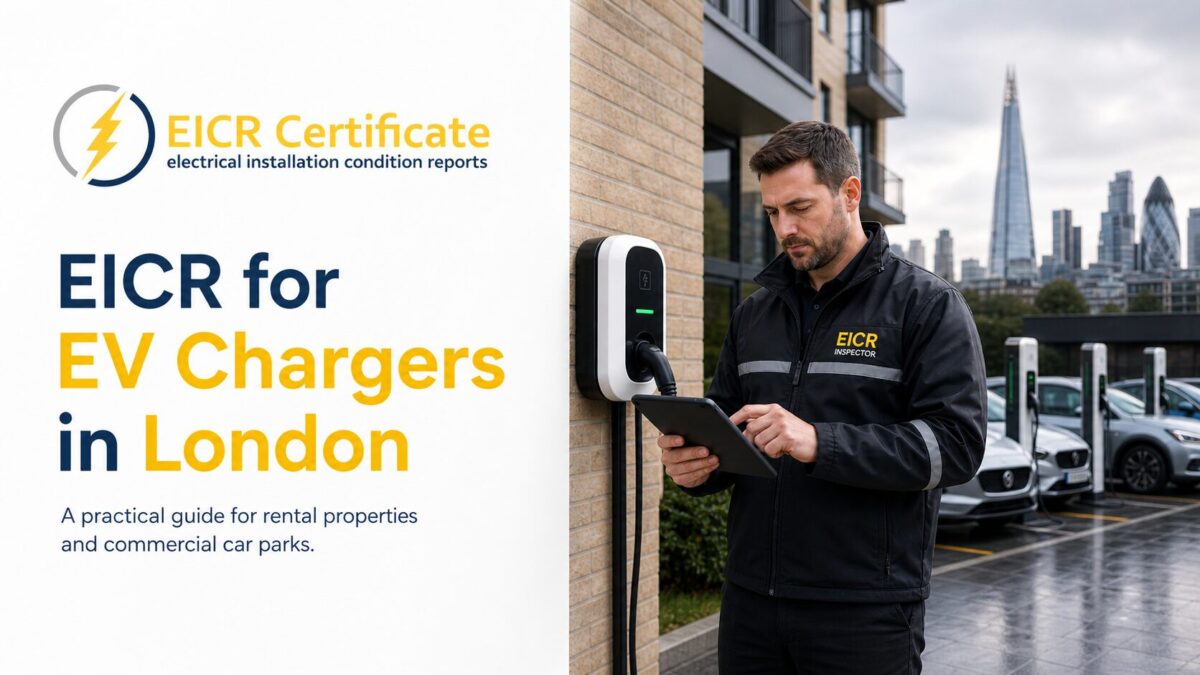
EICR inspector checking an EV charger at a London property with commercial charging points in the background.

Latest EV Chargers UK 2026 Guide

EV chargers are now becoming a normal feature in London homes, apartment blocks, rental properties, office car parks, retail sites and commercial premises. For landlords and business owners, this creates a new electrical safety question: does an EV charger need to be checked during an EICR?

The simple answer is yes. If the EV charger forms part of the fixed electrical installation, it should not be ignored during an Electrical Installation Condition Report. An EV charging point adds electrical load, has its own circuit protection requirements, and may expose the installation to outdoor conditions, earthing risks, RCD issues, poor labelling, cable damage and potential overload.

At London EICR Certificates, we carry out professional EICR certificate inspections in London for landlords, homeowners, businesses, managing agents, commercial premises and properties with EV charging points. Whether you own a rental flat with a private driveway charger, a block of flats with shared charging bays, or a commercial car park with multiple EV charging stations, your electrical installation needs to be safe, properly inspected and clearly reported.

This guide explains how EICR inspections apply to EV chargers in London, what landlords and businesses need to check, common faults found during inspections, and when remedial work may be required.

What Is an EICR for EV Chargers?

An EICR, or Electrical Installation Condition Report, is a formal inspection and test of the fixed electrical installation within a property. It looks at whether the installation is safe for continued use and identifies damage, deterioration, defects, non-compliance and potential risks.

When a property has an EV charger, the EICR should consider the electrical circuit supplying the charger and any relevant parts of the installation connected to it. This may include the consumer unit, distribution board, protective devices, RCD protection, cable route, isolation, earthing arrangement, labelling, signs of overheating, external influences and the general condition of the EV charging point connection.

The EV charger itself may also have its own commissioning certificate, installation certificate or manufacturer records. However, that does not automatically replace the need for an EICR. An EV charger can be correctly installed at the time of fitting but still develop issues later due to wear, poor use, water ingress, damaged cables, altered circuits, overloaded supplies, faulty protection or changes to the property’s electrical installation.

For landlords and commercial property owners, this matters because electrical safety is not just a one-time box-ticking exercise. A charging point may be used daily, often at high load, sometimes outside, and often by tenants, visitors, staff or customers. That makes inspection and maintenance important.

Do EV Chargers Need to Be Checked During an EICR?

If an EV charger is connected to the property’s fixed electrical installation, it should be considered during the EICR. The inspector will assess whether the circuit serving the charger appears safe, correctly protected and suitable for continued use.

This does not always mean the EICR is a specialist EV charger commissioning test. It is not the same as a full manufacturer service or smart charger software check. However, the electrical installation supplying the charger is part of the wider safety picture.

A proper EICR should not simply inspect lights, sockets and consumer units while ignoring an EV charger mounted on the wall. The charger may be one of the highest-load circuits in the property. In some cases, it can draw more current than many everyday domestic appliances. If that circuit has poor protection, incorrect earthing, thermal damage, missing labelling or unsuitable installation conditions, the risk can be significant.

For a London rental property, this is especially important where the landlord has installed the EV charger for tenant use. For commercial premises, it matters where staff, customers, contractors or the public may use EV charging bays.

For a wider inspection of your property, see our EICR services in London.

Why EV Chargers Matter in London Rental Properties

London landlords are increasingly installing EV chargers to make properties more attractive to tenants. A flat with allocated parking and an EV charging point can appeal to professionals, families, company car users and long-term renters. In higher-value areas, EV charging can be seen as a premium feature.

But from an electrical safety point of view, an EV charger is not just another socket. It is a dedicated high-load installation. It may be installed outdoors, exposed to rain, damp, impact, vehicle movement and repeated plugging and unplugging. It may be used for several hours at a time.

In a rental property, the landlord has to think about more than convenience. The main questions are:

Is the EV charger connected to a safe and suitable circuit?

Is the consumer unit or distribution board capable of supporting the additional load?

Is the circuit protected correctly?

Is the earthing arrangement suitable?

Is there evidence of overheating, damage or deterioration?

Has the charger been installed properly and labelled clearly?

Is the installation still safe after tenant use, alterations or previous remedial work?

For landlords, the EICR becomes especially important when a property changes tenant, when a charger has been added since the last inspection, or when the previous EICR did not mention the charging point.

If your property is rented, you should also review our dedicated page for EICR certificates for landlords in London.

Example: Rental Flat with Private Parking and EV Charger

Imagine a landlord owns a two-bedroom flat in Battersea with one allocated parking space. The previous tenant did not own an electric vehicle, but the new tenant does. The landlord agrees to install a wall-mounted EV charger near the parking bay.

The installation may appear straightforward, but the electrician needs to consider the supply capacity, the route from the consumer unit or distribution board, the protective device, RCD protection, isolation, cable size, earthing and whether the charger is suitable for the location.

Two years later, the landlord books an EICR. The inspector notices that the consumer unit has limited labelling, the EV charger circuit is not clearly identified, and there is no accessible paperwork showing when the charger was installed. The charger appears to work, but the inspection identifies that further verification is needed because the circuit documentation is incomplete and the protective arrangement needs checking.

This is exactly why EV chargers should be included in the electrical safety conversation. A charger may look modern and functional, but an EICR is concerned with whether the installation is safe for continued use.

EV Chargers in Houses, Flats and HMOs

EV charger inspection can vary depending on the type of property.

In a single house, the charger may be connected from the main consumer unit to a driveway or external wall. The inspection focus will usually include the domestic consumer unit, protective device, RCD arrangement, earthing, external cable route and visible charger condition.

In a purpose-built flat, the charger may be connected through a landlord supply, communal distribution system or dedicated metered supply. This can be more complex, especially where the parking bay is separate from the flat itself.

In an HMO, the situation can be more sensitive because multiple occupants may use shared facilities and the landlord may have additional management responsibilities. If EV charging is available at an HMO, it should be clearly controlled, documented and inspected.

In a block of flats, EV chargers may serve multiple residents. This can involve load management, communal supplies, distribution boards, signage, access control and ongoing maintenance records.

In all these situations, the property owner or manager should not assume that because the EV charger powers on, everything is compliant. Electrical safety requires proper inspection, testing and documentation.

EICR Checks for Commercial Car Parks with EV Charging Points

Commercial car parks are a major growth area for EV charging in London. Offices, hotels, gyms, supermarkets, retail parks, mixed-use developments, warehouses and residential blocks are all adding charging points.

For commercial sites, an EV charger inspection sits within a wider duty to maintain safe electrical systems. The HSE’s Electricity at Work guidance explains duties around electrical safety and safe systems in workplaces.

A commercial car park EV charging installation may involve:

Multiple charging posts

Three-phase supplies

Dedicated distribution boards

Load balancing systems

Underground cable routes

External isolation points

Protective barriers or bollards

Public or staff access

Payment systems

Outdoor weather exposure

Vehicle impact risk

Emergency isolation arrangements

For an EICR, the inspection should consider whether the electrical installation supplying these charging points remains safe. The risk level can be higher than a single domestic charger because several charging points may operate at the same time, often for long periods, and may be used by people who are not familiar with the site.

If you own or manage a business premises, office, retail unit, commercial car park or mixed-use site, see our dedicated page for commercial EICR certificates in London.

Example: Office Car Park with Six EV Charging Bays

A facilities manager in Central London manages an office building with six EV charging bays in the basement car park. The chargers were installed three years ago as part of a sustainability upgrade. Staff use them daily, and visitors occasionally use them as well.

During an EICR, the inspector reviews the distribution board supplying the chargers, checks the labelling, looks for overheating, assesses the condition of visible cable containment, checks the protective devices and verifies whether the installation has been maintained properly.

Possible findings could include:

Poor circuit labelling

Missing or unclear isolation information

Damaged charger cable

Loose or cracked charger housing

Signs of heat at a protective device

Inadequate access to a distribution board

Missing previous test documentation

Unclear responsibility for maintenance

Overloaded distribution board

No recent inspection record for the EV charging circuit

These findings do not always mean the whole installation is dangerous, but they do mean the building owner or responsible person needs clear advice. A good EICR should help separate urgent safety issues from improvement recommendations.

Common EV Charger Issues Found During an EICR

EV chargers can fail or raise concerns during an EICR for several reasons. Some issues are visible, while others are only found during testing or deeper investigation.

1. Poor or Missing Circuit Labelling

A common issue is poor labelling at the consumer unit or distribution board. The EV charger circuit should be easy to identify. If the charger circuit is not labelled, the inspector may need to investigate further.

Poor labelling creates problems during maintenance, emergencies and future inspections. In commercial car parks, unclear labelling can delay safe isolation and increase risk.

2. Incorrect or Unsuitable RCD Protection

EV charger circuits have specific protection requirements. The IET has published guidance on electric vehicle charging equipment installations, including protection and open PEN considerations.

The exact requirement depends on the charger, circuit design and installation method. However, RCD protection is a key area inspectors will consider. If protection is missing, unsuitable or unclear, this may be recorded on the EICR.

3. Earthing Problems

Earthing is one of the most important issues with EV charging. Outdoor EV chargers can present particular risks depending on the supply arrangement and installation method.

Inspectors may consider whether the earthing arrangement is suitable, whether there are signs of defects, whether bonding is adequate and whether further investigation is needed. EV charging installations have specific considerations under BS 7671 Section 722, including PME and open PEN issues.

4. Overloaded Consumer Unit or Distribution Board

An EV charger can add significant load to an electrical installation. If a consumer unit, supply or distribution board is already heavily loaded, the addition of EV charging may increase stress on the system.

During an EICR, the inspector may identify signs of overheating, poor capacity planning, unsuitable protective devices or general concerns about the load arrangement.

5. Damaged Cables or Charger Housing

Because EV chargers are often located outdoors or in car parks, physical damage is common. Cables may be dragged across the ground, trapped, pulled, exposed to weather or damaged by vehicles.

Cracked charger casing, exposed cable damage, loose connections, broken accessories or water ingress may all be recorded.

6. Poor Installation Position

An EV charger installed in the wrong position can create risk. Examples include chargers installed where cables create trip hazards, chargers exposed to vehicle impact, or charging points located too close to areas where damage is likely.

In a commercial car park, proper positioning, protection and signage become more important.

7. Missing Isolation or Access Problems

An EV charger should be capable of being safely isolated when needed. If the isolator is not accessible, not labelled or not clear, this may create maintenance and emergency problems.

In blocks of flats and commercial premises, access to distribution equipment may be restricted, locked or unclear. This can delay safe inspection and remedial work.

8. No Installation Documentation

If the EV charger was installed after the last EICR, there should usually be suitable documentation. If there are no records, no circuit details and no installation certificate available, the inspector may recommend further investigation.

Can an EV Charger Cause an EICR to Fail?

Yes, an EV charger can contribute to an unsatisfactory EICR if the associated electrical installation has safety defects.

Common examples include:

Damaged EV charger cable exposing conductors

Evidence of overheating at the charger circuit

Unsuitable or missing RCD protection

Unsafe earthing arrangement

Water ingress affecting electrical parts

Poorly installed circuit

No safe isolation

Incorrect protective device

Exposed live parts

Dangerous deterioration

A failed EICR does not always mean the entire property is unsafe to occupy, but it does mean defects have been identified that require action. The severity depends on the coding used in the report.

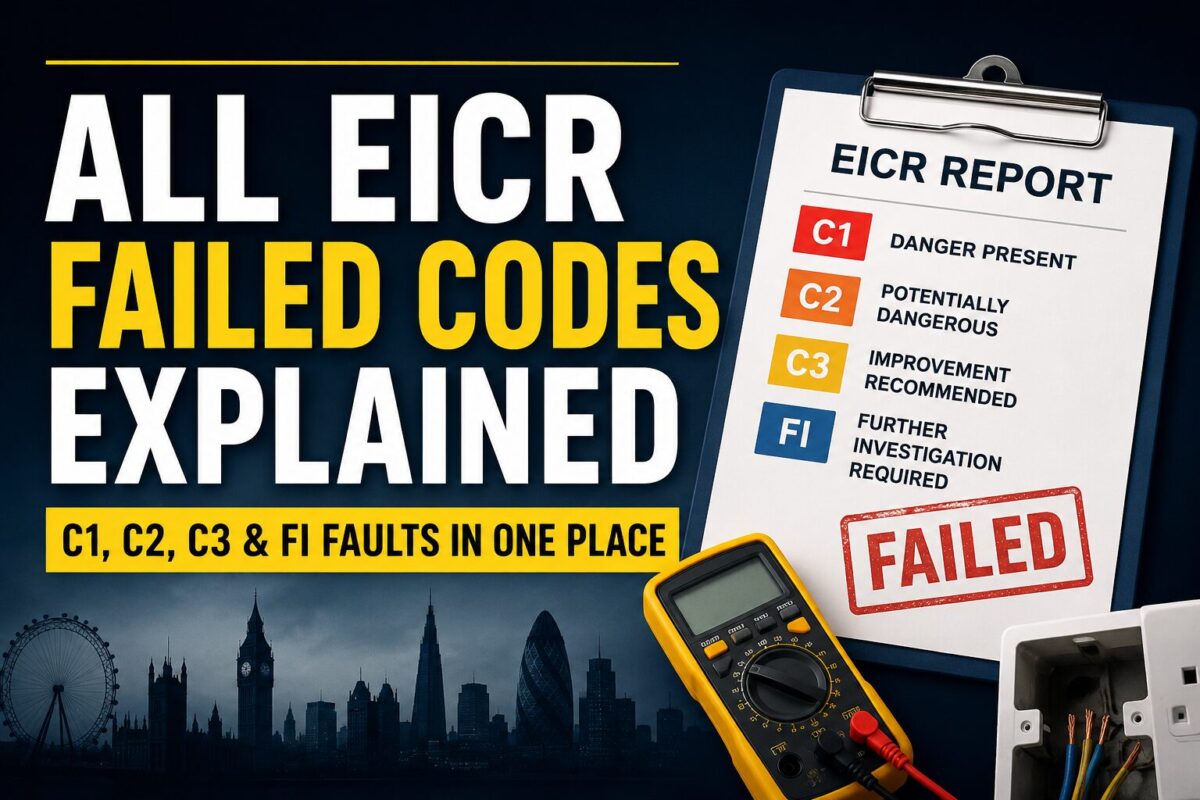
Typical EICR codes include:

C1: Danger present, immediate action required

C2: Potentially dangerous, urgent remedial action required

C3: Improvement recommended

FI: Further investigation required without delay

If an EV charger-related issue receives a C1, C2 or FI code, the EICR will normally be unsatisfactory until the issue is resolved or properly investigated.

For help after a failed report, see our page on remedial work for failed EICR certificates.

Example: EV Charger with Damaged Charging Cable

A landlord in North London books an EICR for a rental house with a driveway EV charger. The charger was installed three years earlier and has been used regularly by tenants.

During the inspection, the electrician notices damage to the charging cable sheath. The charger still works, but the visible damage raises concern. Depending on the severity, this could result in a coded observation and may require repair or replacement.

This is a practical example of why regular inspection matters. Tenants may not report cable damage if the charger still appears to function. A proper EICR can identify defects before they become more serious.

Example: Commercial Car Park with Poor Charger Labelling

A commercial landlord owns a mixed-use building in East London. The basement car park has four EV charging points. During the EICR, the inspector finds that the distribution board labels do not clearly identify which circuits serve the EV chargers. The car park team also cannot confirm where isolation is located.

This may not immediately mean the chargers are dangerous, but it creates a safety management issue. If a fault occurs, staff or contractors may struggle to isolate the correct circuit quickly. The EICR may recommend improved labelling and documentation.

Example: New EV Charger Added After Previous EICR

A landlord has a valid EICR from 2023. In 2025, they install an EV charger for a new tenant. The landlord then asks whether the old EICR still covers the property.

The answer depends on the installation and documentation. If a new circuit has been added, the landlord should keep the correct electrical certificate for that new work. However, when the next EICR is carried out, the charger and its circuit should be included in the inspection scope.

If the landlord cannot produce installation records or if the work appears poorly integrated into the existing system, the inspector may recommend further investigation.

Landlord Responsibilities for EV Chargers in Rental Properties

For landlords, the core issue is simple: the property’s electrical installation must be safe. GOV.UK guidance explains electrical safety standards duties for rented sectors, including landlord responsibilities around inspection and safety.

If an EV charger is part of the property’s fixed electrical installation, the landlord should treat it as part of the electrical safety management of the property.

This means landlords should:

Keep installation certificates and charger documentation

Include the EV charger in future EICR inspections

Check whether the charger was installed by a qualified person

Make sure the tenant knows how to use the charger safely

Act quickly if damage or faults are reported

Keep records of remedial work

Ensure the charger circuit is labelled

Consider inspection after tenant change, damage or alteration

A landlord should be especially careful when a tenant requests permission to install their own EV charger. The agreement should be clear about who owns the charger, who pays for installation, who maintains it, who removes it at the end of tenancy and what documentation must be provided.

Tenant-Installed EV Chargers: What Landlords Should Watch

Tenant-installed EV chargers can create complications. A tenant may arrange an installation with good intentions, but the landlord still needs to protect the property.

Before agreeing to a tenant EV charger installation, landlords should ask:

Who will install the charger?

Will the installer provide certificates?

Will the charger connect to the tenant’s meter or landlord supply?

Will the installation affect communal areas?

Will cables cross shared land?

Who is responsible for maintenance?

Who removes the charger if the tenant leaves?

Will the property’s supply support the additional load?

Will the installation affect insurance?

After installation, landlords should keep all documentation. At the next EICR, they should tell the inspector that a charger has been added.

Business and Commercial Car Park Owner Responsibilities

For businesses, the issue is broader than landlord compliance. Commercial sites need safe electrical systems for employees, customers, visitors and contractors. Electrical systems at work must be maintained to prevent danger under the Electricity at Work framework.

If your business operates EV charging points, you should not rely only on the fact that users can plug in and charge. You need a maintenance and inspection plan.

Commercial EV charging points should be considered in relation to:

Electrical safety

Public liability

Staff safety

Customer safety

Business interruption risk

Fire risk management

Insurance requirements

Lease responsibilities

Facilities management

Emergency isolation

Periodic inspection

Where multiple chargers are installed, the risk profile is higher. A site with ten charging bays has more complexity than a domestic driveway charger. Load management, distribution, user behaviour and physical damage all become more relevant.

EV Chargers in Commercial Leases: Who Is Responsible?

Commercial leases can create confusion. In some buildings, the landlord owns the EV charging infrastructure. In others, the tenant installs it for staff or customer use. Sometimes the managing agent controls the car park and the tenant only has rights to use certain bays.

Before arranging an EICR, business owners and landlords should check the lease. The key question is: who is responsible for the electrical installation serving the EV chargers?

Possible responsibility structures include:

The landlord owns and maintains all charging points

The tenant owns chargers installed within demised premises

The managing agent maintains communal charging equipment

The car park operator maintains the charging infrastructure

A third-party EV charging provider owns and operates the chargers

Even where a third party manages the chargers, the building owner or occupier may still need to understand how the installation connects to the building supply and what documentation exists.

How Much Does an EICR for a Property with EV Chargers Cost in London?

The cost of an EICR for a property with EV chargers depends on the property type, size, number of circuits, access, location, number of distribution boards and complexity of the EV charging installation.

A small rental house with one EV charger is usually simpler than a commercial car park with multiple charging points, three-phase distribution and several boards.

Cost factors include:

Domestic or commercial property type

Number of bedrooms or rooms

Number of circuits

Number of EV chargers

Single-phase or three-phase supply

Access to the consumer unit or distribution board

Whether the charger is on a separate board

Whether previous documentation is available

Whether the property has communal areas

Whether the site is occupied during inspection

Whether testing requires out-of-hours attendance

For a full pricing guide, see our EICR certificate cost in London page.

What Happens If the EV Charger Fails the Inspection?

If an EV charger-related issue causes the EICR to be unsatisfactory, the next step is remedial work or further investigation.

The process usually looks like this:

The EICR identifies the issue

The report gives the relevant observation and code

The electrician explains what needs attention

The landlord or business owner approves remedial work

The fault is repaired or investigated

Suitable evidence or certification is provided

The property owner keeps records for compliance

Some issues are simple, such as improving labels or replacing a damaged accessory. Others are more involved, such as correcting earthing problems, replacing protective devices, upgrading a consumer unit or carrying out additional investigation into the charger circuit.

At London EICR Certificates, we can help with both inspection and follow-up guidance. Where remedial work is needed, we explain the issue clearly and help you understand the practical next step.

Should You Book an EICR Before Installing an EV Charger?

In many cases, yes. If you are planning to install an EV charger in an older London property, it is sensible to understand the condition of the existing electrical installation first.

This is especially useful if:

The property has an old consumer unit

The wiring condition is unknown

The property has not had a recent EICR

The charger will be installed for tenants

The property is a commercial premises

The installation will serve multiple vehicles

The supply may already be heavily loaded

The building has communal areas

The charger will be installed outdoors

An EICR before installation can reveal whether the existing system is suitable or whether remedial work is needed first. This can prevent wasted time, installation delays and unexpected costs.

Should You Book an EICR After Installing an EV Charger?

If the EV charger has been newly installed, you should receive the correct certificate for that electrical work. However, you may still need an EICR depending on the wider property situation.

An EICR after installation may be appropriate if:

The property is due for periodic inspection

The existing EICR is old

The charger was installed without clear records

The property is being rented to new tenants

The property is being sold or refinanced

The business needs updated compliance records

The charger installation affected existing circuits

There are signs of overheating or nuisance tripping

The key point is that the charger’s certificate and the wider EICR are related, but not always the same thing.

Is an EV Charger Certificate the Same as an EICR?

No. An EV charger installation certificate usually relates to the installation work carried out at the time the charger was fitted. An EICR is a periodic inspection report for the condition of the wider electrical installation.

You may need both documents in different situations.

For example, if you install a new EV charger, you should keep the installation certificate. If you are a landlord, you should also have a valid EICR for the rental property. If the charger is later inspected as part of a periodic EICR, the report may comment on the charger circuit and any issues found.

What Information Should You Provide Before Booking?

To make the inspection smoother, provide as much information as possible before booking.

Useful details include:

Property address

Property type

Number of bedrooms or approximate size

Whether it is domestic or commercial

Whether the EV charger is domestic or commercial

Number of EV charging points

Location of the charger

Access details

Parking details

Location of consumer unit or distribution board

Previous EICR if available

EV charger installation certificate if available

Any known issues, tripping or damage

Whether the property is occupied

Whether out-of-hours access is needed

Good information saves time and helps the electrician prepare properly.

Why Choose London EICR Certificates?

London EICR Certificates provides professional electrical safety inspections across London for landlords, homeowners, letting agents, managing agents and commercial property owners.

We can help with:

EICR certificates for rental properties

EICR inspections for properties with EV chargers

Commercial EICR certificates

EICR reports for offices and car parks

Electrical safety inspections for landlords

EICR inspections before or after tenant change

Failed EICR advice

Remedial work guidance

Clear reporting and practical next steps

Our service is designed for London property owners who need fast, clear and reliable electrical safety reporting without confusion.

If your property has an EV charger, we can inspect the relevant electrical installation, explain any issues found and help you understand whether remedial work is needed.

To arrange an inspection, you can book your EICR online.

London Properties We Can Help With

We can assist with EICR inspections for EV charger-related electrical installations in:

Rental houses

Flats with allocated parking

HMOs

Apartment blocks

Converted houses

Communal car parks

Office buildings

Retail units

Hotels

Gyms

Warehouses

Mixed-use developments

Commercial car parks

Private landlord portfolios

Letting agent portfolios

Managed blocks

If you are unsure whether your EV charger needs to be included, the safest option is to tell us about it before the inspection. We can then advise how it fits into the EICR scope.

EV Charger EICR Checklist for Landlords and Businesses

Before your inspection, use this checklist:

Do you know when the EV charger was installed?

Do you have the installation certificate?

Is the charger connected to your property supply?

Is the charger used by tenants, staff, customers or visitors?

Is the charger circuit clearly labelled?

Is the charger visibly damaged?

Does the charger trip the electrics?

Is the consumer unit or distribution board accessible?

Has the property had an EICR since the charger was installed?

Are there multiple chargers on site?

Is the charger indoors, outdoors or in a basement car park?

Is there clear isolation for the charger?

Is there any history of overheating or burning smell?

Do you have maintenance records?

If you answered no to several of these questions, it is worth booking an inspection or asking for advice.

Book an EICR for EV Chargers in London

If your London property has an EV charger, do not leave it out of your electrical safety planning. EV charging points can add load, risk and compliance questions, especially in rental properties and commercial car parks.

London EICR Certificates can inspect your property, review the relevant electrical installation, issue a clear EICR report and explain any remedial work needed.

Book your inspection here:

Book your EICR online

Or explore our main services:

EICR certificate in London
EICR services in London
EICR certificates for landlords in London
Commercial EICR certificates in London
EICR certificate cost in London
Remedial work for failed EICR certificates

❓FAQs About EICR for EV Chargers in London

1. Does an EV charger need to be included in an EICR?

Yes. If the EV charger is connected to the fixed electrical installation of the property, the circuit supplying it should be checked during the EICR. This includes the protective device, cable route, RCD protection, earthing arrangement, labelling, isolation and visible condition of the charger connection.

2. Can an EV charger fail an EICR?

Yes. An EV charger can contribute to an unsatisfactory EICR if the charger circuit has safety issues. Common reasons include damaged cables, poor earthing, missing or unsuitable RCD protection, signs of overheating, water ingress, poor installation, exposed live parts or missing safe isolation.

3. Do landlords need an EICR if their rental property has an EV charger?

Yes. Landlords must make sure the electrical installation in a rental property is safe. If the property has an EV charger, it should be treated as part of the property’s electrical safety setup. The landlord should keep installation certificates, maintenance records and include the charger circuit in future inspections.

4. Is an EV charger certificate the same as an EICR?

No. An EV charger installation certificate normally relates to the work carried out when the charger was installed. An EICR is a wider inspection of the condition of the property’s electrical installation. A property may need both documents.

5. How often should an EV charger be inspected?

The inspection frequency depends on the property type, usage, environment and risk level. A domestic rental property, commercial car park, office car park or shared residential block may all have different inspection needs. If the charger is used heavily or installed outdoors, regular checks are strongly recommended.

6. What EV charger faults are commonly found during an EICR?

Common issues include damaged charging cables, cracked charger housings, poor circuit labelling, unsuitable protective devices, missing RCD protection, signs of heat damage, poor isolation, water ingress, missing installation records and unclear earthing arrangements.

7. Do commercial car parks with EV chargers need an EICR?

Yes. A commercial car park with EV charging points should have its electrical installation inspected and maintained. This is especially important where chargers are used by staff, tenants, visitors, customers or the public. Multiple charging bays can increase electrical load and safety risk.

8. Can a tenant install an EV charger in a rental property?

A tenant should not install an EV charger without written permission from the landlord. The landlord should make sure the installation is carried out by a qualified electrician and that all certification is provided. The landlord should also clarify who owns, maintains and removes the charger at the end of the tenancy.

9. Does an EV charger need RCD protection?

EV charger circuits normally require suitable protective arrangements, including RCD protection where applicable. The correct setup depends on the charger, circuit design, earthing system and installation method. This should be assessed by a qualified electrician.

10. Can London EICR Certificates inspect properties with EV chargers?

Yes. London EICR Certificates can inspect London rental properties, homes, offices, commercial premises, apartment blocks and car parks with EV charging points. We can issue an EICR report and advise if any remedial work or further investigation is required.

Please Submit Details Below

For your convenience, you can also fill out our online contact form below. Please provide as much detail as possible, and a member of our team will get back to you promptly.
Select Certificate Type:
Tags :
EICR Certificates,EICR Inspection
Share This :

EICR for Solar Panels and Battery Storage in London Properties: What Owners and Landlords Need to Know

Are you a homeowner, landlord, or business owner in London? Ensuring the safety and compliance of your property’s electrical installations is crucial, and that’s where an Electrical Installation Condition Report (EICR) certificate comes in. But, how do you obtain one? Our step-by-step guide provides all the information you need to follow to get your EICR certificate. From finding a qualified electrician to scheduling the inspection and addressing any issues highlighted in the report, our guide covers everything you need to know. Don’t risk the safety of your property – read our guide and obtain your EICR certificate today!

Compliance and Regulations,EICR Certificates,EICR Faults & Failures,EICR Guide,Electrical Installation,Property Management,Tenant Safety

EICR for Solar Panels and Battery Storage in London Properties: What Owners and Landlords Need to Know

Home / Articles posted byEICR Certificate
EICR for Solar Panels and Battery Storage in London Properties.

Latest UK 2026 Guide

Solar panels and battery storage systems are becoming more common across London. Homeowners want lower energy bills. Landlords want more energy-efficient rental properties. Commercial property owners want to reduce running costs and future-proof their buildings. But once solar PV panels, inverters, batteries, and upgraded consumer units are added to a property, electrical safety becomes more important, not less.

This is where an Electrical Installation Condition Report, commonly known as an EICR, becomes essential.

An EICR is designed to assess the condition and safety of the fixed electrical installation in a property. It helps identify deterioration, unsafe wiring, poor earthing, overloaded circuits, lack of RCD protection, damaged accessories, unsuitable consumer units, and other risks that could affect people using the building.

But many London property owners ask the same question:

Does an EICR cover solar panels and battery storage?

The short answer is that an EICR can assess the fixed electrical installation connected to the property, including signs that solar PV or battery storage has affected the safety of the wider installation. However, an EICR is not the same as a specialist solar PV inspection or a full battery storage maintenance check. Where solar panels or batteries are installed, the electrician may identify issues that require further investigation by a competent solar PV or battery storage specialist.

For landlords, homeowners, and commercial property owners, this distinction matters. A property may have a valid EICR, but if the solar installation has been poorly connected, altered without proper certification, or added to an ageing electrical system, there may still be safety concerns that need attention.

If you own a London property with solar panels, battery storage, or both, this guide explains what an EICR can check, what it cannot replace, what common issues may appear, and when you should book an inspection.

For standard electrical safety inspections in London, you can also visit our main EICR services in London page.


What Is an EICR?

An Electrical Installation Condition Report is a formal inspection and test of a property’s fixed electrical installation. It is carried out by a competent electrician to assess whether the installation is safe for continued use.

An EICR typically checks items such as:

  • Consumer unit or fuse board condition

  • Earthing and bonding arrangements

  • RCD protection

  • Circuit protection

  • Socket outlets

  • Lighting circuits

  • Cable condition

  • Signs of overheating

  • Electrical accessories

  • Distribution boards

  • Fixed wiring

  • Defects or deterioration

  • Risk of electric shock or fire

  • Previous alterations or additions

For landlords in England, electrical safety inspections are a legal requirement at intervals of no more than five years for rented residential properties. The official government guidance confirms that landlords must ensure electrical installations are inspected and tested by a qualified and competent person at least every five years, and the 2025 update extends the framework to the social rented sector.

For landlords, the report is not just a technical document. It is evidence that the property’s electrical installation has been assessed for safety and compliance. You can learn more on our EICR certificates for landlords in London page.

For homeowners, an EICR is not usually a legal requirement unless the property is being rented, but it is still a sensible inspection when buying, selling, renovating, installing solar panels, upgrading a consumer unit, or adding battery storage. Visit our EICR certificates for homeowners in London page for more details.


Why Solar Panels and Battery Storage Change the Electrical Safety Picture

A normal domestic electrical installation is already complex. Once solar panels and battery storage are added, the electrical setup becomes more advanced.

A property with solar PV may include:

  • Solar panels on the roof

  • DC cabling from panels

  • An inverter

  • AC connection to the property installation

  • Generation meter

  • Isolators

  • Additional protective devices

  • Labelling

  • Connection to the consumer unit or distribution board

A property with battery storage may also include:

  • Battery unit

  • Battery management system

  • Inverter or hybrid inverter

  • Additional isolators

  • Dedicated circuits

  • Fire safety considerations

  • Ventilation requirements

  • Manufacturer-specific installation rules

  • Monitoring equipment

The IET’s Code of Practice for Grid-connected Solar Photovoltaic Systems covers design, specification, installation, commissioning, operation, and maintenance of grid-connected solar PV systems. This shows that solar PV is not just a simple appliance added to a home. It is a technical electrical system that needs competent design and ongoing safe operation.

Battery storage also introduces additional safety considerations. BSI’s PAS 63100:2024 focuses on protection against fire for battery energy storage systems in dwellings, reflecting the increased importance of correct installation, location, and safety control for domestic battery systems.

This is why an EICR is particularly useful in properties where solar or battery systems have been added. It can help assess whether the existing fixed installation remains safe and whether there are visible concerns that require further investigation.


Does an EICR Fully Inspect Solar Panels?

An EICR is mainly focused on the fixed electrical installation of the property. It does not automatically replace a specialist solar PV inspection.

This means a standard EICR may review relevant connected parts of the electrical installation, such as:

  • Consumer unit connection

  • Circuit protection

  • RCD protection

  • Earthing and bonding

  • Labelling

  • Signs of unsafe additions

  • Visible damage

  • Inverter connection points

  • AC-side electrical safety

  • Distribution board condition

  • Overheating or poor workmanship around the fixed installation

However, a normal EICR may not include detailed specialist testing of the solar PV system itself unless specifically agreed and carried out by someone competent in solar PV inspection.

A specialist solar PV inspection may involve further checks such as:

  • DC string testing

  • Solar panel performance checks

  • PV isolator inspection

  • Inverter testing

  • Roof mounting inspection

  • DC cable routing

  • Generation output review

  • Manufacturer-specific checks

  • Solar PV documentation review

  • MCS certificate review where applicable

Electrical Safety First describes solar panels as photovoltaic systems that convert sunlight into electricity and advises using registered electricians for electrical safety matters. Solar technology is beneficial, but it remains an electrical installation that needs proper safety consideration.

So, the practical answer is this: An EICR can identify electrical safety concerns connected to the property installation where solar PV is present, but it should not be treated as a full specialist solar PV service unless that scope is specifically included.

For a London landlord, this means the EICR remains important, but if the report identifies an issue linked to the solar installation, further investigation may be required.


Does an EICR Cover Battery Storage?

Battery storage systems are becoming more popular in London homes and commercial premises. They allow energy generated by solar panels to be stored and used later. In some cases, batteries are installed even without solar panels, usually to take advantage of off-peak electricity tariffs.

An EICR can assess parts of the fixed electrical installation connected to the battery system, including:

  • Consumer unit or distribution board connection

  • Protective devices

  • Circuit loading

  • Earthing arrangements

  • Cable condition

  • Isolation arrangements

  • Labelling

  • Signs of overheating

  • Visible damage

  • Poor workmanship

  • Suitability of existing circuits

However, an EICR is not a full manufacturer-specific battery storage inspection. A proper battery system check may require specialist knowledge of:

  • Battery chemistry

  • Manufacturer instructions

  • Ventilation requirements

  • Location restrictions

  • Fire safety guidance

  • Battery management systems

  • Inverter compatibility

  • Firmware or monitoring systems

  • Shutdown procedures

  • Maintenance requirements

For larger commercial battery systems, the Health and Safety Executive explains that battery energy storage systems carry responsibilities across their life cycle, including designers, installers, and operators. While HSE’s page focuses on grid-scale systems, the principle is relevant: battery storage is a technical system with safety duties at multiple stages.

For domestic systems, PAS 63100:2024 is particularly relevant because it addresses fire protection for battery energy storage systems used in dwellings.

The key point is simple: An EICR can help identify whether the wider electrical installation is safe where battery storage is connected, but a battery system may also need specialist assessment depending on its design, condition, and documentation.


Why London Properties with Solar Panels Need Extra Attention

London has a wide mix of property types. Solar panels and battery storage can appear on:

  • Terraced houses

  • Semi-detached houses

  • Detached homes

  • Converted flats

  • Purpose-built flats

  • HMOs

  • Shops with flats above

  • Office buildings

  • Warehouses

  • Schools

  • Community buildings

  • Commercial units

  • Blocks of flats

  • Mixed-use buildings

Many London properties are older and may already have electrical issues before solar or battery systems are added. Common background problems include:

  • Older fuse boards

  • No RCD protection on some circuits

  • Poor earthing or bonding

  • Previous DIY electrical work

  • Outdated cables

  • Overloaded circuits

  • Poor labelling

  • Old accessories

  • Mixed consumer unit brands

  • Limited spare capacity

  • Circuits altered by previous contractors

When solar panels or battery storage are installed into a property with existing electrical weaknesses, the risk profile changes.

For example, a property may have solar panels installed correctly, but the existing consumer unit may be old, poorly labelled, or lacking modern protection. Another property may have a battery installed, but the original installation may not have been designed with that additional equipment in mind.

This is why an EICR is useful. It does not just look at one product. It assesses the condition of the wider electrical installation.

If your London property has solar panels or battery storage and has not had an EICR recently, booking one is a sensible step. You can use our book your EICR online page to arrange an inspection.


Common EICR Issues Found in Properties with Solar Panels

Properties with solar panels can still fail an EICR for reasons that may not directly relate to the panels themselves. The solar installation may simply reveal or sit alongside existing defects. Common EICR issues may include:

1. Poor Consumer Unit Condition A consumer unit is a major part of the fixed electrical installation. If it is damaged, outdated, poorly enclosed, overloaded, or poorly labelled, it may be recorded on the EICR. Solar PV systems are often connected through the consumer unit or distribution board. If the board is unsuitable, this may create concern.

2. Lack of RCD Protection RCD protection is one of the most common issues found during EICR inspections. If circuits do not have adequate RCD protection, the report may record this depending on the situation, installation type, and risk. Solar PV or battery systems connected to an installation with poor RCD protection can raise additional safety questions.

3. Poor Labelling Solar PV systems should have clear isolation and warning labels. If the property has poor labelling, missing circuit identification, or unclear distribution board schedules, the installation can become harder to inspect, isolate, or maintain safely. This is particularly important in emergencies, where someone may need to understand quickly that solar generation or battery storage is present.

4. Signs of Overheating Overheating around consumer units, isolators, terminals, or protective devices is a serious concern. If an electrician finds heat damage, burning, discolouration, or signs of loose connections, the issue may require urgent attention.

5. Incorrect or Unsafe Alterations Some properties have had solar panels added after the original installation without proper documentation. If the electrician sees evidence of poor workmanship, unsuitable connections, or unsafe alterations, the EICR may recommend further investigation.

6. Earthing and Bonding Problems Main protective bonding and earthing arrangements are critical. If the property has poor earthing or missing bonding, this can affect electrical safety generally. Where solar or battery systems are present, correct earthing becomes even more important.

7. Inadequate Isolation Solar PV and battery systems should have appropriate isolation arrangements. If isolation is unclear, inaccessible, damaged, or poorly labelled, further checks may be needed.

8. Old Wiring Combined with Modern Additions A common London issue is modern technology connected to old infrastructure. A property may have solar panels, smart controls, and battery storage, but still rely on ageing circuits, old accessories, or an outdated consumer unit. An EICR helps identify whether the older installation remains suitable for continued use.


Common EICR Issues Found in Properties with Battery Storage

Battery storage systems can create additional inspection considerations. Common concerns include:

1. Poor Location of Battery Unit Battery systems should be installed according to manufacturer instructions and relevant safety guidance. If a battery is located in an unsuitable area, this may require further specialist assessment.

2. Lack of Clear Isolation The electrician needs to understand how the battery system connects to the property. If there are no clear isolators or labels, this can create risk during inspection, maintenance, or emergency work.

3. Consumer Unit Capacity Concerns Some installations may have battery systems connected to boards that were not designed with enough future capacity. This does not automatically mean the installation is unsafe, but it can require closer review.

4. Inverter and Battery Wiring Concerns Poorly routed cables, exposed wiring, unsuitable containment, or visible damage can all raise concerns during an EICR.

5. Incomplete Documentation Battery systems should come with installation documentation, commissioning paperwork, and manufacturer guidance. If a landlord or homeowner cannot provide documents, the electrician may be more cautious and recommend further investigation.

6. Signs of Heat or Ventilation Problems Battery and inverter equipment can generate heat. Poor ventilation, blocked equipment, heat staining, or installation in unsuitable spaces may require attention.

7. Poor Workmanship from Previous Installers Not all installations are equal. An EICR can reveal signs that work may have been completed without enough care, especially around cable entries, isolation, consumer unit connections, and labelling.


Landlords: Do You Need an EICR if the Rental Property Has Solar Panels?

Yes. If you rent out a residential property in England, the legal duty to have the electrical installation inspected and tested still applies. Solar panels do not remove that requirement.

Government guidance confirms that landlords must have electrical installations inspected and tested by a qualified and competent person at least every five years.

If your rental property has solar panels, the EICR becomes even more important because the electrical installation may be more complex.

A landlord should keep:

  • Current EICR certificate

  • Previous EICR reports

  • Remedial work certificates

  • Solar PV installation documents

  • Battery storage installation documents

  • Inverter documentation

  • MCS certificate if applicable

  • Electrical Installation Certificate for any new electrical work

  • Maintenance records

  • Tenant access records

  • Evidence that remedial work was completed

For landlords, the risk is not just technical. It is also legal and operational. If a tenant reports an electrical issue, if the property changes hands, if a managing agent requests documentation, or if a local authority asks for evidence, you need proper paperwork.

If your rental property has solar panels and you are unsure whether your EICR is current, start with our landlord EICR certificate service.


Homeowners: Should You Book an EICR Before or After Installing Solar Panels?

For homeowners, it is often sensible to book an EICR before installing solar panels, especially if the property is older or has not been inspected for many years.

A pre-installation EICR can help identify:

  • Whether the existing consumer unit is suitable

  • Whether earthing and bonding are adequate

  • Whether circuits are in good condition

  • Whether there are signs of deterioration

  • Whether the installation has existing defects

  • Whether remedial work should be completed before solar installation

This can prevent problems later. For example, if solar panels are installed on a property with poor earthing, old wiring, or a damaged consumer unit, the homeowner may end up needing additional work after the solar installation has already been completed. That can become more expensive and more disruptive.

An EICR after solar installation can also be useful, especially if:

  • You bought a property with solar panels already installed

  • You do not have the original documentation

  • The installation looks old

  • The inverter has been changed

  • A battery has been added

  • You are selling the property

  • You are renting the property

  • You have had electrical faults

  • You are unsure whether previous work was certified

If you are a homeowner in London, see our homeowner EICR certificate page.


Buying a London Property with Solar Panels? Why an EICR Is Worth Booking

Buying a property with solar panels can be attractive. The property may have lower energy bills, improved energy performance, and a more modern electrical setup. But buyers should not assume that solar panels automatically mean the electrical installation is safe.

Before buying, ask for:

  • Current EICR

  • Solar installation certificate

  • MCS certificate if available

  • Inverter documentation

  • Battery storage documentation if fitted

  • Warranty details

  • Maintenance records

  • Evidence of any electrical upgrades

  • Consumer unit certificate

  • Remedial work certificates

If the seller cannot provide a recent EICR, booking one before completion can be a sensible decision.

An EICR may reveal:

  • Old wiring hidden behind a modern solar installation

  • Poor earthing

  • Damaged consumer unit

  • Missing RCD protection

  • Unsafe accessories

  • Evidence of DIY electrical work

  • Poor labelling

  • Further investigation required

This gives the buyer better information before making a financial commitment. A solar PV system may be valuable, but if the wider electrical installation needs significant remedial work, that should be factored into the purchase decision.


Commercial Properties with Solar Panels and Battery Storage

Commercial properties are often more complex than homes. A commercial building may have:

  • Three-phase supply

  • Multiple distribution boards

  • Sub-mains

  • Emergency lighting

  • Plant rooms

  • Air conditioning systems

  • Office equipment

  • Commercial kitchens

  • Machinery

  • EV chargers

  • Solar PV

  • Battery storage

  • Fire alarm systems

  • Data cabinets

  • Tenant areas

  • Landlord common areas

When solar panels or battery storage are added, the electrical installation may become more demanding to inspect and manage.

Commercial EICR inspections are especially important for:

  • Offices

  • Shops

  • Warehouses

  • Restaurants

  • Cafés

  • Schools

  • Clinics

  • Industrial units

  • Mixed-use buildings

  • Serviced offices

  • Blocks with communal electrical systems

A commercial EICR can help identify safety issues that may affect staff, tenants, customers, insurers, and building managers.

If your commercial property has solar panels, the report may help identify whether the electrical installation is safe for continued use and whether any further investigation is needed around the solar or battery system.

For business premises, visit our commercial EICR certificates in London page.


Case Study Example 1: London Landlord with Solar Panels and an Old Consumer Unit

A landlord owns a two-bedroom rental flat in North London. The property has solar panels installed several years ago. The landlord assumes everything is fine because the panels are working and the tenant has not complained.

During an EICR, the electrician finds:

  • An older consumer unit

  • Poor circuit labelling

  • No RCD protection on some circuits

  • No clear documentation for previous electrical alterations

  • Solar-related labelling that is unclear

  • Evidence of old wiring in parts of the property

The solar panels themselves may still be operational, but the wider fixed installation has issues. The report is marked unsatisfactory and remedial work is required.

In this situation, the landlord should not focus only on the panels. The real problem is the condition of the property’s electrical installation. The landlord needs to complete remedial work, obtain evidence, and keep records for compliance.

Relevant service: remedial work for failed EICR certificates.


Case Study Example 2: Homeowner Buying a House with Battery Storage

A homeowner is buying a house in West London. The property has solar panels and a battery storage unit installed in the garage. The estate agent says the system helps reduce electricity bills. The buyer asks for documents, but the seller only provides partial paperwork. There is no recent EICR.

The buyer books an EICR before exchange. The inspection finds:

  • Consumer unit generally in acceptable condition

  • Some missing circuit identification

  • Battery installation connected neatly but documentation incomplete

  • Further investigation recommended for battery manufacturer requirements

  • Minor remedial work needed for labelling and circuit schedule

This does not necessarily stop the purchase, but it gives the buyer useful information. The buyer can request missing documents, ask for clarification, and budget for any follow-up inspection.

This is a good example of how an EICR can reduce uncertainty before buying a property with modern electrical upgrades.


Case Study Example 3: Commercial Building with Rooftop Solar and Multiple Tenants

A commercial landlord manages a mixed-use building in Central London. There are shops on the ground floor and offices above. Rooftop solar panels were installed to reduce energy costs for communal services.

The building has:

  • Multiple distribution boards

  • Landlord supply

  • Tenant supplies

  • Rooftop solar PV

  • Emergency lighting

  • Communal circuits

  • Mechanical plant

During a commercial EICR, the electrician identifies:

  • Incomplete labelling on distribution boards

  • Older protective devices in one area

  • Evidence of previous alterations

  • Need for better documentation around solar PV connection

  • Several circuits requiring further investigation

In this case, the commercial landlord needs a proper compliance plan. The solar system is only one part of the building’s wider electrical risk profile. For commercial properties with solar panels or battery storage, a planned inspection schedule is better than waiting for a tenant complaint, insurance query, or electrical fault.


What Documents Should You Keep for Solar Panels and Battery Storage?

If your London property has solar panels or battery storage, keep all documents in one place. This is important for landlords, homeowners, buyers, estate agents, and managing agents.

Useful documents include:

  • Current EICR

  • Previous EICR reports

  • Remedial work certificates

  • Solar PV installation certificate

  • MCS certificate where applicable

  • Inverter manual

  • Battery storage manual

  • Manufacturer warranty

  • Commissioning documents

  • Electrical Installation Certificate

  • Building control notification where relevant

  • Maintenance records

  • Photos of equipment location

  • Isolation instructions

  • Emergency shutdown guidance

  • Records of any faults or repairs

If you do not have these documents, an EICR is a good starting point, but you may still need further investigation for the solar PV or battery storage system.


What If Your EICR Is Unsatisfactory?

If your EICR is marked unsatisfactory, the report will usually contain observation codes.

Common codes include:

  • C1: Danger present, immediate action required

  • C2: Potentially dangerous, urgent remedial action required

  • C3: Improvement recommended

  • FI: Further investigation required without delay

A report with C1, C2, or FI observations will usually be unsatisfactory. C3 items alone do not normally make the report unsatisfactory, but they should still be considered.

In a property with solar panels or battery storage, an FI code may be used where the electrician cannot confirm safety without additional investigation. This can happen where documentation is missing, alterations are unclear, or specialist equipment needs further assessment.

If your report fails, you should arrange remedial work promptly. For landlords, timing matters because legal duties apply and evidence may need to be provided.

For help after a failed report, visit our EICR remedial work service.


How Much Does an EICR Cost for a Property with Solar Panels?

The cost of an EICR depends on the property type, size, number of circuits, access, location, and complexity of the installation.

A property with solar panels or battery storage may take longer to inspect if:

  • The installation has multiple distribution boards

  • There are unclear labels

  • Documentation is missing

  • There are more circuits than usual

  • Battery storage is connected

  • The property is commercial

  • There are tenant areas and landlord areas

  • The electrician needs to assess visible connections and recommend further investigation

A standard EICR does not necessarily include a full specialist solar PV inspection or battery storage service. If you need that, it should be clarified separately before booking.

For general EICR prices, see our EICR certificate cost page.


When Should You Book an EICR for a Property with Solar Panels or Battery Storage?

You should consider booking an EICR if:

  • You are a landlord and your certificate is due

  • You are buying a property with solar panels

  • You are selling a property and want to reassure buyers

  • You installed solar panels but have not checked the wider installation

  • You added battery storage

  • You upgraded your consumer unit

  • You had remedial work completed

  • You do not have electrical documentation

  • You notice burning smells, tripping circuits, or overheating

  • Your inverter or battery equipment shows faults

  • You are converting the property into a rental

  • You manage a commercial property

  • Your insurer asks for electrical evidence

  • Your managing agent requests a certificate

In London, properties are often altered many times over decades. An EICR helps create a clear safety snapshot of the installation as it exists now.


Internal Electrical Safety Checklist for Solar and Battery Properties

Before booking, check whether you have the following:

  • Access to the consumer unit

  • Access to any distribution boards

  • Access to inverter location

  • Access to battery storage location

  • Solar PV documents

  • Battery documents

  • Previous EICR

  • Details of recent electrical work

  • Tenant access arranged

  • Parking or access instructions

  • Contact person available

  • Keys or concierge details

  • Photos of any known faults

This helps the electrician complete the inspection efficiently and reduces delays.

If you need a fast booking, use our online EICR booking page.


FAQs About EICR, Solar Panels, and Battery Storage

Do solar panels need an EICR? Solar panels themselves do not replace the need for an EICR. If the property is rented, the fixed electrical installation still needs inspection and testing at required intervals. The EICR may identify issues with the wider installation where solar panels are connected.

Does an EICR inspect the solar panels on the roof? A standard EICR does not usually include a full specialist inspection of the solar panels, roof mounting, DC strings, or inverter performance unless this is specifically agreed. It mainly assesses the fixed electrical installation and may recommend further investigation if solar-related issues are found.

Can a property fail an EICR because of solar panels? Yes, if the solar installation has created unsafe conditions, poor connections, inadequate labelling, unsuitable protection, overheating, or other electrical risks. The property may also fail for unrelated issues such as poor earthing, missing RCD protection, or damaged wiring.

Do landlords need a new EICR after installing solar panels? Not always automatically, but it is sensible to review the electrical safety position after significant electrical changes. If solar panels or battery storage have been added, landlords should keep all installation documents and consider whether the existing EICR still accurately reflects the property’s installation.

Is battery storage checked during an EICR? The EICR can assess visible fixed electrical connections and the wider installation where battery storage is connected. It does not usually replace a specialist manufacturer-specific battery inspection.

Should I get an EICR before installing solar panels? Yes, it can be a smart decision, especially for older London properties. A pre-installation EICR can identify existing electrical defects before new solar equipment is added.

What if I bought a house with solar panels but no paperwork? Book an EICR and try to recover any missing solar PV documentation from the seller, installer, or previous owner. If documentation is missing, further solar PV inspection may also be needed.

Is an EICR enough for commercial solar installations? An EICR is important for commercial electrical safety, but larger or more complex solar PV systems may require specialist solar PV inspection and maintenance in addition to the standard commercial EICR.


Final Advice for London Property Owners

Solar panels and battery storage can make a London property more efficient, more attractive, and more future-ready. But they also make the electrical installation more complex.

An EICR gives landlords, homeowners, buyers, and commercial owners a clear view of the fixed electrical installation’s condition. It can identify serious defects, recommend remedial work, flag further investigation, and support compliance.

The key point is this: An EICR is not a full replacement for a specialist solar PV or battery storage inspection, but it is one of the most important electrical safety checks for any property where these systems are installed.

If you own, rent, manage, buy, or sell a London property with solar panels or battery storage, booking an EICR is a practical way to reduce risk and protect the people using the building.

Book your inspection here: Book your EICR online

Or visit: London EICR Certificates

❓FAQs About EICR, Solar Panels and Battery Storage in London

1. Do I need an EICR if my London property has solar panels?

Yes, especially if the property is rented, being sold, being purchased, or has not had an electrical inspection for several years. Solar panels do not replace the need for an EICR. The EICR checks the fixed electrical installation inside the property, including the consumer unit, earthing, bonding, RCD protection and visible electrical safety issues.

2. Does an EICR fully inspect solar panels?

No. A standard EICR does not usually include a full specialist solar PV inspection. It may check visible connections, consumer unit safety, labelling, isolation points and signs that the solar installation has affected the fixed wiring. However, detailed solar panel testing, DC string testing, inverter performance and roof-mounted panel checks may need a specialist solar PV inspection.

3. Can solar panels cause an EICR to fail?

Yes, if the solar installation has been connected unsafely or has created electrical safety concerns. Common issues include poor labelling, inadequate isolation, unsuitable consumer unit connection, signs of overheating, missing documentation, poor workmanship or further investigation being required. A property can also fail for unrelated electrical defects such as poor earthing, old wiring or missing RCD protection.

4. Is battery storage checked during an EICR?

An EICR can check the visible fixed electrical installation connected to the battery storage system, including protective devices, consumer unit connection, cable condition, isolation, labelling and signs of overheating. However, it does not normally replace a full manufacturer-specific battery storage inspection or maintenance check.

5. Should landlords get a new EICR after installing solar panels or battery storage?

It is strongly recommended after significant electrical additions or alterations. Landlords should make sure the existing EICR still reflects the current electrical installation. If solar panels, battery storage, a new consumer unit or major electrical changes have been added, a fresh inspection can help confirm the property remains safe and compliant.

6. What documents should I keep if my property has solar panels?

You should keep the current EICR, previous EICR reports, solar PV installation certificate, MCS certificate if available, inverter documents, battery storage documents, Electrical Installation Certificate for any new electrical work, remedial work certificates, maintenance records and warranty information. These documents are useful for landlords, buyers, estate agents, insurers and managing agents.

7. Should I book an EICR before installing solar panels?

Yes, this is a sensible step, especially for older London properties. A pre-installation EICR can identify problems with the consumer unit, earthing, bonding, wiring condition, RCD protection or overloaded circuits before new solar equipment is added. This can help avoid extra costs and safety issues later.

8. Do homeowners need an EICR for solar panels?

Homeowners are not usually legally required to have an EICR unless the property is rented out, but it is still a smart safety check. An EICR is useful if you are buying a home with solar panels, selling a property, installing battery storage, upgrading the consumer unit or if you do not have proper electrical paperwork.

9. Is an EICR enough for a commercial property with solar panels?

An EICR is important, but it may not be enough on its own for larger commercial solar installations. Commercial buildings with rooftop solar, battery storage, three-phase supplies, multiple distribution boards or tenant areas may also need specialist solar PV maintenance, battery checks and a more detailed commercial electrical safety plan.

10. How much does an EICR cost for a property with solar panels or battery storage?

The cost depends on the property size, number of circuits, access, type of property and complexity of the installation. A property with solar panels or battery storage may take longer to inspect if there are multiple distribution boards, unclear labelling, missing documents or commercial areas. The best approach is to check the EICR certificate cost page or request a quote before booking.

Please Submit Details Below

For your convenience, you can also fill out our online contact form below. Please provide as much detail as possible, and a member of our team will get back to you promptly.
Select Certificate Type:
Tags :
EICR Certificates,EICR Inspection
Share This :

Fake EICR Certificate London and How to Check if Your Electrical Safety Report Is Genuine

Are you a homeowner, landlord, or business owner in London? Ensuring the safety and compliance of your property’s electrical installations is crucial, and that’s where an Electrical Installation Condition Report (EICR) certificate comes in. But, how do you obtain one? Our step-by-step guide provides all the information you need to follow to get your EICR certificate. From finding a qualified electrician to scheduling the inspection and addressing any issues highlighted in the report, our guide covers everything you need to know. Don’t risk the safety of your property – read our guide and obtain your EICR certificate today!

Compliance and Regulations,EICR Certificates,EICR Faults & Failures,EICR Guide,Electrical Installation,Property Management,Tenant Safety

Fake EICR Certificate London and How to Check if Your Electrical Safety Report Is Genuine

Home / Articles posted byEICR Certificate
Fake EICR certificate London guide showing how to check if an electrical installation condition report is genuine.

Latest 2026 Guide

An EICR certificate is not just another property document. For London landlords, homeowners, estate agents and commercial property owners, it can affect legal compliance, tenant safety, insurance, property sales, rental agreements and remedial work decisions.

The problem is that not every EICR certificate is genuine, complete or reliable.

Some reports are issued too quickly. Some are missing proper test results. Some contain vague observations that do not match the test schedule. Some are created by people who are not properly qualified to inspect and test fixed electrical installations. In the worst cases, a landlord or property owner may be handed a fake EICR certificate and only discover the problem later when a tenant, letting agent, buyer, insurer or local authority asks questions.

This guide explains how to check if an EICR certificate is genuine, what details should appear on a proper Electrical Installation Condition Report, what warning signs to look for, and what to do if you suspect your report may be invalid.

If you need a professional EICR inspection in London, you can book directly through London EICR Certificates or visit our EICR Services page to see how we help landlords, homeowners and businesses stay compliant.


What Is an EICR Certificate?

An EICR stands for Electrical Installation Condition Report. It is a formal inspection and testing report that assesses the condition and safety of the fixed electrical installation inside a property.

This normally includes:

Consumer unit or fuse box
Fixed wiring
Sockets
Lighting circuits
Protective bonding
Earthing arrangements
RCD protection
Circuit identification
Inspection observations
Electrical test results
Classification codes such as C1, C2, C3 and FI
A final outcome stating whether the installation is satisfactory or unsatisfactory

For rented homes in England, landlords must ensure electrical installations are inspected and tested by a qualified person at least every five years. The landlord must obtain a report and provide copies to tenants and the local council if requested. GOV.UK guidance confirms that the report is usually an EICR and must include the results of the inspection and testing.

This is why a fake or poorly produced EICR certificate is a serious issue. It may look like paperwork, but legally and practically it is evidence that the electrical installation has been assessed by a competent person.


Why Fake EICR Certificates Are a Serious Problem in London

London has a huge rental market, a fast-moving property market and many older properties with complex electrical systems. Flats, HMOs, converted houses, commercial units, shops, restaurants, offices and mixed-use buildings often have old consumer units, added circuits, unclear labelling and previous electrical alterations.

Because EICR certificates are often needed quickly, some property owners look for the cheapest or fastest option. That creates a market where poor-quality reports, copy-and-paste reports and potentially fake certificates can appear.

A fake EICR certificate can cause major problems.

A landlord may believe the property is compliant when it is not.
A tenant may be living with hidden electrical hazards.
A letting agent may accept a document that later fails due diligence.
A buyer may rely on a report that does not reflect the true condition of the installation.
A commercial tenant may occupy premises with unsafe circuits.
An insurer may challenge a claim if the report is not credible.
A local authority may ask for the report and question its validity.

If an EICR report shows C1, C2 or FI observations, remedial or further investigative work is required. GOV.UK guidance confirms that C1 and C2 observations mean remedial work is required, and FI means further investigation is required. C3 is improvement recommended and does not normally make the report unsatisfactory on its own.

If the original report is fake or unreliable, the landlord may not know whether the property is safe, whether remedial work is genuinely needed, or whether serious faults have been missed.


Is an EICR a “Certificate” or a “Report”?

Many people search for “EICR certificate”, “electrical safety certificate” or “landlord electrical certificate”, but technically an EICR is a report, not a certificate in the same way as an Electrical Installation Certificate.

However, in everyday language, most landlords and agents call it an EICR certificate because it is the document used to prove an inspection has been completed.

The important point is this:

A genuine EICR should not just be a one-page certificate saying “pass” or “fail”.

A proper EICR should include enough detail to show what was inspected, what was tested, what limitations applied, which circuits were tested, what results were recorded and why the final outcome was satisfactory or unsatisfactory.

If you are unsure how to read the structure of your report, see our detailed guide: How to Read and Understand an EICR Report for Your London Property.


How to Check if an EICR Certificate Is Genuine

There is no single visual trick that proves an EICR is genuine. A fake report can still look professional, and a genuine report can still be poorly presented. The best approach is to check the report in layers.

Start with the basics, then review the technical details.


1. Check the Engineer’s Full Name

A genuine EICR should identify who carried out the inspection and testing.

Look for:

Inspector’s full name
Signature or digital signature
Company name
Registration or membership details if applicable
Date of inspection
Contact details

If the report only shows a company name with no engineer details, that does not automatically prove it is fake, but it is a warning sign. You should be able to ask who attended the property and who signed off the report.

For landlords and agents, this matters because the person conducting the inspection should be competent to inspect and test electrical installations.

A proper company should be able to confirm:

The engineer’s name
Their role
Whether they are employed directly or subcontracted
Their qualifications or registration details
The certification body or competent person scheme, if relevant

At London EICR Certificates, we understand that property owners, landlords and agents often need clear engineer details for compliance records. If you require this information for a booking, you can request it when arranging your inspection through our Book Online page.


2. Check the Company Details

A genuine EICR should usually show the details of the contractor or company issuing the report.

Check:

Company trading name
Address or registered details
Phone number
Email address
Website
Logo
Registration details
VAT number if applicable
Company number if shown

Then compare the details with the company’s website, email signature, invoice and online presence.

Red flags include:

No real company name
No address
Only a mobile number
No website
No invoice
No clear business identity
Different company names across the report, invoice and email
A report issued by a company that cannot be found online
A company using another company’s logo or registration number

A genuine electrical contractor should be traceable. If the company claims to be NICEIC, NAPIT or another recognised body member, you should be able to check that claim through the relevant organisation’s register or by contacting the organisation directly.


3. Check the Accreditation or Registration Details

Many customers assume that every EICR must have a NICEIC logo. That is not strictly how it works. A competent person may be registered with different bodies or may hold relevant qualifications and experience.

However, if a report shows a logo such as NICEIC or NAPIT, the details should be legitimate.

Check:

Is the company actually registered with that body?
Does the registration number match the company?
Does the logo appear correctly?
Is the engineer approved to carry out inspection and testing?
Is the report issued under the correct business name?

A major warning sign is when a report uses a recognised logo but provides no registration number, or the registration number belongs to a different company.

Another warning sign is when the report says “NICEIC approved” or “NAPIT registered” but the company refuses to confirm the actual registration details.

If you are comparing EICR providers, read our guide on Who Can Carry Out an EICR in London: NICEIC vs NAPIT.


4. Check the Property Address Carefully

A genuine EICR should clearly show the correct property address.

This seems basic, but errors are common.

Check:

Flat number
Building name
Street name
Postcode
Upper or lower flat if split property
Commercial unit number
Floor level
Whether the report covers the whole building or only part of it

For example, if a property has two separate consumer units, one for the ground floor flat and one for the upper maisonette, one EICR may not automatically cover both unless both installations were inspected and tested.

This is very important in London because many properties are converted houses, HMOs, mixed-use buildings or buildings with multiple supplies.

If your report says “16 Example Road” but your property is actually “Flat B, 16 Example Road”, you need to clarify whether the correct installation was inspected.


5. Check the Date of Inspection and Next Inspection Date

A valid EICR should show when the inspection was carried out and when the next inspection is recommended.

For rented properties, electrical installations normally need to be inspected and tested at intervals of no more than five years, unless the report recommends a shorter period. GOV.UK guidance states that landlords must ensure inspection and testing at least every five years and must keep the report until the next inspection is required or conducted.

Check:

Date of inspection
Date of report issue
Recommended next inspection date
Whether the report is still within its validity period
Whether the report was satisfactory or unsatisfactory
Whether remedial works were completed after an unsatisfactory report

A five-year period does not mean every report is automatically safe for five years. If the report recommends a shorter interval, that shorter date matters.

Example:

If your EICR was completed on 1 May 2026 and recommends the next inspection by 1 May 2031, that follows the standard five-year pattern.

But if the inspector recommends the next inspection in 12 months due to the condition of the installation, poor access, limitations or concerns, you should not ignore that.


6. Check Whether the Report Is Satisfactory or Unsatisfactory

A proper EICR should clearly state whether the electrical installation is satisfactory or unsatisfactory for continued use.

A report is normally unsatisfactory if it includes:

C1: Danger present
C2: Potentially dangerous
FI: Further investigation required without delay

A report can still be satisfactory with C3 observations only, because C3 means improvement recommended.

This is one of the easiest areas where customers get confused. Some fake or poor-quality reports may show observations but not clearly explain the outcome. Others may claim a “pass” while still listing C2 issues, which would be contradictory.

If your report contains C1, C2 or FI observations and still says satisfactory, you should question it immediately.

For more detail, see:

C1 Meaning in EICR
C2 Meaning in EICR
C3 Meaning in EICR London
What FI Means in an EICR Report London


7. Check the Schedule of Test Results

This is one of the strongest ways to identify a questionable EICR report.

A proper EICR should include test results for circuits. The exact format can vary, but it should normally include details such as:

Circuit reference
Circuit description
Protective device type
Protective device rating
R1+R2 or continuity values
Insulation resistance readings
Polarity
Earth fault loop impedance
RCD test results where relevant
Maximum Zs values
Observations linked to specific circuits

If the report has no test schedule at all, ask why.

If every circuit has identical readings, be cautious.

If the report lists several serious faults but the test results appear normal, ask for clarification.

If the report says all sockets failed but provides no supporting results, that needs explanation.

If the report is full of “N/A” or “LIM” with no clear reason, check the limitations section.

Good EICR testing is not just visual. It involves inspection, testing, interpretation and professional judgement.


8. Check Whether the Observations Match the Test Results

This is where many weak reports fall apart.

For example, a report may say:

“Faults present at all sockets in bedroom 1, bedroom 2 and hallway.”

That sounds serious. But the report should explain what the fault is.

Is it reversed polarity?
No RCD protection?
High Zs?
Low insulation resistance?
Broken accessories?
No CPC continuity?
Overloaded circuit?
Incorrect circuit labelling?
Borrowed neutral?
Damaged socket fronts?

A genuine EICR should not simply make vague claims without supporting detail.

If the report says there is a C2 fault, the observation should explain why the defect is potentially dangerous. If the report says FI, it should explain what needs further investigation. If the report says C1, it should normally identify immediate danger.

For example:

Weak observation:
“Sockets faulty.”

Better observation:
“Ring final circuit serving bedroom sockets has failed continuity test. R1+R2 readings could not be confirmed. Further investigation required to identify open circuit fault.”

Better observation:
“Socket outlet in bedroom has visible thermal damage and loose faceplate. Classified C2 due to risk of contact with live parts.”

Specific observations build trust. Vague observations create doubt.


9. Check the Limitation Section

Every EICR has limitations. That is normal.

An inspector cannot usually lift every floorboard, open every wall, inspect hidden cables or test every inaccessible point. However, limitations must be reasonable and clearly stated.

Common limitations include:

Furniture blocking access
No access to loft
Locked cupboard
No access to external meter room
Circuits not energised
Appliances connected that could not be disconnected
No access to some accessories
Tenant unable to move heavy items

A fake or poor report may use limitations to cover the fact that little or no testing was done.

Red flags include:

Too many limitations with no explanation
“Unable to test” across most circuits
No reason for limitations
No access notes
A full satisfactory outcome despite very limited testing
Report completed unusually quickly for a complex property

Limitations should be proportionate. A one-bedroom flat may have fewer circuits and can often be inspected more quickly. A large commercial property, HMO, restaurant or office should not have a shallow report with minimal detail.

If you own a commercial property, see our page on Commercial EICR Certificates in London.


10. Check Whether the Report Was Issued Too Quickly

Speed is useful. Fake speed is dangerous.

A same-day report can be legitimate if the inspection was completed properly and the admin process is efficient. But an EICR cannot be properly completed without sufficient inspection and testing time.

Be cautious if:

The engineer was at the property for only a few minutes
Nobody accessed the consumer unit
No sockets were tested
No circuits were identified
No power was isolated at any point
The report was issued before the inspection took place
The report appears immediately after payment with no site attendance
The tenant says nobody attended

The time needed depends on the property size, number of circuits, access, condition and complexity.

For more detail, see our guide: How Long Does an EICR Take in London?.


11. Check the Invoice, Booking Trail and Communication

A genuine inspection usually leaves a paper trail.

You should normally have:

Booking confirmation
Property details
Access contact
Engineer attendance record
Invoice
Payment receipt
Report
Remedial quote if needed
Written confirmation after remedial works if applicable

If all you have is a PDF report with no invoice, no booking record and no clear company details, investigate before relying on it.

This is especially important for landlords and agents managing multiple properties. If a local authority asks for proof, you need more than a suspicious PDF.

At London EICR Certificates, we use a clear booking process where property details, certificate name, access contact and preferred appointment time are confirmed before the inspection. You can start through our Book Online page.


12. Check for Copy-and-Paste Errors

Fake or low-quality EICR reports often contain copy-and-paste mistakes.

Look for:

Wrong property address
Wrong customer name
Wrong postcode
Wrong inspection date
Wrong number of bedrooms
Commercial property described as residential flat
Wrong consumer unit details
Wrong supply type
Repeated observations that do not match the property
References to rooms that do not exist
Report written for a different property

One small typo does not automatically make a report fake. But multiple wrong details suggest the report may have been copied from another job or produced carelessly.

For compliance documents, accuracy matters.


13. Check the Consumer Unit and Circuit Details

A proper EICR should usually describe the consumer unit and circuits with enough accuracy.

Check whether the report matches what is actually in the property.

Does the report say there is one consumer unit when there are two?
Does it say RCD protection is present when there is none?
Does it list eight circuits when the board has twelve?
Does it describe a modern metal consumer unit when the property has an old plastic board?
Does it mention SPD, RCBOs or AFDDs incorrectly?
Does it show lighting circuits that are not actually present?

A good inspector will identify circuits as accurately as possible, subject to limitations.

If you are unsure whether your consumer unit caused an EICR failure, these guides may help:

EICR Failed Consumer Unit Cover
Messy Consumer Unit EICR London
Is No RCD a Fail on EICR?
No SPD on My EICR Report London Guide


14. Check the Remedial Work Recommendation

A fake or questionable EICR may be used to push unnecessary remedial work.

This can happen in two ways.

The report may falsely pass a dangerous installation.
Or the report may exaggerate faults to sell expensive remedial work.

Both are problems.

If an EICR fails, the report should clearly explain why. It should also identify which observations are C1, C2, FI or C3. A remedial quote should relate directly to the observations.

For example:

If the report says “no RCD protection to sockets likely to supply portable equipment outdoors”, the remedial recommendation may involve RCD protection improvements.

If the report says “missing main protective bonding to gas pipe”, the remedial recommendation may involve installing or upgrading bonding.

If the report says “broken socket exposing live parts”, the remedial recommendation may involve replacing the damaged accessory.

But if the quote recommends a full rewire without clear evidence, ask questions.

We cover this in more detail here: EICR Remedial Work Costs in London and EICR Remedial Works vs Full Rewiring: What Your Property Needs.

If your EICR has failed, you can also visit our dedicated service page: EICR Remedial Work.


15. Check Whether the Report Was Actually Based on Site Attendance

This sounds obvious, but it is one of the biggest concerns with fake certificates.

Ask yourself:

Did anyone attend the property?
Was the tenant contacted?
Did the engineer access the consumer unit?
Was power interrupted during testing?
Were sockets or accessories checked?
Did the engineer ask about limitations?
Did the engineer take enough time for the size of the property?

If the tenant says nobody came, but a report was issued, you should treat it as a serious warning.

If you are a landlord living abroad or outside London, make sure your agent or tenant confirms attendance.

For remote landlords, we recommend keeping:

Tenant confirmation
Access messages
Engineer arrival window
Any photos provided
Invoice and report
Remedial work records

This protects you if questions arise later.


Common Warning Signs of a Fake EICR Certificate

Here are the main red flags:

No engineer name
No company details
No accreditation or registration information
No test results
No schedule of circuits
Wrong property address
Wrong date
No signature
Generic one-page certificate only
Report issued without attendance
Report issued too quickly for the property type
Observations do not match test results
Same readings repeated across every circuit
No limitations section
Unclear satisfactory or unsatisfactory outcome
Company cannot be contacted
Company uses another contractor’s registration number
Cheap price far below normal market cost
Pressure to pay cash only
No invoice or receipt
No clear remedial explanation
Report file looks edited or inconsistent

One warning sign does not always prove fraud. But several warning signs together should be taken seriously.


Case Study 1: The Landlord With a “Passed” EICR That Did Not Match the Property

A landlord in West London had an EICR report showing the property as satisfactory. The report looked professional at first glance. It had a logo, an address and a signature.

However, when the landlord reviewed the report before a new tenancy, several details did not make sense.

The report listed one consumer unit, but the property had two.
The report described the flat as a one-bedroom property, but it was a three-bedroom maisonette.
The test schedule showed only four circuits, but the property had a larger board with several additional circuits.
The tenant could not remember any engineer attending.

The landlord asked the company for clarification but received no clear response.

In this type of situation, the safest approach is not to rely on the document. A new EICR inspection should be arranged with a trusted provider so the landlord has a proper report based on the actual installation.

A false pass can be worse than a fail because it gives the property owner confidence that the installation is safe when nobody has properly checked it.


Case Study 2: The Tenant Complaint After a Cheap EICR

A landlord arranged a very cheap EICR certificate online. The report was issued quickly and marked satisfactory. A few months later, the tenant reported sparking from a socket and flickering lights.

When the landlord checked the report, the test results were minimal. Several fields were blank. The socket circuit did not have clear test readings. The report did not mention any limitations.

A proper follow-up inspection found issues that should have been investigated earlier.

The lesson is simple: the cheapest EICR can become expensive if it is not properly carried out. A genuine inspection takes time, competence and accurate reporting.

If price is your main concern, read our page on EICR Certificate Cost before choosing a provider.


Case Study 3: The Commercial Unit With a One-Page “Certificate”

A small business owner renting a shop in London was handed a one-page electrical safety certificate by the previous tenant. It stated that the installation was safe, but it had no test schedule, no circuit details and no proper observations.

The property had a small kitchen area, electric shutters, lighting, sockets and commercial equipment. A basic one-page statement was not enough to show that the fixed installation had been properly inspected and tested.

For commercial premises, this is especially important because electrical load, business use and duty of care can be more complex than a simple domestic flat.

A commercial EICR should reflect the nature of the premises. A shop, office, restaurant, salon, school, warehouse or clinic may need a more detailed inspection depending on the installation.

See our page: Commercial EICR Certificates in London.


What Should a Genuine EICR Report Include?

A proper EICR should normally include:

Client details
Property address
Purpose of the report
Date of inspection
Details of the installation
Supply characteristics
Earthing arrangement
Consumer unit details
Extent and limitations
Schedule of inspections
Schedule of test results
Circuit details
Observations and recommendations
Classification codes
Overall assessment
Next inspection date
Inspector details
Company details
Signature or authentication

For larger or more complex properties, the report may include multiple schedules or additional notes.

If your document does not include most of this, it may not be suitable to rely on.


Can You Verify an EICR Certificate Online?

Sometimes, yes. Sometimes, no.

It depends on who issued it and what system they use.

Some providers issue reports through software platforms that have verification links or certificate numbers. Others issue PDFs directly. Some registration bodies may allow you to check whether a contractor is registered, but that does not always verify a specific report.

You can still verify several things manually.

Check the company exists.
Check the company contact details.
Check registration details where provided.
Ask the company to confirm the report.
Ask for engineer details.
Ask for clarification of test results.
Ask whether the report was issued from their system.
Check whether the report number matches their records.

If a company refuses to confirm whether they issued a report, that is a major warning sign.


What to Do if You Suspect Your EICR Certificate Is Fake

If you suspect your EICR certificate is fake, do not ignore it.

Take these steps.

First, contact the company named on the report. Ask them to confirm in writing whether they issued the document.

Second, ask for the engineer’s full name and registration or qualification details.

Third, check the company’s official phone number or email from its website, not just the details printed on the suspicious report.

Fourth, compare the report with the property. Check address, consumer unit, circuit count and inspection date.

Fifth, ask for clarification of any observations and test results.

Sixth, if the company cannot verify the report, arrange a new EICR inspection.

Seventh, if you are a landlord and the report was used for compliance, keep a record of your actions. This shows you are taking reasonable steps.

Eighth, if the report was provided by a third party such as a contractor, agent or seller, ask for written explanation.


Should You Get a Second Opinion on an EICR?

Yes, if you have serious doubts.

A second opinion is useful when:

The report seems fake
The observations are vague
The remedial quote seems excessive
The test results do not support the observations
The engineer details are missing
The report contradicts another inspection
You are buying a property
You are taking over a rental property
A tenant or agent disputes the report
A local authority has asked for clarification

A second inspection may cost money, but it can protect you from a much bigger problem.

If you are buying a property, we strongly recommend reading: EICR Before Buying Property London and Do I Need EICR When Buying Property London?.


Why Landlords Must Be Especially Careful

Landlords cannot treat an EICR as a box-ticking exercise.

The regulations require landlords to ensure electrical safety standards are met, arrange inspection and testing by a qualified person, obtain the report, supply it to tenants and local councils where required, and complete remedial or further investigative work where necessary. The GOV.UK guidance also confirms that where remedial or further investigative work is required, it must be completed within 28 days or a shorter period if specified in the report.

A fake EICR creates several risks.

The landlord may not be compliant.
The tenant may be unsafe.
The local council may reject the document.
The landlord may struggle to prove reasonable steps.
The property may require urgent remedial work that has been missed.
Insurance or legal disputes may become more difficult.

From 2026, penalties are also becoming more serious. GOV.UK guidance states that local councils may impose a financial penalty of up to £40,000 on landlords who breach specified duties under the regulations.

That is why proper documentation matters.

For landlord-specific help, visit: EICR Certificates for Landlords in London.


What If the EICR Was Done by the Previous Owner or Previous Landlord?

If you buy a property or take over a rental, you may be given an existing EICR.

Do not assume it is valid without checking.

Ask:

Who commissioned it?
Who carried it out?
When was it completed?
Does it cover the whole property?
Was it satisfactory?
Were remedial works required?
Were remedial works completed?
Is there written confirmation?
Has the installation changed since?
Does the report match the current consumer unit?

If there has been electrical work since the report, you may also need Electrical Installation Certificates or Minor Works Certificates.

If the existing EICR is old, unclear or questionable, arranging a fresh inspection is often the cleanest option.


Fake EICR Certificate vs Poor Quality EICR: What Is the Difference?

Not every bad EICR is fake.

A fake EICR may be a document issued without proper inspection, using false details, copied information or unauthorised branding.

A poor-quality EICR may be genuine in the sense that someone attended, but the report may be incomplete, vague, badly written or technically weak.

Both are problems, but they are not identical.

Fake EICR warning signs:

No real attendance
False company details
False registration details
Copied certificate
Forged signature
No real inspection
No matching records

Poor-quality EICR warning signs:

Vague observations
Weak test schedule
Poor grammar
Missing limitations
Unclear classification
Insufficient explanation
Overuse of generic comments

In both cases, you should not rely blindly on the document.


Why Very Cheap EICR Certificates Can Be Risky

Everyone wants fair pricing. That is understandable.

But an EICR is not just a PDF. It requires a competent person, site attendance, inspection, testing, report preparation, insurance, equipment, admin and professional responsibility.

If a price seems unbelievably low, ask what is included.

Does it include proper testing?
Does it include a full report?
Does it include certificate issue?
Does it include VAT?
Does it include parking or congestion costs?
Does it include all consumer units?
Does it include commercial circuits?
Does it include out-of-hours attendance?

Cheap does not always mean fake. But ultra-cheap, rushed and unclear service should raise questions.

For transparent guidance, see EICR Certificate Cost and EICR Certificate Cost by Bedroom London.


How London EICR Certificates Helps You Avoid Fake or Unreliable Reports

At London EICR Certificates, our focus is simple: clear booking, professional inspection, proper reporting and practical support if the property fails.

We help:

Landlords
Homeowners
Estate agents
Letting agents
Property managers
Commercial property owners
Buyers and sellers
HMO landlords
Block managers
Office tenants and business owners

Our service includes:

EICR inspections in London
Electrical safety reports
Landlord EICR certificates
Commercial EICR inspections
HMO EICR inspections
Remedial work after failed EICRs
Help understanding observations
Clear report explanations
Booking support
London-wide coverage

You can view our main service page here: EICR Services.

If you already know you need to book, use: Book Online.

If you are not sure whether you need a landlord, homeowner or commercial inspection, these pages will help:

EICR Certificates for Landlords
EICR Certificates for Homeowners
Commercial EICR Certificates
HMO EICR Certificates in London


Checklist: How to Verify Your EICR Certificate

Use this checklist before relying on an EICR.

Does the report show the correct property address?
Does it show the inspection date?
Does it show the engineer’s name?
Does it show the company name and contact details?
Does it include registration or accreditation details where claimed?
Does it include the purpose of the report?
Does it include supply and earthing details?
Does it include consumer unit information?
Does it include circuit schedules?
Does it include test results?
Does it include inspection limitations?
Does it include observations and classification codes?
Does the outcome match the observations?
Does the report say satisfactory or unsatisfactory?
Does it state the next inspection date?
Does the company confirm they issued it?
Does the tenant or access person confirm attendance?
Does the report match the actual property?
Were remedial works completed if required?
Do you have written confirmation after remedial works?

If you cannot answer these questions, do not rely on the report without further checks.

Final Advice: Do Not Rely on a Suspicious EICR Certificate

A genuine EICR certificate gives landlords, homeowners, agents and property owners confidence that the electrical installation has been inspected and tested by a competent person.

A fake or unreliable EICR does the opposite. It creates risk.

If your report has missing details, no test schedule, vague observations, wrong property information, unclear engineer details or suspicious accreditation claims, do not ignore it. Verify it. Ask questions. Get written confirmation. If needed, arrange a new inspection.

For London landlords, this is especially important because an EICR is part of your legal compliance record. For homeowners and buyers, it can reveal hidden electrical risks. For commercial property owners, it helps protect staff, tenants, customers and business operations.

If you need a trusted EICR inspection in London, contact London EICR Certificates today.

You can:

View our EICR Services
Check EICR Certificate Cost
Book directly through Book Online
Read our FAQ page
Learn how to read your report here: How to Read an EICR Report

A proper EICR should protect you, not leave you with doubts.

❓Fake EICR Certificate London: Common Questions About Checking if Your Report Is Genuine

1. How can I check if my EICR certificate is genuine?

Check the engineer’s full name, company details, inspection date, property address, accreditation or registration details, circuit test results, observations, classification codes and final outcome. A genuine EICR should include enough technical information to show that the electrical installation was properly inspected and tested.

2. Can an EICR certificate be fake?

Yes. A fake EICR certificate may be issued without a real inspection, may use false company details, may copy another report, or may claim NICEIC, NAPIT or other registration details that do not belong to the person or company issuing the report.

3. What are the warning signs of a fake EICR report?

Warning signs include no engineer name, no company details, no test schedule, wrong property address, vague observations, repeated test values, no signature, no clear satisfactory or unsatisfactory result, and a company that cannot confirm the report when contacted.

4. Should an EICR certificate include test results?

Yes. A proper Electrical Installation Condition Report should usually include a schedule of test results for the circuits inspected. This may include insulation resistance, R1+R2, Zs, RCD test results, circuit details and protective device information.

5. Can I verify a NICEIC or NAPIT EICR certificate?

You can check whether the company or contractor is registered with the relevant body, such as NICEIC or NAPIT. You should also contact the company named on the report and ask them to confirm whether they issued the specific EICR certificate.

6. Is a one-page EICR certificate enough?

Usually, no. A proper EICR should include more than a one-page summary. It should include details of the installation, inspection limitations, circuit schedules, test results, observations, classification codes and the final assessment.

7. What should I do if I think my EICR certificate is fake?

Contact the company named on the report and ask them to confirm in writing that they issued it. Check the engineer details, registration information and test results. If the report cannot be verified, arrange a new EICR inspection with a trusted electrical contractor.

8. Can a fake EICR cause problems for landlords?

Yes. A landlord may believe the property is compliant when it is not. If the report is fake or invalid, the landlord may face issues with tenants, letting agents, local authorities, insurers or legal compliance, especially if electrical hazards are later found.

9. Does a cheap EICR mean it is fake?

Not always. A cheap EICR is not automatically fake, but very low prices can sometimes mean rushed inspections, missing test results or poor-quality reporting. The key issue is whether the inspection was properly carried out and whether the report is complete and verifiable.

10. Can London EICR Certificates provide a genuine EICR inspection?

Yes. London EICR Certificates provides professional EICR inspections for landlords, homeowners, estate agents, property managers and commercial clients across London, with clear reporting and support if remedial work is needed.

Please Submit Details Below

For your convenience, you can also fill out our online contact form below. Please provide as much detail as possible, and a member of our team will get back to you promptly.
Select Certificate Type:
Tags :
EICR Certificates,EICR Inspection
Share This :

Do I Need a New EICR for Every New Tenant in London?

Are you a homeowner, landlord, or business owner in London? Ensuring the safety and compliance of your property’s electrical installations is crucial, and that’s where an Electrical Installation Condition Report (EICR) certificate comes in. But, how do you obtain one? Our step-by-step guide provides all the information you need to follow to get your EICR certificate. From finding a qualified electrician to scheduling the inspection and addressing any issues highlighted in the report, our guide covers everything you need to know. Don’t risk the safety of your property – read our guide and obtain your EICR certificate today!

Compliance and Regulations,EICR Certificates,EICR Faults & Failures,EICR Guide,Electrical Installation,Property Management,Tenant Safety

Do I Need a New EICR for Every New Tenant in London?

Home / Articles posted byEICR Certificate
Landlord guide image about whether a new EICR is needed for every new tenant in London.

Latest 2026 GB Guide

When a new tenant is about to move into a rental property, most London landlords ask the same question:

Do I need a new EICR every time a tenant changes?

The short answer is no, not automatically.

In most cases, you do not need a new EICR certificate for every new tenant if your existing Electrical Installation Condition Report is still valid, satisfactory, within date, and no electrical issues have appeared since it was carried out. However, you must be able to prove that the report is valid and you must give a copy of the latest EICR to the new tenant before they move into the property.

That is where many landlords make mistakes.

Some landlords assume that because an EICR is usually valid for up to five years, they can simply ignore it until the expiry date. That is risky. An EICR is not a permanent guarantee that the property is safe forever. It is a professional inspection of the electrical installation at the time of testing. If the previous tenant damaged sockets, caused water leaks, overloaded circuits, altered fittings, or reported electrical issues, the landlord should not blindly rely on the old report.

For London landlords, this becomes even more important because tenancy changes often happen quickly. One tenant moves out, the property is cleaned, new tenants are ready to move in, and the agent wants the keys released immediately. If the EICR is missing, failed, expired, unclear, or not provided to the tenant correctly, it can create compliance problems, delays, and potential enforcement risk.

At London EICR Certificates, we help landlords, letting agents, homeowners, and property managers arrange fast, professional EICR inspections in London, including checks before new tenancies, urgent move-in inspections, and remedial work where a report has failed.


What Is an EICR Certificate?

An EICR, or Electrical Installation Condition Report, is a formal inspection and test of the fixed electrical installation inside a property.

It looks at the condition and safety of items such as:

Consumer unit or fuse board

Wiring

Socket circuits

Lighting circuits

Earthing and bonding

RCD protection

Electrical accessories

Signs of overheating or damage

Circuit identification and labelling

Electrical test results

The purpose is to confirm whether the electrical installation is safe for continued use. For rental properties in England, landlords must ensure the electrical installation is inspected and tested by a qualified person at least every five years, unless the report recommends an earlier inspection. The GOV.UK landlord guidance also states that landlords must provide a copy of the report to a new tenant before they occupy the premises.

This is the key point:

The law does not say every new tenant automatically requires a brand-new EICR. It says the landlord must have a valid electrical safety report and provide it to the tenant before occupation.

So the question is not only “has the tenant changed?” The better question is:

Is the current EICR still valid, satisfactory, accurate, and suitable for this new tenancy?


Do You Need a New EICR for Every New Tenant?

In most cases, no.

You usually do not need a new EICR every time a new tenant moves in if:

The existing EICR is less than five years old.

The report is satisfactory.

The report does not state that a shorter retest period is required.

There are no unresolved C1, C2, or FI observations.

Any required remedial work has been completed and documented.

No major electrical work has been carried out since the inspection.

The property has not suffered water damage, fire damage, overheating, or electrical faults.

The previous tenant has not damaged sockets, switches, lights, or wiring.

You still have a full copy of the report.

You provide the report to the new tenant before they move in.

If all these points are true, a landlord can normally use the existing EICR for the new tenancy.

However, if any of these points are uncertain, the safest approach is to arrange a new inspection or at least ask a qualified electrician to review the property. This is especially important if the tenant is moving in soon and the landlord cannot confidently prove the electrical installation is safe.

For landlords who are unsure whether their report is still valid, we can inspect the property and issue a new landlord EICR certificate in London.


What Must a Landlord Give to a New Tenant?

A landlord should give the new tenant a copy of the latest valid EICR before the tenant occupies the property.

This should not be left until after move-in. It should be part of the tenancy preparation process, alongside other documents such as the tenancy agreement, deposit information, gas safety certificate where applicable, EPC, and other compliance paperwork.

The tenant should receive:

The full EICR report

Any confirmation of completed remedial work if the original report was unsatisfactory

Any relevant Electrical Installation Certificate or Minor Electrical Installation Works Certificate for works completed after the EICR

The date of the next inspection if available

Ideally, this should be sent by email before the move-in date so there is a clear record. If you are a landlord or agent, keep proof that the report was sent.

That proof may include:

Email copy

Date sent

Recipient email address

Attachment record

Tenancy file note

Agent compliance checklist

This matters because if a tenant or local authority later asks for evidence, you need more than “I think we sent it”. You need a clear record.


When Is an Existing EICR Still Valid for a New Tenant?

An existing EICR is normally still valid if it remains within the inspection interval and the electrical installation has not changed or deteriorated.

Example:

A landlord owns a two-bedroom flat in Battersea. The EICR was completed in June 2024. The report was satisfactory and recommended the next inspection in June 2029. The tenant leaves in May 2026 and a new tenant is due to move in.

In this case, the landlord would usually not need a new EICR just because the tenant has changed.

The landlord should:

Check the report is satisfactory.

Confirm the next inspection date has not passed.

Make sure no electrical work has been carried out since the inspection.

Visually check the property after the old tenant leaves.

Repair any obvious damage.

Give the report to the new tenant before move-in.

Keep proof that the report was provided.

This is a sensible and compliant approach.

But now compare that with a different situation.

A landlord has a three-bedroom flat in Camden. The EICR was completed in 2022 and was satisfactory. The tenant moves out in 2026. During checkout, the agent notices a cracked double socket, a loose kitchen switch, and scorch marks near a plug used for a portable heater.

In that case, relying on the old EICR without further action would be risky. The report may still be within five years, but the installation may have deteriorated. The landlord should arrange repairs and consider whether a new EICR or further testing is required before the next tenant moves in.


When Should You Book a New EICR Before a New Tenant Moves In?

You should book a new EICR before a new tenant moves in if there is any doubt about the safety, validity, or accuracy of the existing report.

A new EICR is strongly recommended if:

The EICR is more than five years old.

The next inspection date has passed.

The report is missing.

The report is incomplete.

The report was unsatisfactory.

There are unresolved C1, C2, or FI observations.

You do not have proof that remedial work was completed.

The previous tenant caused damage.

There was a water leak near electrics.

There was a fire, overheating issue, or burning smell.

Electrical work was carried out after the last report.

A new consumer unit was installed.

New circuits were added.

The property was converted or extended.

The property changed from owner-occupied to rented.

The property became an HMO.

You suspect the previous report was poor quality.

The letting agent or council asks for an updated report.

The safest rule is simple:

If the report is valid, satisfactory, and the property has not changed, you may not need a new EICR. If the report is missing, failed, expired, damaged, altered, or uncertain, book a new inspection.

You can arrange this through our Book Online page.


What If the Existing EICR Was Unsatisfactory?

If your existing EICR is unsatisfactory, you should not rely on it for a new tenancy unless the required works have been completed and properly documented.

An unsatisfactory EICR means the report has identified issues that require action. Common codes include:

C1: Danger present

C2: Potentially dangerous

FI: Further investigation required

C3: Improvement recommended

C1, C2, and FI normally result in an unsatisfactory report. C3 alone does not usually make the report unsatisfactory.

Where remedial or further investigative work is required, the GOV.UK guidance states that landlords must make sure the work is carried out within 28 days, or sooner if the report specifies a shorter period. Landlords must also provide written confirmation of the completed work to the tenant and local authority where required.

This is where many landlords get caught.

They book an EICR. It fails. They arrange some remedial work. Then they assume everything is finished. But they do not keep the written confirmation, certificate, invoice description, or follow-up paperwork.

For a new tenancy, that is weak evidence.

If the original EICR was unsatisfactory, your tenancy file should include:

The original failed EICR

The remedial work invoice

The electrician’s written confirmation

Any relevant electrical certificate

Confirmation that the installation is now safe

Evidence that the tenant received the relevant documents

If you have a failed report, we can help with EICR remedial work in London and issue the correct follow-up documentation once the work is completed.


Does a C3 Mean You Need a New EICR for a New Tenant?

No, not usually.

A C3 means improvement is recommended. It does not normally mean the report has failed.

For example, an older consumer unit may receive a C3 recommendation if it does not meet the latest modern standards but is not considered dangerous. In that situation, the EICR may still be satisfactory.

However, C3 observations should not be ignored forever. They are warnings that the installation could be improved. If a property has several C3 observations and a new tenant is moving in, it may be worth discussing upgrades with an electrician.

Examples of C3 observations may include:

Older consumer unit

Limited RCD protection in certain areas

Older accessories

Minor labelling improvements

Older installation that is safe but not modern

The key point is this:

A satisfactory EICR with C3 observations can usually still be used for a new tenant, but the landlord should understand what the recommendations mean.

If you are unsure how to read your report, see our guide: How to Read and Understand an EICR Report.


Should You Visually Check the Property Between Tenants?

Yes. This is strongly recommended.

Even if a new EICR is not legally required, a visual check between tenancies is a sensible landlord habit. GOV.UK guidance recommends that landlords carry out at least a visual inspection before a new tenancy to confirm that the property remains electrically safe and has not deteriorated since the last inspection.

A visual check does not replace an EICR, but it can identify obvious problems before a new tenant moves in.

Check for:

Cracked sockets

Loose switches

Burn marks

Exposed cables

Broken light fittings

Loose pendant lights

Damaged extractor fans

Consumer unit cover damage

Missing blanks in consumer unit

Signs of water leaks

Damaged outdoor electrics

Tenant-installed fittings

Overloaded extension leads

Damaged cooker switch

Loose shower pull cord

Bathroom light issues

If you notice any of these, get them checked before the new tenant moves in.

This protects the tenant, the landlord, and the rental income. It also prevents the common situation where a tenant moves in, reports an electrical issue immediately, and the landlord then has to arrange urgent access, repairs, and paperwork under pressure.


New Tenant Moving In Tomorrow: What Should You Do?

If a new tenant is moving in tomorrow and you are unsure about the EICR, use this emergency checklist.

Ask yourself:

Do I have the full EICR report?

Is it less than five years old?

Does it say satisfactory?

Is the next inspection date still valid?

Are there any C1, C2, or FI observations?

If there were remedial works, do I have proof they were completed?

Has any electrical work been done since the report?

Has the outgoing tenant caused any damage?

Has the property been visually checked after checkout?

Has the new tenant received the report?

If the answer to any of these is “no” or “I’m not sure”, book an inspection before move-in if possible.

This is exactly the type of situation where a landlord should not gamble. A delayed move-in is frustrating, but a non-compliant or unsafe tenancy is worse.

London EICR Certificates offers fast booking for EICR inspections in London, subject to availability. You can start here: Book an EICR Certificate Online.


Case Study 1: Valid EICR, No New Inspection Needed

A landlord in Wandsworth contacted us because a new tenant was moving in and the letting agent asked whether a fresh EICR was required.

The property was a two-bedroom flat. The landlord had an EICR from 2023. The report was satisfactory, the next inspection date was 2028, and no electrical work had been carried out since the report.

We advised the landlord to:

Check the property after checkout

Repair any obvious damage if found

Send the existing EICR to the new tenant before move-in

Keep email proof that the report was provided

Add the next inspection date to the landlord’s compliance calendar

In this case, a new EICR was not necessary. The landlord avoided unnecessary cost while still handling the tenancy properly.

The lesson:

A valid EICR can usually be reused for a new tenant if it is satisfactory and the property condition has not changed.


Case Study 2: Existing EICR Was Valid, But Property Damage Changed the Risk

A landlord in South London had a valid EICR with three years remaining. On paper, everything looked fine.

However, after the tenant moved out, the property manager found:

Two cracked sockets

A loose hallway switch

A damaged bathroom extractor fan

A scorch mark near a kitchen socket

The landlord initially believed the EICR was enough because it was still within five years. But the property condition had changed after the inspection.

The correct approach was to arrange repairs and confirm the affected accessories were safe before the new tenant moved in.

The lesson:

A valid EICR does not mean a landlord can ignore new damage.

If the electrical installation deteriorates after the report, the landlord must deal with the issue.


Case Study 3: Failed EICR and No Remedial Paperwork

A landlord in East London had an EICR carried out by another company. The report was unsatisfactory due to C2 observations. The landlord said remedial work had been completed, but could not provide any written confirmation.

A new tenant was due to move in, and the agent asked for compliance documents.

The problem was not only the failed EICR. The bigger issue was missing evidence. Without written confirmation that the required work had been completed, the landlord had a weak tenancy file.

We recommended a new inspection and proper documentation. Once the issues were checked and confirmed, the landlord had a clear record for the new tenant and agent.

The lesson:

If an EICR failed, you need a clean paper trail before relying on it for a new tenancy.


EICR and New Tenancy: Common Landlord Mistakes

The most common landlord mistake is thinking that “five years” is the only thing that matters.

Five years is important, but it is not the full picture.

A report can be less than five years old and still be unsuitable if it was unsatisfactory, if remedial paperwork is missing, or if the installation has changed.

Other common mistakes include:

Only keeping the invoice instead of the report

Not checking the next inspection date

Ignoring C1, C2, or FI codes

Not giving the report to the new tenant before move-in

Assuming the letting agent has handled it

Using a cheap report with missing test schedules

Failing to check property damage after tenant checkout

Not keeping proof that documents were sent

Forgetting about remedial certificates

Waiting until the tenant move-in date to check compliance

A proper landlord compliance process should happen before marketing the property, not the night before the tenant collects the keys.


What If the EICR Was Done by a Different Electrician?

That is fine, provided the report is genuine, complete, and valid.

A landlord does not need to use the same company every time. However, you should check whether the report contains enough information and was carried out by a qualified person.

A proper EICR should include:

Property address

Client details

Inspection date

Next inspection date

Overall assessment

Schedule of inspections

Schedule of test results

Consumer unit details

Circuit details

Observations and codes

Limitations

Inspector details

Signature or authentication

If the report looks vague, incomplete, or suspicious, be careful. A cheap one-page “certificate” is not the same as a proper EICR report.

For more guidance, see our article on what a proper EICR certificate should include.


Does Electrical Work After the EICR Mean You Need a New Report?

Not always, but it depends on the work.

If minor electrical work was carried out after the EICR, the electrician should provide the appropriate certification for that work. If a new circuit or consumer unit was installed, the paperwork becomes more important.

Examples of work that may affect your EICR position include:

New consumer unit

New shower circuit

New cooker circuit

New sockets

New lighting circuits

Rewiring

Extension wiring

Loft conversion wiring

Outdoor electrical installation

EV charger installation

Major kitchen refurbishment

If the electrical installation has changed significantly since the last EICR, a new inspection may be sensible before a new tenant moves in.

If you are not sure whether your previous electrical work affects your report, see our guide: Do You Need an EICR After Electrical Work?


What About HMOs?

HMOs can be more complex because they often involve higher occupancy, more intensive use, licensing conditions, communal areas, fire alarm systems, emergency lighting, and additional local authority expectations.

If a property has become an HMO since the last EICR, or if the tenant arrangement has changed significantly, do not assume the old report is enough.

Examples:

A standard flat becomes rented to multiple unrelated occupants.

A house is converted into room lets.

Additional cooking facilities are added.

Communal areas are introduced.

More electrical load is added.

Licensing conditions require updated compliance evidence.

For HMOs, landlords should be more cautious. A new or updated EICR may be advisable, especially if the existing report was based on a different use of the property.

See our full guide: HMO EICR Certificates in London


What About Letting Agents Managing the Move-In?

If a letting agent manages the tenancy, the landlord should still make sure the EICR process is handled properly.

Agents often help collect and issue compliance documents, but the landlord should not assume everything is done unless there is proof.

Before the tenant moves in, confirm:

The agent has the latest EICR.

The report is satisfactory.

The report is still in date.

The tenant has received it.

The file contains proof of service.

Any remedial works are documented.

The next inspection date is diarised.

For letting agents and property managers handling multiple properties, the best approach is to keep a central compliance tracker with expiry dates, certificate status, and booking notes.

London EICR Certificates works with landlords and agents across London. We can help with single-property inspections, urgent move-in checks, and portfolio bookings.


How Much Does a New EICR Cost in London?

The cost of a new EICR in London depends on property type, size, number of bedrooms, number of circuits, access arrangements, and whether the property is residential or commercial.

A small flat will usually cost less than a large house, HMO, office, restaurant, or commercial building.

When a new tenant is moving in, landlords often focus only on saving money. That is understandable, but the cost of one proper EICR is usually small compared with the risk of:

Delayed tenancy start

Tenant complaints

Unsafe electrics

Council enforcement

Emergency repair costs

Void period

Disputes with letting agents

Problems during licensing or insurance checks

For current pricing guidance, see our EICR Certificate Cost in London page.


Is It Worth Getting a New EICR Even If the Old One Is Still Valid?

Sometimes, yes.

A new EICR may be worth arranging if:

The report is close to expiry.

You recently bought the property.

The previous report was done cheaply.

You do not trust the old report.

The property has had difficult tenants.

You are changing letting agent.

You are applying for a licence.

You want a clean compliance file.

You are planning to rent long-term.

You want to avoid mid-tenancy disruption later.

For example, if your EICR expires in six months and a new tenant is about to move in on a 12-month tenancy, it may be sensible to renew the EICR now instead of disturbing the tenant later.

This is not always legally required, but commercially it can be the smarter decision.


Practical Landlord Checklist Before a New Tenant Moves In

Use this checklist before every new tenancy.

  1. Find the latest EICR

Do not rely on memory. Locate the actual report.

  1. Check the inspection date

Make sure it is less than five years old or within the recommended retest period.

  1. Check the next inspection date

Some reports recommend an earlier inspection.

  1. Check the overall assessment

It should say satisfactory if you intend to rely on it.

  1. Review the observations

Look for C1, C2, FI, and C3 codes.

  1. Confirm remedial work

If the report failed, make sure there is written evidence that the required work was completed.

  1. Check for changes

Ask whether any electrical work has been carried out since the report.

  1. Inspect the property visually

Look for damage after the previous tenant moves out.

  1. Send the report to the tenant

Provide it before occupation.

  1. Keep proof

Save email evidence and add the next inspection date to your compliance calendar.

This checklist is simple, but it prevents most EICR compliance problems before they happen.


When London EICR Certificates Can Help

We help landlords who need clear, fast, professional EICR support before a new tenant moves in.

Our services include:

Landlord EICR inspections

Electrical safety certificates

Urgent EICR bookings

Pre-tenancy electrical checks

Failed EICR remedial work

Portfolio EICR inspections

Commercial EICR inspections

Report explanation and next-step advice

We regularly work with landlords, estate agents, letting agents, homeowners, commercial tenants, and property managers across London.

If your new tenant is moving in soon and you are unsure whether your current EICR is valid, the safest option is to get the property checked.

Start here:

Book an EICR Certificate Online

Or learn more here:

EICR Certificates for Landlords in London


Final Answer: Do You Need a New EICR for Every New Tenant?

No, you do not automatically need a new EICR every time a new tenant moves into your London rental property.

You can usually rely on the existing EICR if it is:

Still in date

Satisfactory

Complete

Less than five years old, unless a shorter period applies

Supported by remedial paperwork if any work was needed

Still accurate based on the current condition of the property

Provided to the new tenant before occupation

However, you should book a new EICR if the report is expired, missing, unsatisfactory, incomplete, questionable, or if the property has suffered damage, alteration, water leaks, overheating, or electrical issues since the last inspection.

The best landlord rule is:

Do not book a new EICR just because the tenant changed. Book a new EICR when the old report no longer gives you confidence that the property is safe, compliant, and properly documented.

If you need a new EICR certificate before your tenant moves in, London EICR Certificates can help you arrange a fast inspection and clear report.

Book your EICR inspection online today.

❓New Tenant EICR Certificate FAQs for London Landlords

1. Do I need a new EICR every time a new tenant moves in?

No. You do not automatically need a new EICR for every new tenant if the existing report is still valid, satisfactory, in date, and the electrical installation has not changed or been damaged since the inspection.

2. Can I use the same EICR for a new tenancy?

Yes, you can usually use the same EICR for a new tenancy if it is less than 5 years old, marked as satisfactory, and does not state that an earlier reinspection is required.

3. What must I give to a new tenant before they move in?

You should give the new tenant a copy of the latest valid EICR before they occupy the property. Keep email proof or written confirmation that the report was provided.

4. What if my current EICR is unsatisfactory?

If your EICR is unsatisfactory, you should not rely on it for a new tenancy until the required remedial or further investigative work has been completed and properly documented.

5. Do I need a new EICR if the old tenant damaged sockets or switches?

Possibly. If the previous tenant damaged sockets, switches, lighting, wiring, or accessories, you should arrange repairs before the new tenant moves in. Depending on the damage, a new EICR or further testing may be advisable.

6. Is an EICR always valid for 5 years?

Not always. Many rental EICRs are valid for up to 5 years, but the report may recommend an earlier reinspection depending on the condition of the electrical installation.

7. What happens if my EICR expires during a tenancy?

You should arrange a new EICR before the existing report expires. Do not wait until after the expiry date, especially if the property is occupied.

8. Does a C3 observation mean I need a new EICR?

No. A C3 means improvement is recommended, but it does not normally make the EICR unsatisfactory. However, landlords should still understand the issue and consider whether improvements are sensible.

9. Should I check the property electrics between tenants?

Yes. Even if a new EICR is not required, landlords should visually check the property between tenancies for damaged sockets, loose switches, burn marks, exposed cables, water leaks, or other obvious electrical risks.

10. When should I book a new EICR before a new tenant moves in?

Book a new EICR if the old report is expired, missing, unsatisfactory, incomplete, close to expiry, or if there has been electrical work, damage, water leaks, overheating, or any concern about the installation since the last inspection.

Please Submit Details Below

For your convenience, you can also fill out our online contact form below. Please provide as much detail as possible, and a member of our team will get back to you promptly.
Select Certificate Type:
Tags :
EICR Certificates,EICR Inspection
Share This :

EICR Certificate for Probate, Inherited Property & Empty Homes in London: What Executors and Families Need to Know

Are you a homeowner, landlord, or business owner in London? Ensuring the safety and compliance of your property’s electrical installations is crucial, and that’s where an Electrical Installation Condition Report (EICR) certificate comes in. But, how do you obtain one? Our step-by-step guide provides all the information you need to follow to get your EICR certificate. From finding a qualified electrician to scheduling the inspection and addressing any issues highlighted in the report, our guide covers everything you need to know. Don’t risk the safety of your property – read our guide and obtain your EICR certificate today!

EICR Certificates,EICR Faults & Failures,EICR Guide,Electrical Installation,Property Management

EICR Certificate for Probate, Inherited Property & Empty Homes in London: What Executors and Families Need to Know

Home / Articles posted byEICR Certificate
EICR certificate for probate, inherited property and empty homes in London electrician inspection.

Latest 2026 Guide

Dealing with an inherited property in London is rarely straightforward. Between legal paperwork, estate administration, and preparing the property for sale or rental, one critical area is often overlooked: electrical safety.

If you are managing a probate property, inherited home, or empty flat, arranging an EICR certificate (Electrical Installation Condition Report) is one of the smartest decisions you can make early on.

It protects you legally, speeds up property transactions, and prevents costly surprises later.


Why Probate and Inherited Properties Often Have Electrical Issues

Most inherited properties in London fall into one of these categories:

  • Not updated for 10–30 years
  • Previously owned by elderly occupants
  • Left vacant for extended periods
  • Contain outdated fuse boards or wiring

From experience, these properties frequently fail their first inspection.

This is why many executors now arrange an EICR certificate in London before even listing the property.

👉 Learn more about our full inspection process here:
https://londoneicrcertificates.co.uk/eicr-services/


Do You Legally Need an EICR for a Probate Property?

There is no direct legal requirement for probate itself.

However, you will need an EICR if:

  • You plan to rent the property (mandatory)
  • A buyer requests an electrical report
  • The property is being refinanced or insured
  • You want to prove electrical safety before sale

For landlords, it is legally required:
👉 https://londoneicrcertificates.co.uk/eicr-certificates-for-landlords-in-london/


When You Should Get an EICR (Critical Timing)

Before Selling

Buyers are becoming far more cautious in London.

Providing an electrical installation condition report upfront:

  • Prevents deal delays
  • Avoids price negotiations
  • Builds trust instantly

Before Letting

If the inherited property becomes a rental:

  • EICR is required every 5 years
  • All C1 and C2 faults must be fixed

After Long Vacancy

Empty homes often develop hidden issues:

  • Moisture affecting wiring
  • Rodent damage
  • Circuit deterioration

Before Renovation

An EICR helps identify:

  • Whether rewiring is needed
  • Safe load capacity
  • Hidden electrical risks

Real Case Study: Probate Flat in Central London

A client inherited a 1-bedroom flat in Central London that had been empty for 6 years.

They initially planned to sell without any checks.

We carried out a full EICR inspection, and the findings included:

  • No RCD protection (C2)
  • Unsafe socket wiring (C2)
  • Old consumer unit

The property failed.

We completed remedial work within 48 hours:

👉 https://londoneicrcertificates.co.uk/remedial-work-for-failed-eicr-certificates/

After upgrades:

  • Property passed
  • Sale completed faster
  • Buyer confidence increased

Real Case Study: Inherited House Converted to Rental

A family inherited a 3-bedroom house in North London.

They decided to rent it out.

During the EICR:

  • Earthing faults discovered
  • Lighting circuits unsafe
  • Overloaded kitchen wiring

We resolved all issues and issued a compliant certificate.

They were able to legally rent within days.


What Happens During an EICR Inspection?

A qualified electrician will:

  • Test all electrical circuits
  • Inspect fuse board / consumer unit
  • Check earthing and bonding
  • Identify safety risks

The final report will classify issues as:

  • C1 – Immediate danger
  • C2 – Potential danger
  • C3 – Improvement recommended

If you want to understand reports clearly:
👉 https://londoneicrcertificates.co.uk/how-to-read-an-eicr-report-and-ensure-electrical-safety-in-london/


EICR Certificate Cost for Probate Properties in London

Typical costs:

  • 1-bedroom flat: from £129 + VAT
  • 2–3 bedroom property: £149–£199 + VAT
  • Larger properties: depends on complexity

👉 Check full pricing:
https://londoneicrcertificates.co.uk/eicr-certificate-cost/


Biggest Mistakes Executors Make

Delaying the Inspection

This leads to last-minute stress when selling.

Ignoring Electrical Issues

Small problems often become expensive repairs later.

Using Multiple Contractors

Inspection + repairs split = delays and higher cost.


Why Using One Company for EICR + Remedial Work Is Better

This is where most people lose time and money.

When one company handles everything:

  • Faster turnaround
  • Lower total cost
  • No conflicting reports
  • Easier compliance

We handle both inspection and repair in one process.


Why Choose London EICR Certificates

We specialise in EICR certificates in London for:

  • Probate properties
  • Inherited homes
  • Landlords and investors
  • Estate agents

What you get:

  • NICEIC-approved electricians
  • Same-day or next-day availability
  • Fast certificate turnaround
  • Full London coverage

👉 Areas covered:
https://londoneicrcertificates.co.uk/areas-we-cover/


Booking an EICR for an Empty or Inherited Property

We regularly deal with:

  • No occupants
  • Estate agents holding keys
  • Executors managing remotely

The process is simple:

  1. Book online
    👉 https://londoneicrcertificates.co.uk/book-online/
  2. Provide access details
  3. We complete inspection
  4. Report issued within 24 hours

Final Advice (From Experience)

If you are handling a probate or inherited property in London:

Do not wait.

Electrical issues are one of the most common reasons property sales collapse or get renegotiated.

An early EICR:

  • Saves time
  • Protects you legally
  • Helps you make better decisions

Book Your EICR Certificate Today

If you need a fast and reliable EICR certificate in London, we can handle everything from inspection to full compliance.

👉 Book now:
https://londoneicrcertificates.co.uk/book-online/

👉 View all services:
https://londoneicrcertificates.co.uk/eicr-services/

❓EICR Certificate for Probate, Inherited Property & Empty Homes in London❓

Do I need an EICR certificate for a probate property in London?

Not always for probate itself, but an EICR is strongly recommended before selling, renting, insuring, or renovating an inherited property.

Is an EICR legally required before selling an inherited property?

No, it is not usually a legal requirement for sale, but buyers, solicitors, estate agents, or mortgage lenders may request one.

Do I need an EICR if I want to rent out an inherited property?

Yes. If the property will be rented, landlords must have a valid EICR certificate and complete any required remedial work.

Can an empty property fail an EICR?

Yes. Empty homes can fail due to old wiring, moisture damage, rodent damage, missing RCD protection, poor earthing, or outdated consumer units.

How quickly can I get an EICR for a probate property in London?

In many cases, an inspection can be arranged quickly, with the report usually issued within 24 hours after inspection.

Who can give access if the inherited property is empty?

Access can usually be arranged through an executor, family member, estate agent, solicitor, key safe, or property manager.

What happens if the inherited property fails the EICR?

The report will list the faults. Any C1 or C2 issues must be corrected before the property can be considered electrically satisfactory.

How much does an EICR certificate cost for an inherited property in London?

The cost depends on property size, number of circuits, and condition. A small flat usually costs less than a larger house or older property.

Should I get an EICR before renovating an inherited property?

Yes. It helps identify unsafe wiring, old consumer units, overloaded circuits, and whether electrical upgrades are needed before renovation starts.

Can London EICR Certificates handle both inspection and remedial work?

Yes. We can carry out the EICR inspection, identify any faults, complete required remedial work, and issue the final satisfactory certificate.

Please Submit Details Below

For your convenience, you can also fill out our online contact form below. Please provide as much detail as possible, and a member of our team will get back to you promptly.
Select Certificate Type:
Tags :
EICR Certificates,EICR Inspection
Share This :

Do You Need the Same Company for EICR and Remedial Work in London? Full Guide (2026)

Are you a homeowner, landlord, or business owner in London? Ensuring the safety and compliance of your property’s electrical installations is crucial, and that’s where an Electrical Installation Condition Report (EICR) certificate comes in. But, how do you obtain one? Our step-by-step guide provides all the information you need to follow to get your EICR certificate. From finding a qualified electrician to scheduling the inspection and addressing any issues highlighted in the report, our guide covers everything you need to know. Don’t risk the safety of your property – read our guide and obtain your EICR certificate today!

EICR Certificates,EICR Faults & Failures,EICR Guide,Electrical Installation,Property Management

Do You Need the Same Company for EICR and Remedial Work in London? Full Guide (2026)

Home / Articles posted byEICR Certificate
Electrician carrying out EICR inspection and remedial work in London property – do you need the same company for EICR and repairs

Where Most EICR Problems Actually Begin

For most landlords and property owners in London, the EICR inspection itself is not the stressful part.

The real confusion begins after the report lands in your inbox.

You open the document expecting a simple pass or fail, but instead you’re faced with technical observations, classification codes, and a list of issues that now need to be addressed. At that point, the situation quickly shifts from a routine compliance task into a decision that affects cost, timing, and even your ability to rent or sell the property.

One of the first and most important questions that comes up is this:

Do you need to use the same company that carried out the EICR to complete the remedial work?

It’s a fair question, and one that doesn’t have a one-line answer. While there is no legal requirement forcing you to stay with the same contractor, the practical implications of that decision can be significant.

This guide breaks it down properly, based on how things actually work in London, not just theory.


Quick Answer: Are You Required to Use the Same Company?

No, you are not legally required to use the same company.

You are completely free to:

  • choose a different electrician
  • get multiple quotes
  • request a second opinion

However, this flexibility comes with trade-offs.

The decision you make here will directly impact:

  • how quickly your property becomes compliant
  • whether you pass the re-test first time
  • how much you end up paying overall

What a Failed EICR Actually Means (And Why It Matters)

To understand the decision properly, you need to understand what an EICR represents.

An Electrical Installation Condition Report is not just a checklist. It is a structured assessment carried out under BS 7671 regulations, combining:

  • physical inspection
  • circuit testing
  • measured readings
  • professional judgement

When a report is marked as “unsatisfactory”, it means the installation contains issues classified as:

  • C1 – Immediate danger (requires urgent action)
  • C2 – Potentially dangerous (must be fixed to pass)
  • FI – Further investigation required

Even a single C2 results in a fail.

Common issues we see across London properties include:

  • lack of RCD protection on circuits
  • outdated or overloaded consumer units
  • missing or inadequate bonding
  • damaged sockets or switches
  • signs of previous poor-quality electrical work

If you want to understand these codes in more detail, refer to:
https://londoneicrcertificates.co.uk/how-to-read-an-eicr-report-and-ensure-electrical-safety-in-london/


Why Remedial Work Is Not Just “Fixing Things”

This is where many landlords misunderstand the process.

Remedial work is not simply about repairing faults. It is about ensuring that the installation will meet the required standard when it is tested again.

That means:

  • repairs must be done correctly
  • circuits must pass testing values
  • compliance must be verified, not assumed

This is why the choice of contractor matters more than it initially seems.


Using the Same Company: Why It Often Leads to Better Outcomes

From a practical standpoint, most landlords in London choose to continue with the same company. Not because they have to, but because it simplifies the process.

Continuity of Knowledge

The engineer who carried out the inspection already understands the installation in detail. They have tested the circuits, recorded readings, and identified specific concerns.

There is no need to repeat that process.


No Interpretation Gap

EICR observations are not always black and white. Some findings involve professional judgement, especially in older properties.

When the same company completes the remedial work:

  • they are working to their own findings
  • they know exactly what needs to be resolved
  • the re-test aligns with the original assessment

This reduces the risk of disagreement or missed issues.


Faster Completion

Time is often critical.

Whether you are:

  • preparing for new tenants
  • finalising a property sale
  • responding to a compliance notice

Delays can become costly.

Using the same company often allows:

  • next-day remedial work
  • immediate re-testing
  • certificate issued within 24–48 hours

Book inspection or remedial work here:
https://londoneicrcertificates.co.uk/book-online/


Case Study: North London Rental Property

A landlord in Islington had a failed EICR with multiple C2 observations.

Issues included:

  • no RCD protection
  • inadequate bonding
  • several damaged accessories

They chose to proceed with the same company.

Outcome:

  • remedial work completed within one day
  • re-test carried out immediately
  • property passed without further issues

Total delay: less than 48 hours


Using a Different Company: When It Makes Sense

There are valid reasons to switch.

For example:

  • you feel the original quote is too high
  • you want an independent opinion
  • the original contractor is unavailable

In these cases, using another electrician can be justified.


Where Problems Typically Occur

The issues arise when expectations don’t match reality.

Different Interpretation of the Report

A new electrician may review the report and disagree with certain findings.

This can lead to:

  • partial repairs
  • skipped recommendations
  • uncertainty about what is actually required

Incomplete Remedial Work

Fixing visible issues does not guarantee compliance.

Example:

  • a socket is replaced
  • but circuit testing still fails

The result is a failed re-test, even after work has been carried out.


Additional Costs and Delays

Switching companies often leads to:

  • paying for another inspection
  • extended timelines
  • repeated work

Case Study: East London HMO

A landlord in Stratford decided to use a cheaper contractor after a failed EICR.

Initial findings included:

  • overloaded circuits
  • missing bonding
  • outdated consumer unit

The second contractor completed partial upgrades but did not fully address testing requirements.

Re-test result:

  • still unsatisfactory

Outcome:

  • second round of work required
  • additional costs
  • tenant move delayed by 3 weeks

Cost Comparison: Same vs Different Company

In theory, switching companies may seem cheaper.

In practice:

Same Company

  • no duplicate inspection
  • direct repair and re-test
  • faster turnaround

Different Company

  • new inspection often required
  • potential rework
  • higher overall cost in many cases

For a detailed breakdown of pricing, see:
https://londoneicrcertificates.co.uk/eicr-certificate-cost/


Do You Always Need a Re-Test?

Yes.

After remedial work is completed:

  • the installation must be re-tested
  • compliance must be confirmed
  • a new EICR certificate must be issued

Without this, the property remains non-compliant.


Legal Responsibilities for Landlords

In London and across the UK:

  • issues must be resolved within 28 days
  • tenants must receive updated certification
  • records must be retained

Failure to comply can result in:

  • significant fines
  • enforcement action
  • legal consequences

How to Decide What’s Right for Your Property

Rather than focusing only on price, consider:

  • how quickly you need the certificate
  • the complexity of the installation
  • the risk of failing again
  • the total cost, not just the initial quote

In many cases, the most efficient option is the one that avoids duplication and ensures a smooth path to compliance.


Our Approach: One Process from Inspection to Certification

At London EICR Certificates, we handle the full process:

  • EICR inspection
  • remedial work
  • re-testing
  • final certification

This removes:

  • confusion between contractors
  • delays caused by miscommunication
  • risk of failed re-tests

Learn more about remedial work:
https://londoneicrcertificates.co.uk/remedial-work-for-failed-eicr-certificates/

Explore full services:
https://londoneicrcertificates.co.uk/eicr-services/


Areas We Cover

We provide EICR and remedial services across London inside the M25.

Check coverage here:
https://londoneicrcertificates.co.uk/areas-we-cover/


Final Thoughts

You are not required to use the same company for EICR and remedial work.

But in real-world situations, the decision is less about what is allowed and more about what works.

For most landlords, the priority is:

  • passing quickly
  • avoiding repeated costs
  • keeping the process simple

In those cases, using the same company often provides the most efficient and reliable outcome.


Book Your EICR or Remedial Work Today

If your EICR has failed or is due soon, acting quickly will save time, money, and stress.

Book online now:
https://londoneicrcertificates.co.uk/book-online/


Conclusion

EICR compliance is not just about fixing faults. It is about achieving a verified, compliant electrical installation that meets current standards.

Choosing the right approach to remedial work can make the difference between a smooth process and a costly delay.

Make the decision based on outcome, not just price.

❓EICR and Remedial Work in London: Common Questions Landlords Ask❓

1. Do I have to use the same company for EICR remedial work?

No. You are not legally required to use the same company that carried out the EICR inspection. You can choose another qualified electrician, but using the same company often makes the process faster because they already understand the report, test results, and required repairs.

2. Can another electrician fix the faults from my failed EICR?

Yes. Another qualified electrician can complete the remedial work, provided the work meets current electrical safety standards. However, the installation will still need to be checked and confirmed as satisfactory afterwards.

3. Is it better to use the same company for EICR and remedial work?

In many cases, yes. The same company already knows why the EICR failed, what needs correcting, and what must be re-tested. This can reduce delays, confusion, and the risk of paying twice for repeat inspections.

4. Do I need a new EICR after remedial work?

Usually, yes. After C1, C2, or FI issues are corrected, the property must be re-tested or verified so a satisfactory EICR can be issued. Without this, the property may still be treated as non-compliant.

5. How quickly should EICR remedial work be completed?

For rented properties, landlords are generally expected to complete required remedial work within 28 days, or sooner if the report identifies immediate danger. Urgent issues should not be delayed.

6. What happens if I use a different company and the property fails again?

You may need further repairs, another re-test, and additional certification. This can increase the final cost and delay renting, selling, or proving compliance.

7. Can I get a second opinion on a failed EICR?

Yes. If you believe the report is unclear, incorrect, or the remedial quote seems excessive, you can request another qualified electrician to review the installation. A second opinion is reasonable, especially for expensive or complex remedial work.

8. Who signs off the EICR after remedial work?

The electrician or company responsible for verifying the corrected installation must confirm the work is safe and compliant. In many cases, the original EICR provider can re-test and issue the updated satisfactory report.

9. Does using the same company cost more?

Not always. It may actually cost less overall because the company already has the test results and fault details. Using another contractor can sometimes lead to extra inspection, re-test, or correction costs.

10. Can London EICR Certificates handle both the inspection and remedial work?

Yes. We can carry out the EICR inspection, provide a clear remedial quote if the property fails, complete the required work, and arrange re-testing so the property can move towards a satisfactory certificate as quickly as possible.

Please Submit Details Below

For your convenience, you can also fill out our online contact form below. Please provide as much detail as possible, and a member of our team will get back to you promptly.
Select Certificate Type:
Tags :
EICR Certificates,EICR Inspection
Share This :

HMO EICR Certificate Cost in London (2026) Full Guide for Landlords

Are you a homeowner, landlord, or business owner in London? Ensuring the safety and compliance of your property’s electrical installations is crucial, and that’s where an Electrical Installation Condition Report (EICR) certificate comes in. But, how do you obtain one? Our step-by-step guide provides all the information you need to follow to get your EICR certificate. From finding a qualified electrician to scheduling the inspection and addressing any issues highlighted in the report, our guide covers everything you need to know. Don’t risk the safety of your property – read our guide and obtain your EICR certificate today!

EICR Certificates,EICR Faults & Failures,EICR Guide,Electrical Installation,Property Management

HMO EICR Certificate Cost in London (2026) Full Guide for Landlords

Home / Articles posted byEICR Certificate
Engineer carrying out an EICR inspection in an HMO property in London for a blog about HMO EICR certificate costs in 2026.

If you own or manage an HMO in London, an EICR is rarely as simple as booking a standard inspection and waiting for a pass certificate. Houses in Multiple Occupation usually involve more circuits, more occupants, more wear and tear, more shared areas, and far more chances for electrical issues to be uncovered during testing. That is exactly why many landlords start with one key question: how much does an HMO EICR certificate cost in London, and what makes that cost increase?

The short answer is simple. HMO EICR costs in London are usually higher than the cost of a basic flat inspection because the property is more complex. The more honest answer is that pricing depends on the size of the property, the number of bedrooms, how many consumer units are installed, whether there are communal areas, whether the wiring is older, and whether remedial work is likely to be needed after the inspection.

This guide explains what HMO landlords in London should realistically expect in 2026. It covers what an HMO EICR includes, what affects the cost, what commonly causes failures, what remedial work may cost, and how to prepare your property before the electrician arrives. If you are ready to arrange a professional inspection, you can book directly through our online booking page or explore our dedicated HMO EICR Certificates in London service.

Why HMO EICRs Usually Cost More Than Standard EICRs

An HMO is not just a house with more tenants. From an electrical inspection perspective, it often means a more demanding and time-consuming job. These properties usually involve:

  • More sockets, switches, and lighting points
  • More opportunities for DIY electrical alterations over the years
  • Heavier daily usage across kitchens, bedrooms, and shared areas
  • Older consumer units that may not meet current safety expectations
  • More difficulty accessing every room during the inspection
  • A greater chance of mixed electrical work from different periods

A one-bedroom or two-bedroom flat can often be inspected relatively quickly if access is straightforward and the installation is simple. An HMO is different. Even a smaller HMO may have several bedrooms, more appliances, more occupant turnover, and extra risk points in shared kitchens, hallways, and communal spaces. That added complexity affects the inspection time, the level of reporting required, and the likelihood of recommendations or failures.

For landlords, agents, and portfolio managers, this is exactly why it makes sense to use a provider that regularly handles rental properties across London. Our EICR Certificates for Landlords page explains the legal and practical side in more detail, while our EICR Services page shows the wider inspection options we provide across the capital.

What Is Included in an HMO EICR?

An EICR stands for Electrical Installation Condition Report. It is a formal inspection and test of the fixed electrical installation within the property. For an HMO, that usually includes:

  • Consumer unit or consumer units
  • Distribution boards
  • Socket circuits
  • Lighting circuits
  • Earthing and bonding
  • Fixed wiring
  • Accessible accessories and fittings
  • Shared areas and communal electrical points
  • Test results recorded against the installation

The inspection is not just a visual check. A proper EICR involves live and dead testing, a detailed visual assessment, and professional coding of any issues found. These observations may be recorded as C1, C2, C3, or FI. If you want a better understanding of what those codes mean in practice, read our guide on how to read and understand an EICR report.

In practical terms, the landlord receives a formal report confirming whether the installation is satisfactory or unsatisfactory. If the report is unsatisfactory, remedial work is normally required before a satisfactory outcome can be achieved.

What Affects HMO EICR Certificate Cost in London?

There is no single fixed price for every HMO because no two HMOs are exactly the same. The biggest pricing factors are listed below.

1. Number of bedrooms

A five-bedroom HMO will almost always take longer to inspect than a three-bedroom HMO. More rooms usually mean more circuits, more accessories, and more testing time.

2. Number of consumer units

Some HMOs have a single consumer unit. Others have more than one, especially where layouts have been altered over time. More boards generally mean more inspection work and more reporting.

3. Shared kitchens and communal areas

Hallways, staircases, shared kitchens, laundry points, smoke alarm circuits, extractor fans, and other communal elements all add complexity to the inspection.

4. Age of the installation

Older properties in London often contain legacy wiring, outdated boards, poor labelling, missing bonding, or historical modifications that increase both inspection time and failure risk.

5. Access

If every room is accessible and tenants are informed in advance, the process is far smoother. If tenants are unavailable or access is restricted, the inspection becomes more difficult and delays can increase cost.

6. General condition of the electrics

A well-maintained HMO is usually quicker to inspect and more likely to pass. Poor maintenance, visible damage, overloaded extensions, loose fittings, or obvious deterioration can all indicate wider problems.

7. Whether remedial work is needed

The certificate cost and the total compliance cost are not always the same thing. A landlord may pay for the inspection first, then later need remedial works to correct faults and obtain a satisfactory result. You can read more on our EICR remedial work page and our EICR certificate cost guide.

Typical HMO EICR Cost Scenarios in London

Below is the kind of pricing logic landlords should expect in real-world situations. Exact prices vary depending on layout, access, and complexity, but these examples help set realistic expectations.

Small HMO

A smaller HMO with 3 to 4 bedrooms, one consumer unit, and straightforward access will usually sit at the lower end of the HMO EICR cost range.

Medium HMO

A 5 to 6 bedroom shared property with communal areas and heavier electrical usage will usually cost more because of the extra time needed for inspection and testing.

Large or complex HMO

A larger HMO, an older conversion, or a property with multiple boards, altered wiring, or previous electrical work of mixed quality will usually sit at the higher end of the range and may also carry a greater chance of remedial costs.

This is why cheap EICR pricing can be misleading for HMOs. A landlord may see an attractive headline price online, but once the property type, number of rooms, and access complexity are factored in, the real figure can look very different. In many cases, paying for a thorough inspection from the outset is cheaper than paying twice after a rushed or incomplete job.

Common Reasons HMOs Fail EICR Inspections

HMOs often fail for repeat issues that show up again and again. Some of the most common include:

  • Missing or inadequate bonding
  • Outdated or unsafe consumer units
  • Lack of RCD protection where required
  • Damaged sockets or switches
  • Poor circuit labelling
  • Overloaded circuits
  • Signs of poor previous workmanship
  • Loose accessories
  • Bathroom or kitchen safety concerns
  • Inadequate earthing arrangements

The reason HMOs are more vulnerable to these issues is straightforward. More occupiers means more daily use. More daily use means more wear. Add older London housing stock and years of alterations into the mix, and the risk level rises quickly.

A landlord who stays ahead of these issues usually saves money in the long term. If you wait until a licensing deadline, a new tenant move-in, or a local authority request, the inspection becomes urgent and there is less time to deal with problems properly.

Realistic Remedial Work Costs After a Failed HMO EICR

This is the part many landlords underestimate. The EICR inspection fee is only one part of the total picture. If the report comes back unsatisfactory, the next question is what needs fixing and how much those works will cost.

Typical remedial items in HMOs can include:

  • Replacing damaged sockets or switches
  • Correcting poor circuit identification
  • Improving bonding
  • Replacing an old consumer unit
  • Addressing exposed live parts or unsafe fittings
  • Rewiring isolated defective sections
  • Correcting polarity or continuity issues
  • Replacing unsafe lighting accessories in communal spaces

Minor remedials may be relatively modest. Larger works, especially consumer unit replacement or more extensive fault-finding, can significantly increase the total cost. That is why many clients use both our inspection and remedial work service together, so the full process is handled by one team from diagnosis through to satisfactory certification.

Case Study Example 1: Small HMO in South London

A landlord with a four-bedroom HMO in South London booked an inspection shortly before renewing tenancy agreements. On the surface, the property appeared fine. Lights worked, sockets were in use, and there had been no major complaints from tenants.

During the inspection, several issues were identified:

  • Poor circuit labelling at the consumer unit
  • No proper RCD protection on one section of the installation
  • A damaged accessory in the communal hallway
  • Signs of older alterations in the kitchen

The landlord initially assumed the inspection itself would be the end of the process. Instead, the report came back unsatisfactory. The positive point was that the remedial work remained manageable because the faults were discovered early and dealt with promptly. Once the repairs were completed, the property achieved a satisfactory outcome and the landlord avoided a last-minute compliance problem.

Case Study Example 2: Larger HMO Conversion in West London

Another example involved a larger London property that had gradually been converted into an HMO with several occupants. The owner had inherited older electrical work and was unsure what had been properly upgraded and what had simply been made functional over time.

The inspection revealed:

  • Multiple alterations from different periods
  • Inconsistent labelling
  • Ageing consumer unit components
  • Signs of overloading in a shared kitchen area
  • Wear to accessories in tenant rooms

This type of property takes longer to inspect and carries a higher chance of follow-up works. In this case, the landlord benefited from receiving a clear report, prioritised remedial recommendations, and a structured route to compliance rather than guessing at repairs.

How Landlords Can Reduce HMO EICR Problems Before the Visit

A landlord cannot test an installation properly without a qualified electrician, but there are sensible steps you can take before the appointment.

Make sure access is organised

Inform all tenants in advance and confirm access to each bedroom, kitchen, communal space, and consumer unit. Access delays make inspections slower and more difficult.

Check obvious defects

Look for visibly damaged sockets, hanging fittings, broken switches, missing covers, or signs of overheating.

Clear the consumer unit area

The electrician should be able to access the board safely and immediately without moving stored items.

Mention previous works

If you know rewiring, upgrades, or alterations have taken place, mention them. This helps the electrician understand the installation history.

Avoid overloading

Tenants often rely on extension leads, adapters, and overloaded socket arrangements. While these may not always be the central issue in the report, they can point to wider electrical strain.

Book before it becomes urgent

Leaving the inspection until the property is being relicensed, re-let, or requested by an authority is rarely the best approach. Booking earlier gives you time to deal with any faults properly. If you are ready to arrange a visit, our Book Now Online page makes the process straightforward.

HMO EICR vs Standard Landlord EICR

This is an important distinction. A standard rental flat may be simpler, faster to inspect, and lower risk. An HMO often involves shared occupation, more complex usage patterns, and greater legal sensitivity. Landlords should not treat the two as identical when budgeting.

That is why HMO-specific guidance matters. Your inspection should reflect the reality of the property, not a generic price assumption. Our broader EICR Certificates for Landlords in London page is also useful if you manage mixed property types across your portfolio.

Why London HMO Landlords Should Prioritise Proper Electrical Compliance

London HMOs are under greater scrutiny than many standard single-let properties. Whether that pressure comes from licensing, tenant expectations, insurance concerns, letting agents, or your own risk management, the electrical side should never be left uncertain.

A proper EICR helps you:

  • Understand the real condition of the fixed wiring
  • Identify dangerous or deteriorating faults
  • Plan remedial budgets more sensibly
  • Protect tenants and reduce liability
  • Avoid the cost of last-minute emergency works
  • Keep compliance records organised as a professional landlord

This is not just about passing a certificate. It is about making sure the property is genuinely safe and defensible if it is ever questioned later.

Why Landlords Choose London EICR Certificates

At London EICR Certificates, we work with landlords, homeowners, businesses, and property professionals across London. We understand that an HMO landlord usually needs more than a basic inspection. You need clear communication, practical reporting, realistic advice, and a route to remedial work if issues are found.

You can explore our key pages here:

Final Thoughts

So, how much does an HMO EICR certificate cost in London in 2026?

The honest answer is that it depends on the property. The right way to think about it is not just the inspection fee itself, but the full compliance picture: the size of the property, the complexity of the installation, the likelihood of faults, and whether remedial work may be needed after testing.

A well-managed HMO usually makes the process smoother. A neglected or heavily altered property usually costs more, both financially and operationally. The earlier you get clarity, the easier it is to budget properly, fix issues correctly, and keep your property compliant.

If you own or manage an HMO and want a professional inspection with straightforward advice, book with our team today through our online booking page or visit our HMO EICR service page for more information.

❓HMO EICR Cost in London: Frequently Asked Questions for Landlords❓

1. How much does an HMO EICR certificate cost in London?

The cost of an HMO EICR certificate in London depends on the size of the property, number of bedrooms, number of consumer units, and how complex the electrical installation is. A larger HMO with communal areas and older wiring will usually cost more to inspect than a smaller shared house.

2. Why is an HMO EICR more expensive than a standard flat EICR?

An HMO usually has more circuits, more sockets, more occupants, and more shared areas to inspect. This makes the testing process more detailed and time-consuming, especially in older London properties where the installation may have been altered over time.

3. What is included in an HMO EICR inspection?

An HMO EICR normally includes inspection and testing of the fixed wiring, consumer unit, socket circuits, lighting circuits, earthing, bonding, and accessible electrical points in both private rooms and communal areas. The electrician then issues an Electrical Installation Condition Report showing whether the installation is satisfactory or unsatisfactory.

4. Do communal areas affect the cost of an HMO EICR?

Yes. Communal hallways, kitchens, staircases, lighting, extractor fans, and shared power points can all add to the inspection time. The more shared facilities an HMO has, the more detailed the inspection usually needs to be.

5. How long does an HMO EICR take to complete?

The time required depends on the size and condition of the property. A smaller HMO may take less time, while a larger or more complex property with multiple boards, access issues, or older wiring can take significantly longer to inspect and test properly.

6. What happens if my HMO fails the EICR?

If your HMO fails, the report will list the faults found and the codes given to them. You will usually need remedial work to fix the issues before the installation can be classed as satisfactory. Common faults include missing bonding, damaged accessories, poor circuit protection, or outdated consumer units.

7. Can I still rent out my HMO if the EICR is unsatisfactory?

If the EICR is unsatisfactory, you should treat the issues seriously and arrange remedial work as quickly as possible. For landlords, an unsatisfactory report can create compliance problems and increase risk, especially if dangerous or potentially dangerous defects are identified.

8. What are the most common reasons an HMO fails an EICR in London?

Common reasons include lack of RCD protection, poor earthing or bonding, damaged sockets or switches, overloaded circuits, old consumer units, and electrical alterations carried out to a poor standard. HMOs are more likely to have these issues because of heavier usage and repeated tenant turnover.

9. How can landlords reduce HMO EICR costs before the inspection?

Landlords can reduce delays and avoid unnecessary issues by making sure all rooms are accessible, informing tenants in advance, clearing access to the consumer unit, and dealing with obvious damage before the electrician arrives. Good preparation makes the inspection smoother and more efficient.

10. How often should an HMO have an EICR in London?

HMOs should be inspected at the interval recommended on the previous report or whenever required by current landlord obligations, licensing conditions, change of tenancy risk, or concerns about the condition of the installation. If you are unsure, it is best to arrange a professional inspection and confirm the correct timeframe for your property.

Please Submit Details Below

For your convenience, you can also fill out our online contact form below. Please provide as much detail as possible, and a member of our team will get back to you promptly.
Select Certificate Type:
Tags :
EICR Certificates,EICR Inspection
Share This :

EICR Before Buying a Property in London: Why Smart Buyers Check Electrical Safety First

Are you a homeowner, landlord, or business owner in London? Ensuring the safety and compliance of your property’s electrical installations is crucial, and that’s where an Electrical Installation Condition Report (EICR) certificate comes in. But, how do you obtain one? Our step-by-step guide provides all the information you need to follow to get your EICR certificate. From finding a qualified electrician to scheduling the inspection and addressing any issues highlighted in the report, our guide covers everything you need to know. Don’t risk the safety of your property – read our guide and obtain your EICR certificate today!

EICR Certificates,EICR Faults & Failures,EICR Guide,Electrical Installation,Property Management

EICR Before Buying a Property in London: Why Smart Buyers Check Electrical Safety First

Home / Articles posted byEICR Certificate
EICR before buying property in London electrical inspection by certified electrician.

Buying a property in London is a big move. Whether it is your first flat, a family house, a buy-to-let, or a renovation project, most buyers focus on the same things first: location, price, condition, lease length, survey results, and how quickly the transaction can move. That all matters. But there is one area that gets ignored far too often until it becomes an expensive problem.

That is the electrical installation.

A property can look clean, modern, and well presented during a viewing while hiding serious electrical issues behind the walls, inside the consumer unit, or under years of poor alterations. New light fittings, a fresh coat of paint, and a stylish kitchen do not tell you whether the electrics are safe, compliant, or likely to cost you thousands after completion.

That is why smart buyers book an EICR in London before making an offer or before exchange. An Electrical Installation Condition Report gives you a much clearer picture of the condition of the fixed wiring and electrical system. It can uncover hidden faults, safety risks, outdated installations, and likely remedial costs before you commit your money.

If you are buying in London, especially an older flat, Victorian terrace, ex-rental property, or home that has been extended or altered, arranging an inspection can be one of the smartest decisions you make.

If you want to understand the inspection side in more detail, you can also visit our EICR Services page and our guide on how to read and understand an EICR report.

What is an EICR and why does it matter to buyers?

An EICR is a formal inspection and testing report on the fixed electrical installation of a property. It looks at the condition of the wiring, earthing, bonding, protective devices, sockets, switches, consumer unit, and overall electrical safety of the installation.

Most buyers hear about surveys, damp reports, or structural checks. Fewer think about the electrics in the same serious way. That is a mistake.

You are not just buying walls and floor space. You are buying responsibility for the condition of the property from the day completion takes place. If the electrics are unsafe, outdated, or fail inspection later, that becomes your problem.

An EICR certificate in London can help you:

  • spot hidden electrical risks before purchase
  • understand whether the electrics are modern or outdated
  • identify urgent safety defects
  • estimate likely remedial costs
  • negotiate a better purchase price
  • avoid nasty surprises after moving in
  • protect tenants if you are buying to let
  • plan future renovation work properly

For buyers, this is not about paperwork for the sake of paperwork. It is about reducing risk.

Why visual viewings are not enough

A property viewing is not an electrical inspection. Even a well-presented home can hide major problems.

You might see:

  • attractive downlights
  • modern sockets
  • a kitchen extension
  • a recently decorated hallway
  • a “neat” looking fuse board

But what you do not see matters more:

  • poor-quality alterations done by previous owners
  • borrowed neutrals
  • missing bonding
  • overloaded circuits
  • lack of RCD protection
  • damaged accessories
  • high impedance readings
  • old wiring still buried in the installation
  • dangerous DIY work from years ago

A lot of buyers assume that if the lights turn on and the sockets work, the electrics must be fine. That is not how it works.

Electrical systems can function and still be unsafe.

That is one of the biggest reasons buyers book an EICR test in London. A working installation is not always a safe installation.

Which types of London properties are highest risk?

In our experience, certain types of properties deserve extra caution.

Older period homes

Victorian, Edwardian, and older converted properties often have a long history of alterations. Extensions, loft conversions, kitchen upgrades, rewires, partial rewires, and DIY changes can all leave a messy electrical legacy.

Ex-rental properties

If a property has been rented for years, some works may have been done only to keep it functioning rather than to bring it up to a stronger modern standard. Some landlords maintain properties properly. Others patch things up and move on.

Flats in converted buildings

Converted houses can sometimes have complicated wiring arrangements, questionable alterations, and dated consumer units, especially where ownership has changed several times.

Properties that “look recently refurbished”

Fresh finishes can actually hide more than they reveal. Cosmetic improvement does not guarantee electrical quality.

Homes with old consumer units

If the fuse board looks dated, crowded, poorly labelled, or like it has been modified multiple times, that is a red flag.

Properties with extensions or outbuildings

Garden rooms, rear extensions, lofts, garage conversions, and annexes often introduce extra electrical work. If that work was not done properly, problems can spread across multiple circuits.

Real example: how an EICR can save a buyer thousands

Let’s say a buyer is looking at a two-bedroom flat in London. The place looks good. The seller has repainted, added spotlights, and updated the kitchen. Everything feels clean and ready to move into.

The buyer books an EICR before exchange.

During inspection, the report reveals:

  • no RCD protection on important circuits
  • poor circuit labelling
  • missing bonding to services
  • signs of previous poor-quality electrical alterations
  • damaged accessories
  • evidence the consumer unit should be upgraded

The buyer now has useful leverage.

Instead of completing blindly and discovering the problems later, they can:

  • renegotiate the purchase price
  • ask the seller to complete remedial work
  • budget accurately before moving in
  • decide whether the deal still makes sense

Without the EICR, that buyer might only discover the real condition after they have already completed, moved in, and started getting quotes.

That is when costs feel painful.

A simple case study scenario

Here is a realistic buyer scenario that shows why this matters.

Case study: South London buyer purchasing a rental flat

A buyer agreed a purchase on an older flat that had been rented out for years. On the surface, the flat looked acceptable. The estate agent described it as “ready to go” and the electrics were said to be “working fine”.

The buyer chose to arrange an EICR before final commitment.

The inspection highlighted:

  • unsatisfactory condition of certain circuits
  • absence of modern protective measures on parts of the installation
  • signs of non-professional past alterations
  • recommended remedial work and likely consumer unit upgrade

The estimated cost of corrective works was significantly higher than the buyer expected.

Because the issue was identified early, the buyer had three options:

  1. renegotiate the agreed price
  2. request a contribution or reduction from the seller
  3. walk away and avoid inheriting a hidden problem

That is the real value of a pre-purchase EICR in London. It gives you decision-making power.

How an EICR helps with negotiation

This is where buyers often win.

When you discover electrical issues before exchange, you are no longer negotiating in the dark. You have a professional inspection report showing the condition of the installation and identifying defects that may need attention.

That can help you:

  • justify a revised offer
  • support a request for remedial works
  • challenge an unrealistic asking price
  • decide whether a “bargain” property is actually overpriced
  • prevent emotional overspending on a risky property

In a competitive London market, some buyers feel pressure to move quickly and not “cause problems”. But protecting yourself is not being difficult. It is being smart.

If you are spending hundreds of thousands of pounds on a property, checking the electrics is not excessive. It is basic risk management.

Common issues found during pre-purchase EICRs

Not every property has serious issues, but these are some of the more common defects that can show up:

  • outdated consumer units
  • lack of RCD protection
  • poor circuit identification
  • missing main bonding
  • damaged switches or sockets
  • overloaded circuits
  • incorrect protective devices
  • DIY additions or alterations
  • signs of overheating
  • poor earthing arrangements
  • unsafe accessories in special locations
  • faults linked to older wiring systems

Some issues are minor. Others affect safety and can result in an unsatisfactory report.

If you want to understand how fault coding works, our guide on how to read an EICR report explains the basics clearly.

Do buyers legally need an EICR before purchasing?

In many standard private purchases, an EICR is not always a strict legal requirement before buying.

But that is the wrong question.

The better question is this:

Do you want to buy a London property without knowing whether the electrical installation is safe or likely to cost you money?

For owner-occupiers, an EICR is often a smart precaution.
For buy-to-let buyers, it becomes even more important because once you own the property, landlord safety obligations become part of the picture too.

If you are planning to rent the property out, you should also review our page on EICR Certificates for Landlords in London.

If you are buying for yourself or your family, our EICR Certificates for Homeowners in London page is worth a look too.

What if the property already has an old EICR?

Some sellers may say they already have an electrical report.

That does not always settle the matter.

You need to ask:

  • How old is the report?
  • Was the report satisfactory or unsatisfactory?
  • Were all recommendations or remedial works completed?
  • Has any electrical work been done since the report was issued?
  • Was the property rented, altered, extended, or refurbished afterward?

An old EICR is useful background, but it does not always tell you the current condition with enough confidence. If the installation has changed or if the report is no longer recent, a fresh inspection may still be the safer option.

Cost vs risk: why the maths is simple

A lot of buyers hesitate because they do not want “another cost” during the purchase process.

That thinking can backfire hard.

The cost of an EICR is small compared with:

  • the purchase price of the property
  • the cost of remedial electrical works
  • the cost of a consumer unit upgrade
  • the cost of rewiring parts of the property
  • the stress of discovering faults after completion
  • the risk of moving into a property with hidden safety issues

If you want pricing information, visit our EICR Certificate Cost page or use our EICR Price Calculator.

For most buyers, the financial logic is simple:

A modest inspection cost now can save a much larger bill later.

When should buyers book the EICR?

The best time is usually once you are seriously interested in the property and want proper clarity before fully committing.

Some buyers arrange it:

  • before making a final offer
  • after offer acceptance
  • before exchange
  • during due diligence on a buy-to-let or investment purchase

The right timing depends on the deal, the seller, access, and how serious the transaction is.

If you are moving quickly and need a fast turnaround, our Book Online page makes it easy to arrange an inspection.

What happens if the EICR finds problems?

First, do not panic.

An unsatisfactory result does not automatically mean the property is a disaster. It means you now know more than you did before. That is the whole point.

Depending on the findings, you may decide to:

  • continue with the purchase but renegotiate
  • ask the seller to address specific issues
  • budget for remedial works after completion
  • step away if the overall risk feels too high

If remedial work is needed, we also provide remedial work for failed EICR certificates, so buyers and new owners can move from inspection to corrective works without unnecessary delays.

Why this matters even more in London

London property is expensive. That makes mistakes more expensive too.

A buyer in London is often already dealing with:

  • high purchase prices
  • legal fees
  • surveys
  • mortgage pressure
  • renovation budgets
  • service charges or leasehold costs
  • timelines around tenants or moving dates

When money is already stretched, discovering hidden electrical issues after completion can hit hard.

That is why London buyers should be more careful, not less.

The older housing stock, high number of converted buildings, and constant history of alterations across London properties make electrical due diligence more important than many people realise.

The emotional side buyers forget

There is also a peace-of-mind factor here that matters.

Most buyers do not want to move into a new home worrying about:

  • whether the old wiring is safe
  • whether the fuse board needs replacing
  • whether hidden faults will start appearing
  • whether they overpaid for a risky property
  • whether tenants will later report electrical issues if it is an investment property

A proper EICR gives clarity. Even when defects are found, you are in a stronger position because you know where you stand.

Uncertainty is expensive. Clarity is powerful.

Why buyers choose London EICR Certificates

At London EICR Certificates, we focus on clear, practical electrical safety inspections for London properties. We understand that buyers do not want jargon, fluff, or vague answers. They want honest findings, a professional report, and a realistic understanding of risk.

We help property buyers, landlords, homeowners, and businesses across London with:

  • fast EICR booking
  • clear reporting
  • inspection support for flats, houses, and rentals
  • practical next-step advice
  • remedial work where required
  • local London coverage

You can also explore:

Final thought: smart buyers do not rely on appearances

A property can photograph well, stage well, and still hide electrical problems that cost serious money.

That is why smart buyers in London do not rely only on appearances, seller assurances, or quick viewings. They verify what they are buying.

If you are buying a property in London and want more certainty before you commit, booking an EICR is one of the smartest steps you can take. It can protect your budget, improve your negotiation position, and help you avoid inheriting expensive electrical issues the moment the keys are handed over.

Book your pre-purchase EICR in London

If you are in the process of buying and want a professional electrical inspection before moving forward, we’re here to help.

Book your inspection here:
https://londoneicrcertificates.co.uk/book-online/

Or learn more about the service here:
EICR Services London

A small check now can save you a big problem later.

❓Pre-Purchase EICR FAQ for London Property Buyers❓

1. Do I really need an EICR before buying a property in London?

If you are serious about protecting your investment, yes. An EICR can reveal hidden electrical faults, outdated wiring, missing protection, and safety issues before you commit to the purchase.

2. What does an EICR check before buying a house or flat?

An EICR checks the condition of the fixed electrical installation, including the consumer unit, wiring, sockets, switches, earthing, bonding, and protective devices to identify safety risks or defects.

3. Can an EICR help me negotiate the property price?

Yes. If the inspection finds faults or likely remedial costs, you may be able to use the report to renegotiate the agreed price or ask the seller to deal with the issues before completion.

4. Is a normal property survey enough to check the electrics?

Not usually. A standard survey may flag visible concerns, but it does not test the electrical installation in the same way an EICR does. That is why buyers often arrange a dedicated electrical inspection.

5. What electrical problems are commonly found in London properties before purchase?

Common issues include outdated consumer units, lack of RCD protection, missing bonding, poor circuit labelling, damaged accessories, unsafe alterations, and signs of old or poorly maintained wiring.

6. Should I get an EICR when buying an older property in London?

Yes, especially if the property is older, has been extended, converted, rented out, or refurbished over the years. These homes are more likely to have hidden electrical issues or older installations.

7. What happens if the EICR comes back unsatisfactory before I buy?

It does not automatically mean you should walk away. It gives you useful information so you can decide whether to renegotiate, ask for remedial works, budget for repairs, or reconsider the purchase.

8. How much does a pre-purchase EICR cost in London?

The cost depends on the size and type of property, but it is usually small compared with the financial risk of buying a property with hidden electrical defects or expensive remedial work needed after completion.

9. How quickly can I book an EICR before exchange or completion?

In many cases, an inspection can be arranged quickly depending on access and location. Fast booking is especially important if you are working toward exchange and want clarity before moving forward.

10. Is an EICR worth it for cash buyers and buy-to-let investors?

Absolutely. Cash buyers still take on the full risk after purchase, and buy-to-let investors need to think about safety, compliance, and future costs. An EICR helps both types of buyers make a smarter decision.

Please Submit Details Below

For your convenience, you can also fill out our online contact form below. Please provide as much detail as possible, and a member of our team will get back to you promptly.
Select Certificate Type:
Tags :
EICR Certificates,EICR Inspection
Share This :

If I Did Electrical Work in My Property, Do I Need an EICR in London?

Are you a homeowner, landlord, or business owner in London? Ensuring the safety and compliance of your property’s electrical installations is crucial, and that’s where an Electrical Installation Condition Report (EICR) certificate comes in. But, how do you obtain one? Our step-by-step guide provides all the information you need to follow to get your EICR certificate. From finding a qualified electrician to scheduling the inspection and addressing any issues highlighted in the report, our guide covers everything you need to know. Don’t risk the safety of your property – read our guide and obtain your EICR certificate today!

EICR Certificates,EICR Faults & Failures,EICR Guide,Electrical Installation,Property Management

If I Did Electrical Work in My Property, Do I Need an EICR in London?

Home / Articles posted byEICR Certificate
Electrician carrying out electrical work in a property in London with EICR report checklist and question marks about whether an EICR is needed after electrical work

 (Latest 2026 London Guide)

If you have recently had electrical work carried out in your property, one of the first questions that often comes up is simple:

Do I now need an EICR?

It is a smart question, and honestly, a lot of London property owners, landlords, buyers, and even tenants get confused here.

Some people assume that any electrical work automatically means they need a new EICR. Others think that once an electrician has changed a socket, installed lighting, upgraded a consumer unit, or carried out rewiring, that alone is enough and no further inspection is needed.

The truth is a bit more nuanced.

In some situations, an Electrical Installation Condition Report, often called an EICR, is the right next step. In others, the work may instead be covered by an Electrical Installation Certificate or a Minor Electrical Installation Works Certificate, depending on what was actually done and who carried it out. NICEIC explains that an EICR is a report on the current condition of an installation, while an EIC or Minor Works Certificate is used to certify new work or alterations at the time they are put into service.

So if you are wondering whether you need an EICR after electrical work in your London property, this guide will break it down properly without the waffle.

If you want professional help with inspections, you can start with our main EICR Services in London page or go straight to Book Online.

What Is an EICR?

An EICR is an inspection and testing report that assesses the current condition of the electrical installation in a property. It is designed to identify wear and tear, age-related deterioration, damage, defects, or anything that could present a safety risk. NICEIC describes the EICR as an assessment of the in-service condition of the electrical installation rather than a certificate for newly completed work.

That matters because many people use the phrase “EICR certificate”, but technically, an EICR is a report. In the real world, though, people search for things like “EICR certificate London” and “electrical safety certificate,” so both phrases still matter for SEO and user understanding.

If you are new to the topic, our page on How to Read and Understand an EICR Report for Your London Property is a good next read.

So, Do You Need an EICR After Electrical Work?

Not always.

Whether you need an EICR depends on:

  • the type of electrical work carried out
  • whether the work was minor or major
  • whether the property is owner-occupied or rented
  • whether you already have valid certification for the new work
  • whether there is any reason to doubt the condition of the rest of the installation

In many cases, the electrical work itself should come with its own certification. NICEIC says that if the job involved a new installation, a new circuit, or significant alteration work, an Electrical Installation Certificate may apply. If the job only involved an addition or alteration to an existing circuit, a Minor Electrical Installation Works Certificate may be the correct document instead.

That means a fresh EICR is not automatically required every time electrical work is done.

But there are plenty of situations where getting an EICR is still the smart move.

When You May Not Need an EICR

You may not need a separate EICR immediately after electrical work if:

1. The work was minor and properly certified

For example:

  • replacing a light fitting
  • moving a socket
  • adding a spur
  • minor additions or alterations to an existing circuit

In these situations, a Minor Works Certificate may be the right paperwork rather than a full EICR. NICEIC specifically notes that additions or alterations to an existing circuit can be covered by a Minor Electrical Installation Works Certificate.

2. The installation is otherwise modern and recently tested

If your property already had a recent satisfactory EICR and the new work was small, certified properly, and carried out by a competent electrician, you may not need another full condition report straight away.

3. The work was part of a larger certified installation project

For example, if a properly qualified electrician completed a consumer unit replacement, new circuit installation, or more extensive work and gave you the appropriate certificate, the immediate question may not be “Do I need another EICR?” but “Do I now have the correct certification for the work done?”

When You Probably Should Get an EICR

This is where it gets real.

Even if an EICR is not legally required after every piece of electrical work, there are many cases where booking one is the right decision.

1. You are not sure what work was done

This is common in London, especially with:

  • older flats
  • renovated buy-to-lets
  • properties sold with vague paperwork
  • inherited homes
  • ex-rental properties

If you have had work done and do not fully trust the scope, quality, or paperwork, an EICR gives you a fuller picture of the entire installation, not just the one bit somebody touched.

2. Different parts of the installation may still be old

A new consumer unit does not magically make the rest of the wiring perfect. New sockets in one room do not mean the rest of the circuits are fine. An EICR checks the broader installation condition, which is exactly why it is often valuable after piecemeal upgrades.

3. You are planning to rent the property out

For landlords in England, the government guidance says the electrical installation in private rented properties must be inspected and tested by a qualified person at least every five years, with a report provided. The 2020 rules were updated in 2025 to extend similar requirements to the social rented sector.

So if electrical work has been done and you intend to let the property, relying on informal reassurance is not the play. You want the paperwork to stand up.

See our specialist page for EICR Certificates for Landlords in London.

4. You are selling, buying, or refinancing

A buyer may ask for evidence of electrical safety. A survey may raise concerns. A lender, managing agent, or solicitor may want clarity. In those moments, a clear EICR can save time and stop the back-and-forth.

5. DIY work has been carried out

This is a big one.

If you or a previous owner carried out electrical work yourselves, getting an EICR is often the safest way to understand whether the installation is actually sound. That is not about panic. It is about facts.

EICR vs Minor Works Certificate: What’s the Difference?

This is the bit a lot of property owners get mixed up on.

An EICR is for:

  • assessing the condition of an existing electrical installation
  • identifying defects, deterioration, and risks
  • periodic inspection and testing
  • giving an overall view of safety

A Minor Works Certificate is for:

  • small additions or alterations to an existing circuit
  • certifying that specific completed work was safe at the time it was done

NICEIC’s guidance for householders says that additions or alterations to an existing circuit can be certified using a Minor Electrical Installation Works Certificate, while EICRs are separate reports used to assess condition.

So the simple version is this:

A Minor Works Certificate tells you a specific job was signed off.
An EICR tells you what shape the wider installation is in.

That is a massive difference.

What About an Electrical Installation Certificate?

For larger jobs, a full Electrical Installation Certificate may be issued instead of a Minor Works Certificate.

This can apply to more substantial work such as:

  • new circuits
  • full or partial rewires
  • larger installation changes
  • consumer unit changes in some situations
  • more significant alterations

Again, that certificate is about the new work carried out, not always the entire existing installation.

So if your question is:

“I have a certificate for the work. Do I still need an EICR?”

The answer is:

Maybe not immediately, but you might still want one if you need confidence in the overall condition of the property’s electrics.

Does Building Regulations Approval Matter?

Yes, and this is where property owners should not get lazy.

Under UK building regulations, some electrical work may require compliance through the proper route. GOV.UK explains that if you use someone registered with a competent person scheme, they may be able to self-certify certain building work instead of you arranging separate building regulations approval yourself.

Part P of the Building Regulations covers electrical safety in dwellings. GOV.UK’s approved guidance makes clear that Part P deals with the safety of electrical installation work in dwellings.

So if work was done in your flat or house, you should care about:

  • who did it
  • whether they were properly qualified
  • what certification they issued
  • whether any relevant notification or compliance route was followed

If paperwork is missing, unclear, or feels dodgy, that is a strong reason to arrange an EICR.

Real Examples: When an EICR Makes Sense After Electrical Work

Let’s make this practical.

Example 1: New lights and sockets in a kitchen refurb

You renovated your kitchen in a London flat. The contractor added sockets, changed lighting, and made some wiring alterations.

If the electrician issued the right certification for the work, you may not automatically need a full EICR. But if the rest of the property is old, the board looks dated, or you have no recent EICR, booking one can give peace of mind and a clearer picture.

Example 2: Consumer unit upgrade in an older house

You replaced an old fuse box with a new consumer unit.

That is good, but it does not automatically confirm that every circuit in the property is now in perfect condition. If the house still has older wiring or mixed past alterations, an EICR can reveal whether the installation as a whole is actually in decent shape.

Example 3: Outdoor lighting and garden power added

You had outside lighting and power installed for a garden office or patio area.

That work should be properly certified. But if the cables, protective devices, earthing, or circuit arrangements raise questions, an EICR can help verify broader safety and suitability.

Example 4: DIY upgrades by a previous owner

You bought a flat in London and later discovered a mix of odd sockets, inconsistent accessories, and no clear paperwork.

This is exactly the sort of property where an EICR becomes valuable. You are not just checking one visible change. You are checking what is behind the surface.

Mini Case Study 1: The “Looks Fine” Flat That Wasn’t Fine

A London flat owner had a few upgrades done before putting the property on the market. The kitchen lighting had been replaced, extra sockets installed, and the bathroom fan rewired. On the surface, everything looked neat.

But when a buyer asked for evidence of electrical safety, the seller realised there was no recent EICR and the paperwork for the work done was incomplete.

A later inspection found that while the new fittings looked modern, parts of the older installation still had issues that needed attention.

Lesson: cosmetic improvement is not the same as confirmed electrical safety.

Mini Case Study 2: The Landlord Who Assumed the Electrician’s Invoice Was Enough

A landlord had remedial electrical work done after tenant complaints. The electrician attended, replaced a few accessories, and sent an invoice. The landlord assumed that meant the property was now fully compliant.

It did not.

For rented homes in England, landlords need inspection and testing at least every five years by a qualified person, with the report retained and shared as required. An invoice is not a substitute for the report.

Lesson: work done and compliance evidence are not always the same thing.

Mini Case Study 3: The Homeowner Who Wanted Peace of Mind Before Moving In

A buyer completed on a London property where some electrical work had clearly been done over the years. There were newer sockets in some rooms, older accessories in others, and a newer-looking board.

They could have guessed everything was okay.

Instead, they booked an EICR before fully moving in.

That gave them clarity on what was fine, what needed monitoring, and what needed sorting now rather than later.

Lesson: sometimes an EICR is less about legal necessity and more about making smart property decisions.

If My Property Is Owner-Occupied, Do I Still Need One?

For owner-occupied properties, you may not have the same specific rental obligations that apply to landlords. But that does not mean an EICR is pointless.

If work has been done and you want to know the installation is actually safe, an EICR can still be a very smart move. NICEIC notes that EICRs help identify age, wear and tear, and damage in the installation.

That is especially relevant if:

  • your property is older
  • you have recently bought it
  • you are planning renovations
  • you have no recent electrical paperwork
  • you suspect DIY or poor-quality historic work
  • you want reassurance before letting, selling, or insuring the property

If that sounds like your situation, see our page on EICR Certificates for Homeowners in London.

Can an EICR Replace Missing Electrical Certificates?

Not exactly.

If specific work should have been properly certified at the time it was completed, an EICR is not a time machine. It does not retroactively become the original installation certificate or Minor Works Certificate for the job.

What it can do is help assess the current condition of the installation and identify whether it appears safe for continued use.

So if you are missing paperwork, an EICR is often still highly useful, but it is not the same document as the original certification that should have been issued for the completed work.

What If the Work Was Done Badly?

Then the sooner you know, the better.

A lot of people only ask about an EICR after one of these happens:

  • sockets stop working
  • RCDs keep tripping
  • lights flicker
  • an electrician questions previous work
  • a buyer asks for paperwork
  • a tenant reports concerns
  • there has been water ingress, damage, or signs of overheating

At that point, guessing is expensive.

A proper EICR can reveal whether the issue is isolated or whether it points to wider installation problems.

If you are dealing with defects after a failed inspection, our Remedial Work for Failed EICR Certificates page explains the next step.

Common Property Scenarios and Whether an EICR Is Worth Considering

Here’s the practical version people actually want:

Worth strongly considering an EICR:

  • after buying an older flat or house
  • after discovering DIY electrical work
  • after piecemeal upgrades over several years
  • before renting the property out
  • before selling if paperwork is incomplete
  • after a consumer unit change in an older property
  • after flood or water damage affecting electrics
  • when you cannot verify what earlier contractors did

You may rely on the job certificate first, then review:

  • minor additions to an existing circuit
  • light fitting changes
  • small socket alterations
  • straightforward certified electrical work by a competent electrician

Red flags that mean do not leave it:

  • no paperwork
  • conflicting advice
  • old board plus new-looking additions
  • visible poor workmanship
  • repeated electrical faults
  • uncertainty over earthing or bonding
  • you simply do not trust the previous work

Why This Topic Matters So Much in London

London properties are rarely simple.

You are often dealing with:

  • converted flats
  • older housing stock
  • layered renovation history
  • landlord patches over the years
  • work done by different electricians at different times
  • incomplete records during sales and lettings

That is exactly why this question keeps coming up.

It is not just “Do I need an EICR after electrical work?”

It is usually:

“Can I trust what has been done in the rest of the property?”

That is the real question.

What Should You Do Next?

If electrical work has been carried out in your property, use this simple approach:

Step 1: Ask what exact work was done

Was it minor alteration work, a new circuit, a consumer unit replacement, or larger installation work?

Step 2: Check what paperwork you received

Did you get:

  • a Minor Works Certificate
  • an Electrical Installation Certificate
  • nothing at all

Step 3: Think about the whole installation

Even if one section was certified, do you actually know the condition of the rest of the electrics?

Step 4: Consider your property plans

Are you:

  • renting it
  • selling it
  • buying it
  • renovating more
  • moving tenants in
  • trying to avoid future surprises

Step 5: Book an EICR if clarity is needed

If there is uncertainty, missing paperwork, older wiring, or broader concern, an EICR is often the smartest next move.

You can:

Final Answer

If you did electrical work in your property, you do not always need a new EICR immediately.

Sometimes the right document is a Minor Works Certificate or an Electrical Installation Certificate for the job itself. GOV.UK and NICEIC guidance make that distinction clear: building regulations and certification can apply to the new work, while an EICR is used to assess the condition of the installation as a whole.

But if:

  • the property is rented
  • paperwork is missing
  • the installation is older
  • the work was piecemeal
  • you are buying, selling, or renovating
  • or you just want proper confidence in the electrics

then booking an EICR is often the right call.

And honestly, in London, where properties often have years of mixed electrical history behind the walls, that clarity can save you a lot of stress later.

❓Frequently Asked Questions About EICRs After Electrical Work in London❓

1. Do I need an EICR after electrical work in my property?

Not always. It depends on what work was carried out. Some minor jobs may only require a Minor Electrical Installation Works Certificate, while more serious or wider concerns about the property’s electrics may make an EICR the better option.

2. What is the difference between an EICR and a Minor Works Certificate?

An EICR checks the overall condition and safety of the electrical installation in the property. A Minor Works Certificate is usually issued for smaller additions or alterations to an existing circuit, such as adding a socket or changing part of a circuit.

3. Do I need an EICR after changing a consumer unit?

Not always immediately, but it is often worth considering, especially in older London properties. A new consumer unit does not automatically prove that the rest of the wiring and circuits are in good condition.

4. Do I need an EICR after a rewire or major electrical renovation?

In many cases, major work should come with the correct installation certificate for the work itself. However, if you want reassurance about the wider condition of the property or if there is any uncertainty about older parts of the installation, an EICR can still be a smart step.

5. Can I rely on an electrician’s invoice instead of an EICR?

No. An invoice only shows that work was carried out and paid for. It is not the same as an EICR or an electrical certificate. If you need proof of safety or compliance, you need the correct electrical documentation.

6. What if electrical work was done in my property but I received no certificate?

That is a red flag. If no proper certificate was provided, it is worth getting the work checked. In many cases, booking an EICR is the best way to understand the current condition and safety of the installation.

7. Do landlords need an EICR after electrical work in a rental property?

Landlords need to make sure the electrical installation in their rental property is inspected and tested at the required intervals. If electrical work has been carried out, it is important to make sure the property still has the right certification and remains compliant.

8. Should I get an EICR before selling my property if electrical work was done?

It can be a very good idea, especially if the property is older, the paperwork is incomplete, or the buyer asks for proof of electrical safety. A clear EICR can help avoid delays and questions during the sale.

9. Is an EICR worth getting after DIY electrical work?

Yes, definitely. If electrical work was done by you or by a previous owner and you are not fully sure it was done correctly, an EICR is one of the best ways to check whether the installation is safe.

10. How do I know whether I need an EICR or another electrical certificate?

The answer depends on the type of work done and the condition of the rest of the installation. If the work was minor, a Minor Works Certificate may be enough. If you need to assess the safety of the full property, an EICR is usually the right option.

Please Submit Details Below

For your convenience, you can also fill out our online contact form below. Please provide as much detail as possible, and a member of our team will get back to you promptly.
Select Certificate Type:
Tags :
EICR Certificates,EICR Inspection
Share This :

What a Proper EICR Certificate in London Should Actually Include

Are you a homeowner, landlord, or business owner in London? Ensuring the safety and compliance of your property’s electrical installations is crucial, and that’s where an Electrical Installation Condition Report (EICR) certificate comes in. But, how do you obtain one? Our step-by-step guide provides all the information you need to follow to get your EICR certificate. From finding a qualified electrician to scheduling the inspection and addressing any issues highlighted in the report, our guide covers everything you need to know. Don’t risk the safety of your property – read our guide and obtain your EICR certificate today!

EICR Certificates,EICR Faults & Failures,EICR Guide,Electrical Installation,Property Management

What a Proper EICR Certificate in London Should Actually Include

Home / Articles posted byEICR Certificate
Electrician carrying out EICR inspection in London with consumer unit testing and EICR report showing C1 C2 C3 fault coding.

 (2026 London Guide)

If you are searching for an EICR certificate in London, there is a good chance you are already seeing wildly different prices, different promises, and very different levels of professionalism.

Some companies make it sound like an EICR is just a quick visit and a piece of paper. Others promise a cheap electrical safety certificate in London without explaining what is actually being inspected. On the surface, it can all look the same.

It is not.

A proper Electrical Installation Condition Report in London should do far more than tick a compliance box. It should give you a clear view of the safety and condition of the electrical installation in your property. It should identify real risks, explain what they mean, and tell you exactly what needs to happen next.

That matters whether you are a landlord trying to stay compliant, a homeowner wanting peace of mind, a business owner managing risk, or a buyer who wants to know what they are walking into before completing a purchase.

The problem is that many people only realise the difference between a proper EICR and a weak one after they have already paid for it.

That is why this guide matters.

In this article, I am going to break down what a proper EICR certificate London service should actually include before you book, what red flags to watch for, why some cheap inspections end up costing more, and what a reliable inspection process should look like from start to finish.

If you are still comparing providers, this will help you book with confidence rather than guesswork.

What an EICR Certificate Actually Is

An EICR stands for Electrical Installation Condition Report. It is a professional inspection and testing report used to assess the safety and condition of a property’s fixed electrical installation.

That includes things like the consumer unit, wiring, sockets, switches, lighting circuits, earthing, bonding, and other key parts of the system.

A proper EICR is not the same thing as PAT testing. It is not the same thing as a quick visual check. It is not just a pass or fail sheet with no explanation.

A proper report should tell you:

  • what was inspected
  • what was tested
  • what faults or observations were found
  • how serious those findings are
  • whether the overall installation is satisfactory or unsatisfactory
  • what needs to happen next

If you want a broader look at the inspection process itself, your readers can naturally move from this guide to your main EICR Services page, where the service is explained in more direct booking terms.

Why This Matters So Much in London

London properties are not all the same. Not even close.

A newly refurbished flat in Canary Wharf is a very different inspection environment from a Victorian house conversion in Fulham, an HMO in Islington, or a commercial unit in Central London. Older wiring, mixed upgrades over time, rushed refurbishments, poor DIY alterations, overloaded circuits, old consumer units, and missing bonding are all things that come up regularly in London stock.

That means a proper EICR inspection in London needs real attention to detail.

It also means that the cheapest option is often not the smartest one.

A landlord who just wants “a certificate” can end up with a vague report that causes delays with a tenant move-in. A homeowner can be told everything is fine when it is not. A business owner can assume a small issue is minor only to find later that it affects insurance, safety, or continuity of operations.

This is exactly why the wording “proper EICR certificate” matters. People are not only buying a report. They are buying clarity, compliance, and confidence.

A Proper EICR Should Start With a Real Visual Inspection

The first part of a proper EICR is not random testing for the sake of it. It starts with a systematic visual inspection of the installation.

This means the engineer should be looking at the overall condition of the electrical system and checking for visible issues such as damage, poor workmanship, outdated components, signs of overheating, unsafe accessories, missing covers, inadequate labelling, and obvious defects.

For example, a visual inspection may reveal:

a cracked socket outlet in a rental flat
a consumer unit with missing blanks
signs of scorching around breakers
poor cable management from previous alteration works
missing main bonding to gas or water services
evidence of old or non-compliant fittings in bathrooms or kitchens

This matters because some problems are visible before testing even begins.

A weak inspection often skips over this stage or reduces it to a glance. A proper report does not.

A Proper EICR Includes Electrical Testing, Not Just Looking Around

This is where the real difference starts to show.

A proper EICR London service includes actual electrical testing of the fixed installation. It is not just a walk-through. Testing is what helps confirm whether circuits are safe, whether protective devices operate correctly, and whether there are hidden issues that cannot be spotted visually.

Depending on the property and installation, this can include testing related to:

continuity
insulation resistance
polarity
earth fault loop impedance
RCD performance
prospective fault current
verification of earthing arrangements

This is one of the biggest areas where cheap providers cut corners.

If someone is promising a very low-cost EICR and a very fast turnaround with no proper explanation, you have to ask yourself how much real inspection and testing is actually being done. Because a genuine electrical installation condition report is based on evidence, not assumptions.

A Proper Report Should Explain C1, C2, C3 and FI Clearly

One of the most confusing parts for property owners is the coding.

A good EICR should not just throw codes at you and leave you guessing. It should make it clear what those codes mean and why they matter.

In general terms:

C1 means danger is present and immediate action is required.
C2 means potentially dangerous and urgent remedial work is needed.
C3 means improvement recommended, but it does not automatically make the report unsatisfactory.
FI means further investigation is required without delay.

A proper engineer should not only record the code. They should identify the issue clearly enough that you know what the problem is.

For example, instead of just saying “C2 present,” a useful report should make it clear whether the issue relates to lack of RCD protection, bonding, exposed live parts, or another identifiable fault.

This matters massively for trust.

A customer who receives vague codes with no real explanation is more likely to feel confused or sold to. A customer who receives a clear, specific explanation is much more likely to trust the process and proceed calmly with the next step.

If your report comes back unsatisfactory and remedial work is required, the natural next internal step is your Remedial Work for Failed EICR Certificates page.

A Proper EICR Should Cover the Consumer Unit, Circuits, Earthing and Bonding

A real EICR is about the full fixed installation, not one or two visible parts of it.

A proper report should give enough detail to show that the engineer has assessed the key components of the installation, including the consumer unit, the condition and identification of circuits, protective devices, earthing arrangements, and bonding.

This is important because many serious issues are tied to these fundamentals.

For example:

A property may look clean and modern on the surface, but if the earthing arrangement is inadequate, that is a serious concern.

A flat may have recently decorated walls and new sockets, but if the consumer unit is outdated or poorly configured, the installation may still fail.

A landlord may assume the property is fine because there were no tenant complaints, but missing or inadequate bonding can still be picked up during inspection.

This is why a proper EICR is about the safety of the installation as a system, not just whether a few lights turn on.

What a Good EICR Company Should Explain Before You Book

This is where customers often get caught out.

Before booking, a proper company should be able to explain what is included, what type of property they are pricing for, what happens if issues are found, and how the report process works.

They should not make it feel vague.

A good provider should be comfortable explaining things like:

whether the quote is for a studio flat, house, office, shop, or HMO
what arrival window or booking process applies
whether the price includes the inspection and report only
whether remedial work, if needed, is quoted separately
how long the inspection may take
how quickly the report is normally issued

That kind of clarity builds trust before the visit even happens.

If someone only sells on price and avoids detail, that is usually a red flag.

If the customer wants cost guidance before moving forward, you want this blog to link naturally into your EICR Certificate Cost page or your EICR Price Calculator.

Cheap EICR Certificates Usually Sound Better Than They Turn Out

Let’s be honest here.

A lot of people search for the cheapest EICR certificate in London because they think all reports are basically the same. That is understandable. On paper, it looks like one certificate versus another certificate.

But in practice, the difference can be huge.

A cheap inspection can become expensive when:

the visit is rushed and the report lacks clarity
faults are not explained properly
the inspection misses something important
you need a second company to review it
the tenant move-in gets delayed
the managing agent asks questions you cannot answer
you receive a fail but no clear path to resolution

That is why the real question is not only “what is the cheapest price?” It is “what am I actually getting?”

There is a big difference between a budget-sounding inspection and a proper electrical safety certificate London service carried out by people who know exactly what they are doing.

Case Study Example 1: The Flat That Looked Fine but Wasn’t

A landlord in West London had a two-bedroom rental flat that had been occupied for years with very few complaints. On the surface, everything looked fine. Lights worked. Sockets worked. The tenant had not reported any major electrical issues.

The landlord assumed the EICR would be straightforward.

During inspection, however, issues were identified around the consumer unit setup and missing bonding. The installation did not present as a dramatic disaster, but it was not satisfactory. Because the report was clear, the landlord understood exactly what needed to be done, arranged the remedial works, and got the property back into a compliant position without weeks of back-and-forth.

That is the point.

A proper EICR does not exist to create panic. It exists to reveal the truth of the installation clearly enough that sensible action can be taken.

Case Study Example 2: The “Cheap Quote” That Wasn’t Actually Cheap

A property owner looking to sell a London flat received a very low quote elsewhere and nearly booked it based on price alone. But when they started asking basic questions, the answers were vague. No one would explain the process properly. There was no clarity around timings, what happened if faults were found, or what level of detail the report would include.

That uncertainty alone was a warning sign.

Instead of gambling on the lowest quote, the owner booked a more transparent provider. The inspection found a couple of genuine issues that were clearly explained, the next steps were easy to understand, and the property owner could move forward with much more confidence.

Sometimes the difference between a stressful transaction and a smooth one is not the inspection itself. It is the clarity of the reporting and the professionalism around it.

Case Study Example 3: Commercial Client Who Needed Clarity, Not Confusion

Commercial properties are where weak reporting really starts to hurt.

Imagine a small London office preparing for occupancy changes or internal compliance checks. The business owner does not need fluff. They need a report that is clear enough for decision-making and practical enough to act on.

A proper commercial EICR certificate London service should identify the state of the installation, note any urgent concerns, and present next steps in a way a non-electrician can understand.

That is why your commercial page should be part of the internal journey from this blog. If a reader is managing a workplace, office, retail unit, or mixed-use premises, they should naturally click through to Commercial EICR Certificates in London.

Landlords, Homeowners and Businesses Need Slightly Different Things

One mistake a lot of websites make is talking to everyone in exactly the same way.

A landlord usually cares most about compliance, timing, tenant turnover, and avoiding delays.

A homeowner usually cares about safety, future-proofing, peace of mind, and understanding the condition of the electrics in plain English.

A business owner usually cares about risk, continuity, and meeting duty-of-care expectations.

This is why a strong authority blog should acknowledge those differences.

If the reader is a landlord, guide them toward EICR Certificates for Landlords in London.

If they are a homeowner, guide them toward EICR Certificates for Homeowners in London.

If they are looking at the service more broadly, guide them to EICR Testing in London and your main Home Page.

That kind of internal linking is not only good for SEO. It helps the reader find the exact path that matches their situation.

What the Final Report Should Give You

At the end of the process, a proper EICR should leave you with more than a PDF attachment in your inbox.

It should leave you with clarity.

You should know whether the installation is satisfactory or unsatisfactory. You should know what observations were made. You should know whether any urgent action is required. You should know whether improvements are recommended. And if work is needed, you should know what the next logical step is.

That sounds basic, but this is where many poor-quality services fail.

A proper report reduces confusion. It helps conversations with agents, tenants, buyers, contractors, or managing companies. It turns a technical inspection into something useful in the real world.

That is what customers actually value.

How to Choose the Right EICR Company in London

Here is the real-world filter.

Before you book, ask yourself:

Does the company sound like they understand my property type?
Do they explain what is included clearly?
Do they seem focused only on price, or on quality and clarity too?
If faults are found, will I actually understand what happens next?
Do they have proper service pages and support content that show real expertise?
Do they look like a business built around electrical safety, not just a generic lead-gen page?

These questions matter because the inspection itself is only one part of the customer experience. Communication, reporting quality, clarity, and follow-through are part of the service too.

Why This Blog Matters for Your Booking Decision

If you have read this far, you already get the core point.

A proper EICR certificate in London should include real inspection, real testing, clear fault coding, useful reporting, and a sensible path forward.

It should not feel vague. It should not feel rushed. It should not leave you more confused than before the inspection took place.

Whether you are booking for a flat, house, rental property, HMO, shop, office, or mixed-use building, the same principle applies: the value of the report is in its accuracy, clarity, and usefulness.

And that is exactly why choosing the right provider matters far more than chasing the lowest headline figure.

Final Thought

There are plenty of companies online promising a quick EICR London service. Some of them will do a decent job. Some will not. The customer usually cannot tell the difference until they are already in the process.

That is why authority matters.

A company that explains the process clearly, publishes useful guidance, shows relevant service pages, and helps customers understand what a proper report includes is already separating itself from the noise.

A proper EICR is not just a certificate. It is a professional assessment of the safety of a property’s electrical installation. Done properly, it protects landlords, reassures homeowners, supports businesses, and helps everyone make better decisions.

If you are ready to move forward, the smartest next step is simple: book with a company that treats the report as more than a box-ticking exercise.

You can explore the service in more detail on our EICR Services page, check pricing on our EICR Certificate Cost page, or go straight to Book Now Online.

When it comes to electrical safety, clarity beats guesswork every time.

❓Frequently Asked Questions About What a Proper EICR Certificate in London Should Include❓

1. What should a proper EICR certificate in London actually include?

A proper EICR certificate in London should include a visual inspection of the electrical installation, detailed electrical testing, clear observation codes such as C1, C2, C3 or FI, and a final outcome showing whether the installation is satisfactory or unsatisfactory. It should also explain what needs to happen next if remedial work is required.

2. Is an EICR just a pass or fail certificate?

No. A proper EICR is much more than a simple pass or fail sheet. It is a detailed Electrical Installation Condition Report that explains the condition of the fixed electrics in the property, identifies defects or risks, and shows whether the installation is considered safe for continued use.

3. How long should a proper EICR inspection take?

The time depends on the size, age, and complexity of the property. A small modern flat may take less time than an older house, HMO, or commercial premises. If an EICR is done too quickly without proper explanation, that can be a sign the inspection was rushed.

4. What parts of the property are checked during an EICR?

A proper EICR should assess the fixed electrical installation, including the consumer unit, wiring, circuits, sockets, switches, lighting, earthing, bonding, and protective devices. The aim is to review the overall safety and condition of the installation, not just whether power is working.

5. What do C1, C2, C3 and FI mean on an EICR report?

C1 means danger is present and immediate action is needed. C2 means potentially dangerous and urgent remedial work is required. C3 means improvement is recommended but it does not automatically make the report unsatisfactory. FI means further investigation is required without delay. A good EICR company should explain these clearly.

6. Why are cheap EICR certificates in London sometimes risky?

Cheap EICR certificates can be risky because some low-cost inspections are rushed, poorly explained, or missing proper testing. That can lead to unclear reports, missed issues, delays, and extra costs later. The better question is not only how cheap it is, but what is actually included.

7. Does a proper EICR include remedial work?

Usually, the EICR inspection and report are one part of the service, while remedial work is quoted separately if faults are found. A professional company should explain this clearly before booking so the customer understands what is included in the original price.

8. Is an EICR the same as PAT testing?

No. An EICR checks the fixed electrical installation of a property, while PAT testing focuses on portable electrical appliances. They are different services and one does not replace the other.

9. Who needs an EICR certificate in London?

Landlords often need a valid EICR to meet legal obligations for rented properties. Homeowners may book one for peace of mind, before selling, after buying, or when concerned about older electrics. Businesses also use EICRs to assess safety and reduce risk in commercial premises.

10. How do I know if I am booking a proper EICR company in London?

Look for a company that explains the process clearly, asks the right questions about your property, provides straightforward pricing, and makes it clear what the report includes. A proper EICR company should focus on safety, clarity, and useful reporting rather than just pushing the cheapest headline price.

Please Submit Details Below

For your convenience, you can also fill out our online contact form below. Please provide as much detail as possible, and a member of our team will get back to you promptly.
Select Certificate Type:
Tags :
EICR Certificates,EICR Inspection
Share This :

Is Your 2021 EICR Certificate Still Valid in 2026? Avoid the £40,000 Fine in London

Are you a homeowner, landlord, or business owner in London? Ensuring the safety and compliance of your property’s electrical installations is crucial, and that’s where an Electrical Installation Condition Report (EICR) certificate comes in. But, how do you obtain one? Our step-by-step guide provides all the information you need to follow to get your EICR certificate. From finding a qualified electrician to scheduling the inspection and addressing any issues highlighted in the report, our guide covers everything you need to know. Don’t risk the safety of your property – read our guide and obtain your EICR certificate today!

EICR Certificates,EICR Faults & Failures,EICR Guide,Electrical Installation,Property Management

Is Your 2021 EICR Certificate Still Valid in 2026? Avoid the £40,000 Fine in London

Home / Articles posted byEICR Certificate
Expired 2021 EICR certificate warning image for London landlords facing possible fines in 2026.

Avoid EICR Fine of up to £40,000 in London (2026 Guide)

If you are still relying on a 2021 EICR certificate in 2026, you need to stop and check your position properly. A lot of London landlords assume that once they have an Electrical Installation Condition Report on file, they are covered forever. They are not. In many cases, that old certificate may already be out of date, no longer acceptable for compliance, or completely useless if the property has changed hands, changed tenants, undergone electrical alterations, or had issues flagged that were never properly resolved.

This is where people get caught out.

They are not trying to break the rules. They think they are doing the right thing. They had an inspection done a few years ago, saved the PDF somewhere in their inbox, and mentally ticked the compliance box. Then a local authority asks for evidence, a tenant raises a safety issue, or a letting agent requests valid paperwork, and suddenly that old report becomes a major problem.

For landlords in London, this is not a small admin issue. It can turn into a legal, financial, and operational mess very quickly. If the report is no longer valid, if remedial work was never completed, or if you cannot prove the property is electrically safe, you may face enforcement action, delays to letting, pressure from tenants, and in serious cases, penalties that can climb into the tens of thousands.

That is why this question matters so much in 2026: is your 2021 EICR certificate still valid, and if not, what should you do right now?

If you need a fresh inspection, the safest move is to arrange a professional EICR certificate in London as soon as possible, especially if the property is rented, about to be re-let, being sold, or has had any electrical changes since the last report.

What Is an EICR Certificate and Why Does It Matter?

An EICR, short for Electrical Installation Condition Report, is a formal inspection and test of the fixed electrical installation in a property. It checks the condition of the consumer unit, wiring, circuits, earthing, bonding, sockets, switches, fittings, and overall electrical safety of the installation.

People often call it an EICR certificate, although technically the formal document is the report itself. Either way, the point is the same. It is the document that shows whether the fixed electrics were found to be satisfactory or unsatisfactory at the time of inspection.

For landlords, this is not just a nice extra. It is a core part of electrical safety compliance. For homeowners, it is one of the smartest ways to understand the true condition of a property. For buyers, it can expose hidden faults before money changes hands. For businesses, it reduces risk and helps prove due diligence.

If you want the plain-English version of how the document works, your readers should also be guided to How to Read and Understand an EICR Report for Your London Property, because a lot of people hold reports they do not fully understand.

So, Is a 2021 EICR Certificate Still Valid in 2026?

Sometimes yes. Sometimes absolutely not.

That is the honest answer.

A 2021 EICR may still be valid in 2026 if the report was satisfactory, the recommended next inspection date was five years, there have been no serious changes to the installation, and the property has remained in a condition consistent with that inspection.

But loads of people miss the part that really matters: validity is not just about the year printed on the report. It is about the recommendation on the report, the property’s use, what has changed since then, and whether the original issues were actually dealt with.

A certificate from 2021 does not magically protect you in 2026 just because you still have the PDF.

Here are the main reasons a 2021 EICR may no longer be good enough in 2026:

The report was only valid for a shorter period

Not every report recommends the full five-year interval. Some reports recommend earlier re-inspection depending on the property type, age, condition, usage, or concerns found during testing.

The report was unsatisfactory

If the 2021 EICR found C1, C2, or FI observations and remedial work was never properly completed and documented, then holding the original report is not proof of compliance. It may actually be proof that you knew there were electrical safety issues and failed to resolve them.

The property has had changes since the inspection

New circuits, kitchen refurbishments, consumer unit changes, rewiring, extensions, fault history, water damage, or heavy wear can all affect whether the old report still reflects reality.

The tenancy situation changed

If you are re-letting, changing tenants, or facing requests from agents or councils, the old report may come under more scrutiny. Even where an older report is technically within the date range, landlords often need a cleaner, more defensible position.

The original report was weak or low quality

Not every inspection in the market is done to the same standard. Cheap, rushed inspections can produce poor-quality reports that do not stand up well when challenged later.

If you are unsure, it is usually smarter to get an updated EICR testing in London inspection than gamble on an old document and hope nobody checks.

Why This Becomes Dangerous for London Landlords

London is not a forgiving market when compliance goes wrong.

Let’s be real. Properties are expensive, tenants are more aware of their rights, agents increasingly want clean paperwork, and councils are far more active than many landlords think. One outdated document can create a chain reaction: delayed move-ins, legal stress, tenant complaints, blocked renewals, and expensive remedial work done under pressure.

This is why an old 2021 EICR can become a legal timebomb in 2026.

It is not just about the report itself. It is about what happens when somebody asks to see it and it turns out not to be enough.

A landlord may think:
“I’ve got an EICR.”
But the real questions are:
Was it satisfactory?
Was remedial work completed?
Was the next inspection date reached?
Has the installation changed?
Can you prove the property is still electrically safe today?

If the answer to those questions gets messy, the old certificate becomes a liability, not a shield.

What Happens If Your EICR Has Expired?

If your EICR has expired, or if it can no longer be relied on, the solution is not complicated, but it does need handling properly.

You need a fresh inspection from a competent electrician who understands landlord compliance, report coding, remedial priorities, and proper documentation. That gives you a current picture of the installation and puts you back in control.

Until that happens, you are exposed.

That exposure can show up in different ways:

A new tenant is ready to move in, but you cannot confidently provide current electrical safety paperwork.

A letting agent asks for documents and spots that the report is outdated or incomplete.

A tenant reports an electrical issue, and suddenly your old paperwork gets examined much more closely.

A local authority requests evidence of compliance and your old report is either expired, unsatisfactory, or unsupported by proof of remedial work.

A property sale or refinance gets delayed because the buyer, lender, or surveyor wants updated electrical evidence.

These are not rare scenarios. They happen all the time.

If speed matters, the cleanest path is to book online and get the property checked before the situation turns into a bigger problem.

Real-World Example: The “I Thought I Was Covered” Landlord

Let’s walk through a realistic case.

A landlord in South London had a one-bed flat inspected in mid-2021. The report was unsatisfactory because of missing bonding and lack of RCD protection on part of the installation. The electrician sent a quote for remedial work. The landlord was busy, the tenant stayed in place, and nothing got done for months. Eventually the email got buried.

Fast forward to early 2026. The tenant leaves. The landlord wants to re-let quickly. The new agent asks for the EICR. The landlord sends the old report thinking all is fine. The agent spots that the report is unsatisfactory and asks for the remedial completion paperwork and updated certificate. There is none.

Now the landlord has a vacant property, a delayed re-let, lost rent, urgent remedial work, and last-minute booking stress.

What started as “I already have an EICR” turned into:

  • compliance delay
  • rushed scheduling
  • unexpected cost
  • void period loss
  • avoidable stress

That is the real lesson. A 2021 report only helps if it is still valid, still relevant, and supported by the right follow-up.

Case Study Example: The Buyer Who Used an Old EICR and Regretted It

Here’s another realistic scenario.

A buyer purchases a London flat in 2026. The seller provides a 2021 EICR and says the electrics were fine at the time. The buyer accepts it without commissioning a new inspection. A few months later, nuisance tripping begins. An electrician investigates and finds borrowed neutrals, signs of poor alterations, and circuit issues linked to later works carried out after the original report.

The buyer assumed the old certificate meant the installation was still safe.

It did not.

This is exactly why anyone buying a property should treat an older report as background information, not as proof of current condition. If you are advising readers who are buying, link them to the right service pages and relevant buying-related content, while also pointing them toward EICR Certificates for Homeowners if they are owner-occupiers rather than landlords.

The Most Common Mistakes People Make With Old EICR Certificates

One of the biggest SEO wins on this topic is going deeper than generic advice. So let’s say it properly.

The first mistake is assuming the issue is only about the date. People ask, “It was done in 2021, so is it valid until 2026?” But the real issue is not just the year span. It is the report outcome, follow-up action, and present condition of the installation.

The second mistake is confusing a previous inspection with ongoing safety. An EICR is a snapshot taken at the time of inspection. It is not a lifetime warranty.

The third mistake is not reading the observations properly. If the report contains C1, C2, or FI items, the property may not have been compliant even back then unless the faults were fixed and confirmed.

The fourth mistake is choosing ultra-cheap inspections and expecting bulletproof compliance. Low-cost, rushed reports are often the ones that create the most expensive headaches later.

The fifth mistake is waiting until a tenant is moving in next week. Last-minute compliance is always harder, always more stressful, and often more expensive than sorting it in advance.

This is also why cost should be explained honestly. If your readers want pricing clarity, send them directly to your EICR Certificate Cost page instead of forcing them to guess.

Could an Old 2021 Report Still Be Fine?

Yes, sometimes.

Let’s not overdo the fear angle. There are absolutely cases where a 2021 EICR is still fine in 2026. For example, if the report was satisfactory, recommended a five-year re-inspection, the property has had no meaningful electrical changes, there have been no warning signs, and the use of the property has remained stable, then it may still be within its recommended period.

But even then, you need to think commercially and practically.

If you are about to:

  • start a new tenancy
  • market the property
  • refinance
  • sell
  • respond to council questions
  • deal with reported electrical issues

…then relying on an older certificate may still be a weak move, even if it is technically within the recommendation window.

A clean, recent report gives you much stronger footing.

What If the 2021 EICR Was Unsatisfactory?

Then the game changes immediately.

An unsatisfactory EICR means the report identified observations serious enough to fail the installation at the time of inspection. Usually that means one or more items coded C1, C2, or FI.

In that situation, the old report is not your protection. It is evidence of an identified problem.

If remedial work was completed, great. But you still need documentation proving that the relevant issues were corrected. In many cases, the best next step is either written confirmation of remedial completion or a fresh EICR, depending on the scale of work and how much time has passed.

If remedial work was never done, the property may have been sitting in a non-compliant or unsafe state for a long time.

This is why your remedial page is such an important conversion page. When this topic comes up, there should be a natural in-text link to EICR remedial work for failed certificates so readers do not get stuck in panic mode without a solution.

How to Check If Your 2021 EICR Is Still Usable in 2026

Here’s the practical way to assess it.

Start with the report outcome. Was it satisfactory or unsatisfactory?

Then check the recommended next inspection date on the report.

Then ask what has changed since 2021. Has the consumer unit been changed? Has the kitchen or bathroom been refitted? Was there flood or leak damage? Were new circuits installed? Has the property had fault complaints, tripping, or visible deterioration?

Then gather the supporting paperwork. If faults were found, do you have evidence they were corrected?

Then think about the purpose. Are you just filing documents away, or do you need the report to support a current tenancy, a new let, a sale, or a compliance request?

If any of those answers are shaky, a new inspection is the smart move.

Why London Properties Need More Care Than People Realise

London housing stock is mixed, old, patched, extended, subdivided, and often altered multiple times over the years. A flat may look modern on the surface and still have legacy electrical issues hidden behind it. Victorian conversions, ex-local authority flats, buy-to-let units, HMOs, and older commercial spaces all bring their own patterns of risk.

That is why a generic national article is never enough for this topic. The London angle matters.

Different property ages, heavier tenancy turnover, fast refurb cycles, and a mix of old and new electrical work mean a 2021 certificate can age badly if the installation has evolved since inspection.

This is also why local relevance matters for SEO and trust. In this article, you should naturally reinforce that your team handles EICR London inspections for landlords, homeowners, and businesses across the capital, with dedicated pages for local coverage across Central, East, West, North, and South London.

What Landlords Should Do Right Now in 2026

If you are a landlord reading this and your EICR was done in 2021, do not leave it as a “deal with later” job.

Pull the report out today and check:

  • was it satisfactory?
  • what re-inspection period was stated?
  • were there any observations?
  • was follow-up work completed?
  • have there been any changes since then?
  • do you have new tenants, agent pressure, or upcoming compliance checks?

If the answer is anything less than crystal clear, book a new inspection and fix the uncertainty.

That is not just the safer move. It is the smarter business move.

Lost rent from delays, rushed remedial work, unhappy tenants, and legal stress usually cost far more than sorting the electrical compliance properly in the first place.

Landlords should also be pushed toward the most relevant service page for their intent, which here is EICR Certificates for Landlords in London. That page supports the exact audience this blog is trying to convert.

What Homeowners and Buyers Should Take From This

Even if you are not a landlord, this topic still matters.

Homeowners often assume that because no one is legally forcing them to update an EICR on a strict schedule, it is something they can ignore. That can be a big mistake, especially in older homes, recently purchased properties, or homes showing warning signs like tripping, outdated consumer units, damaged accessories, flickering lights, or previous poor-quality alterations.

A 2021 report may tell you what the condition was back then. It does not tell you with certainty what condition the property is in today.

If you are a homeowner planning works, buying a property, or simply wanting peace of mind, it makes sense to consider a fresh inspection through the homeowners EICR service page.

What About Commercial Properties?

Commercial properties are their own beast.

Shops, offices, restaurants, warehouses, and mixed-use buildings often face heavier usage, more frequent fit-outs, more modifications, and greater operational risk if electrical issues are missed. A 2021 report in a business premises may be nowhere near enough comfort in 2026 if the occupation, load, layout, or electrical demand has changed.

If your readers are business owners, property managers, or commercial landlords, you want to direct them toward Commercial EICR Certificates in London, where the conversation can shift toward compliance, continuity, risk control, and professional reporting.

The Financial Cost of Getting This Wrong

People focus on the inspection cost and completely miss the bigger picture.

The real cost of mishandling an old EICR can include:
void periods while you scramble to get compliant,
delayed move-ins,
emergency electrician callouts,
remedial work under time pressure,
agent and tenant disputes,
lost deals,
and the stress of being on the back foot when asked for paperwork.

Then there is the reputational cost. If a tenant, buyer, or agent loses confidence in how you manage the property, that can drag into every other part of the transaction.

Compared with that, the price of getting a current report done is small. Your EICR price calculator is a strong internal link here because it turns concern into action.

The Bottom Line

A 2021 EICR certificate is not automatically valid just because it exists and just because it is now 2026. It may still be usable in some cases, but a lot depends on the report outcome, the recommended re-inspection period, whether remedial work was completed, and whether anything has changed in the property since the original inspection.

That is the truth.

For landlords in London, the risk of relying on an outdated or unsupported report is just not worth it. The smart move is to review the old document properly and, where there is any doubt, get a fresh inspection carried out by a competent electrician who knows exactly how landlord compliance works.

If your current paperwork is old, unclear, unsatisfactory, or likely to be challenged, sort it now before it costs you time, money, and unnecessary stress.

If you want a fast, professional route to compliance, you can book your EICR online, check your likely pricing on the EICR certificate cost page, or explore the right service for your situation through EICR services in London.

A 2021 report might still be fine.

But guessing is not compliance.

And in London, guessing is how expensive problems start.

❓2026 EICR Certificate Validity FAQ for London Landlords, Homeowners and Property Buyers❓

1. Is a 2021 EICR certificate still valid in 2026?

It can be, but not always. It depends on the outcome of the original report, the recommended next inspection date, whether the report was satisfactory, and whether any electrical changes or problems have happened since then. A lot of people wrongly assume the year alone tells them everything.

2. How long is an EICR certificate usually valid for in London?

In many cases an EICR is recommended for up to 5 years, but that is not a blanket rule for every property. Some reports recommend a shorter period depending on the type, age, condition, and use of the installation. The safest move is to check the actual re-inspection date written on the report.

3. Can I rent out my London property in 2026 using an old 2021 EICR?

Only if the report is still within its valid inspection period, was satisfactory, and still properly reflects the current condition of the property. If it was unsatisfactory, outdated, or the installation has changed since then, relying on it could create a compliance problem.

4. What happens if my 2021 EICR was unsatisfactory?

If the report was unsatisfactory, the original document alone does not prove compliance. You would need evidence that the faults were corrected, and in many cases the smartest step is to arrange a new EICR inspection so you have a clean and current report.

5. Do I need a new EICR if I had electrical work done after the 2021 report?

Very often, yes. If the property had alterations, a new consumer unit, added circuits, rewiring, kitchen or bathroom works, or any major changes, the old report may no longer reflect the true condition of the installation in 2026.

6. Can a landlord be fined for relying on an expired or invalid EICR certificate?

Yes, that is the real risk. If a landlord cannot provide valid electrical safety documentation when required, or if serious issues were identified and not resolved, it can lead to enforcement action, delays, legal pressure, and potentially very large financial penalties.

7. Is a previous EICR enough if a new tenant is moving in?

Not automatically. Before a new tenancy starts, landlords should be sure the report is still valid, relevant, and backed up by any needed remedial completion records. If there is any doubt at all, getting a fresh EICR is usually the smarter move.

8. What is the difference between a satisfactory and unsatisfactory EICR?

A satisfactory EICR means no dangerous or potentially dangerous issues were found that would fail the installation at the time of inspection. An unsatisfactory EICR means issues such as C1, C2, or FI observations were recorded, and those need to be addressed properly.

9. Should buyers trust a 2021 EICR when purchasing a property in 2026?

It should be treated as useful background information, not guaranteed proof that the electrics are still safe today. If you are buying a property, especially an older London flat or house, a more current electrical inspection is often the better decision.

10. What should I do right now if I’m not sure whether my 2021 EICR is still valid?

Check the original report date, the recommended next inspection date, whether the outcome was satisfactory, and whether any electrical changes or issues have happened since. If anything looks unclear, old, or risky, book a new EICR inspection and get current paperwork in place.

Please Submit Details Below

For your convenience, you can also fill out our online contact form below. Please provide as much detail as possible, and a member of our team will get back to you promptly.
Select Certificate Type:
Tags :
EICR Certificates,EICR Inspection
Share This :

Last-Minute EICR Before a New Tenant Moves In

Are you a homeowner, landlord, or business owner in London? Ensuring the safety and compliance of your property’s electrical installations is crucial, and that’s where an Electrical Installation Condition Report (EICR) certificate comes in. But, how do you obtain one? Our step-by-step guide provides all the information you need to follow to get your EICR certificate. From finding a qualified electrician to scheduling the inspection and addressing any issues highlighted in the report, our guide covers everything you need to know. Don’t risk the safety of your property – read our guide and obtain your EICR certificate today!

EICR Certificates,EICR Faults & Failures,EICR Guide,Electrical Installation,Property Management

Last-Minute EICR Before a New Tenant Moves In

Home / Articles posted byEICR Certificate
Electrician carrying out a last-minute EICR inspection in a London rental property before a new tenant moves in.

2026 London Full in Dept Guide

If you are a landlord in London and your new tenant is about to move in, finding out at the last minute that your EICR certificate has expired can feel like chaos.

This happens more often than people think.

Maybe the letting agent asks for the report two days before handover. Maybe you assumed the previous certificate was still valid. Maybe the property has been empty during refurbishment and the move-in date suddenly crept up on you. Or maybe the tenant is ready, the keys are waiting, and then someone asks the question you did not want to hear:

“Do you have a valid EICR?”

That is where panic kicks in.

The good news is this. A last-minute EICR does not have to turn into a disaster if you move quickly and do the right things in the right order. In this guide, we will break down exactly what landlords in London need to know, what delays bookings, what can go wrong, how to avoid it, and how to get your property inspection sorted fast.

If you need help urgently, you can always go straight to our EICR Certificates for Landlords in London page or Book Online to get the process moving.

Why a last-minute EICR becomes a big problem for landlords

A lot of landlords do not ignore electrical safety on purpose. It is usually a timing problem.

You are dealing with check-outs, cleaning, deposit issues, new tenancy paperwork, agent emails, inventories, maybe a bit of decorating, and then suddenly the electrical report becomes urgent. If the previous electrical installation condition report is out of date, or if there is no valid paperwork available, that can hold everything up.

The issue is not just paperwork for the sake of paperwork.

A proper EICR certificate in London helps show that the fixed electrical installation in the property has been inspected and tested. It gives you clarity on whether the installation is satisfactory, whether there are potentially dangerous defects, and whether remedial work is needed before the property should continue to be occupied in the normal way.

For landlords, this matters for three big reasons:

  • legal compliance
  • tenant safety
  • avoiding delayed move-ins and stressful disputes

That is why a last-minute booking is often not just a routine job. It is a deadline-driven compliance issue.

If you are not sure what the report actually contains, read our guide on how to read and understand an EICR report for your London property.

What is an EICR and why do landlords need one?

An EICR stands for Electrical Installation Condition Report. It is an inspection and test of the fixed electrical installation in a property.

That includes things like:

  • consumer unit
  • sockets
  • lighting circuits
  • earthing and bonding
  • protective devices
  • wiring condition
  • overall electrical safety of the installation

For rented properties, landlords need to take electrical safety seriously. In practical terms, a valid landlord electrical safety certificate London search is usually coming from someone who wants to make sure the property is ready to let and does not create risk for the tenant or the landlord.

If your property is a rental, your priority should be making sure the report is current, satisfactory where possible, and easy to provide when needed.

You can learn more about the process on our EICR Services page.

When landlords usually realise they need an urgent EICR

The classic last-minute situations look like this:

1. The letting agent asks for it just before move-in

This is probably the most common one. Everything else is ready, then the agent asks for the certificate and you realise it has expired or cannot be found.

2. The old report is no longer valid

A landlord may think, “We had one done a few years ago, so we should be fine.” Then they check the date and realise they are not.

3. The property has just been refurbished

After decorating, kitchen works, rewiring, fuse board upgrades, or general refurbishment, the landlord wants confirmation the electrical installation is in a safe condition before the new tenancy begins.

4. A previous unsatisfactory report was never fully dealt with

This one catches people out badly. They had an inspection, issues were flagged, but the remedial side dragged on and the matter never got properly closed out.

If that sounds familiar, check our Remedial Work for Failed EICR Certificates page.

5. The landlord is buying time and hoping it will not be asked for

Real talk, this is a terrible strategy. Once the tenancy handover is close, that missing or expired electrical safety certificate becomes a problem fast.

Can you get a last-minute EICR in London?

Yes, in many cases you can.

But “last-minute” only works smoothly if the property is actually ready for inspection.

A lot of landlords think the hardest part is finding an electrician. Sometimes it is not. Sometimes the real issue is access, tenant coordination, missing information, blocked consumer units, furniture in the way, or discovering the property has faults that need remedial work before it can achieve a satisfactory outcome.

So yes, you can absolutely arrange an urgent EICR London service, but speed depends on:

  • location in London
  • property type
  • size of the property
  • access arrangements
  • whether the installation is straightforward
  • whether defects are found
  • whether any follow-up work is required

If you need pricing first, use our EICR Price Calculator or read our EICR Certificate Cost page.

The landlord checklist before booking a last-minute EICR

Here is the part that actually saves time.

If you want to avoid delays, get these things ready before you book.

1. Confirm the full property address

Sounds basic, but you would be surprised how often this gets sent over incomplete, especially for flats in London.

Make sure you have:

  • full address
  • flat number if applicable
  • postcode
  • building name if relevant

This avoids confusion on the certificate and helps the booking process move faster.

2. Decide whose name should go on the certificate

This should normally be the landlord, owner, company name, or managing party that needs the report.

If the wrong name is issued initially, that creates admin you do not need when time is tight.

3. Arrange access properly

This is massive.

If the property is empty, confirm who will open up.
If there are tenants still inside, confirm they know the appointment time.
If keys are with a concierge, agent, or neighbour, sort that in advance.

Last-minute bookings get delayed more by access problems than anything else.

4. Make sure the electrician can access all key areas

For a proper EICR test London, access matters.

That includes:

  • consumer unit
  • sockets
  • lights
  • fixed electrical points
  • cupboards containing electrical accessories
  • outbuildings or additional supply points if applicable

If furniture, storage, boxes, or locked cupboards block key areas, that can slow down the inspection or make it incomplete.

5. Mention any known electrical issues beforehand

Do not hide obvious problems hoping they will go unnoticed.

If you already know about:

  • tripping circuits
  • broken sockets
  • damaged light fittings
  • old fuse board
  • missing labels
  • previous failed report
  • water damage near electrics

say so upfront. It helps everyone plan properly and reduces surprise delays.

6. Be realistic about the condition of the installation

If the property is older, has not had electrical attention in years, or has had lots of DIY additions over time, you need to be realistic. A same-day inspection is one thing. A guaranteed satisfactory result is another.

This is where landlords sometimes get frustrated. They want a fast certificate, but the installation itself is not ready.

The truth is simple. If the property has C1 or C2 issues, it may need remedial work before things are properly resolved.

What can delay a last-minute EICR?

This is where landlords lose time.

Poor access arrangements

Nobody there. Keys not available. Tenant forgot. Agent not answering. This is one of the biggest causes of wasted appointments.

Hidden or blocked consumer unit

If the board is behind shelves, wardrobes, stacked storage, or kitchen clutter, inspection becomes harder and slower.

Existing faults

If the installation has obvious issues, the inspection may reveal a report that is unsatisfactory. At that point, you may need remedial work before you can move forward with confidence.

Confusion over certificate details

Wrong property name, wrong certificate name, wrong access contact, wrong date. Admin mess always slows down urgent jobs.

Unrealistic expectations

Some landlords think “urgent” means “skip the process.” It does not. A proper electrical inspection condition report still has to be carried out correctly.

What if the EICR comes back unsatisfactory?

This is the part landlords fear, but honestly, it is better to know than to guess.

If defects are found, the report may be marked unsatisfactory. That does not always mean catastrophe. It means issues need to be addressed.

Some faults are relatively straightforward. Others are more involved.

Examples can include:

  • lack of RCD protection where required
  • broken accessories
  • earthing or bonding problems
  • issues at the consumer unit
  • damaged wiring
  • exposed live parts
  • incorrect circuit identification

The key thing is not to panic. The right move is to get clear on what the observations mean, what needs fixing first, and how quickly remedial works can be scheduled.

That is exactly why we also provide remedial work for failed EICR certificates.

Should you wait until the tenant moves in?

Honestly, no. Bad move.

If you already know the EICR is due, expired, missing, or likely to reveal issues, sorting it before the new tenant moves in is the smarter play.

Why?

Because once the tenant has moved in:

  • arranging access can get harder
  • schedules get tighter
  • complaints can start faster
  • remedial work becomes more disruptive
  • you lose control of timing

A vacant property or pre-handover window is usually the best moment to get the inspection done.

How long does an EICR take?

That depends on the property size, layout, condition, and complexity of the electrical installation.

A small flat is obviously different from a large house, HMO, office, or commercial unit.

Things that affect inspection time include:

  • number of circuits
  • age of installation
  • whether accessories are easily accessible
  • whether faults are found
  • whether the installation is well labelled and maintained

If you want the wider picture, see our EICR Testing in London page.

What type of landlords benefit most from this guide?

Pretty much all of them, but especially:

Private landlords

If you own one or two rental properties and do not want the headache of a delayed move-in, this matters.

Portfolio landlords

If you manage multiple units, late compliance on one property can cause admin chaos across the board.

Letting agents

If you are coordinating move-ins for landlords, this guide helps keep the tenancy pipeline smoother.

Overseas landlords

If you are not in London and relying on agents or contractors, the booking needs to be even tighter.

For landlord-focused service support, go to EICR Certificates for Landlords in London.

What about homeowners or sellers?

This blog is mainly aimed at landlords, but the same urgency can apply if you are:

  • preparing a property for sale
  • buying a flat and want peace of mind
  • moving family into a property after renovation
  • checking an inherited property before occupancy

If that sounds more like your situation, visit EICR Certificates for Homeowners in London.

What if the property is commercial?

If a new occupier is taking a shop, office, workspace, restaurant, or other commercial premises, electrical safety becomes just as important, often more so.

In those cases, you should not rely on residential assumptions. Commercial properties need their own proper assessment.

See our Commercial EICR Certificates in London page for that.

The most common landlord mistakes before a new tenant moves in

Let’s be brutally honest here. These are the mistakes that cause most of the stress.

Leaving it until the week of move-in

This is the big one. It turns a routine compliance job into an urgent problem.

Assuming the old report is still valid

Never assume. Check the date.

Not knowing where the previous certificate is

You should always keep compliance documents organised and easy to access.

Booking the inspection before arranging access

This wastes time and risks missed appointments.

Ignoring obvious electrical issues

If sockets are broken, circuits trip, or previous comments were raised, deal with them early.

Chasing the cheapest price only

A cheap EICR certificate London option that turns into delays, poor communication, or messy follow-up can cost more in the end.

If price matters, and of course it does, use our EICR Certificate Cost page to understand realistic pricing instead of guessing.

What to do today if your tenant is moving in soon

If your tenant is due to move in soon, do this today:

Step 1

Check whether you already have a valid EICR.

Step 2

If not, gather the property details:

  • full address
  • name for the certificate
  • access contact
  • phone number
  • preferred day and time

Step 3

Make sure access is genuinely arranged.

Step 4

Mention any known issues or previous failed report.

Step 5

Book the inspection as soon as possible.

That is the fastest path to getting control of the situation.

You can start that now via Book Online.

Why landlords across London use us

When time is tight, landlords do not just want any electrician. They want a service that is clear, responsive, and used to dealing with real-life move-in deadlines.

That means:

  • straightforward booking
  • clear communication
  • experience with landlord properties
  • fast turnaround mindset
  • help if remedial work is needed
  • service across London

Whether you need an EICR certificate for landlords London, a general electrical certificate London, or urgent help before a tenancy starts, our goal is to make the process easier, not more confusing.

You can explore our main service pages here:

Final word

If your new tenant is moving in soon and your EICR certificate is not sorted yet, do not leave it hanging over your head.

A last-minute EICR in London is fixable, but only if you act fast, organise access properly, and use a service that understands landlord timelines.

The worst thing you can do is wait another few days hoping nobody asks.

The smarter move is to get it booked, get clarity on the condition of the installation, and move into the tenancy with confidence instead of stress.

If you need help now, check our EICR Certificates for Landlords in London page or go straight to Book Online.

❓Last-Minute EICR Before a New Tenant Moves In: Frequently Asked Questions❓

1. Do I need a valid EICR before a new tenant moves into my London property?

Yes, if you are letting out a property in London, you should make sure you have a valid EICR in place before the new tenant moves in. Leaving it until the last minute can create stress, delays, and compliance problems that are easy to avoid if you act early.

2. Can I book an urgent or last-minute EICR in London?

Yes, in many cases you can arrange an urgent EICR in London, but availability depends on access, property size, and how quickly the inspection can be scheduled. The earlier you act, the better your chances of getting it sorted before move-in day.

3. What happens if my old EICR has expired just before the new tenancy starts?

If your previous EICR has expired, you should arrange a new inspection as soon as possible. Do not assume you can rely on the old report once it is out of date. A fresh inspection gives you an up-to-date view of the electrical condition of the property.

4. Can a tenant move in if the EICR has not been done yet?

This is exactly the kind of situation landlords should avoid. If the EICR has not been completed and the property has not been properly checked, you are taking an unnecessary risk. It is far better to get the inspection done before handover so everything is clear from day one.

5. How quickly can I get an EICR certificate in London?

That depends on the property, the booking schedule, and whether the installation passes without issues. Some properties can be inspected and processed quickly, while others may need remedial work before everything is fully resolved.

6. What can delay a last-minute EICR booking?

The biggest delays usually come from poor access arrangements, incomplete property details, blocked consumer units, tenants not being available, or electrical faults being discovered during the inspection. A rushed booking only works well if the property is properly prepared.

7. What if the EICR comes back unsatisfactory right before the tenant moves in?

If the report is unsatisfactory, the next step is usually to deal with the issues identified and arrange any needed remedial work. Some faults are straightforward, while others may take more time. The key thing is to act quickly and not ignore the report.

8. How much does a last-minute EICR in London cost?

The cost depends on the size and type of the property, as well as whether it is a flat, house, HMO, or commercial premises. Urgency, access complexity, and follow-up works can also affect the final cost, so it is best to get a clear quote based on the actual property.

9. What do I need to prepare before the electrician arrives?

You should have the full property address, the name for the certificate, access contact details, and clear access to the consumer unit, sockets, and main electrical points. If there are known faults or previous EICR issues, mention them upfront so there are no surprises.

10. Is it better to do the EICR before the tenant moves in or after?

Before, every time. It is usually much easier to inspect, test, and deal with any issues while the property is empty or before the tenancy begins. Once the tenant has moved in, access becomes harder and any remedial work can be more disruptive.

Please Submit Details Below

For your convenience, you can also fill out our online contact form below. Please provide as much detail as possible, and a member of our team will get back to you promptly.
Select Certificate Type:
Tags :
EICR Certificates,EICR Inspection
Share This :